

Can you imagine that in 2025, you can practice yoga, browse an art exhibition, or even dance with a cocktail in hand—inside a centuries-old Buddhist temple in Beijing? Once solemn spaces for meditation and monastic discipline, many temples across China have been reimagined as wellness retreats, cultural hubs, or lifestyle destinations.
But nowhere captures this evolution more dramatically than Shaolin Temple. In the 1980s, it was a neglected relic with crumbling halls and a handful of monks. Under the leadership of Shi Yongxin, it became a global brand—home to touring kung fu monks, commercial franchises, and digital offerings. That is, until 2025, when the abbot himself was taken down in a corruption scandal involving billions in assets, secret mistresses, and illegitimate children.

To understand how Chinese Buddhism arrived at this unlikely intersection of devotion, commerce, and scandal, we have to begin much earlier—at the crossroads of empire, translation, and trade.
Heavenly Horses and Han Dynasty Beginnings
The recent downfall of Abbot Shi Yongxin (释永信) of Shaolin Temple (少林寺) marks the end of an era. In a symbolic twist, his successor Shi Yinle (释印乐) was appointed from the White Horse Temple (白马寺, Baima Si), widely regarded as the first Buddhist temple in China. The appointment connects two milestones in Chinese Buddhism: linking the ancient cradle of Chinese Buddhism to its most internationally recognized modern temple.
Buddhism trotted into China almost two millennia ago, arguably on the back of a white horse. According to legend, Emperor Ming of Han (汉明帝) dreamed of a golden deity and dispatched envoys who returned from India with two monks, scriptures, and a white horse carrying Buddhist sutras (佛经). In 68 AD the White Horse Temple was established in Luoyang – officially marking Buddhism’s arrival and subtly transforming language. The Chinese term for temple, “sì” (寺), had meant a 'government office', but the emperor allowed its use in the new monastery’s name; ever since, sì denotes a religious temple. This new foreign faith, bearing promises of salvation and exotic mystique, began taking root in Han soil. Early translation efforts by monks like Kumārajīva (鸠摩罗什) in the 4th–5th centuries greatly aided Buddhism’s localization. Kumārajīva, a Central Asian monk-scholar, became one of China’s greatest Buddhist translators, rendering Indian scriptures into elegant Chinese and introducing key Mahayana (大乘佛教) philosophies. His work revolutionized Chinese Buddhism, improving accuracy and readability of sutras. Armed with accessible texts and imperial patronage, the foreign creed gradually shed its outsider status and grew familiar to the Chinese, setting the stage for a cultural blossoming.

Flourishing in a Fractured Land: Fervor from North to South
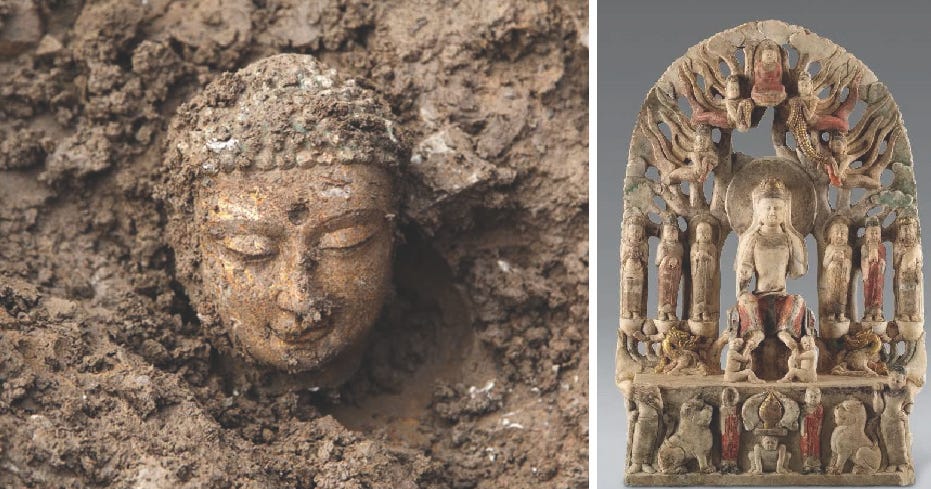
By the age of division (3rd–6th centuries), Buddhism had spread widely across war-torn China, offering consolation amid chaos. In the Northern dynasties (386–581), the faith positively flourished – carving its grandeur into rock. Medieval travelers would have encountered colossal Buddhas and celestial bodhisattvas in cave-temples like Yungang (云冈, in Datong, Shanxi) and Xiangtangshan (响堂山, in Handan, Hebei). During the Northern Qi dynasty (550–577 AD), artisans created “masterfully rendered statues of Buddhas, Bodhisattvas, nature spirits, and demons”, reflecting a time of vibrant cultural exchange in north China. Many such works, later looted or defaced, are now deemed treasures of Buddhist art. In these turbulent centuries, China also met the man who, in legend, would be hailed as its first Zen patriarch – Bodhidharma (菩提达摩). Arriving from India (perhaps around 520 AD), Bodhidharma brought a meditation-focused practice of Buddhism (dhyāna, 禅定) to the Chinese. Famously, he is said to have gazed at a monastery wall for nine years in silent contemplation, baffling an emperor and spawning countless Chan (Zen, 禅) koans (Paradoxical anecdotes or questions used in Chan (Zen) Buddhism to trigger sudden insight and transmit the mind-seal (心印) from master to disciple). Bodhidharma is said to have meditated in a cave near Shaolin Temple, where he later became closely associated with the temple’s spiritual legacy and martial arts traditions. Bodhidharma’s teachings emphasized direct insight through meditation over ritual or scripture, planting the seed of Chan Buddhism in Chinese soil.

By the Sui and Tang dynasties (581–907 AD), Buddhism entered a golden age of imperial patronage and doctrinal innovation. Flourishing under the Tang cosmopolis, Buddhism “formed unique sects such as Tiantai (天台宗), Huayan (华严宗), Pure Land (净土宗), and Chan (禅宗)”, in what became its classical era in China. Doctrinal schools sprouted like a hundred lotus blooms: Huayan philosophy envisioned the cosmos as an infinite web of interpenetrating phenomena; Tiantai synthesized sutras into a graded path to enlightenment; Chan (Zen) stressed wordless awakening; Pure Land promised rebirth in paradise through devout chanting.
Grand monasteries and pilgrimage sites thrived – from the grand pagodas of the North to the lush mountain cloisters of the South. By Tang’s peak, China was a center of Buddhist scholarship exporting its own missionaries to Korea, Japan, and Vietnam. The cosmopolitan Tang court welcomed monks from India and beyond, even as Chinese pilgrims (like the famous Xuanzang, 玄奘) journeyed west in search of sutras. Under Empress Wu (武则天, the only Empress in Chinese history, Reign period: 690–705), Buddhism almost became a state religion; under Emperor Xuanzong (玄宗, Reign period: 712–756), it contributed richly to art and literature. Yet as Buddhism wove into China’s cultural fabric, accumulating wealth and power, it also drew periodic backlash from Confucian and Daoist quarters – a tension that would soon erupt.
Trials of Faith: Persecutions and Power Struggles
Buddhism’s meteoric rise did not come without resistance. Critics grumbled that monasteries hoarded wealth and eroded traditional hierarchies. Indeed, by late Tang, monasteries owned vast estates tilled by tenant farmers but paid no taxes – a situation uncannily parallel to medieval Europe’s powerful monasteries and abbeys. Chinese emperors periodically decided that the sangha (僧伽, meaning 'clergy') had grown too rich or too ungovernable, and swung the wrecking ball. History recorded four great persecutions of Buddhism by the emperors – “wholesale suppression…on four occasions from the 5th through 10th century”– often with pragmatic motives. The most infamous was Tang Wuzong’s (唐武宗) crackdown of 845 AD. A devout Daoist facing fiscal strain, Emperor Wuzong outlawed Buddhism empire-wide in order to “appropriate war funds by stripping Buddhism of its financial wealth and to drive ‘foreign’ influences from China”. In a mere 20 months, over 4,600 monasteries were demolished, 260,000 monks and nuns defrocked and forced back to lay life. Gold and bronze Buddha statues were melted down for coins, temple lands confiscated to refill imperial coffers. Other religions fared no better – Nestorian Christians, Zoroastrians, and Manichaeans were swept up in Wuzong’s purge.
Earlier, in 574 AD, the Northern Zhou Emperor Wu (北周武帝) – finding “temples had become too rich and powerful” – seized monastery lands and compelled monks to return to farming or soldiering. And back in 446 AD, Northern Wei’s Emperor Taiwu (北魏太武帝), under influence of militant Daoists, slaughtered monks after discovering a rebel leader had stashed arms in temples. Each suppression was driven by a mix of ideology and economics: monasteries were tax shelters and havens for draft-dodgers (peasants might shave their heads to avoid labor service). Confucian officials, too, lambasted Buddhism as an alien cult undermining familial duties and social order. These attacks on Buddhism recall Europe’s own clashes of church and state – from Henry VIII’s dissolution of monasteries to France’s Revolutionary seizures of church lands. In both East and West, religious institutions accumulating untaxed wealth eventually invited secular backlash. A key difference, however, is that in China, no Buddhist pope ever rivaled the emperor; the imperial power ultimately kept the sangha under heel. When emperors needed treasure or scapegoats, temples had little defense. After each persecution, Buddhism did revive – but a bit more sinicized and politically tamed. Notably, after the 845 debacle, Chinese Buddhism emerged leaner, with Chan (Zen) and Pure Land as the dominant, more sinified traditions, while many scholastic schools waned. Chan and Pure Land proved resilient and adaptable enough to endure where others faded.
Meditation and the Marketplace: Chan and Pure Land Ascendant
From the Song dynasty (960–1279) onward, Chan (Zen) and Pure Land Buddhism came to eclipse other schools in China’s religious landscape. In fact, rather than compete, the two often converged: many monks were content to practice meditation by day and chant Amitābha’s name (阿弥陀佛) by night. Chan Buddhism had always valued self-reliance – the old Chan adage taught “those who do not work, neither shall they eat (一日不作,一日不食).” Chinese Chan monasteries implemented an ethic of manual labor and self-sufficiency as part of spiritual practice. Monks farmed their own fields and drew water, striving to sustain their community without over-reliance on lay donors. This tradition of “forest monasteries” meant Chan abbeys could be less entangled with secular patrons, a “self-sufficiency and manual labor” system that allowed them to thrive independently. Chan masters prized the unmediated experience of enlightenment – iconoclasm was their badge. They preached that the true Dharma (佛法) was transmitted “outside the scriptures,” not through ritual or scholasticism. Over time, Chan’s austere ethos deeply influenced East Asian culture (Zen tea ceremony, ink painting, martial arts, etc.), exporting the notion that spiritual awakening could blossom in everyday tasks and ordinary minds.
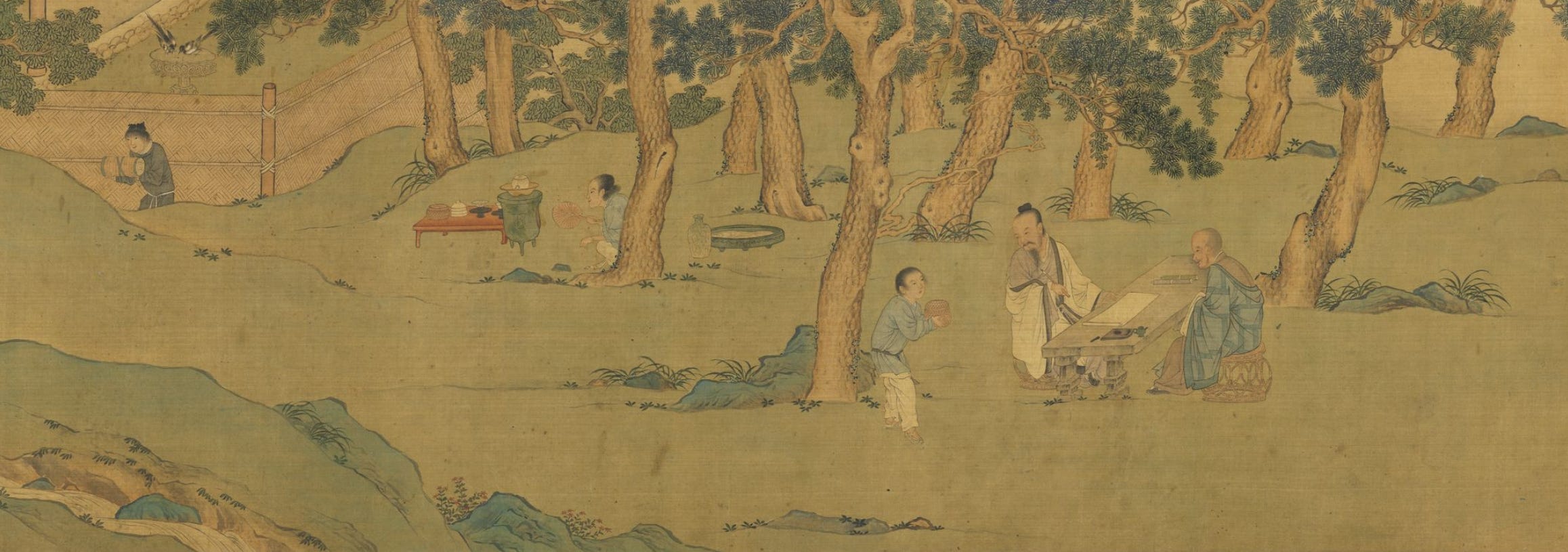
If Chan was the path of the elite monastics and literati, Pure Land Buddhism was the faith of the common people. Pure Land teaching boiled Buddhist practice down to one simple, universal act: reciting the name of Amitābha Buddha with faith, in hopes of rebirth in his Western Paradise. It promised an easier salvation for the masses – “exclusively reciting ‘Namo Amitābha’ (南无阿弥陀佛)…depend on Amitābha’s vows to be reborn in the Pure Land and gain Buddhahood there”. Because this approach required neither learning nor austerity, it swept through the populace. By Song times, Pure Land societies (even quasi-secret White Lotus societies, initially aligned with Pure Land teachings but later evolved into a rebellious secret society) spread the practice among villagers and lay believers. Pure Land became “the most popular path in China”, embraced by women and men of all classes. Its focus on chanting and devotion – especially at the moment of death – also ffit with Chinese folk religion’s concern for auspicious send-offs to the afterlife. A Chinese idiom, “临时抱佛脚” (“grasp the Buddha’s foot when in need”), captures this ethos: people who otherwise neglect spiritual practice may suddenly flock to pray or chant in times of crisis or on their deathbeds, hoping for last-minute grace. This pragmatic, even opportunistic streak in popular religiosity was nurtured by Pure Land’s accessibility.
While Chan demanded discipline and insight, Pure Land offered spiritual insurance – a safety net for those who would invoke Amitābha’s compassion at life’s critical junctures. Together, Chan and Pure Land formed a yin-yang balance that carried Chinese Buddhism into the modern era: one path emphasizing inner cultivation and insight, the other emphasizing faith and otherworldly succor. Both, in different ways, domesticated Buddhism to Chinese sensibilities, integrating it with Confucian family values and Daoist cosmic harmony.
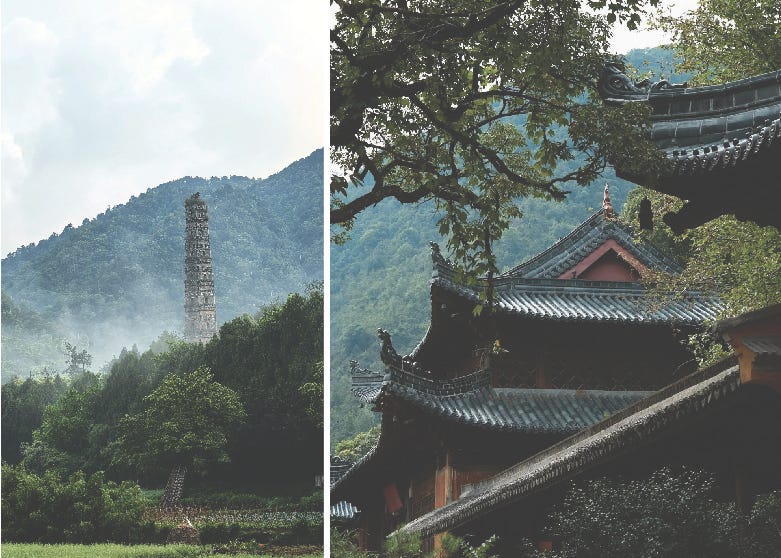
Over centuries, Chinese Buddhists would also spread these interpretations abroad – most notably to Japan, where Zen (Chan) and Jōdo (Pure Land) lineages took strong root. Japanese monks from ancient times traveled to China’s great monasteries to drink from the source: the monk Saichō (最澄(766-822)日本天台宗创始人)learned Tendai Buddhism on Tiantai mountain; Kūkai (空海) studied esoteric Buddhism in Tang Xi’an; and in the 13th century, the monk Dōgen (道元) journeyed to China to receive Chan teachings, later founding Japan’s Sōtō Zen (曹洞宗). The Japanese thus regard several Chinese temples as their sects’ ancestral patriarchal halls (祖庭).
Mandalas and Mandarins: Buddhisms Beyond the Heartland
No portrait of Chinese Buddhism is complete without its rich diversity of traditions. While Han Chinese embraced Mahayana schools, on the empire’s frontiers other forms of Buddhism took hold with profound political significance. Tibetan Buddhism (Vajrayana, 密宗), with its lamas and living buddhas, became an instrument of statecraft during several dynasties. When the Mongol Yuan dynasty ruled China in the 13th–14th centuries, they elevated Tibetan lamas to high positions, employing them to administer Tibetan and Mongol regions. The Qing dynasty (1644–1911) continued this policy of “using the lama to rule the frontier.” The Qing emperors – themselves Manchus keen to pacify Mongolia and Tibet – lavished patronage on Tibetan Buddhism. In Beijing, Yonghe Temple (Lama Temple, for more story) in 1744, became the empire’s hub for Lamaist Buddhism. The Yonghe Temple became home to waves of Mongolian and Tibetan monks, and a center for managing reincarnations of high lamas. It was here that the Emperor Qianlong (ruled from 1736 to 1795) instituted the Golden Urn lottery (金瓶掣签, system for selecting Tibetan Buddhist reincarnations (tulkus) by drawing names from a golden urn, ensuring impartiality and imperial oversight) in 1792 to have a say in identifying reincarnated lamas, cementing central government's control over Tibetan Buddhist leadership.
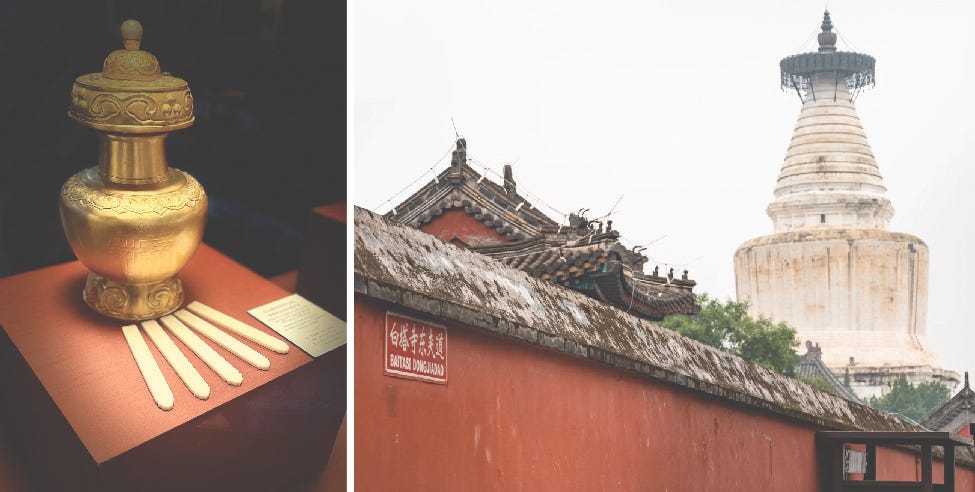
Tibetan Buddhism’s combination of religious and political authority—embodied by figures like the Dalai Lama—offered Chinese rulers both a compelling model and a useful instrument of control. Emperors adopted lofty titles like “Emperor Bodhisattva” and participated in Tibetan rites, as if to claim mandate over both faith and realm. Doctrinally, Tibetan Buddhism introduced tantric practices and a pantheon of fierce deities into the Chinese milieu. In the Qing court, thangkas (唐卡, sacred paintings) and sutras in Tibetan script were not uncommon. The political role of Tibetan Buddhism – effectively a “church-state” model in Tibet and Mongolia – thus intersected with Chinese imperial ambitions. Beijing’s skyline still features several Tibetan-style stupas and temples—lingering echoes of a time when imperial power danced with the lamas.
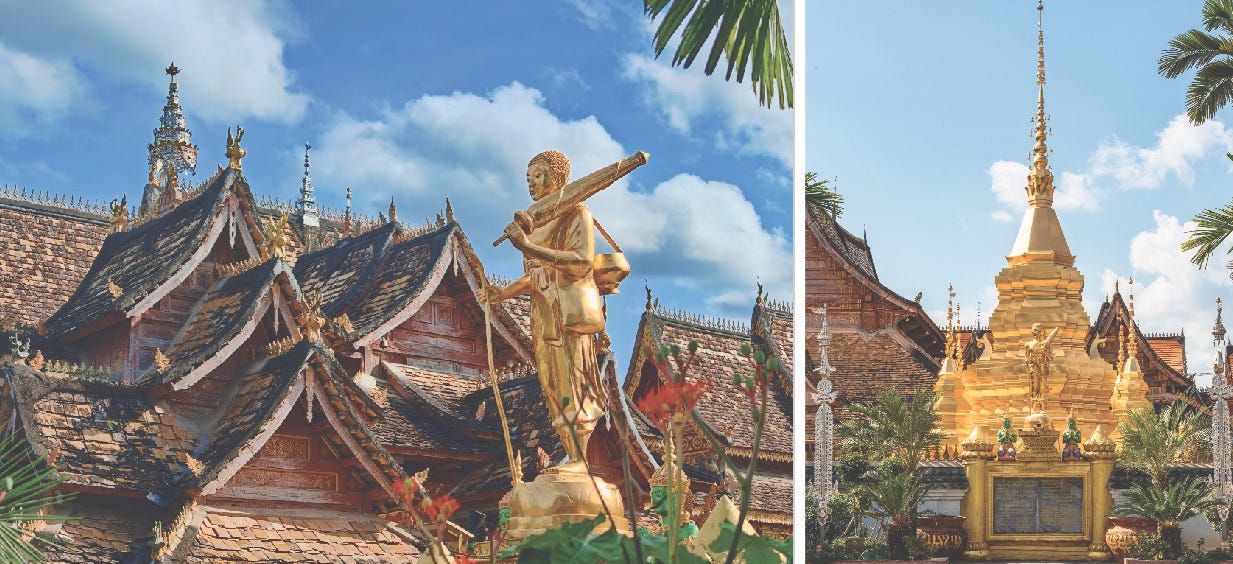
Meanwhile, in the southwest, Theravada Buddhism (小乘佛教) took root among ethnic minorities. As early as the 6th–7th centuries, merchants and missionaries from Myanmar spread Theravada Buddhism into Yunnan province. To this day, the Dai people (傣族) of Xishuangbanna in Yunnan practice Theravada, their temples and saffron-robed monks mirroring the traditions of Thailand or Myanmar. The Dai, Blang (布朗族), and Jingpo (景颇族) communities maintain Pali (巴利语) scriptures and celebrate Buddhist festivals on the lunar calendar, providing a vivid contrast to the Mahayana practices of the Han Chinese. China also has a small presence of Thai and Burmese-style pagodas in its borderlands, underscoring the patchwork of Buddhist practices under one flag. These southern temples, with their pointed golden roofs and drums and gongs, remind us that the Buddhist world transcends political borders – and that China has always been a crossroads of different Buddhist currents.
Destruction, Rebirth, and the Shaolin CEO Monk
Fast-forward to the 20th century: after surviving imperial intrigues and warlord purges, Buddhism in China faced its most existential threat during the Cultural Revolution (1966–1976), temples were ransacked, monks defrocked, and Buddha statues shattered by Red Guards zealous to destroy the “Four Olds” (refer to old ideas, old culture, old customs, and old habits — traditional elements targeted for destruction during China’s Cultural Revolution). Public religious practice was all but extinguished. Yet Buddhism was not wiped out; it survived in the hearts of devotees and in overseas Chinese communities. With economic reform and opening in the 1980s, China saw a cautious religious revival. Temples were gradually repaired and reopened under state supervision. A government-sanctioned Buddhist Association oversaw clergy and doctrine.
As China got back on its economic feet, an unlikely development occurred: Buddhist monasteries themselves became big business. The most emblematic example is the Shaolin Temple in Henan – reputed birthplace of Chan Buddhism and the home of kung fu legend. In the 1980s, Shaolin was a dilapidated shadow of its former glory (only a handful of monks remained). Then came the 1982 martial arts film “Shaolin Temple”, starring Jet Li, which became a national sensation and put Shaolin back on the map. Sensing an opportunity, a young monk named Shi Yongxin (释永信) helped transform Shaolin into a modern enterprise. Over the next three decades as abbot, Shi Yongxin earned nicknames like the “CEO monk” for his aggressive commercialization of Shaolin’s brand.
Shaolin monks performed kung fu tours abroad; the temple franchised its name to everything from herbal products to online games. In 2008, Shaolin opened an online store hawking shoes, tea, and even a $1,400 kung fu manual. The temple ran side businesses in “book publishing, medicine, kung fu performances, film production, asset management and real estate”. By the 2000s, Shaolin was raking in revenue like a multinational – a stark contrast to its ascetic ideals. Abbot Shi, once lauded for dragging temples “out of the feudal era” and into the market economy, also courted controversy. Rumors swirled of luxury cars and secret mistresses, and some faithful questioned whether turning monasteries into profit centers betrayed Buddhism’s spirit. Shi Yongxin defended his approach as leveraging capitalism to spread the Dharma, but critics dubbed him “China’s Kung Fu CEO”, emblematic of an era when even enlightenment carried a price tag.
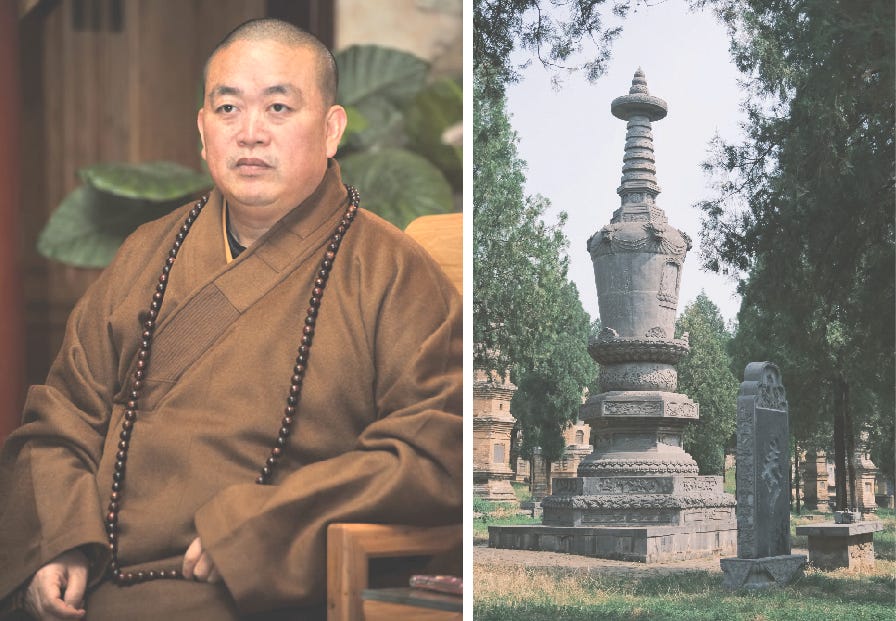
The Chinese government, for a time, tacitly encouraged religious sites to self-fund via tourism and commerce. In the freewheeling 1990s and early 2000s, local governments turned famous temples into ticketed attractions. Some monasteries sold shares in commercial ventures; others licensed their image rights. However, by the mid-2010s, the state grew alarmed at excesses – temples becoming outright for-profit corporations, and corruption scandals in religious charities. In 2017, Beijing intervened decisively: regulators issued edicts to “further curb the commercialization of Buddhism and Daoism”, banning the sale of temple stock, exploitative fees for incense or prayer services, and profiteering off religious icons. Authorities tightened oversight of temple finances and cracked down on scams (like fortune-telling rackets). It was against this backdrop that Shi Yongxin’s fall from grace unfolded in 2025. After long-running allegations, the Shaolin abbot was placed under investigation in July 2025 for embezzling temple funds and “violating Buddhist precepts” by allegedly maintaining multiple mistresses. The revelations – essentially accusing him of living more like a debauched tycoon than a monk – shocked the public. The official Buddhist Association moved swiftly, revoking Shi Yongxin’s monastic credentials (戒牒) and expelling him from the clergy. The very man who epitomized Buddhism’s commercialization was made a cautionary example as China attempts to purify and rein in its religious institutions. Shi’s downfall also highlights an inflection point – the end of an era when temples were judged mainly by their earnings, and the beginning of a return to spiritual fundamentals.
The “Rejuvenation” of Faith – Millennials at the Monastery
Even as authorities clamp down on the overt monetization of religion, Buddhism in China has found unexpected new life among the younger generation. In recent years – especially since the late 2010s – an unlikely trend has swept China’s bustling cities: urban, educated millennials flocking to temples in search of peace. On Xiaohongshu and Weibo, young people post aesthetically pleasing shots of temple courtyards and statues, tagging them as weekend getaways.
What’s driving this phenomenon? In part, burnout with China’s intense work culture. Movements like “lying flat” (躺平, tangping) and “let it rot” (摆烂, bailan) – passive rebellions against cutthroat competition – reflect disillusionment among youth who feel they “can’t win by working hard, and can’t win by giving up either”. Temples offer a third path: stepping off the treadmill altogether, if only for a weekend, to reset one’s mind. On Weibo, one user quipped, “Might as well go practice Buddhism”, after lamenting the futility of modern striving. Others describe temple retreats as an escape from urban pressures – a place where smartphones are set aside and the soul can breathe.
Zen and mindfulness concepts have permeated pop culture, sometimes actually via Western influences like yoga and meditation apps. It has become fashionable for China’s cosmopolitan class to pepper conversations with references to being “Buddha-like” (佛系) – meaning chill, non-confrontational, detached from extreme desires. Some take this beyond slang: yoga studios and “禅修” (Zen meditation) workshops have proliferated in big cities, sometimes melding Buddhist mindfulness with wellness trends. Even tech companies have invited monks to lead meditation sessions for employees. For a growing subset of urban Chinese, Buddhism is becoming a lifestyle choice – a lens for self-help and mental health in an increasingly high-pressure society.
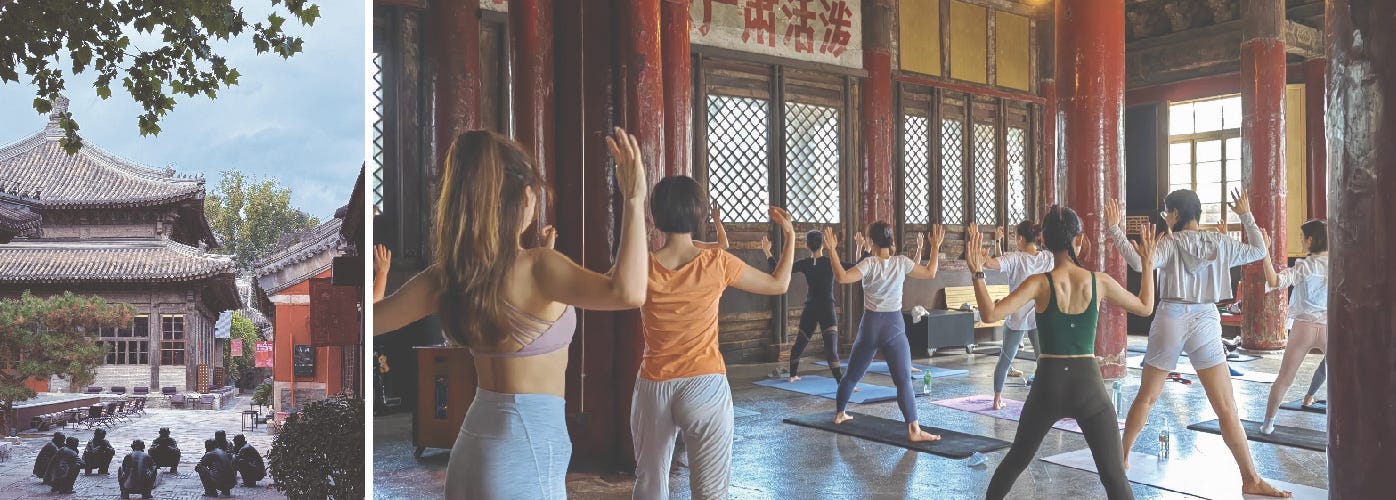
During the COVID-19 pandemic and its aftermath, many young people faced unemployment and growing disillusionment—some turned to Buddhism for spiritual comfort, while others did so more out of superstition or habit. Temples quickly adapted: gift shops now stock beaded bracelets for luck, which often sell out and are even resold online at a markup. The ritual of burning incense has also gone digital—young visitors now scan QR codes to make donations or virtually burn golden prayer papers, sometimes watching their names scroll across a digital merit board. As one observer put it, “young people love these new forms,” finding them novel and oddly reassuring. It’s now common for students or job seekers to make donations before exams or interviews—essentially “paying forward” for a bit of divine luck.
In Beijing, the Temple of the Reclining Buddha (Wofo Si) has become an unexpected favorite among young office workers—not just for its peaceful atmosphere, but also because “Wofo” sounds like “office” in Chinese, making it a tongue-in-cheek destination for those job hunting. Meanwhile, at Yonghe Temple, known for answered prayers, long queues of millennials appear during exam season or Lunar New Year, eagerly shaking fortune sticks and consulting oracles for guidance.
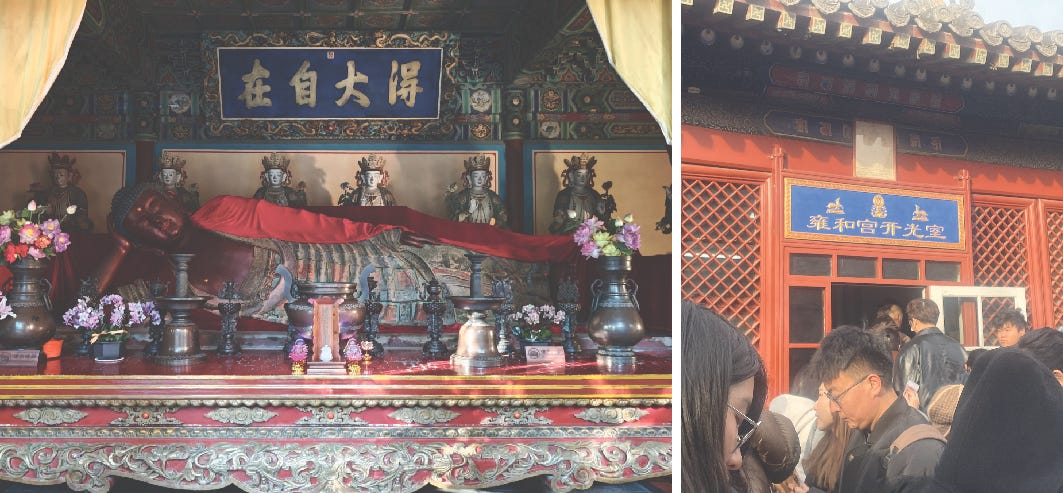
Kaiguang (开光), literally meaning “opening of light,” is a Chinese Buddhist and Taoist consecration ritual—also called the “eye‑dotting” ceremony—where senior clerics use cinnabar brushwork and prayers to ritually “open” a newly created statue or icon, inviting the divine presence to inhabit it so it can be formally worshiped.
Monks at these temples report that most retreat participants and dedicated lay practitioners today are under 35. Across the country, some temples have gained unexpected reputations: in Nanjing, for example, Jiming Temple is half-jokingly known as a place that "cuts karmic ties" (斩孽缘)—a term referring to the ending of entangled or ill-fated romantic relationships—earning it a reputation for helping visitors break up and embrace singlehood. The fact that China’s most globalized cities are now also hotspots of Buddhist interest speaks to something deeper. For some, it’s spiritual searching; for others, a bid for luck in an uncertain economy. But either way, it suggests that even amid skyscrapers and AI startups, the ancient search for peace and meaning continues.
The Wheel Turns
Buddhism in China has never had a linear story – it waxes and wanes, revered in one era and reviled in the next, commercialized by one abbot and purified by another. Today, as China strides forward as a superpower, Buddhism must navigate the delicate balance between tradition and modernity, between serving the people’s spiritual needs and aligning with state objectives. The faith that arrived with foreign monks and merchant caravans has become unmistakably Chinese, woven into the nation’s cultural DNA. The government’s ongoing campaign to promote “Traditional Chinese Culture” actually provides an opening for Buddhism to flourish as part of China’s heritage.
Monasteries are being restored not just as tourist sites but as genuine centers of learning – for example, temple libraries and institutes are translating scriptures and engaging in interfaith dialogues. Chinese Buddhism is also leveraging technology: monks live-stream Dharma talks on social media, and temple websites offer virtual incense-lighting for devotees far away. Paradoxically, while older generations might view religion with skepticism (a legacy of Maoist atheism), young Chinese are embracing a post-materialist mindset that sees value in ancient wisdom and mindfulness. The future of Buddhism in China may thus be less about grand new sects or miracles, and more about a quiet integration into daily life – a “background hum” of spirituality in a secular society. From companies inviting monks to teach meditation for stress relief, to schools quietly reintroducing Confucian-Buddhist classic texts, Buddhism could become a soft force for social cohesion and moral education.
Challenges remain: the line between faith and superstition, devotion and commodification, must be carefully managed. The Chinese Communist Party is wary of any mass movement (even a religious one) outside its control, so Buddhism’s public expressions will stay closely guided by state policy. Scandals like Shaolin’s remind religious leaders to uphold propriety or face exile. Yet, one might argue that Buddhism has survived far worse and still come out transformed but not destroyed. Two thousand years ago, a Chinese emperor dreamed of a golden Buddha, and today, countless ordinary Chinese dream of something beyond the material – whether they find it in a monastery, a yoga studio, or a smartphone app chanting sutras. The story of Buddhism in China is still unfolding, its wheel of Dharma turning through each new dynasty and generation.
If you liked this journey through China's spiritual and cultural history, hit subscribe. Sharing helps keep thoughtful writing alive.
If my insights brought you a fresh perspective, please consider supporting me by buying me a coffee. Your generosity fuels my writing.


Thanks for this wonderfully written post, tracing the ebb and flow of Buddhism in China overtime. As I was reading it, I can't help but compare it with how Buddhism has evolved in Japan. Zen and Pure Land were both "transported" to Japan, carried forward in deeper and more diversified forms. The core tea figures were drawn to Zen (and along with it, Confucianism and Taoism), and some even convert to Pure Land closer to their deaths.
Before the recent geopolitical tension, I see many Chinese visiting temples here who seem to be drawn towards modern spirituality. Interestingly in Kyoto, it's not the locals but foreigners who are drawn towards "outward" seeking of spirituality. There is a wide range of tea and/or meditation experiences offered, as well as price range. Temples are rather prestigious, not taxed here in Kyoto, while the city is going bankrupt - and then you see run-down kids playgrounds in the city.
Shitsurae is writing a follow-up series on Buddhism and Dogen that may be of interest to you: https://www.shitsurae-japan.com/p/dogens-teachings-a-contemporary-theory
So interesting that this also happens with Buddhism…