

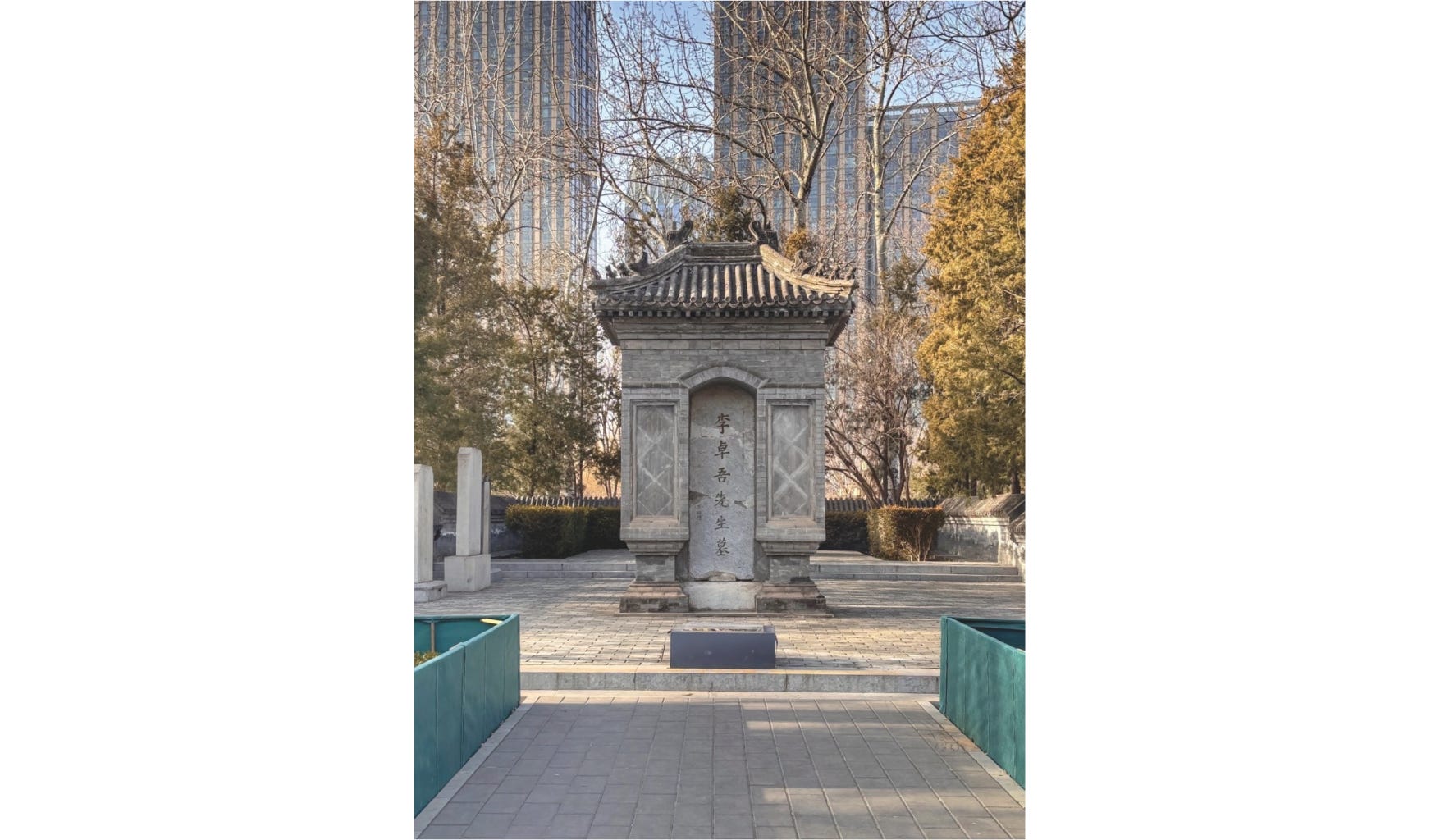
Two years after Giordano Bruno burnt in Rome. A heretic in Chinese history cut his throat in a Beijing jail, in 1602. He had been arrested on the charge of “daring to advocate a disordered Way, deluding the age, deceiving the people.” 敢倡亂道,惑世誣民. His name was Li Zhi 李贽 (1527–1602, courtesy name Zhuowu 卓吾). Even the recommended sentence of his “crime” was merely deportation to his home county under surveillance, he chose to end his life in the capital. Today, his tomb still stands in a park in Tongzhou, on Beijing’s eastern edge.
For four hundred years, whenever Chinese have sought a native precedent for breaking with orthodoxy, they have reached for him. Heretics appear every generation. The question I find more interesting is how he became the icon.
A Book to Burn
Li Zhi grew up in Quanzhou (a major commercial hub on the Maritime Silk Road) as a conventional chinese scholar 读书人. Six generations back, an ancestor had sailed the trade route to Hormuz, converted to Islam and married a local woman. By the time Li Zhi was born the business was long gone. But the family background might influence him unconsciously, leaving him far less tuned to the traditional four-class hierarchy (士农工商 scholars, farmers, artisans, and merchants) than a standard agrarian family.
No one is born a heretic. Li Zhi followed convention and studied the classics for the keju (科举, civil service examinations). He then spent twenty-five years as an unremarkable, mid-ranking Ming official. Elite culture was dominated by Daoxue (道學, "the Learning of the Way")—the Neo-Confucian orthodoxy synthesized by the Cheng–Zhu school during the Song dynasty. As the foundation of the state examination curriculum, it immersed every educated man in identical texts, commentaries, and values. Its core premise held that moral perfection is attained gradually through canonical texts under orthodox masters.
The rigid system had already been challenged. Wang Yangming (王陽明, 1472–1529) relocated the moral principle to the mind itself, formulating the doctrine of innate knowing (liangzhi, 良知). The innate knowing was not exlusive to the scholar. it was fully present in everyone, even a common farmer. When Li Zhi encountered these currents in the 1560s through public lecture assemblies, they were being pushed to radical conclusions by the Taizhou school, which famously proclaimed that "the streets are full of sages" (满街皆圣人). The idea tried to dissolve the hierachy and monoply of knowledge of Confucianism from inside. That people tired of elite talking about virture but doing the opposite.
Li Zhi quitted from office at fifty-four. Traditionally, retired officials returned to their ancestral homes to serve family and clan interests. Li Zhi refused. At sixty-two, he took Buddhist vows and shaved his head. It was a radical gesture of renunciation, since hair was considered a sacred inheritance from one’s parents (身体发肤,受之父母). In 1590, at sixty-four, he published a collection of his correspondence titled A Book to Burn (焚書).
In the preface, he explained both the contents and the title: “What I have written cuts close to the mortal spot of today’s scholars. Since it strikes their chronic disease, they are bound to want me dead, and so I want it burned” (所言頗切近世學者膏肓,既中其痼疾,則必欲殺我矣,故欲焚之).
His direct target was orthodox moralism, whose practitioners he dismissed as jia daoxue (假道學)—phony moralists. While Wang Yangming sought to reform Confucianism from within, Li Zhi systematically dismantled it.
Dismantling the Doctrines
Li Zhi did not establish a rival theoretical system; instead, he posed the foundational questions no one dared ask and answered them with blunt clarity.
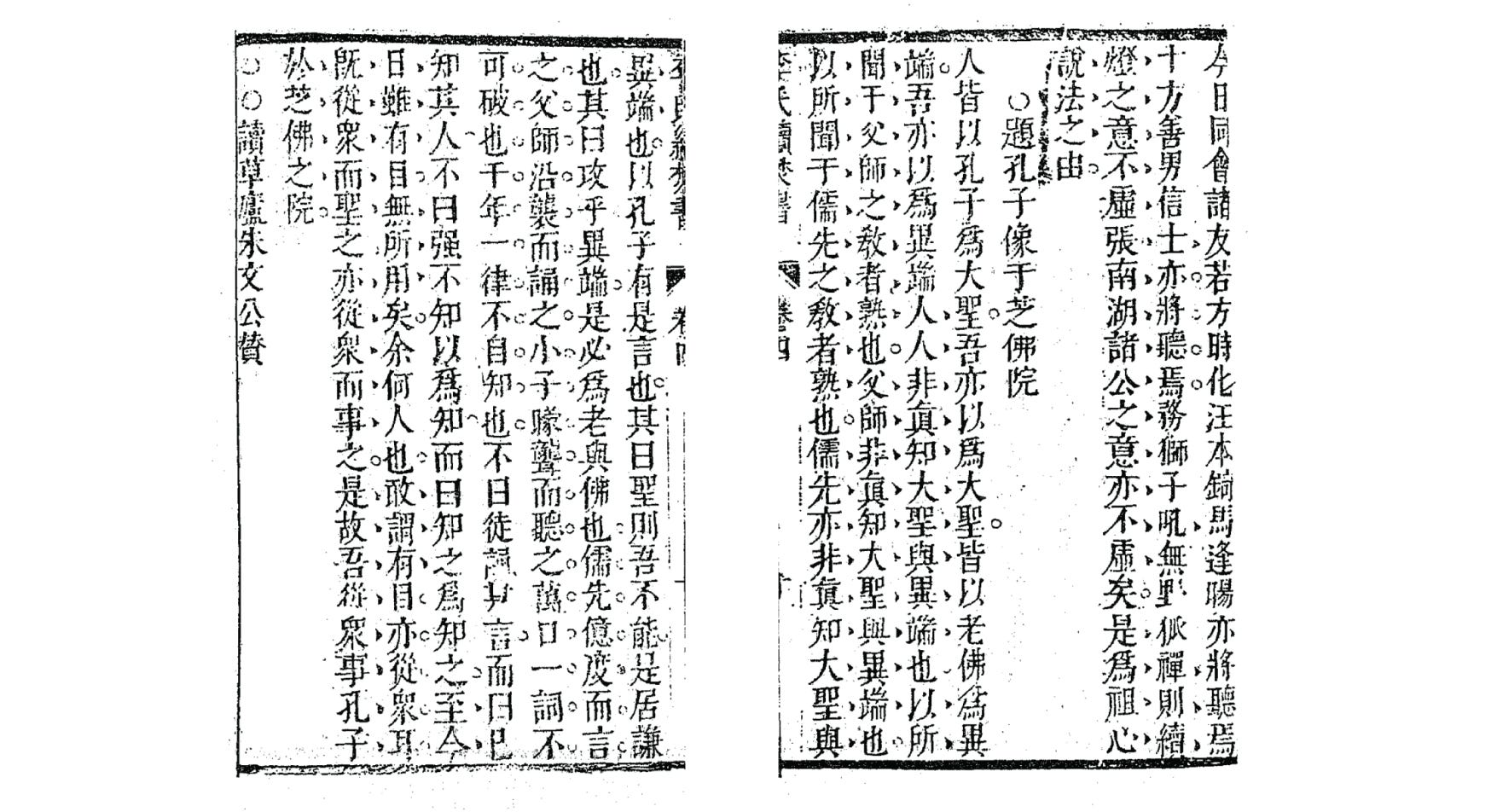
His most celebrated philosophical contribution is “On the Child-Mind” (童心說). In its opening passage, he wrote that the child-mind is entirely authentic and untainted, “the original mind of the very first thought” (夫童心者,絕假純真,最初一念之本心也). The child-mind possesses no predetermined doctrine. Once external dogmas enter through the senses and take control, that original authenticity is destroyed (蓋方其始也,有聞見從耳目而入,而以為主於其內而童心失). The more rigid doctrines one accumulates, the farther one drifts from genuine truth—a direct inversion of the Cheng–Zhu tenet that canonical study leads to moral clarity.
He warned that second-hand knowledge derived from canonical commentaries smothers original insight. He argued that the Six Classics, the Analects, and the Mencius were largely eulogies composed by court historians or fragmentary notes kept by muddled disciples who recorded partial recollections without context.
He also questioned the unquestioned authority of Confucius himself: everyone revered Confucius as the supreme sage, but on what empirical grounds? Early scholars asserted it, teachers and parents repeated it, and children memorized it long before they could evaluate it critically. “Ten thousand mouths, one wording, irrefutable; a thousand years, one pitch, and no one aware of it” (萬口一詞,不可破也;千年一律,不自知也).
Similarly, he attacked the orthodox mandate to “Preserve Heavenly Principle and Eliminate Human Desire” (存天理,灭人欲). Li Zhi maintained that basic material needs are the moral principle: “Wearing clothes and eating food—that is human relations and the order of things. Strip away food and clothing, and no human relations remain” (穿衣吃飯,即是人倫物理;除卻穿衣吃飯,無倫物矣).
In an era when women were barred from intellectual life, Li Zhi took a radical stance: “You may say that people come as men and women. You may not say that insight does” (謂人有男女則可,謂見有男女豈可乎?). In his final decades, he openly accepted and taught female disciples.
The Heretical Years
Li Zhi later mocked his early conformity: “Before fifty I was truly a dog. The dog in front barked at a shape, and I barked along with it” (余五十以前真一犬也,因前犬吠形,亦隨而吠之).
Having forfeited his official stipend upon retirement, he survived on the hospitality of sympathetic patrons. He first stayed in Huang’an, Hubei, in the household of Geng Dingli. When Geng died in 1584, his elder brother Geng Dingxiang took over. A prominent Daoxue scholar with a large following, Geng Dingxiang clashed fiercely with Li Zhi in a written polemic that generated much of A Book to Burn.
In 1585, Li Zhi relocated to Zhifo Yuan (芝佛院), a Buddhist monastery by a lake in Macheng. He sent his wife and daughter back to Quanzhou; when his wife died there after years of pleading for his return, he did not attend her funeral. Two years later, he shaved his head while keeping his beard, continued to eat meat and drink wine, and hung a portrait of Confucius inside the Buddhist sanctuary. He also began instructing women, including a literate widow from a prominent local family. In a conservative county where moral reputation was everything, these nonconformist lectures triggered widespread outrage.
Around 1600, a hostile mob burned Zhifo Yuan to the ground and demolished the stupa Li Zhi had constructed for his own remains. At seventy-four, he fled north to Henan before settling in Tongzhou outside Beijing. In spring 1602, an imperial censor submitted a formal memorial denouncing his writings. The Wanli Emperor ordered his arrest and the confiscation and destruction of his books.
His prison interrogation was composed. When questioned, Li Zhi insisted his writings were intended to serve the sagely way rather than harm it. The court recommended deporting him back to Quanzhou under local surveillance—the single outcome he had spent two decades resisting.
Li Zhi asked for a barber. Once the barber set down the razor and stepped aside, the seventy-six-year-old picked up the blade and slit his throat. He lingered for two days. When asked why he had done it, he replied: “What does an old man of seventy-six have left to seek?” (七十老翁何所求).
Becoming the Icon
Following his death and the imperial ban on his texts, Li Zhi’s writings became the most sought-after underground literature in the Ming empire, prompting commercial printers to affix his name to unrelated manuscripts to inflate sales.
His ideas deeply influenced the late-Ming literary avant-garde. The Three Yuan Brothers of Gong’an (公安三袁) visited him for ten days in 1590, translating his concept of the “child-mind” into their own aesthetic theory of native sensibility (xingling, 性灵): “Express what is authentic to oneself; do not be bound by formal rules” (独抒性灵,不拘格套). In 1595, Yuan Hongdao wrote while serving as a fatigued magistrate: “Luckily I keep a copy of A Book to Burn by my bedside. It dispels gloom, aids digestion, and clears dimming eyes. It is remarkably effective” (幸床头有《焚书》一部,愁可以破颜,病可以健脾,昏可以醒眼,甚得力).
The Qing dynasty maintained the imperial ban on his works, yet scholar-officials continued to read them in private. The editors of the Siku Quanshu (Complete Library of the Four Treasuries) preserved his entry solely to denounce him: “His books may be destroyed, and his name is not fit to soil these pages. Yet because he deceived the age with extravagant talk and rustic scholars still revere his empty reputation... we preserve this entry to thoroughly expose his crimes” (其书可毁,其名亦不足以污简牍,特以贽大言欺世,至今乡曲陋儒,震其虚名,如置之不论恐贻害人心,故特存其目,以深曝其罪).
In 1859, Li Zhi’s influence reached Bakumatsu Japan. In Noyama Prison, the samurai reformer Yoshida Shōin (吉田松陰) transcribed A Book to Burn by hand and urged his disciple Takasugi Shinsaku to study it before Yoshida was executed that autumn. In 1907, the revolutionary scholar Liu Shipei (刘师培) published a study of Li Zhi in his Tokyo-based anarchist journal Tianyi Bao, leading to a reprint of A Book to Burn in Shanghai in 1908.
Li Zhi was subsequently reclaimed by nearly every modern anti-traditionalist movement. Prior to the May Fourth Movement, Wu Yu (吴虞) published A Supplementary Biography of Li Zhuowu (明李卓吾别传) in 1916, hailing him as an anti-Confucian pioneer—prompting Hu Shi to later dub Wu Yu the hero who single-handedly “smashed the shop of Confucius.”
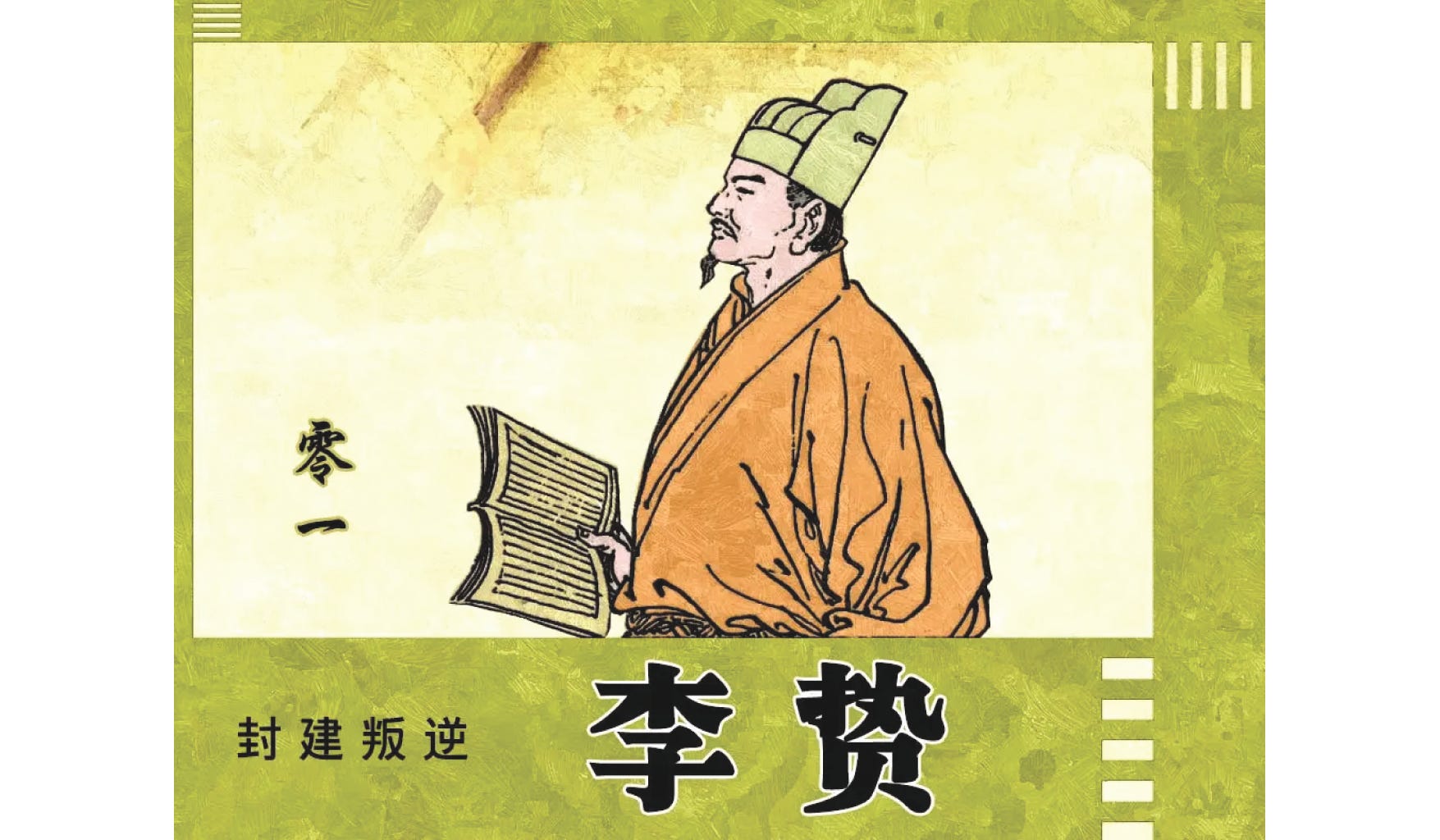
In 1974, Li Zhi experienced perhaps his most surreal transformation during the Cultural Revolution’s “Criticize Lin, Criticize Confucius” (批林批孔) campaign. Driven by the theoretical project to divide all Chinese intellectual history into a binary struggle between “reactionary Confucianism” and “progressive Legalism,” party propagandists found Li’s anti-orthodox writings. Because he had mocked Confucian hypocrisy and praised historical figures like Qin Shi Huang, the iconoclast was retrofitted into an early Legalist champion. Major state publishing houses rushed out massive print runs of A Book to Burn, accompanying them with ideological commentaries, popular study pamphlets, and illustrated picture booklets.
For modern readers, however, Li Zhi’s enduring portrait remains the concluding chapter of Ray Huang’s 1587, A Year of No Significance (万历十五年). Rather than portraying him as a standard political rebel, Huang framed him as a tragic, brilliant intellectual crushed by an ossified institutional order. Since its 1982 Chinese publication, that chapter has served as the gateway through which most contemporary readers first encounter Li Zhi.
Complied daily Wenyan Decoded
Each day, I unpack a single sentence from the Chinese classics, character by character, showing how these ancient texts still shape the way Chinese culture thinks, argues, and feels today. The goal is not translation, but connection: ultimately, the aim is for readers to engage with the original text itself, rather than rely on the translation.
Day 1
夫童心者,絕假純真,最初一念之本心也。
Fú tóngxīn zhě, jué jiǎ chún zhēn, zuìchū yīniàn zhī běnxīn yě.
“The child-mind: free of all borrowing, purely true — the original mind of the very first thought.”
— 焚書·卷三·童心說 (A Book to Burn, “On the Child-Mind”) by Li Zhi (李贽, 1527–1602)
This is one of the most famous arguments from Li Zhi. The late-Ming ‘heretical’ scholar used it to critique stale doctrines and the trend of ornate but hollow writing. This argument was also a key reference point for the Chinese quest for individualism, and has been called China’s declaration of authenticity.
Unpacking the sentence:
