

Growing up in China, many people’s first encounter with Islam comes through the Hui community (回民) – Chinese Muslims who are virtually indistinguishable from the Han majority in language and lifestyle, save for their Islamic faith. In a typical school class of 40 two decades ago in Beijing, there might be 3–4 Hui students, known mainly for avoiding pork while otherwise blending in. Indeed, Hui Muslims (numbering over 10 million, about 0.8% of China’s population) are scattered across the country. They speak Chinese as their mother tongue and are often seen as culturally “Han” Muslims, practicing Islam within a Chinese social fabric. This unique integration is apparent from Beijing’s bustling Niujie (“Oxen Street”) (牛街) district – home to the capital’s oldest mosque – where halal butcher shops and noodle stalls sit alongside typical Beijing hutong alleyways. Hui Muslims have long been a part of China’s urban landscape, their mosques and customs embedded in local society. Yet their story – from ancient trade routes to modern state policies – reveals a distinctive trajectory of Islam in China.

The Arrival of Islam via Silk Road and Sea
Islam first reached China not through conquest but commerce. By the Tang dynasty (7th–10th centuries), Arab and Persian merchants were sailing to Chinese ports and trekking the Silk Road caravans. According to tradition, the Prophet Muhammad’s companion Sa’d ibn Abi Waqqas reached the port of Guangzhou in 627 CE, and China’s earliest Muslim communities took root in coastal trading hubs. Guangzhou’s Huaisheng Mosque (the “Lighthouse Mosque”) (怀圣寺), Local lore claims it was founded in the 7th century by Waqqas, but modern scholars believe its earliest construction was later in Tang or Song times.
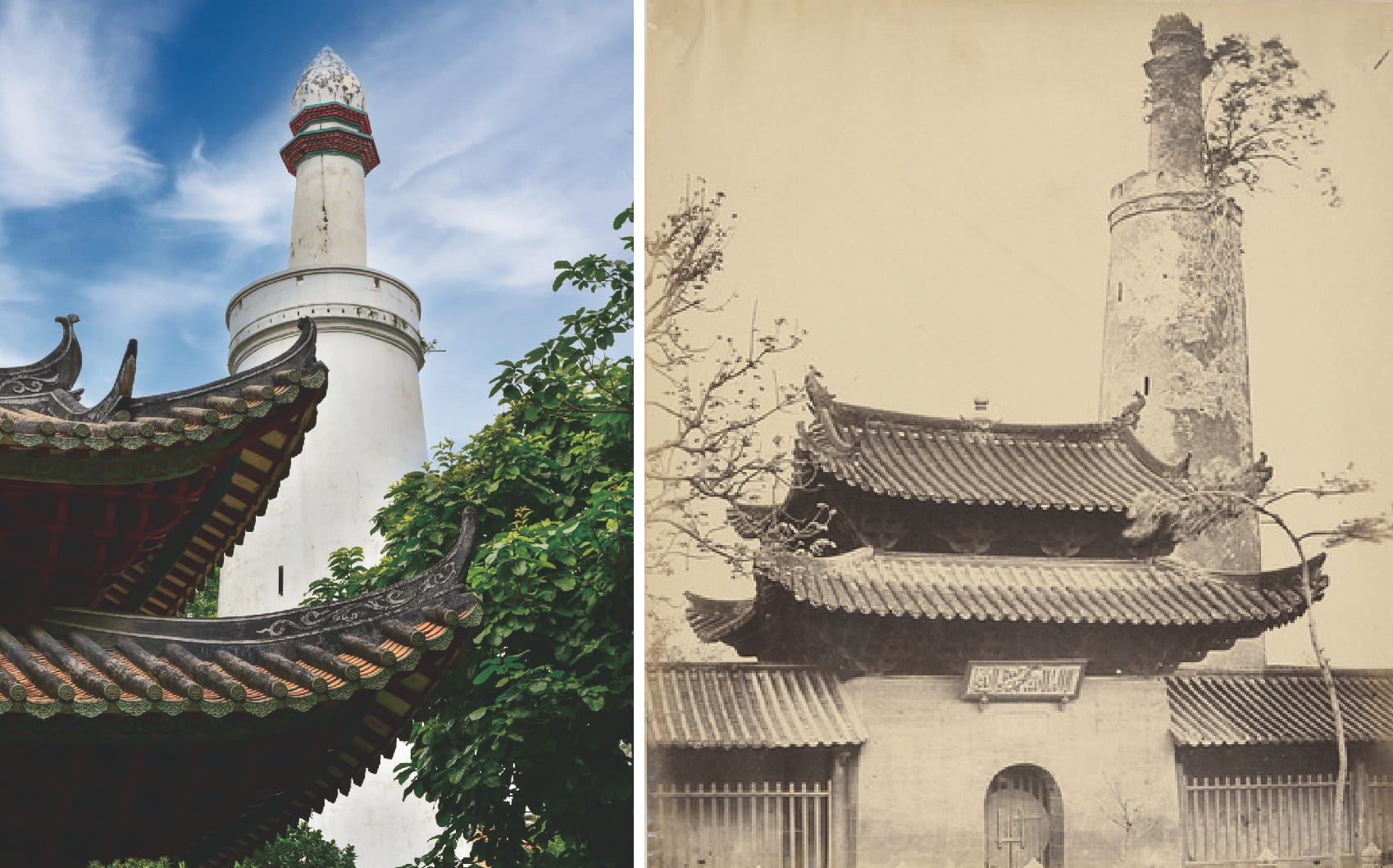
While the Waqqas legend is hard to verify, it is clear that by the Song dynasty (960–1279) substantial Arab-Persian merchant colonies existed in Guangzhou, Quanzhou, Hangzhou and elsewhere. Many of today’s Hui trace their lineage to these Silk Road sojourners: Persian and Central Asian traders who settled in China and intermarried with local people centuries ago. On the southeastern coast, clans of Arab origin maintained Muslim traditions for generations, and some family genealogies still proudly claim ancestors who arrived in the Tang era
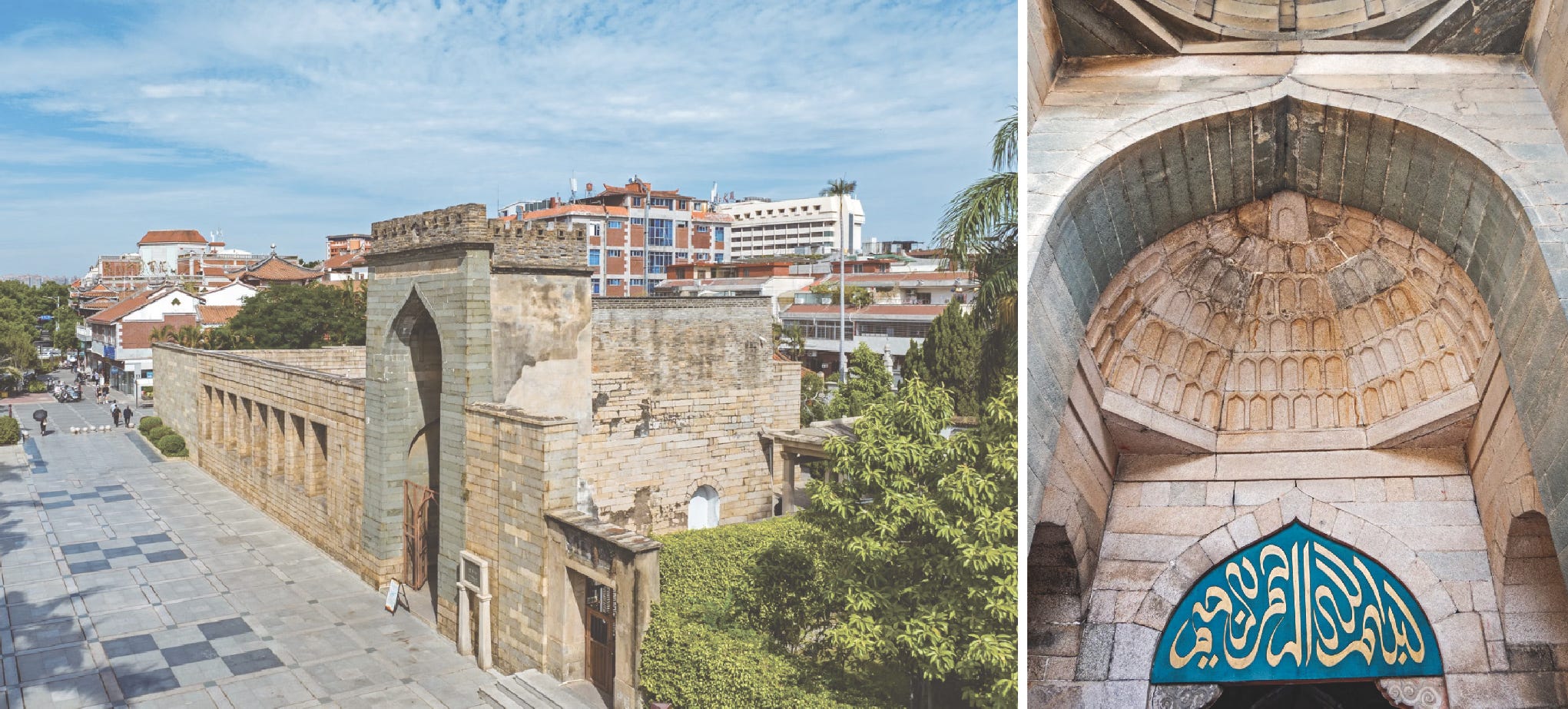
The earliest mosques in China reflect this cosmopolitan origin. In the port of Quanzhou, Fujian, stands the Qingjing Mosque (locally called the Ashab Mosque), which an inscription dates to 1009 CE. Built in stone by Arab settlers, it deliberately imitated the grand mosque of Damascus, with a monumental granite arched portal (Iwan) and other Middle Eastern design features. Although earthquakes and time have reduced it to partial ruins, its pointed arch gateway and carved Arabic calligraphy are preserved as a testament to early Islam in China. This makes Qingjing the oldest extant Arab-style mosque in the country, and indeed it was recognized as part of a UNESCO World Heritage Site in 2021 for Quanzhou’s role as a Song-Yuan global trade emporium.
While Islam arrived by sea in the east, it also swept in overland from the west. In the 10th century, Turkic rulers in Central Asia began adopting Islam, and this spread into what is now Xinjiang (western China) among the Uyghur Turks. Later, the Mongol Empire in the 13th–14th centuries facilitated a great diffusion of peoples and faiths across Eurasia. The Mongols were religiously eclectic and employed many Muslim officials and soldiers from Central and West Asia in their administration. During the Yuan dynasty (1271–1368) under Mongol rule, the Muslim population in China surged as Persians, Arabs, and other Central Asians (called “Semuren”, or “colored-eye people” in Yuan records) settled throughout the realm. The Yuan court was notably tolerant and even patronized Islamic astronomy and medicine. Many of these immigrants intermarried with Han Chinese or other locals, sowing the seeds for Muslim communities in inland China. Over time, the distinction between foreign-born Muslims and local converts blurred, giving rise to a new Chinese-speaking Muslim population – the ancestors of today’s Hui. By the Ming period, “Huihui” had become the common Chinese term for Muslims of various origins, indicating a recognized minority within the empire. In China’s northwest provinces – Gansu, Ningxia, Shaanxi – sizeable Hui enclaves took shape as descendants of Central Asian Muslims who migrated during Yuan and early Ming times. Thus, by the early modern era, China’s Muslims were a mosaic of diverse origins: Arabic, Persian, Turkic, Mongol, and Chinese, all bound by Islam and gradually coalescing into the Hui identity.
The Evolution of Chinese Mosque Architecture
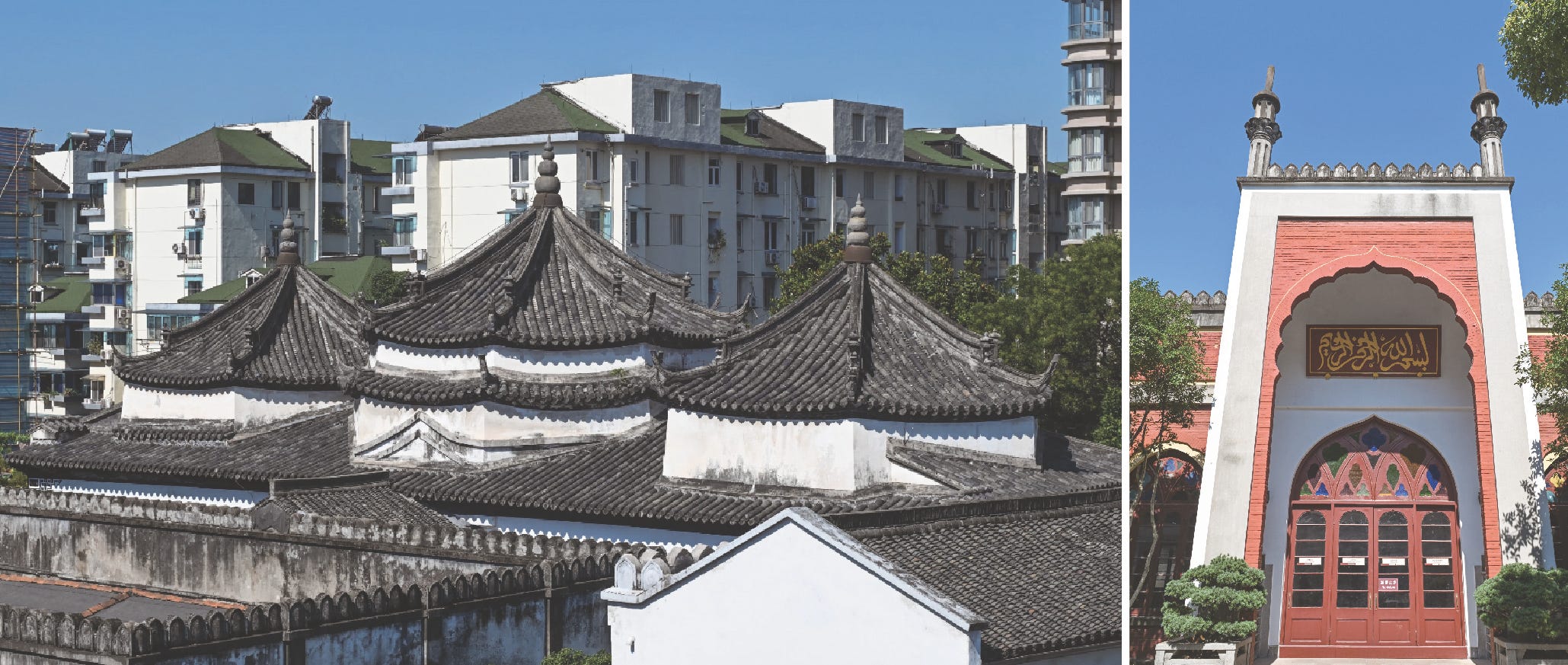
One of the most remarkable aspects of Islam in China is how its sacred architecture evolved in dialogue with Chinese aesthetics. The very earliest mosques, like those in coastal Quanzhou and Guangzhou, incorporated Middle Eastern elements – arches, domes, and minarets – reflecting their foreign founders. In Hangzhou, the Phoenix Mosque (凤凰寺), first built in Tang times, was later rebuilt in 1451 and intriguingly included three dome-shaped vaults over its prayer hall after a 17th-century renovation – a design flourish thought to be inspired by Mughal Indian mosques. These early examples show an experimental blending: traditional Chinese courtyard layouts fused with imported Islamic architectural motifs.
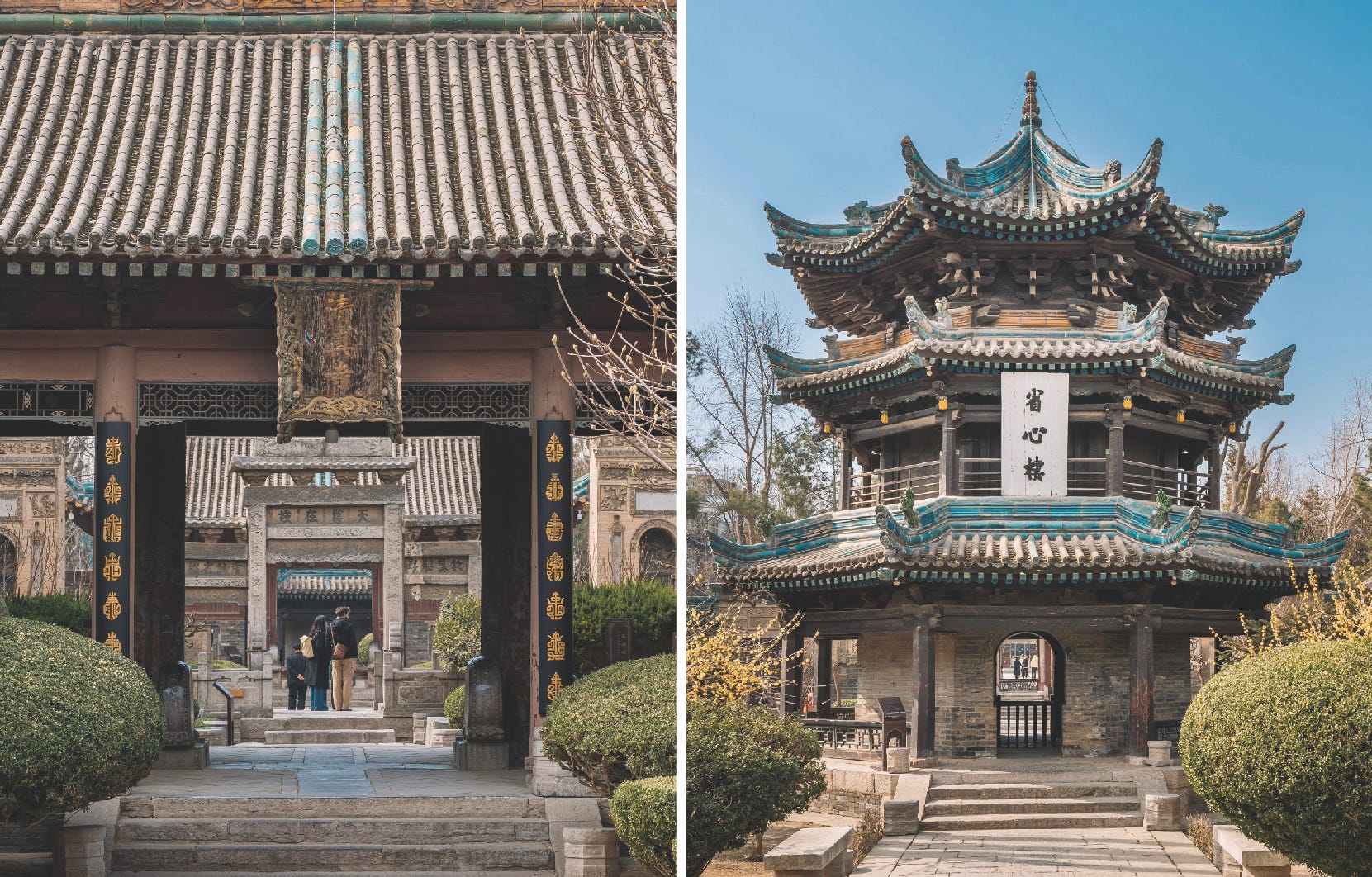
However, as the Muslim communities became indigenized, a Sinicized mosque style emerged. In imperial China, monumental religious buildings – whether temples, pagodas, or monasteries – followed certain aesthetic norms: wooden post-and-beam construction, curved tiled roofs, elaborate painted eaves, and symmetrical courtyard plans enclosed by walls. Over time, most Chinese mosques came to embrace this local architectural language. The best-known example is the Great Mosque of Xi’an in Shaanxi, founded (by tradition) as early as 742 CE and rebuilt in its current form during the Ming dynasty (1368-1644). It looks for all the world like a classical Chinese temple complex, complete with tranquil gardens and pavilions. Its layout is a series of courtyards aligned on a north-south axis, ending in a grand prayer hall facing west (toward Mecca), except for the Arabic calligraphy etched on wooden plaques and walls. A visitor entering Xi’an’s Great Mosque must pass under several paifang (decorative archways) and a tall wooden pavilion the Xingxinlou (省心楼), or "Examining the Heart Tower," which serves as a minaret in the form of a multi-eaved pagoda. In imperial times, local authorities discouraged any non-Confucian religious building from visually dominating the skyline, so mosque designers adopted low-rise, harmonious forms. The result is that from the street, a Hui mosque could be mistaken for a Confucian or Buddhist shrine, its Islamic identity revealed only upon closer look at the inscriptions.
By the Ming dynasty (1368–1644), the Sinicization of mosque architecture was largely complete. Ming emperors, having expelled the Mongols, were wary of foreign influences and worked to integrate frontier peoples. They referred to Islam as the “Pure and True” religion (清真), but expected it to stay within a Chinese cultural framework. Historical records show that Ming rulers allowed mosque building but with implicit conditions – for instance, Emperor Zhu Di (Yongle) reportedly issued an edict protecting Islam and mosques. Any domes or cylindrical minarets that may have been introduced in Yuan times were replaced by wooden pavilions and pagoda-like towers under Ming and Qing oversight.
The Niujie Mosque in Beijing, first built in 996 CE, illustrates this evolution. Its current buildings date from 1443 and 1696 (Ming and Qing periods) and feature single-eaved roofs, caisson ceilings, and a modest pavilion as a minaret – utterly Chinese in form.
The same pattern is seen across eastern and central China: mosques in cities like Nanjing, Jinan, Guangzhou, and Hangzhou were (re)built in the style of local temples. This Sinicized model wasn’t imposed by edict so much as encouraged by the environment. Chinese Muslim communities themselves chose to express their faith in the artistic idiom of the surrounding society, a physical reflection of their dual identity. By the eighteenth and nineteenth centuries, a visitor to a Hui enclave in China might only recognize the mosque by the Arabic lettering on a plaque reading “清真寺” (Qingzhen Si, Temple of Purity and Truth) – the term for mosque – or by stepping inside to find the mihrab indicating the qibla. In essence, Chinese Islam developed an architectural style “at home” in China: Islamic in function, Chinese in form.
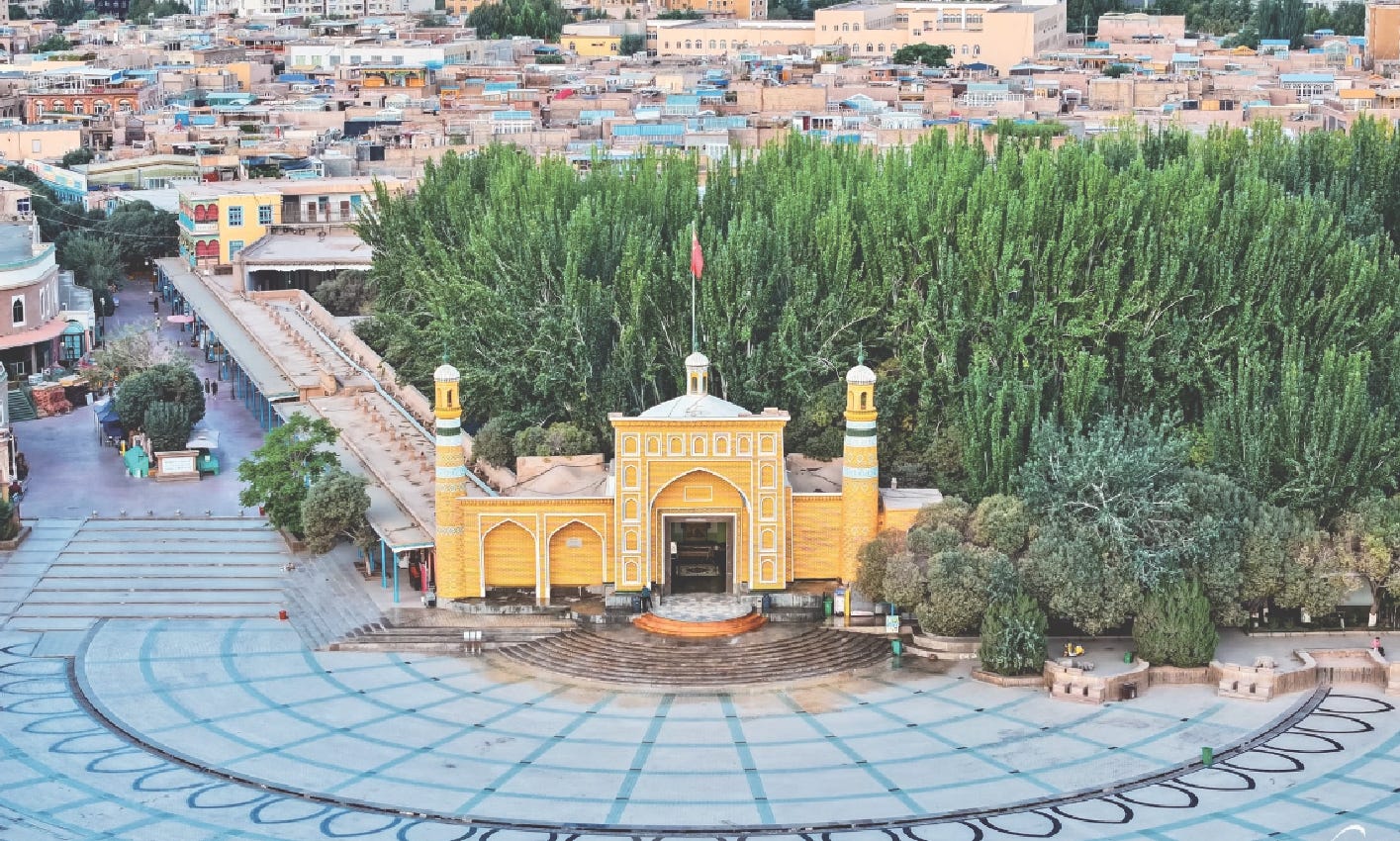
It is worth noting that the Uyghur Muslims of China’s far west (Turkic-speaking and culturally distinct from Hui) followed a different architectural trajectory. In Xinjiang oases like Kashgar and Turpan, mosque design hewed closer to Central Asian styles – brick masonry, lofty arched portals (pishtaq), big domes and slim minarets – akin to the mosques of Samarkand or Bukhara. For example, Kashgar’s Id Kah Mosque (15th century) boasts a grand yellow-brick façade with two towering minarets, while the 18th-century Emin Minaret in Turpan is a 44-meter-high cylindrical tower next to a mosque of vaulted halls. These features were uncommon in eastern China’s Hui mosques but flourished in the Uyghur region, reflecting a different cultural lineage. Thus historically, two mosque traditions co-existed: the Hui’s Sinicized courtyard mosques in the east, and the Uyghurs’ Persianate mosques in Xinjiang.
Revival and Reinvention in the 20th Century
The modern era brought new forces that transformed China’s Islamic architecture yet again. During the Cultural Revolution (1966–1976), religion of all kinds was suppressed; mosques, churches, and temples were seized or destroyed. Countless old mosques were razed or converted to secular use – even the venerable Niujie Mosque was used as a factory at one point.
After 1979, China’s policy shifted to one of cautious religious toleration under Deng Xiaoping. This opening unleashed a mosque-building boom. By official counts, the country now has around 28,000 mosques. Many of these were newly built or reconstructed on old sites from the 1980s through early 2000s, funded by both local donations and foreign benefactors.
Crucially, the mosque revival coincided with renewed connections to the broader Islamic world. Middle Eastern countries, flush with petrodollar wealth, showed interest in China’s Muslims. Nations like Saudi Arabia, Iran, Turkey, and Pakistan provided grants for mosque construction as a form of goodwill and outreach. Chinese Muslims traveling for Hajj or studies brought back fresh ideas and aesthetics. As a result, the new mosques often broke from the old Sinicized template. Instead, they embraced a pan-Islamic architectural style recognizable from Cairo to Kuala Lumpur – a trend some scholars dub the “Arabization” of Chinese mosques. Concrete and steel replaced wood, and designs featured the ubiquitous symbols of global Islam: onion domes and minarets topped with crescents, painted in the white and green palette popular in the Middle East. it marked a sharp departure from the muted, walled garden mosques of earlier Chinese tradition.

By the late 1990s and 2000s, many cities saw their historic mosques expanded or entirely rebuilt in flamboyant new styles. In provincial capitals like Lanzhou and Xining, hulking mosques sprouted with multiple domes and tall minarets piercing the skyline. The Sojourners’ Mosque of Lanzhou (a once-destroyed Qing-era mosque, rebuilt in 2007) became an oft-cited example – it now sports a giant turquoise dome and four soaring pillars, a design intended to signal “connection to the broader Islamic world” and pride in global Muslim identity. Even in Beijing, the 2008 Olympic era saw calls to renovate Niujie Mosque with larger domes (though ultimately its ancient structure was preserved). Smaller towns in Muslim-majority areas like Ningxia or Qinghai welcomed funds from Kuwait or the UAE to build grand new prayer halls patterned loosely after Medina’s Mosque or other famous sites. These developments meant that a young Hui Muslim coming of age around 2010 might have assumed green domes and pointed minarets were as authentically “Chinese mosque” as the lotus bud pagodas were to their grandparents.
Sinicization Redux – The Campaign to Remake Mosques
In recent years, however, the Chinese state has taken a sharp turn towards reasserting Chinese cultural elements in all religions – what it calls the policy of “宗教中国化” or “religion with Chinese characteristics.” Starting around 2016–2017, and intensifying in 2018, a nationwide drive began to “de-Arabize” or “Han-ify” mosque architecture. Arabic-style domes, minarets, and embellishments were deemed expressions of “foreign religious influence” and targeted for removal. In practice, this meant that many of the prominent domes and towered minarets added in previous decades were retrofitted or torn down. In some cases, entire mosques were demolished and rebuilt in a faux-Ming dynasty style with sweeping roofs and upturned eaves – effectively disguising them as Chinese cultural monuments rather than Islamic ones.
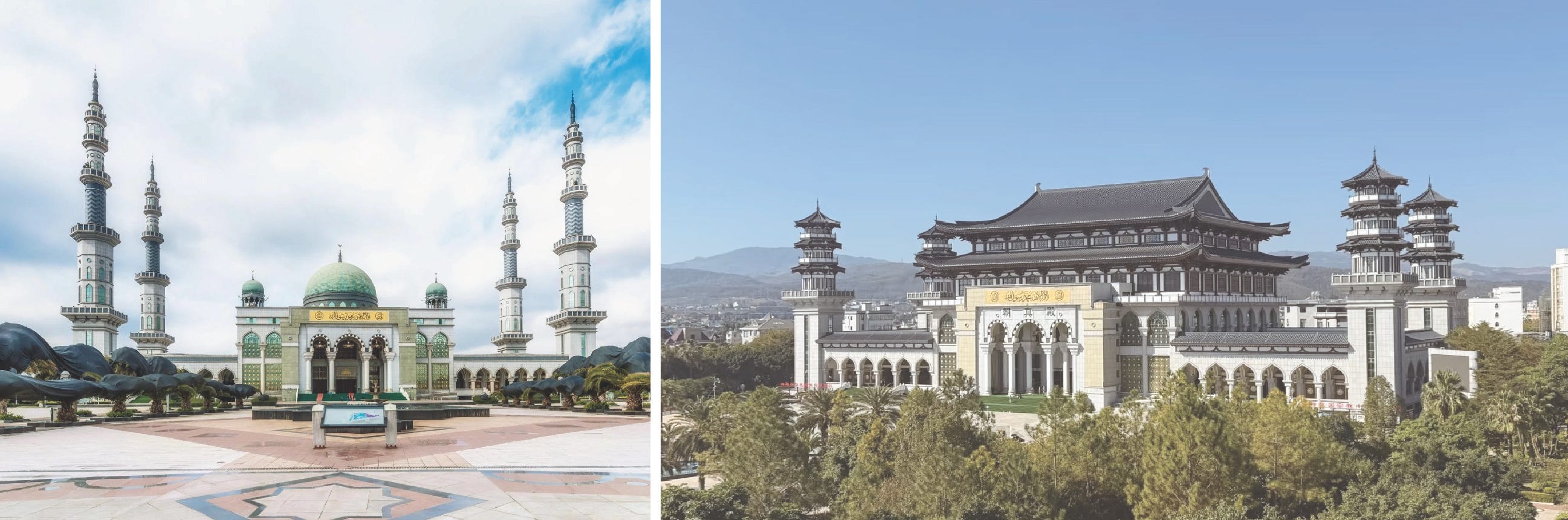
The scope of this campaign is startling. In 2020, an investigation by the Financial Times used satellite imagery to analyze 2,312 mosques across China that had notable “Islamic” architectural features (domes or minaret towers). It found that about 75% of these mosques had been altered or outright demolished since 20181. Even the majestic Shadian Grand Mosque, known as the largest mosque in East Asia, could not escape. By mid-2023, Shadian’s great dome had been dismantled and its four minarets truncated, each rebuilt into octagonal pavilion-towers with tiled roofs to match traditional Chinese pagodas.
The justification for this Sinicization drive is couched in language of national unity and anti-extremism. The campaign is part of broader policy of aligning religions with socialist values and Chinese identity. Authorities argue that visual symbols like domes and Arabic scripts could encourage “separatism” or foreign influence, especially given China’s concerns about Islamist militancy.
Internationally, the Sinicization of mosques has drawn surprisingly muted reactions from Muslim-majority countries. Saudi Arabia, Egypt, the UAE, Pakistan – nations that are outspoken about Islamic causes elsewhere – have remained largely silent on China’s mosque makeovers. In fact, many of these governments have explicitly backed China’s general approach to handling its Muslim minorities, praising China for “providing care” to Muslims and defending Beijing’s right to fight extremism.
Women-Led Mosques – A Chinese Innovation
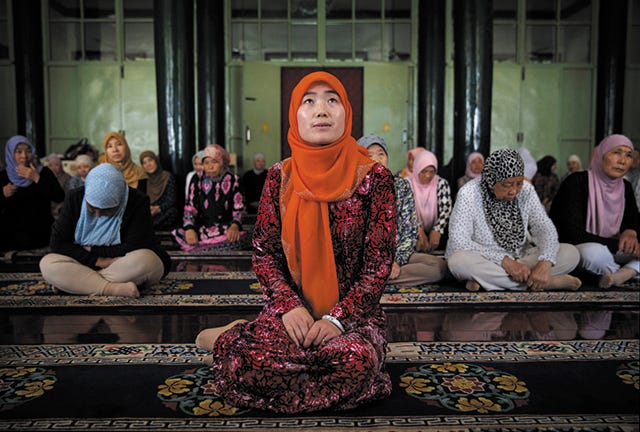
Amid these weighty issues of architecture and geopolitics, it is worth highlighting a lesser-known facet of Chinese Islam that often surprises outsiders: the existence of women-only mosques led by female imams. China is virtually the only country in the Islamic world with an established tradition of nü ahong (女阿訇) – female imams – who guide women believers in prayer and Quranic instruction. The origins of this tradition date back a few centuries. In the late Ming and early Qing period (17th–18th century), Hui Muslim communities in central China (Henan, Shanxi provinces) began setting up separate spaces for women’s religious education. Initially these were Qur’anic schools for girls, meant to improve women’s basic religious literacy. Over time, some of these schools evolved into full-fledged women’s mosques (known as nüsi, literally “women’s temple”) by the 18th and 19th centuries. The oldest surviving women’s mosque is said to be the Wangjia Hutong Women’s Mosque in Kaifeng, Henan, which was founded in 1820. By the early 20th century, a network of women-run mosques had spread in parts of China.
In these mosques, the imam’s role is performed by a woman. These female imams lead women-only congregational prayers, usually standing shoulder to shoulder with the other women (rather than in front, out of modesty customs). They also teach women and girls how to recite the Quran, basic Islamic doctrine, and offer guidance on daily life from a religious perspective. The existence of women-only sacred space gave Chinese Muslim women a degree of religious authority and community involvement rare in other Islamic societies. In Kaifeng alone, there were 16 women’s mosques by 2010 – about one women’s mosque for every three men’s mosques. In cities like Zhengzhou, Xi’an, and Linxia, women’s mosques also existed, often adjacent to a main mosque or as converted homes serving as prayer halls for women.
Only recently have “women-led mosques” started to appear in the West – for example, the Women’s Mosque of America in Los Angeles (est. 2015) or a female-led mosque in Copenhagen. Interestingly, the pioneers of these Western women’s mosques often cite China’s nü ahong as an inspiration, proving that Chinese Islam can also export ideas to global Islam. The Chinese government has generally viewed women’s mosques benignly, even positively, as it aligns with gender equality principles. In fact, after the 1980s reforms, some women’s mosques registered with authorities as independent religious entities, which experts note signifies official acceptance of parallel female-led institutions. Thus, amidst tightening control over religious expression, the female mosques of China quietly persist as an historical curiosity and a symbol of the adaptability of Islam within a Chinese context.
Halal Canteens and the Hui Economy
Religious life is not only about monuments and prayers – it also touches daily material needs. One visible aspect of Islam’s long presence in China is the ubiquity of halal food (清真食品) in many cities. Over centuries, Chinese Muslims developed a distinctive cuisine (often called qingzhen cai) that adheres to Islamic dietary laws while incorporating Chinese flavors. Dishes like hand-pulled lanzhou beef noodles, mutton steam buns, and spiced lamb skewers are beloved by Muslims and non-Muslims alike. In large cities, it’s common to find a “halal canteen” in universities, state-owned companies, and government office complexes to cater to Muslim staff and students. For example, in Beijing, almost every university has a halal dining hall offering meals free of pork and alcohol, open to all but crucial for Muslim students. Some of these canteens have even gained reputations for tastier food (especially lamb dishes) than the regular cafeterias, leading savvy non-Muslim students to occasionally dine there – but the rule is you cannot bring in outside (non-halal) food or violate the space’s norms. This accommodation is part of a broader pattern of minor affirmative action towards ethnic minorities in Communist China. Official institutions often maintain separate kitchen facilities to ensure Muslims can observe their dietary laws.
Apart from food, Hui and other Muslim minorities in China historically benefited from certain preferential policies. For decades, ethnic minorities (including Hui) received bonus points on the national college entrance exam and some extra slots in university admissions as a form of affirmative action. In practice, the advantage was modest (often 5–10 extra points in exams) and aimed mainly at minorities from underdeveloped regions. Nonetheless, it became contentious, and there were even cases of Han Chinese falsifying minority status to gain an edge. In recent years the government has moved to phase out these ethnic education bonuses, arguing that conditions have improved and that merit-based equality should rule. Still, for a long time, a Hui student in, say, Ningxia or Qinghai had a slightly higher chance of getting into a top university than an identical-scoring Han student. Other accommodations included exemptions from the one-child policy (most minorities were allowed 2 or more children under the old population control regime), minority-only scholarships, and designated minority seats in local legislatures. The state’s narrative was that these measures helped develop minority regions and fostered ethnic unity.
Economically, the Muslim dietary tradition has given rise to a thriving Halal industry in China. The country’s 28 million Muslims represent a sizable domestic market for halal meats and ingredients. Moreover, Chinese firms see opportunity in exporting to the global halal market (estimated over $2 trillion). In northern China, several large meat processing companies have built a reputation for halal-certified products. For example, Jilin Haoyue Group – based in Changchun – operates one of Asia’s biggest halal beef slaughterhouses and exports beef to the Middle East and Southeast Asia.

The Chinese Muslim Synthesis
From the first Arab traders in Tang dynasty ports to the Hui college kids eating at a halal canteen in Beijing today, the saga of Islam in China is one of synthesis and adaptation. Chinese Muslims have weathered cycles of openness and repression, influencing and being influenced by the larger Islamic world. Their mosques – at times crowned with Arabian domes, at other times with Chinese pagoda roofs – are physical metaphors for this layered identity. The recent drive to remove domes and “Sinicize” Islamic practice is, in one light, a reaffirmation of the historical fact that Islam in China always took on a Sino-centric character. Yet it is also an assertion of state power over religious expression, reminding us that identity in China has always been shaped by the hand of authority.
Even so, the Hui and other Muslim minorities remain a living bridge between two civilizations. In the face of pressures, they have found creative ways to preserve their faith – whether through discreet architectural detail, localizing Islamic education (as seen with women imams), or developing culinary niches that allow them to adhere to tradition in a modern economy. A visitor exploring Xi’an’s Muslim Quarter, or Urumqi’s Grand Bazaar, or Linxia’s “Little Mecca” streets, will still hear the call to prayer and see believers heading to worship, even if the mosque’s silhouette has changed. In the grand narrative of the Islamic world, Chinese Muslims and their dragon-sculpted mosques occupy a quiet corner, often overlooked. Yet their story is a testament to the diversity of Islam – its ability to put down roots in distant soil and grow into something uniquely local. China’s Muslims have been, and will likely continue to be, heirs to both an ancient Chinese heritage and a rich Islamic legacy, navigating between minarets and pagodas as circumstances require.
If my insights brought you a fresh perspective, please consider supporting me by buying me a coffee. Your generosity fuels my writing.
https://www.theguardian.com/world/article/2024/may/25/shadian-last-major-islamic-style-mosque-in-china-loses-its-domes#:~:text=In%202018%2C%20the%20campaign%20officially,modified%20or%20destroyed%20since%202018
28,000 mosques! Who would have guessed? I got very close to the Hui community in Tianjin, learning more is greatly appreciated. 🙏🏻
Whenever Jingyu pops up as I scroll Substack, I read it. One of THE best “explainers” of Things Chinese anywhere.
I am glad to see that China’s contemporary crackdown on Islamic culture, including architecture, has been noted. Within the long river that is Chinese history, it should not be exaggerated, but nor should it be denied or airbrushed.
I heartily recommend two books for anyone interested in the history of Islam in the China context, both by the scholar Rian Thum: The Sacred Routes of Uyghur History (focus on Xinjiang’s Uyghurs), and Islamic China: An Asian History.
Neither is a light read, but both are superbly researched and insightful.