

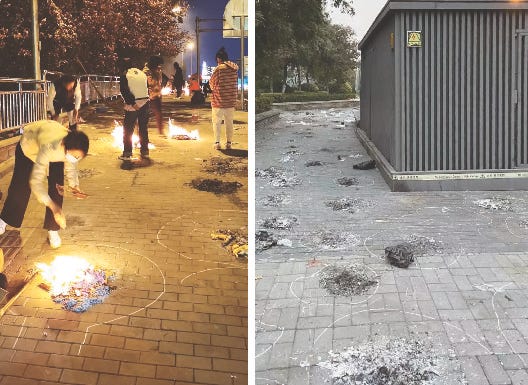
A few days after the Ghost Festival (中元节 Zhongyuan)—the fifteenth day of the seventh lunar month, September 6 this year—Chinese sidewalks still show faint crescents of ash where families burned paper money for the wandering dead. Everyone knows the etiquette: don’t step on the “money for the ancestors,” don’t call spirits by name, and when the flames sink, turn away without looking back.
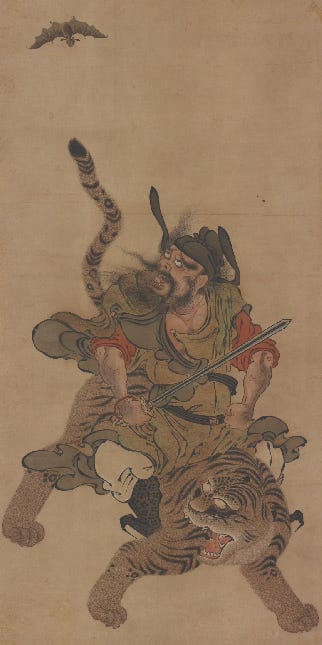
Into this ritual world, a modern spectacle arrived: Game Science released a trailer for Black Myth: Zhongkui. On screen, a wild-eyed warrior with a black face and a red beard rides a tiger, with two monstrous hercules-like figures holding his long sword. For global audiences he’s a startling new hero after Wukong; for Chinese viewers he’s familiar if less famous—Zhongkui (钟馗), the ghost-queller who has patrolled doorways and nightmares for a millennium.

How can a culture feed ghosts in one scene and applaud a ghost-slayer in the next? The answer appears when you see the map: ghosts (鬼), gods (神), and the Three Teachings (儒释道, Confucianism–Buddhism-Daoism) interlock like gears. They keep order in the world we see—and in the one we don’t.
When ancestors become ghosts — Confucianism (儒 Ru)
In much of modern Western pop culture, ghosts are framed as place-bound presences—‘the haunted house,’ the old hotel, the battlefield—rather than members of an ongoing household. In China, ghosts were usually closer to home. The dead did not vanish into nothingness; they remained part of the family.
If properly remembered with offerings, they were ancestors (祖先 zuxian)—guardians watching over descendants. If neglected, they became “hungry ghosts,” wandering in misery, eager to snatch scraps of food or incense. Rituals like the Ghost Festival in the seventh lunar month gave these lost souls a chance at comfort. For the living, it was a reminder: neglect your ancestors, and you might condemn them to hunger.
Ghosts were thus bound to ethics. They enforced filial piety (孝 xiao), the foundation of Confucian order. A family that failed in ritual obligations faced not only social shame but also spiritual consequences.
Offices of the unseen — Daoism (道 Dao)
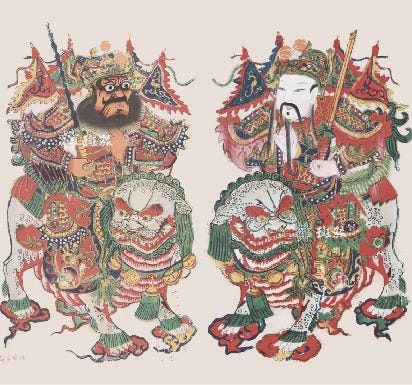
Step outside and the afterlife starts to look like city hall. City Gods (城隍 Chenghuang) preside over jurisdictions, keep ledgers of deeds, and are notorious for menacing corrupt officials. The Land God (土地公 Tudi Gong) manages crops, boundaries, neighborhood luck. In the kitchen, a small print of the Kitchen God (灶君 Zaojun) watches without fuss and files a year-end report to Heaven—a domestic audit long before spreadsheets. On the threshold, the Tang generals Qin Qiong (秦琼 Qin Qiong) and Yuchi Jingde (尉迟敬德 Yuchi Jingde) glare as Door Gods (门神 Menshen), uniformed sentries at the border between worlds. Offerings are compliance filings that keep a soul in good standing; talismans (符箓 fulu) function like stamped warrants; thresholds are checkpoints with border guards.

This is the Daoist contribution: a celestial administration with ranks, seals, and procedures. From the Three Pure Ones (三清 Sanqing) and the Jade Emperor (玉皇 Yuhuang) down to ghost constables, Daoism supplies the machinery that makes the spirit world legible. Priests carry registers and conduct jiao/zhai rites to manage spirits. Even literature echoes the architecture: the Ming novel Investiture of the Gods (《封神演义》 Fengshen Yanyi) reads like a cosmic HR manual—job titles for gods—canonizing heroes and villains into posts so the cosmos runs on schedule. In this system, Zhongkui isn’t a lone hero; he’s an appointed enforcement officer who disciplines rogue spirits—and, by extension, the human vices they embody. Think of him as the spirit world’s Internal Affairs.
Justice with a long memory — Buddhism (佛 Fo)
Running alongside the administrative logic is a Buddhist map of justice: karma (业 ye), rebirth (轮回 lunhui), and the Ten Courts of Hell (十殿阎罗 Shidian Yanluo), where Yama (阎罗王 Yanluo Wang) and his judges weigh a life before assigning the next. The punishments are vivid but not final; merit (功德 gongde) can be transferred, suffering relieved. The Ghost Festival has a Buddhist backbone called Ullambana (盂兰盆 Yulanpen).

In the story, the monk Mulian (Maudgalyāyana, 目连) finds his mother reborn as a hungry ghost realm with a needle-thin throat and a belly that can never be filled. He tries to feed her—rice turns to flames in her hands. Realizing that his private virtue isn’t enough, Mulian asks the Buddha what to do. The Buddha answers with procedure, not poetry: on the fifteenth day of the seventh lunar month, prepare a Ullambana (盂兰盆, Yulanpen) offering—fruits, incense, and dishes—not for one ghost but for the entire monastic community. When the sangha accepts the offering, its collective purity multiplies the merit (功德); then transfer it (回向, huixiang) to those trapped in suffering. Mulian obeys. The merit flows “like water to the low places,” his mother’s torment loosens, and a door opens for her to rise.

That is why, at Zhongyuan, people chant sutras and set river lanterns—to pass merit and comfort souls, especially those without descendants. In Chinese practice this sits alongside the Daoist Zhongyuan idea (the earth-officer’s pardon), which is why you often see both Buddhist chanting and Daoist rites on the same night.
If Daoism provides the offices, Buddhism provides the courtroom and the cure: appellate benches that hear petitions, and pathways for repair where merit is the only currency on appeal.
Above these courts stands the authority of the Buddha—historically Śākyamuni (释迦牟尼佛 Shijiamouni Fo)—and the network of bodhisattvas who act like high commissioners within this moral order: Kṣitigarbha (地藏菩萨 Dizang) vows to empty the hells; Guanyin (观音) answers cries here and now; Amitābha (阿弥陀佛 Amituofo) opens the Pure Land (净土 Jingtǔ) as a rehabilitative destination where laypeople—by reciting the Buddha’s name (念佛 nianfo)—seek a favorable “transfer” for the next stage of their case. In other words, Buddhist sovereignty gives the system both final jurisdiction and routes to clemency.
How the three interlock
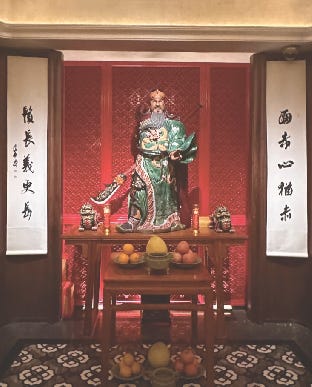
Confucianism does not build a pantheon; it builds a grammar for duty. It also sacralizes exemplars. The most famous is Guan Gong (关公/关帝 Guan Yu), elevated as a patron of loyalty and righteousness (忠义 zhongyi). Shopkeepers light incense to him when signing a deal; sworn brothers invoke him to seal solidarity; in many Buddhist monasteries he stands as a Dharma Protector (伽蓝神), a Confucian virtue presiding in a Buddhist hall, often honored with Daoist pomp. Ethics is the why; ritual is the how.
Put together, the Three Teachings do not compete so much as interlock. Confucianism tells you why to act and whom you owe; Daoism tells you who runs the place and how to file; Buddhism tells you how consequences work and how to make amends. On the ground, people simply stack them. A family lays out food for ancestors; monks chant for the hungry dead; Door Gods glower from the lintel while the Kitchen God takes notes. No one stops to reconcile doctrine. The result is functional completeness: ethics at home, administration in heaven, justice with compassion in between.
When human heroes become gods
Just as Guan Yu rose from history into sanctity, Qin Qiong and Yuchi Jingde became household guardians, their military loyalty translated into spiritual protection. Many such figures were absorbed into Daoist practice and even serve as Buddhist protectors of the Dharma.
Zhongkui follows the pattern with a twist. In one of the most circulated versions, Zhongkui sits the imperial examinations, dazzles the court, and is ranked 状元—the top scholar in the 殿试 (palace exam). But when he kneels to receive the laurel, the emperor recoils at his frightening appearance and—against procedure—refuses to ratify the result. Humiliated, Zhongkui hurls himself against the palace steps and dies on the spot. Folktellers make the symbolism blunt: a man who passed every test of the human bureaucracy is broken by prejudice at the gate.
What follows converts injury into office. That night Emperor Xuanzong (唐玄宗) dreams of a bearded scholar storming the throne room, beheading a palace demon and chasing its accomplices under the bed. The figure names himself Zhongkui, vows to purge disorder, and asks for appointment. When the emperor wakes, he commissions the painter Wu Daozi (吴道子) to fix the vision in ink and confers a title, elevating Zhongkui as “Lord of Demon-Quelling” (驱魔大神). The hat and sash he was denied in life become his insignia in death. The point is clear: if the human system misfires, Heaven hires.
In paintings and New Year prints he glares from the lintel, sword raised, imps scuttling at his feet. Households hung his image not only to scare phantoms, but to summon a magistrate, someone who would cut through the vices that breed disorder: greed (贪), rage (嗔), delusion (痴).
Belief, thinned but alive
Modern Chinese are pragmatic. In megacities, formal belief often recedes, yet temples still fill with students, job-seekers, and young couples hedging fate. Chinese mourning rituals traditionally involved burning paper as an offering, a practice that has recently come under scrutiny due to air pollution. In response, cities have launched "civilized mourning" campaigns that mix traditional incense with modern alternatives. These efforts aim to curb open-air burning, shifting the rituals to parks, temple courtyards, or even virtual "cloud tomb-sweeping" apps. In the countryside, processions and temple fairs prove resilient—sometimes rebranded as intangible-heritage tourism. Viral moments—like Hebei’s Yixian “Grandma Temple” (奶奶庙) where visitors pray for everything from exams to safe driving—show how a temple economy turns nostalgia, anxiety, and weekend travel into measurable commerce: incense, talismans, merit slips, red bracelets. The theology may blur, but the bureaucratic habit persists: when formal channels feel slow or remote, people still know where to file a petition in the unseen.

China’s ghost-god system is not a jumble of myths; it is a constitution without a single book. Zhongyuan keeps the calendar; Zhongkui keeps the peace; Confucianism writes the rules; Daoism staffs the offices; Buddhism audits the ledgers. You don’t have to believe in ghosts to see the design. You only have to notice how the invisible keeps the visible in line.
If my insights brought you a fresh perspective, please consider supporting me by buying me a coffee. Your generosity fuels my writing.


Fascinating article! Thank you
Love your take about how the Three Teachings 'do not compete so much as interlock.' Great article!