

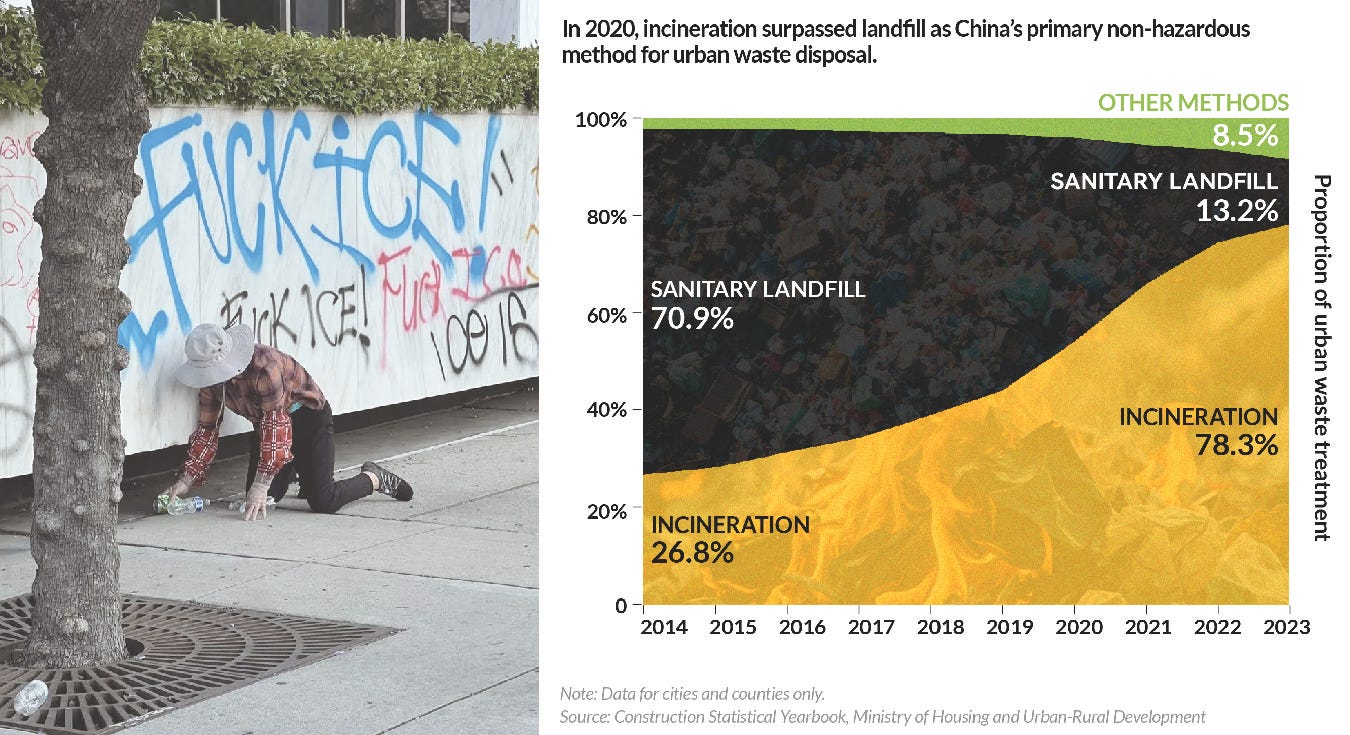
In the summer of 2025, amid a roiling street protest in Los Angeles, an elderly Chinese immigrant quietly went about her own business: picking up discarded bottles and cans. A viral video captured the grey-haired “auntie” stooping to collect recyclables, seemingly oblivious to the chaos around her.
Around the same time, headlines from China reported an unexpected problem: waste-to-energy plants were running short of trash to burn. The news stirred memories of the environmental debates of the 2010s, when warnings about a looming “garbage siege” and overflowing landfills filled the air. Back then, I was so inspired that I even tried to build a garbage-sorting machine with friends at school. But the predicted siege never came—instead, the narrative flipped. That dissonance, between the images in my mind and the reality on the ground, sent me searching for the path that led us here.
From Scarcity to Surplus
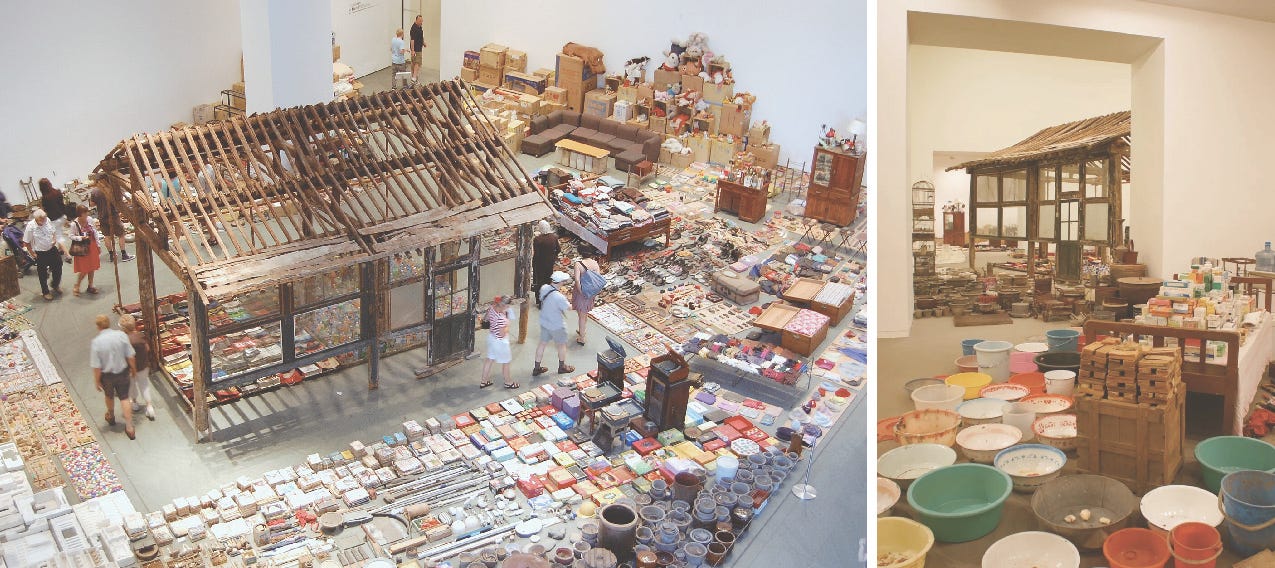
Long before “zero-waste” became an environmental ideal, frugality was a survival skill in China. Decades of scarcity and political turmoil in the mid-20th century taught an entire generation to never throw anything useful away. One striking illustration is artist Song Dong (宋冬)’s renowned installation Waste Not (物尽其用). First exhibited in 2005, it displayed over 10,000 everyday objects that Song’s mother had hoarded over a lifetime – from plastic wash basins to empty toothpaste tubes – all meticulously arranged in neat rows. She “refused to throw anything away if she could possibly reuse it,” having endured poverty during China’s 1950s–60s upheavals . Like many of her era, she feared hard times might return, treating the habit of “waste not” as a magic weapon against future want.
Fast-forward to today’s China, and the context has flipped. After a generation of breakneck economic growth, China’s problem is no longer scarcity – it is overconsumption, and the drowning of the old thrift habit in a rising sea of disposables. The nation’s rapid urbanization and the digital convenience revolution have dramatically swollen the waste stream. Food delivery and e-commerce have made life easier but left behind mountains of plastic and cardboard. For millions of busy urbanites, ordering lunch with a swipe has replaced cooking; an avalanche of single-use containers is the consequence.
Even people themselves are producing more garbage as living standards rise. China’s per-capita municipal trash generation has surged in recent years. In 2021, the average resident of 11 major Chinese cities generated over one kilogram of waste per day, a symbolic threshold of throwaway abundance. The country as a whole is now the world’s largest municipal solid waste generator, producing 215 million tons of trash in 2017 and projected to reach 500 million tons annually by 2030 if trends continue.1 The transformation is staggering: only a few decades ago, Chinese cities were relatively modest waste producers. Shenzhen, for example, handled just 50 tons of household waste per day in 1979; today Shenzhen’s daily output is 15,000 tons, a 300-fold increase as one environmental report noted.2 This explosion of rubbish has quite literally started to overwhelm the landscape – a phenomenon Chinese media dubbed “garbage siege” (垃圾围城). By the 2010s, landfills around major cities were nearing capacity, some growing into artificial mountains on the urban fringe. In Xi’an, a landfill the size of 100 football fields (江村沟, Jiangcungou) was filled to the brim and forced to close in 2019, decades ahead of schedule, thanks to the torrential growth of the city’s waste output.
Incineration: From Nuisance to Necessary (and Safer) Evil
Confronted with a deluge of garbage, China initially followed the classic eco-playbook of “reduce, reuse, recycle.” It installed recycling bins, invested in public education campaigns, and pressured the delivery industry to cut down on excessive packaging, with some attempts at reuse along the way. But as consumption surged—driven especially by e-commerce and the booming food-delivery sector—the traditional approach could no longer keep pace. Instead of relying solely on upstream reduction or meticulous household sorting, Chinese authorities increasingly turned to technology and large-scale infrastructure to tackle the problem. Over the past decade, the country has built an extensive network of waste-to-energy incineration plants, making them a central pillar of its waste-management strategy.
The evolution of China’s incineration industry is a story of both necessity and innovation. The first experimental plant opened in Shenzhen back in 1985, but it faltered because Chinese household waste then was too wet and low-calorie (food scraps dominated) to burn efficiently. As living standards improved and waste became “drier” (more paper, plastics, packaging), incineration became more viable in the 2000s . The government encouraged private investment in these projects by 2005, offering subsidies and guaranteed electricity purchases. A decade later, strengthened environmental regulations forced incinerators to install real-time emissions monitoring and publicly display their pollution data, aiming to allay fears of invisible toxins. By 2020, a national online platform was live-streaming incinerator smokestack readings across the country – a level of transparency almost unheard of in earlier years.

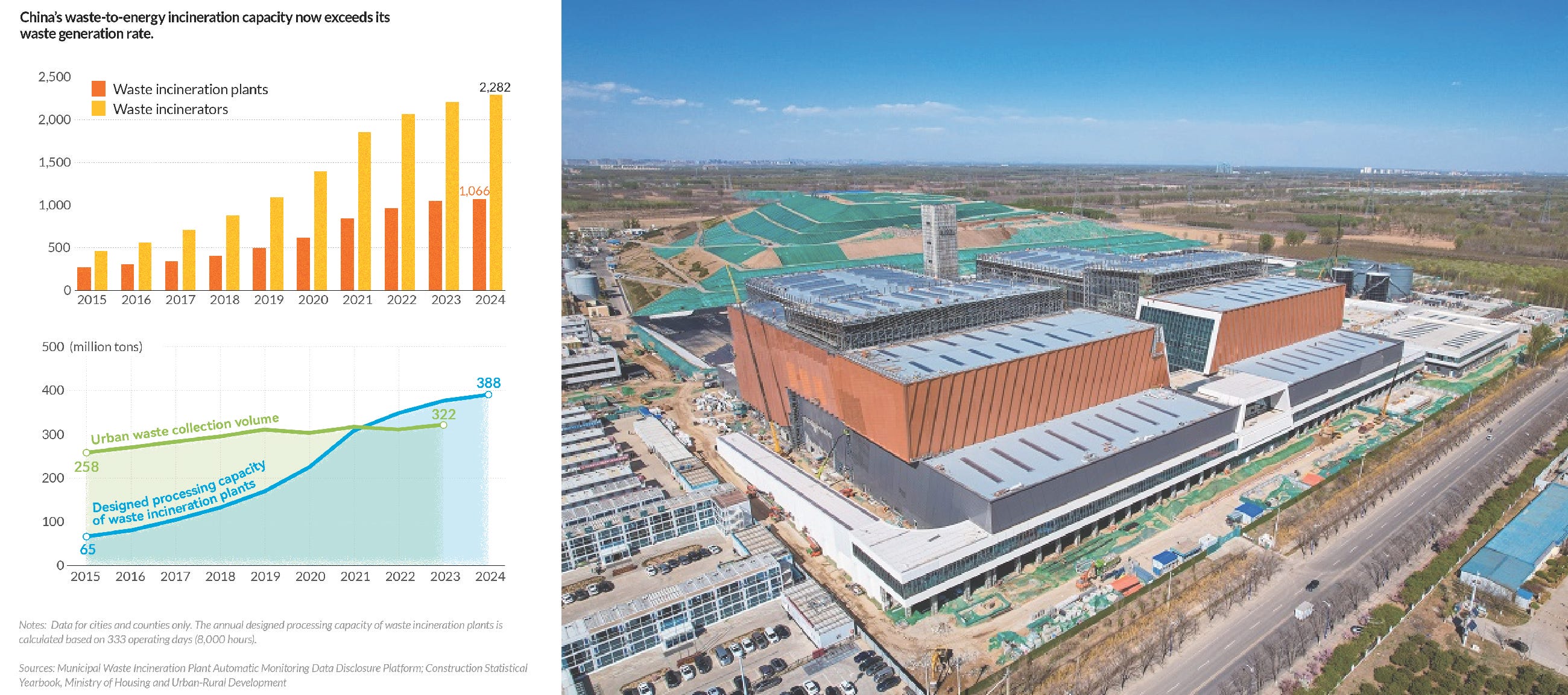
Over 2,100 incinerators are now operating nationwide – some of the largest are gargantuan facilities processing thousands of tons daily. Shenzhen, for example, opened one plant designed to handle 8,000+ tons of waste each day, and it often runs at or above capacity. Incineration has helped many Chinese cities finally get a handle on their garbage “siege” by dramatically shrinking volumes (burning reduces trash to ash) and generating useful energy in the bargain.
Modern Chinese waste-to-energy plants improve environmental performance by maintaining extremely high combustion temperatures and advanced flue gas scrubbing to destroy harmful compounds – crucially, to minimize dioxins (二噁英), the carcinogenic byproduct of burning plastics. Dioxins form most readily in the “danger zone” of 200–450 °C, typically during the cooling phase after combustion. To prevent this, many new incinerators use “rapid heat–rapid cool” technology: waste is burned at 850–1,000 °C or higher for at least 1–2 seconds, then the flue gas is cooled extremely quickly—often in under two seconds—past the dioxin formation range. This combination of fast, complete combustion and rapid quenching effectively suppresses both de novo synthesis and precursor-based formation, keeping emissions well below international limits.
Official data show that by 2018, virtually all operating incinerators were meeting strict dioxin emission standards.3 Nonetheless, public skepticism persists, especially among communities chosen as sites for new burners. In the past 15 years, waves of “Not In My Backyard” protests have greeted incinerator proposals from Guangdong to Hubei. In Beijing’s suburban Asuwei area, plans to build a large incinerator a few kilometers from residential neighborhoods sparked an intense grassroots campaign. Residents organized petition drives, marched with banners reading “Firmly oppose burning garbage”, and even compiled their own research reports warning of dioxin dangers. These public pressures did succeed in delaying projects – Beijing’s Asuwei incinerator was stalled for years – but in most cases, authorities eventually pushed ahead. By mid-2020s, China has largely bet its waste management future on incineration, arguing that technological fixes can tame the pollution.
When Trash Becomes Treasure (or at Least, Fuel)
Paradoxically, China’s aggressive build-out of incinerators has been so successful at gobbling up garbage that it’s created a new problem: not enough trash to go around. In an unexpected twist, capacity has overshot the available waste supply in some regions, leaving incinerator furnaces hungry. By 2024, China’s waste-to-energy plants could theoretically burn more than the country’s cities were collecting. As a result, many plants now operate below capacity – on average only about 60% of their incineration capacity is being utilized, leaving 40% idle. In response, local governments have started trucking in waste from elsewhere to keep burners fed. A few enterprising operators have literally begun mining old landfills, excavating long-buried “aged waste” and shoveling it into incinerators – both to reclaim landfill space and to feed incinerator.
Waste-to-energy (WtE) has emerged as a key component of the global waste-management landscape. Today, over 2,800 WtE plants operate across the world, processing more than half a billion tons of trash annually.4 Yet, they still handle only a fraction of global municipal waste—most ends up in landfills.
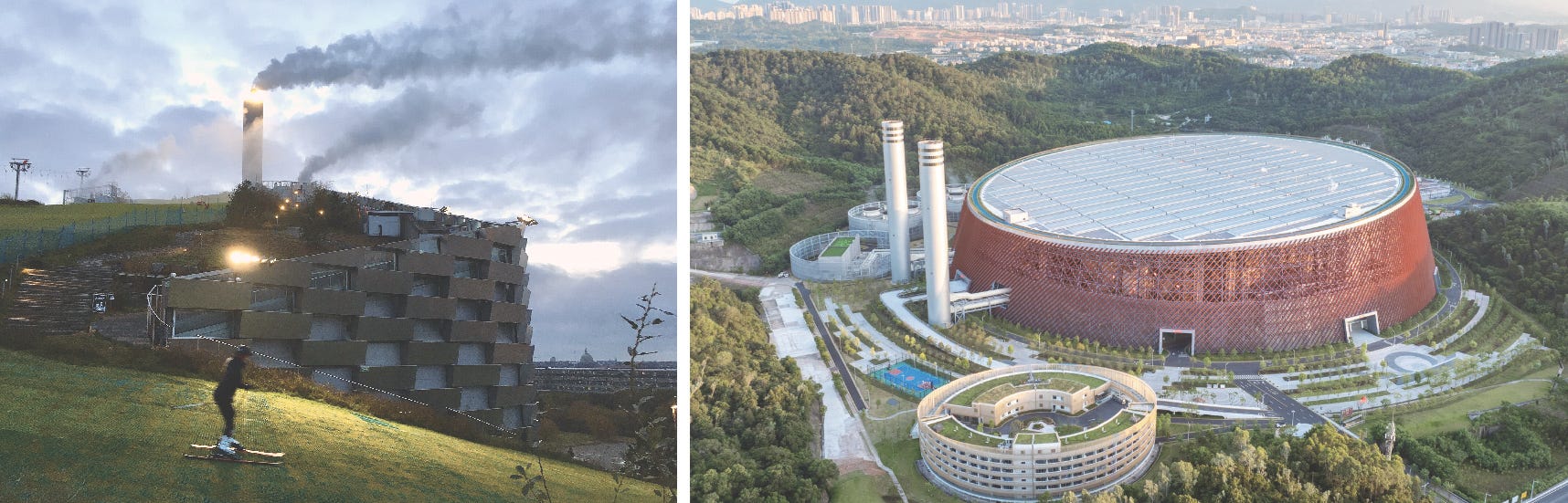
Some of the world’s most striking waste-to-energy projects are as imaginative as they are functional. In Copenhagen, the Amager Bakke facility—better known as CopenHill—doubles as a district heating plant and a ski slope, blending infrastructure with recreation. In China, the Shenzhen East Waste-to-Energy Plant, mentioned earlier, stands as the largest of its kind in the world, designed not just for capacity but as an architectural statement. Sweden, meanwhile, leads in household waste-to-energy conversion: more than half of the country’s domestic waste is transformed into heat and electricity, with incinerators providing district heating for nearly half the population.
To Sort or to Burn: Rethinking Recycling
China’s turn toward high-tech incineration has quietly upended another pillar of conventional environmental wisdom: the role of meticulous trash sorting and recycling. Not long ago, Chinese cities looked to places like Japan, Germany, or Taiwan with admiration for their intricate garbage sorting systems. Enthusiastic articles and even textbooks held up Japan’s 30-category household recycling regimen as a model of civic virtue.
In 2019, Shanghai became a test case when it rolled out an ambitious mandatory waste separation program. Under the new rules, every Shanghai resident had to divide their household discards into four bins: “wet” (compostable food scraps), “dry” (other landfill waste), “hazardous”, and “recyclable”. Suddenly, trash talk was on everyone’s lips in Shanghai – people exchanged tips on whether a soiled paper napkin was wet or dry waste, or how to categorize leftover hot-pot broth. The city hired 1,700 instructors and even developed a smartphone app to help confused citizens navigate questions like: Where do pig bones go? (Answer: wet waste). How to throw a cherry? (Answer: cherry pits are dry waste but cherry pulp are wet).
But the sorting campaign has proved challenging to sustain, and its impact is now being re-evaluated in light of China’s incineration boom. Even at its peak, Shanghai’s sorting system was not meant to eliminate incineration, but to support it. Sorted “dry” waste was destined for incinerators, while “wet” kitchen waste would be processed into biogas or fertilizer. In practice, the lines blurred. Many residents grew weary of the complex rules and fell back to old habits, especially when enforcement officers weren’t around. Public attention shifted elsewhere (not least due to the COVID-19 outbreak in 2020). And as China’s incinerators became cleaner and more efficient, some experts began to question the need for obsessive sorting at the household level. After all, if modern furnaces can safely burn mixed waste and generate energy, why force every citizen to become a part-time garbologist?
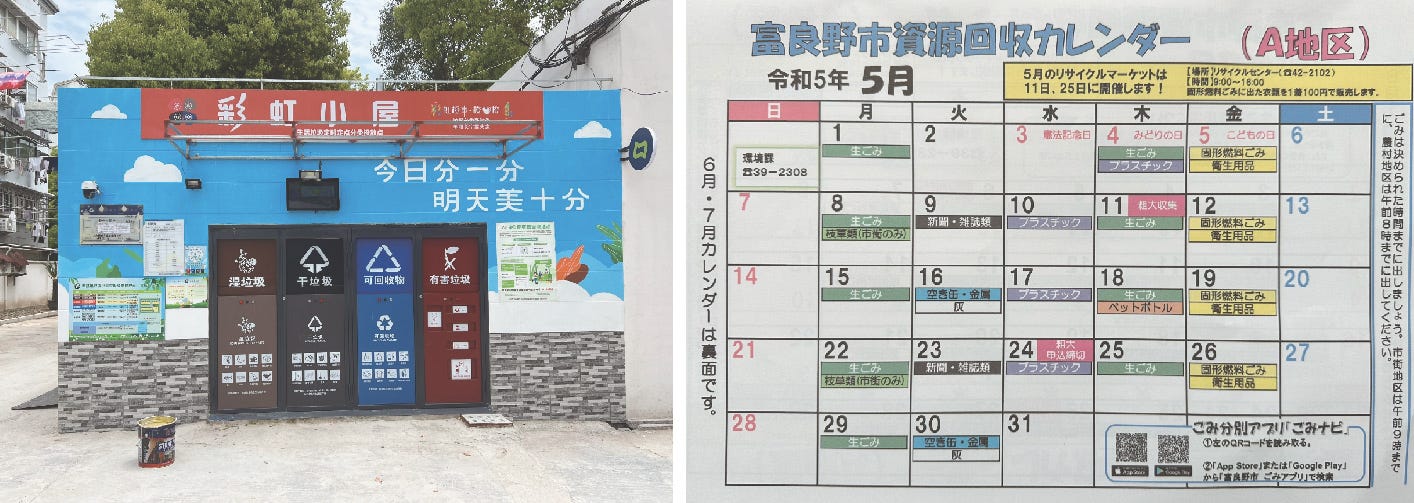
In an ironic twist, the admired Japanese model – which requires citizens to wash, sort, and store garbage in dozens of categories for scheduled pickups – may be less suited to China’s needs than previously thought. Chinese cities found that a simpler dichotomy – say, “rottable vs. non-rottable” – might be more practical. In some communities, officials discovered that villagers easily understood separating food scraps (which decompose) from everything else (which doesn’t), whereas they were baffled by elaborate Western-style recycling lexicons. By leveraging industrial sorting and incineration, China could arguably achieve the environmental outcomes that personal sorting seeks, but with far less citizen labor.
The Plastic Pivot and Green Innovation
In January 2020, Beijing unveiled one of the world’s toughest plastic restrictions: a phased ban on non-biodegradable single-use plastics across the country. Thin plastic shopping bags were to be banned in major cities by the end of 2020, and in all cities by 2022; disposable plastic straws were banned nationwide; foam takeaway containers and plastic cutlery were similarly outlawed on a tight timeline.
Biodegradable plastics – materials that break down under composting conditions – went from niche to big business overnight. Because the ban exempted “degradable” plastics, companies rushed to label products as compostable and ramp up production of bioplastics (like PLA made from corn starch). In the space of a year or so, Chinese manufacturers raced to build new biodegradable plastic factories. By late 2020, at least 36 companies had announced new biodegradable plastic projects, adding an astonishing 4.4 million tons of annual capacity – a sevenfold increase in output in under 12 months5. This is a staggering industrial response, effectively creating a biodegradable plastics sector almost from scratch. Suddenly, shopping malls in Beijing offered PLA-based “green” bags, restaurants switched to compostable straws, and delivery apps experimented with biodegradable packaging for meals.
Greenpeace East Asia warned in late 2020 that bioplastics are no panacea – many require very specific high-temperature composting to actually break down, and China has relatively few facilities capable of that. Without proper composting systems, biodegradable items might simply persist in landfills or oceans, defeating the purpose. In essence, switching from petroleum plastic to plant-based plastic without reducing single-use consumption could just swap one problem for another. The government appears aware of this risk: it has simultaneously promoted programs to reduce overall plastic use and to encourage reusable packaging in delivery services.
Waste and the Value of Nothing
In Chinese contemporary art, trash and discarded objects have become potent symbols to critique consumer society and to reconnect with memories of a leaner past. Take for example Xu Bing’s “Phoenix” – two monumental bird sculptures, each nearly 30 meters long, that were crafted entirely from construction site waste. Xu, a renowned Chinese artist, collected steel rebar, shattered concrete, rusted tools, hard hats and other cast-off materials from Beijing building projects and assembled them into a pair of mythical phoenixes. Originally commissioned to hang in the atrium of a glitzy new skyscraper, Phoenix carried an unintended message – one that made the building’s developers uneasy. The birds are beautiful, yet born from rubble, implicitly asking: At what cost comes this shiny new city? Who toils amid the scraps? By glorifying garbage into art, Xu Bing turned the narrative of waste on its head: the trash of urbanization literally became the embodiment of China’s soaring aspirations.

China’s path from frugality to affluence has created environmental challenges on a massive scale, but it is also forging a distinct approach to solving them. The traditional Chinese ethic of thrift – exemplified by that bottle-picking auntie in Los Angeles or Song Dong’s mother saving bits of soap – has not disappeared; it survives in everyday behaviors and cultural memory. Yet the nation’s response to its modern waste crisis is not simply to resurrect old habits of penny-pinching and reuse.
Whether it is burning garbage for energy on an unprecedented scale or jump-starting an entire biodegradable plastics industry almost overnight, China often takes an “industrial route” to greenness. In contrast, in the West, environmental progress is often framed as a gradual cultural shift—citizens learning to recycle, consuming less, and slowly adopting greener lifestyles. In China’s case, the pace is faster, but trade-offs and debates abound: incinerators reduce landfill blight but carry emissions risks; bioplastics cut petroleum use yet raise questions about their real-world effectiveness. Citizens are increasingly vocal about these choices. Still, there is no denying the sheer scale and speed of China’s push—garbage no longer “surrounds” its cities as it once did.
If my insights brought you a fresh perspective, please consider supporting me by buying me a coffee. Your generosity fuels my writing.
https://www.dw.com/en/china-to-ban-single-use-plastic-bags-and-straws/a-52065123
https://e360.yale.edu/features/as-china-pushes-waste-to-energy-incinerators-protests-are-mounting
https://pubmed.ncbi.nlm.nih.gov/37659366/
https://sigmaearth.com/waste-to-energy-projects-that-are-powering-entire-cities/
https://www.greenpeace.org/international/press-release/46066/biodegradables-will-not-solve-chinas-plastics-crisis/