

When Yuan Mei 袁枚 wrote Suiyuan Shidan (随园食单, Menu of the Sui Garden) in the 18th century, he actively rejected the ostentatious banquets of his era, favoring refined simplicity, genuine flavors, and an environment conducive to authentic connection. Just as he argues in the opening of his book “凡物各有先天,如人各有資稟。Every ingredient has its innate nature, just as every person has their innate endowment.” He established culinary principles that still influence modern Chinese cuisine, particularly Huaiyang cuisine 淮扬菜.
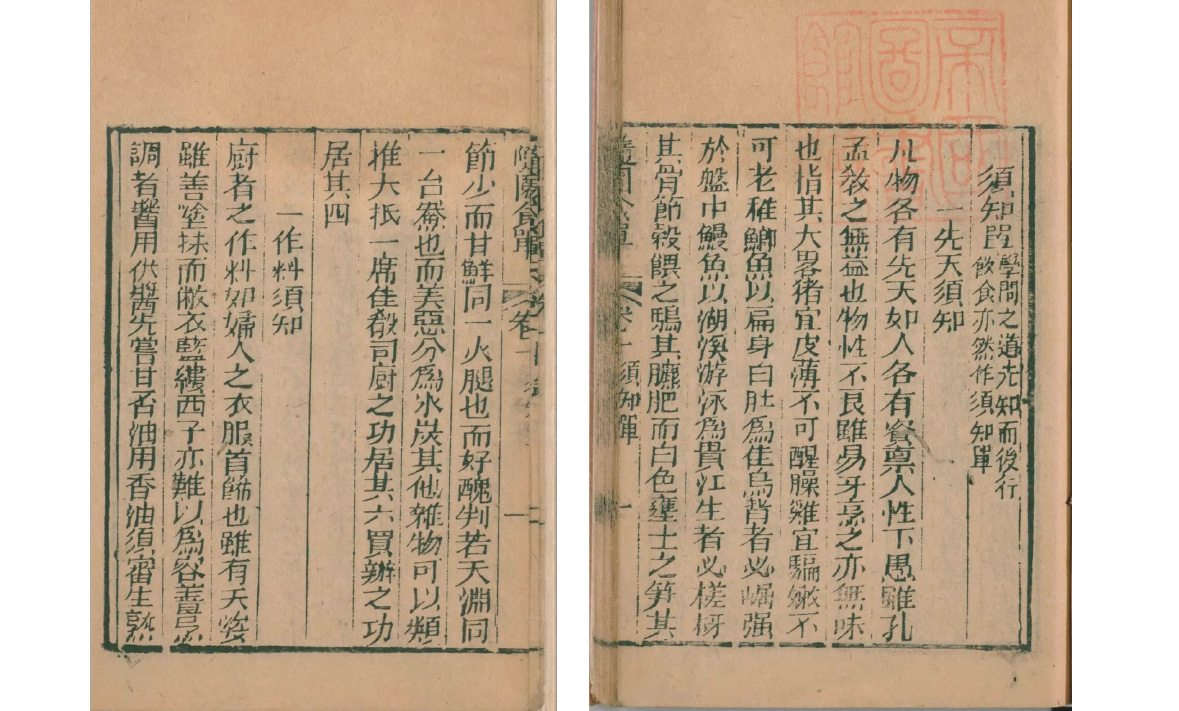
This is the weekly article of Wenyan Decoded - Classical Chinese for the Modern Mind. Find detailed unpacking and audio of the five sentences at the Weekly Decoded Section
So, the question remains: what is Chinese food? Is it Kung Pao and General Tso’s chicken? Is it a lavish banquet featuring abalone, sea cucumber, and Moutai liquor? Or is it a humble food stall selling Chinese pancakes and noodles? While all of these are authentic representations, they fail to capture a remarkable culinary evolution currently reshaping China’s urban landscape: the explosive rise of the “Chinese Bistro.”
The Bistro Trend
For the urban resident, dining has shifted toward experiential fulfillment. Diners are stepping away from traditional, etiquette-heavy banquets characterized by social hierarchies and noisy environments. Instead, the modern Chinese Bistro functions as a new kind of urban sanctuary, providing intimate social interactions and an immersive aesthetic experience without the heavy social burdens.
The core of this culinary movement lies in a highly strategic philosophy of “local dishes, Western presentation” (土菜洋做). Chefs are deconstructing hyper-regional, traditionally rustic Chinese cuisines and elevating them. Massive shared platters have been decisively replaced by refined, small-portion “Tapas” formats. This approach allows diners to sample a wide array of bold regional flavors in a single sitting, satisfying curiosity while honoring the ingredient.
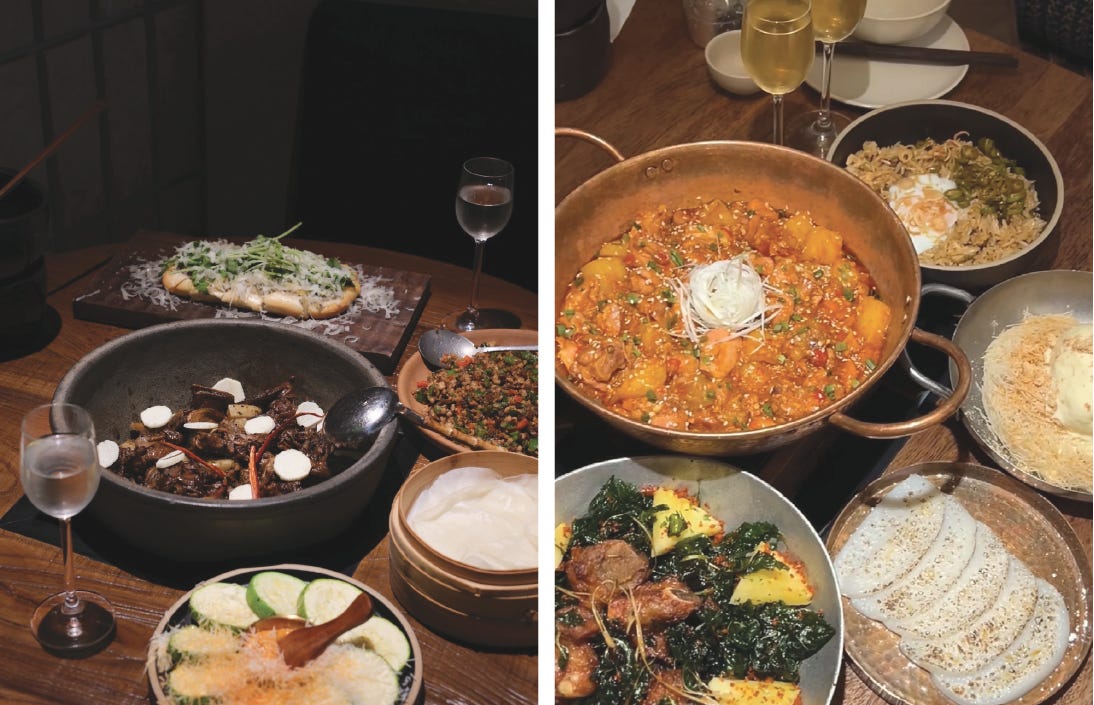
Furthermore, the beverage pairing philosophy has undergone a complete transformation. Traditional Chinese dining is often bound to heavy baijiu or industrial lagers, drinks inherently tied to obligatory toasting cultures (it’s a tradition of the last several decades, for more on baijiu, see China’s Two Liquors). Bistros have entirely discarded this dynamic. Their curated menus feature natural wines, low-ABV fruit wines, craft beers, and modernized traditional rice wines. The unique acidity and light bodies of natural wines, fermented with wild yeast, perfectly balance the complex spices, heavy umami, and fermented notes of regional Chinese cooking.
Experiencing the Bistro
Walking into modern bistros like Yeego (野果) or Jiaodong Xiaoguan (胶东小馆), you won't find the chaotic, thousand-square-meter seafood halls of the past. Instead, you find a careful curation of raw wood, warm lighting, and soothing independent music.
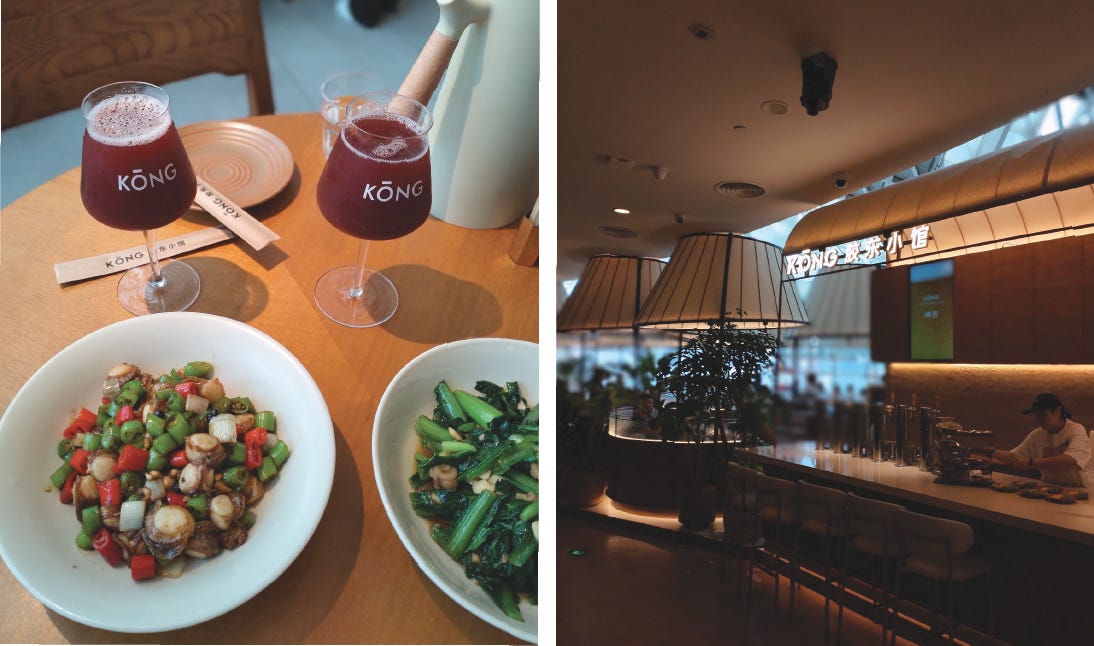
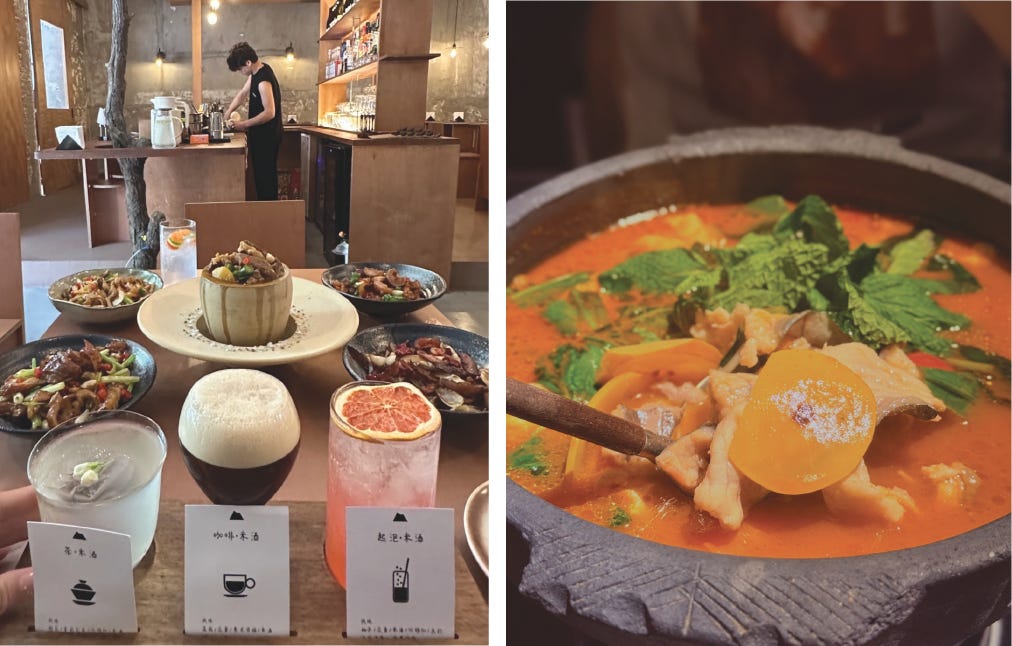
They take highly localized ingredients, like Yunnan's seasonal mushrooms and historic fermented sour broths, or Shandong's fresh sea urchins, and transform them into highly visual "beautiful meals" (漂亮饭). Pairing a fruit-scented natural white wine. it elevates the entire tasting experience, creating an environment where the food, the drink, and the atmosphere are in perfect dialogue.
A Classical Philosophy for a Modern Trend
Would Yuan Mei, the ultimate 18th-century food purist, enjoy a modern Chinese Bistro? He would probably scoff at the “instagramable” plating. He hated anything that distracted from the ingredient itself. Yet, if he sat down and tasted the curated pairing of a wild-fermented natural wine with the sharp, innate umami of Jiaodong seafood, he might recognize a familiar philosophy.
Beneath the modern, Westernized execution, the core ambition of the Bistro movement—matching light with light, respecting the innate nature of local ingredients, and creating an environment for intimate connection—is surprisingly aligned with his centuries-old manifesto.
The Chinese Bistro is a modern attempt to answer a very classical question: How do we respect the true nature of food? This week in Wenyan Decoded, we’ve been exploring exactly how Yuan Mei answered this question 300 years ago. Let’s look back at the five core principles we unpacked this week, and see how his 18th-century vocabulary still perfectly describes the modern pursuit of culinary harmony.
The Weekly Decode
Menu of the Sui Garden, by Yuan Mei, a Qing Dynasty poet-gourmand argues that the kitchen is a philosophical practice, and that taste, like all arts, begins with respect for the material.
Day 1 Innate Nature
凡物各有先天,如人各有資稟。Fán wù gè yǒu xiāntiān, rú rén gè yǒu zīpǐng.
人性下愚,雖孔、孟教之,無益也;Rénxìng xià yú, suī Kǒng, Mèng jiào zhī, wú yì yě;
物性不良,雖易牙烹之,亦無味也。wùxìng bù liáng, suī Yì Yá pēng zhī, yì wú wèi yě.
“Every ingredient has its innate nature, just as every person has their innate endowment. If a person’s nature is deeply foolish, even Confucius and Mencius teaching them would be useless; if an ingredient’s nature is not good, even Yi Ya cooking it would produce no flavor.”
— 隨園食單·須知單·先天須知 (Menu of the Sui Garden, “Essential Knowledge: Innate Nature”) by Yuan Mei (袁枚, 1716–1797)
The sentence is built on a parallel analogy: 人 (people) ↔ 物 (ingredients), 性 (nature) ↔ 性 (nature), 孔孟 (the greatest teachers) ↔ 易牙 (the greatest cook).
Yuan Mei makes a claim that goes against modern beliefs: not everything can be improved through effort. Some natures are fixed. He insists that the first act of excellence is honest assessment, knowing what you are working with before you touch it.
Unpacking the sentence:
凡 (fán) — all, every, in general; whenever → Classical 凡 opens a universal statement, “in all cases.” It announces a principle, not an observation. Modern Chinese uses 凡是 (compound) or 所有.
先天 (xiāntiān) — innate nature, what comes before birth → Literally “before heaven,” what exists prior to heavenly intervention, what you are born with. Still used in modern Chinese, but narrowed to a medical-technical term (先天性 = congenital). Yuan Mei applies it to ingredients: a pig has innate quality just as a scholar has innate talent. This move is the spine of the entire 須知單, borrowing metaphysical vocabulary for a cookbook.
資稟 (zīpǐng) — innate endowment, natural gifts → 資 = resources, capital; 稟 = to receive from heaven or nature. The compound means “what nature gave you.” This echoes Mencius’s arguments about 性 (human nature).
雖 (suī) — even if, although → Classical 雖 is a powerful concessive: “even if X, still Y.” It carries both halves of the concession alone. Modern Chinese weakened this into a two-part structure: 雖然...但是 (”although...but”), splitting the weight across two markers. Classical 雖 needs no partner.
易牙 (Yì Yá) — the legendary cook of Duke Huan of Qi → The most famous chef in Chinese history. He was so devoted to his lord’s palate that he allegedly cooked his own son to create a dish the Duke had never tasted. Yuan Mei invokes him as the ceiling of culinary skill but the allusion adds a dimension of dark grandeur.
也 (yě) — sentence-final assertion particle → 無益也 / 無味也 — both clauses end with 也, which stamps the statement as definitive. Modern Chinese has no exact equivalent; the closest is the emphatic 啊 or just a full stop. 也 carries a philosophical finality that punctuation cannot replicate.
Day 2 On Harmony
要使清者配清,濃者配濃,Yào shǐ qīng zhě pèi qīng, nóng zhě pèi nóng,
柔者配柔,剛者配剛,róu zhě pèi róu, gāng zhě pèi gāng,
方有和合之妙。fāng yǒu héhé zhī miào.
“(You) must match the light with the light, the rich with the rich, the gentle with the gentle, the bold with the bold, only then will (you) achieve the wonder of harmony.”
— 隨園食單·須知單·配搭須知 (Menu of the Sui Garden, “Essential Knowledge: Pairing”) by Yuan Mei (袁枚)
Yuan Mei’s rule is ultimately about coherence: every element in a composition must respect the register of its neighbors. The modern food world, obsessed with “fusion,” but combination without coherence is just confusion. And interestingly, more Chinese style ‘bistros’ are booming across China, some of which are experimenting with cross-cultural pairings.
Unpacking the sentence:
清 (qīng) — clear, light, pure, delicate → One of the most loaded aesthetic words in Chinese culture. Classical 清 describes a quality that is simultaneously sensory (clarity of a broth), moral (purity of character), and aesthetic (elegance of style). Yuan Mei uses it as a flavor category, but his literati readers would hear all three registers. Modern Chinese preserves 清 in compounds: 清淡, 清高, 清新, but rarely lets it stand alone with this full resonance.
者 (zhě) — one who; that which → 清者 = “that which is light”; 濃者 = “that which is rich.” 者 is a nominalizer, turning adjectives into noun phrases. This is 者 at its most efficient: one character doing the work of “the kind of ingredient that is...”
剛 (gāng) — bold, hard, firm, unyielding → A word borrowed from philosophy and metalwork. Classical 剛 describes the quality of tempered steel or an unyielding personality. Yuan Mei describes food using the same vocabulary Chinese philosophy uses for character types (剛柔 is a key binary in the Yijing) is entirely deliberate.
方 (fāng) — only then; only in this way → A conditional adverb meaning “only after.” Modern Chinese would say 才能 or 才會. Classical 方 is more decisive. It implies that no shortcut exists.
和合 (héhé) — harmony, harmonious union → Two near-synonyms combined for emphasis. 和 = harmony (blending differences); 合 = joining, fitting together. The compound suggests not just mixing, but a marriage where both parties are enhanced.
Day 3 On Solitude
味太濃重者,只宜獨用,不可搭配。Wèi tài nóngzhòng zhě, zhǐ yí dú yòng, bù kě dāpèi.
如李贊皇、張江陵一流,Rú Lǐ Zànhuáng, Zhāng Jiānglíng yī liú,
須專用之,方盡其才。xū zhuān yòng zhī, fāng jìn qí cái.
“Ingredients whose flavor is too rich and heavy should only be used alone, they cannot be paired. They are like Li Zanhuang and Zhang Jiangling: you must give them sole command before their talents can be fully realized.”
— 隨園食單·須知單·獨用須知 (Menu of the Sui Garden, “Essential Knowledge: Solo Use”) by Yuan Mei (袁枚)
Yuan Mei states a culinary principle: strong flavors must stand alone. Then illustrates it with political history, treating both as domains where the same logic applies.
Some talents must be given their own project, their own domain, their own stage. A crab paired with sea cucumber doesn’t become “surf and turf.” It becomes a war where neither side wins. Yuan Mei is describing a theory of leadership: the greatest talents demand the most space. The art is knowing when to pair and when to let something stand magnificently alone.
Unpacking the sentence:
者 (zhě) — one who; that which
獨 (dú) — alone, solitary, exclusively → Classical 獨 carries philosophical weight beyond “alone.” It implies self-sufficiency and singular authority. Modern Chinese preserves 獨 in 獨立, 獨特, but rarely uses it with the admiring tone Yuan Mei gives it here.
宜 (yí) — should, is suitable, is fitting → 宜 is softer than a command but firmer than a suggestion. Modern Chinese would say 應該 (should), which sounds like instruction. Classical 宜 sounds like nature speaking. What is 宜 is not arbitrary. It follows from the thing’s own character.
李贊皇 (Lǐ Zànhuáng) — 李珏, Li Jue, powerful Tang Dynasty chancellor → A towering political figure of the 9th century, known for his forceful, uncompromising governance. He was so dominant that sharing power was nearly impossible.
張江陵 (Zhāng Jiānglíng) — 张居正, Zhang Juzheng, Ming Dynasty Grand Secretary → The most powerful minister of the Wanli era (16th century), who effectively ran the empire single-handedly. Like Li Jue, he was a figure who could not share the stage. Yuan Mei pairs two dominating politicians from two different dynasties as analogies for food ingredients.
方 (fāng) — only then; only in this way
盡 (jìn) — to exhaust, to fully realize, to bring to completion → Classical 盡 means to push something to its absolute limit to leave nothing unexpressed. Modern Chinese compounds it: 盡力 (exhaust one’s strength), 盡情 (to the fullest).
其 (qí) — their, its → Here 其 is a possessive pronoun referring back to the powerful ingredients (or powerful politicians, the analogy keeps both readings alive). 其 is one of classical Chinese’s most versatile characters.
Day 4 Avoiding Sameness
一物有一物之味,不可混而同之。Yī wù yǒu yī wù zhī wèi, bù kě hùn ér tóng zhī.
猶如聖人設教,因才樂育,不拘一律。 Yóu rú shèngrén shè jiào, yīn cái lè yù, bù jū yī lǜ.
“Each ingredient has its own flavor; they must not be muddled together into sameness. It is like the sage establishing his teaching: nurturing each talent joyfully according to its nature, never bound to a single rule.”
— 隨園食單·須知單·變換須知 (Menu of the Sui Garden, “Essential Knowledge: Variation”) by Yuan Mei (袁枚)
Yuan Mei makes the cook a sage structurally. The sage reads each student’s nature and adapts. The cook reads each ingredient’s nature and adapts.
Unpacking the sentence:
混 (hùn) — to muddle, to blur distinctions → It implies a loss of identity. The water becomes cloudy; the boundaries disappear. Modern Chinese preserves this negative charge: 混亂 (chaos), 混淆 (to confuse). The distinction between 配 (pairing with respect) and 混 (muddling into sameness) is the core of his aesthetic.
而 (ér) — and thereby, and thus → 而 connects cause to consequence. Key Function Word. This is 而 in its sequential-resultative function, different from the adversative 而 (”but”).
猶如 (yóu rú) — just as, it is exactly like → Stronger than simple 如 (like). 猶 adds emphasis: “it is precisely as if.” The connector 猶如 insists this is not metaphor but equivalence.
因 (yīn) — according to, following → Key Function Word, different from common modern Chinese 因, which is a Conjunction: because / since (causal)
因才樂育 (yīn cái lè yù) — to joyfully nurture each according to their talent → 才 = talent, natural ability; 樂 = joyfully, with delight; 育 = to nurture, to cultivate. The phrase echoes the Confucian ideal of 因材施教 (teach according to individual aptitude)
拘 (jū) — to confine, to restrict, to be bound by → 拘 suggests being physically restrained. Modern Chinese preserves 拘 in 拘束 (constrained), 不拘小節 (not fussed about trifles).
Day 5 The Arc of the Palate
上菜之法:鹹者宜先,淡者宜後;Shàng cài zhī fǎ: xián zhě yí xiān, dàn zhě yí hòu;
濃者宜先,薄者宜後;nóng zhě yí xiān, báo zhě yí hòu;
無湯者宜先,有湯者宜後。wú tāng zhě yí xiān, yǒu tāng zhě yí hòu.
“The method of serving courses: salty dishes should come first, mild ones after; rich dishes first, lighter ones after; dishes without broth first, those with broth after.”
— 隨園食單·須知單·上菜須知 (Menu of the Sui Garden, “Essential Knowledge: Serving Order”) by Yuan Mei (袁枚)
The palate has a narrative arc. You begin with what is bold and assertive, when the palate is fresh and ready for impact, then descend toward what is subtle and fluid as the palate tires and seeks gentleness. Start strong. End soft. Let intensity yield to nuance. This is why ‘soup’ is served at the end in Chinese cuisine, and at the beginning in Western cuisine.
Unpacking the sentence:
法 (fǎ) — method, law, principle → Classical 法 carries more weight than modern 方法 (method). It implies a principle that should not be violated which is closer to “law” than “technique.”
鹹 (xián) — salty → In this context, 鹹 does not mean “too salty” but “with pronounced salty flavor” — dishes that are boldly seasoned. Yuan Mei’s taxonomy of flavor is sensory, not moral. Salty is not inferior to mild; it simply comes first. The word itself is straightforward, but notice what Yuan Mei is doing: he is organizing an entire meal the way a poet organizes a poem — by intensity.
宜 (yí) — should, is fitting → 宜 is softer than a command but firmer than a suggestion. Modern Chinese would say 應該 (should), which sounds like instruction.
者 (zhě) — that which; the kind that → 鹹者, 淡者, 濃者, 薄者, 無湯者, 有湯者, six appearances of 者 as a nominalizer, each creating a category. This is 者 at its most powerful: one character turning any adjective or phrase into a class of things.
Wenyan Decoded - Classical Chinese for the Modern Mind is a new experimental daily section of Old North Whale Review. Each day, I unpack one sentence from the Chinese classics, character by character, showing how these ancient texts still shape the way Chinese culture thinks, argues, and feels today. The goal is not translation but connection: by the end, I want everyone reading the original, not the footnote.
If my insights brought you a fresh perspective, please consider supporting me by buying me a coffee. Your generosity fuels my writing.
看完肚子好餓…
pronunciation of 禀 = bǐng