

Pope Francis, the first Jesuit pontiff in history, chose the papal name “Francis” not only to honor Saint Francis of Assisi but also as a subtle respect to Saint Francis Xavier (方济各·沙勿略), one of the founding members of the Society of Jesus (Jesuits). Saint Francis Xavier was among the earliest Catholic missionaries to East Asia and died in 1552 on Shangchuan Island (上川岛), Guangdong, en route to entering China proper. More than three centuries later, under Pope Francis’ tenure, ties between the Holy See and China began warming again—a historical echo that reminds us of an earlier era when Jesuit missionaries thrived in China and cultural exchange between East and West reached its apex.
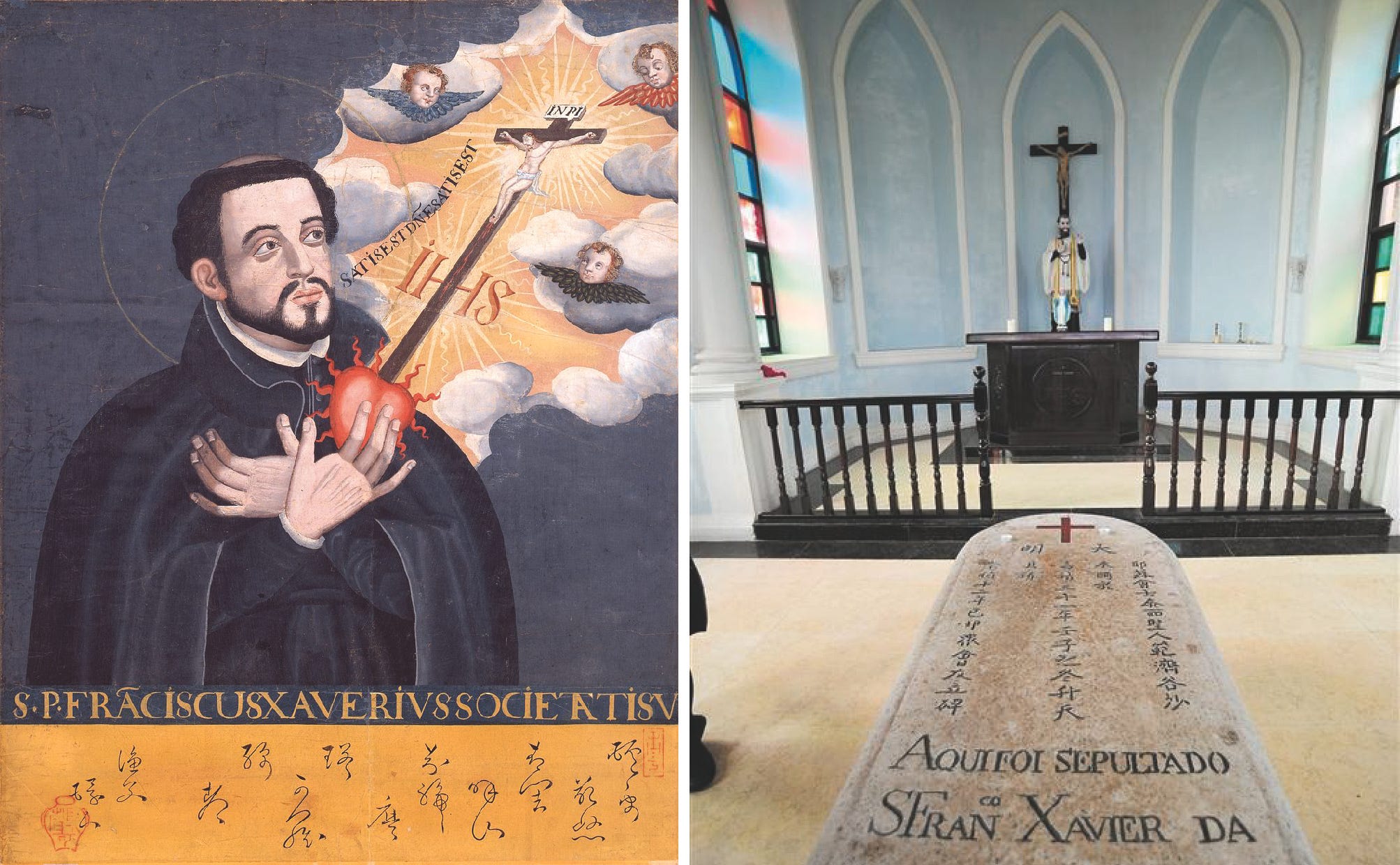
When viewed through the prism of the Jesuits’ historical legacy, these recent developments are not unprecedented—they are, in fact, a repetition of a largely forgotten golden age. Between the late Ming and mid-Qing dynasties (late 1500s to mid-1700s), Jesuit missionaries enjoyed nearly a century of influence and favor, especially under the reign of the Kangxi Emperor (康熙帝, Born in 1654, he ruled China from 1661 to 1722 and is often compared to France’s Louis XIV for his long reign, centralizing power, and fostering of science, culture, and diplomacy). During this time, a remarkably balanced exchange between China and the West flourished—an era often omitted or reinterpreted through the lens of modern colonial trauma or Western civilizational superiority.
The 19th-century Opium Wars, followed by the so-called “century of humiliation,” gave rise to grand historical narratives like Joseph Needham’s “Chinese Science Problem” or Samuel Huntington’s “Clash of Civilizations.” These paradigms often reduce early Sino-Western interactions to a series of misunderstandings or asymmetries. But such frameworks obscure the reality of the 17th and early 18th centuries—a period when Chinese emperors and European scholars engaged as intellectual equals, if not as diplomatic partners.
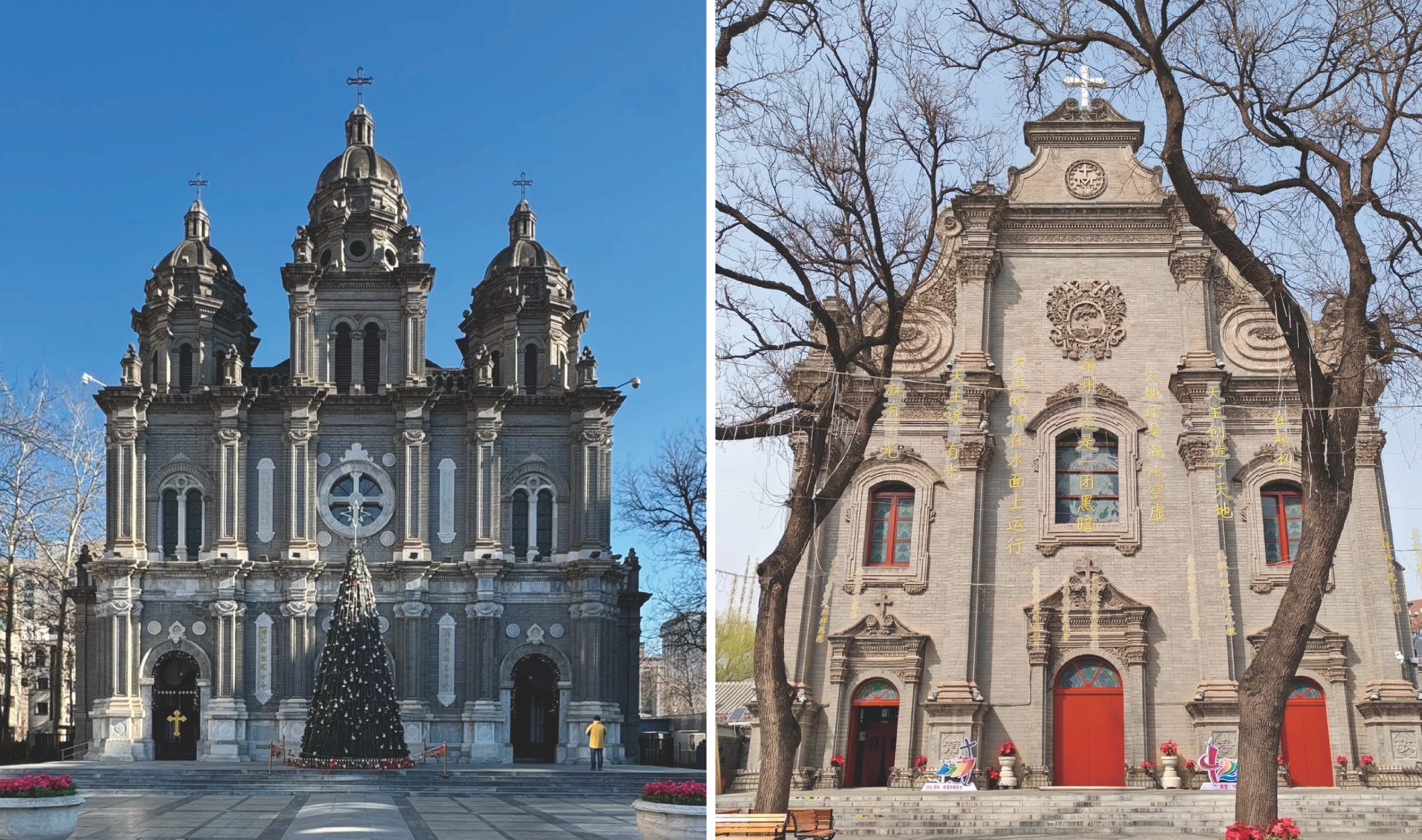
This forgotten harmony is still physically present today in Beijing’s old city, where, tucked behind ancient trees and grey brick courtyards, stand the remnants of Jesuit-built cathedrals. Known locally only by their compass names—Dongtang (东堂, East Church), Nantang (南堂, South Church), Xitang (西堂, West Church), Beitang (北堂, North Church)—these structures are silent witnesses to a time when East and West met on common ground.

From Matteo Ricci (利玛窦) to the Emperor’s Inner Circle
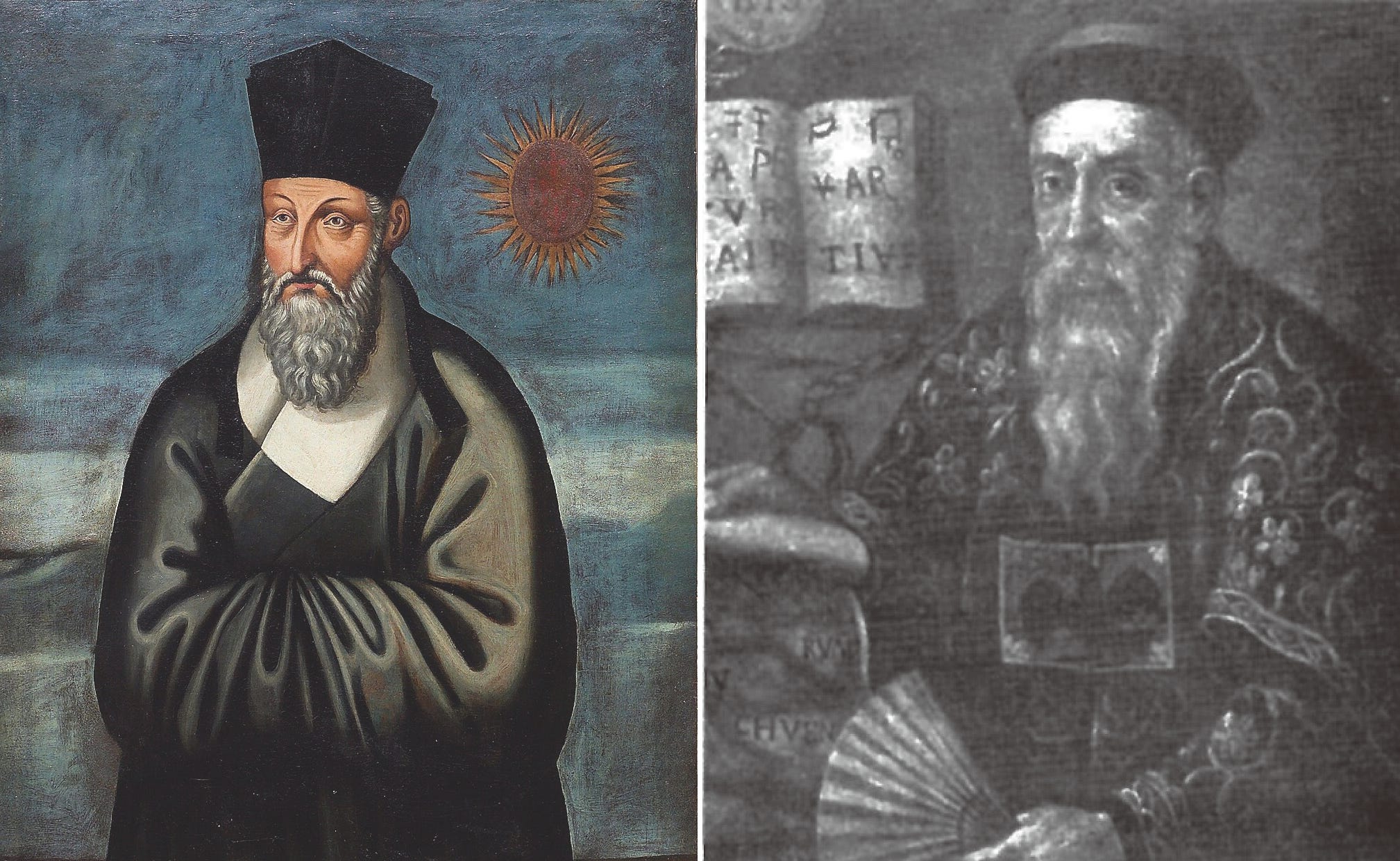
In the late Ming Dynasty (circa 1580s to 1644), the Italian Jesuit Matteo Ricci (利玛窦) pioneered a strategy of “adapting to Confucian culture” (入乡随俗) as the pathway for evangelization. Donning the robes of a Confucian scholar, Ricci presented himself as an equal to China’s literati class and gained access to Beijing in 1601. He established what would later become the Church of the Immaculate Conception, known today as the Nantang (南堂, South Church). His success opened the gates for a wave of Jesuit missionaries, who brought with them astronomy, geometry, cartography, and European scientific instruments.
But just as Jesuit influence grew, the Ming dynasty crumbled. In the mid-17th century, during the Qing conquest, Jesuit missionaries were swept up by war. In 1647, two European Jesuits—Ludovico Buglio (利类思) and Gabriel de Magalhães (安文思)—were captured during a Manchu military campaign in Sichuan. Initially treated as war prisoners, they were soon recognized for their scientific knowledge. Rather than being executed or imprisoned, they were absorbed into the Qing court’s technical elite.
More curiously, they were classified as booi aha (包衣阿哈)—a unique Manchu household bond akin to “personal retainers” or “inner household servants.” In Qing terms, this signaled proximity to the emperor himself, distinct from slavery or servitude. The Jesuits became part of the imperial household, not just foreigners with useful knowledge but personal advisers and trusted insiders.
Kangxi and the Jesuits — Science, Power, and Companionship
In 1661, Aisin Gioro Xuanye (爱新觉罗·玄烨), just eight years old, ascended the throne as the Kangxi Emperor. With the young sovereign under regency, power was initially held by court ministers like Sonin (索尼) and Oboi (鳌拜). During this time, tensions simmered beneath the surface: Manchu nobles and Han officials vied for control of state institutions, while debate raged over whether to embrace Western astronomy and calendrical systems introduced by Jesuit missionaries.
Under the previous Emperor Shunzhi (顺治帝, Born in 1638, he ruled China from 1644 to 1661 as the first Qing emperor to govern from Beijing), the German Jesuit Johann Adam Schall von Bell (汤若望) had been favored and placed in charge of the Imperial Bureau of Astronomy (钦天监). But following Shunzhi’s death, a fierce backlash against foreign influence erupted. Schall von Bell was accused of selecting an inauspicious date for the burial of a royal concubine—a politically charged “calendar case” (历狱) that saw him imprisoned and sentenced to death, though he survived due to age and illness.

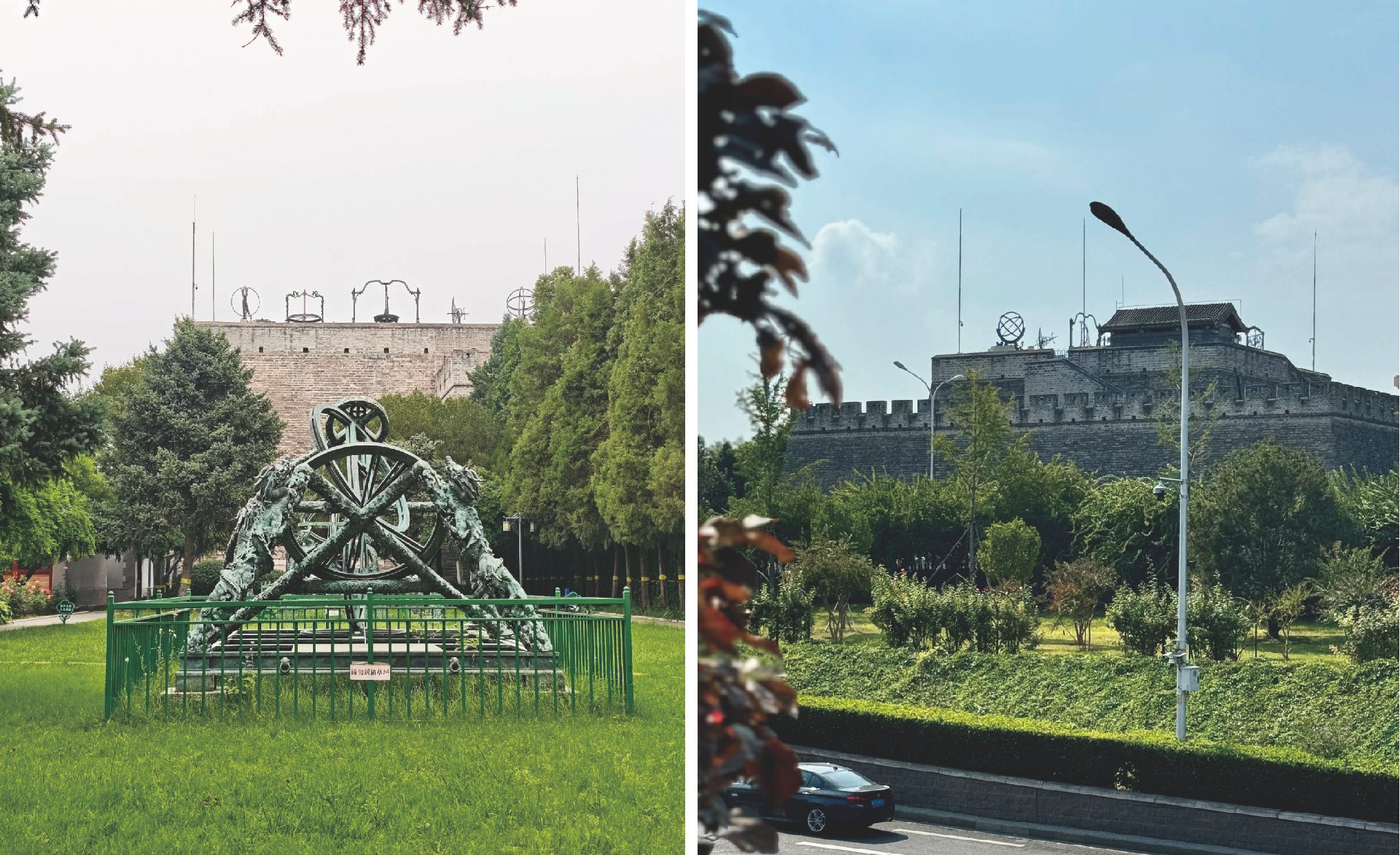
Kangxi, though still young, understood the deeper implications of this incident: it wasn’t just about astronomy, but about control—who had the authority to interpret the heavens for the Son of Heaven. In 1669, after orchestrating the arrest of Oboi and asserting his rule, the teenage emperor exonerated Schall and reinstated the Jesuits. He appointed the Belgian Jesuit Ferdinand Verbiest (南怀仁) as Director of the Imperial Observatory.
Kangxi’s relationship with the Jesuits deepened on many fronts. He studied Euclidean geometry, arithmetic, music, and even Latin with their help. Verbiest translated the first six books of Elements into Manchu. He personally coined several Chinese terms for algebraic concepts: the unknown variable became “yuan” (元), exponent became “ci” (次), and roots or solutions became “gen” (根) or “jie” (解). These terms are still used in Chinese mathematics today. French Jesuit Joachim Bouvet (白晋), one of Kangxi’s close companions, authored Chinese-language works, including Shuli Jingyun (《数理精蕴》), which explained geometry and algebra through a fusion of Chinese and Western terminology. These were not mere lessons—they were dialogues across civilizations.
The Jesuits didn’t just teach—they innovated. They designed advanced cannon for the Qing army, built astronomical instruments, and created new military maps. Verbiest oversaw the casting of more than 900 European-style cannons, giving Qing troops a significant edge during campaigns like the suppression of the Revolt of the Three Feudatories and the wars against Dzungar leader Galdan (噶尔丹).
In diplomacy, the Jesuits also proved invaluable. When the Qing and Russia negotiated the Treaty of Nerchinsk in 1689—the first official border agreement between China and a European power—Jesuits Thomas Pereira (徐日升) and Jean-François Gerbillon (张诚) served as interpreters and technical advisors. Their fluency in Latin, Russian, Manchu, and Chinese made them indispensable. In effect, the Jesuits served as China's earliest diplomats to Europe.
And Kangxi reciprocated their loyalty with tangible rewards. He granted churches prime land in Beijing, bestowed high court ranks on missionary scientists, and in 1692, issued the Edict of Toleration (容教令), which formally recognized Roman Catholicism as a legal religion within the empire. The edict praised Christians as “law-abiding and upright,” and forbade officials from harassing believers. It marked the first time a non-Buddhist, non-Daoist foreign religion was officially protected by imperial decree.
This was the height of Jesuit favor. The South Church (南堂), East Church (东堂), and eventually the North Church (北堂)—built on confiscated noble estates—became flourishing hubs of Christian activity in the Qing capital. By the 1690s, Catholic converts in China reportedly exceeded 200,000.
The Rites Controversy — Diverging Roads and Emperor’s “Missing Person Notice”
But this golden era was not to last. It was derailed not by Qing policy, but by an internal dispute within the Catholic Church known as the Chinese Rites Controversy (中国礼仪之争).
At the heart of the controversy was a simple yet profound question: could Chinese Catholics continue practicing traditional Confucian rituals like ancestor worship (祭祖) and rites honoring Confucius (祭孔)? The Jesuits, with their adaptive approach to evangelization, argued that these rituals were civil in nature—not religious—and thus compatible with Christianity. They even endorsed the use of Chinese terms like “Tian” (天, Heaven) and “Shangdi” (上帝, Supreme Lord) to refer to God.
But rival Catholic orders such as the Dominicans and Franciscans were scandalized. They accused the Jesuits of compromising doctrine and reported the matter to Rome. The Vatican vacillated for decades, issuing contradictory rulings. Then, in 1704, Pope Clement XI issued the decree Cum Deus Optimus, definitively banning Chinese ancestral and Confucian rites, and forbidding alternative Chinese names for God.
The Pope also sent a special legate to enforce the ruling—Charles-Thomas Maillard de Tournon (多罗). He arrived in Beijing in 1705 and immediately presented himself before the emperor, proclaiming that Confucian rites were idolatrous and must be renounced by all Christians.
Kangxi was livid. He had tolerated and even welcomed Christianity on the understanding that it coexisted with Chinese tradition. Now a foreign cleric, newly arrived and barely literate in Chinese, presumed to lecture the Son of Heaven on his own civilization. In response, Kangxi expelled Tournon, placing him under de facto house arrest in Macau, where the legate died in 1710.
To reassert control over religious affairs in China, Kangxi issued a firm decree: any missionary wishing to remain in China had to sign a statement pledging to respect Confucian rites and follow the precedent set by Matteo Ricci.
But Kangxi did not abandon hope for reconciliation. In 1706, he dispatched a diplomatic mission to Rome, led by two trusted Jesuits—Antoine de Barros (龙安国) and Philippe Couplet (薄贤士). Their ship was lost at sea. Undeterred, in 1708, Kangxi sent two more emissaries: Joseph de Mailla (艾若瑟) and Joachim Bouvet (陆若瑟). They reached Europe and began discussions with the papacy, but communications were slow and plagued by delay. By 1716, neither envoy had returned. Rumors circulated. Letters arrived with conflicting information. Some, Kangxi suspected, were forgeries.
Frustrated and suspicious, the emperor took a dramatic step. On October 30, 1716 (Kangxi 55th year, 9th month, 17th day), he issued an extraordinary proclamation. Known in English scholarship as the “Red Manifesto,” this open letter was printed in Chinese, Manchu, and Latin. It was addressed “to all men from the West” and distributed at ports such as Guangzhou, intended for any Westerner entering China to take back to Europe, looking for his ‘Missing Imperial Envoy’.
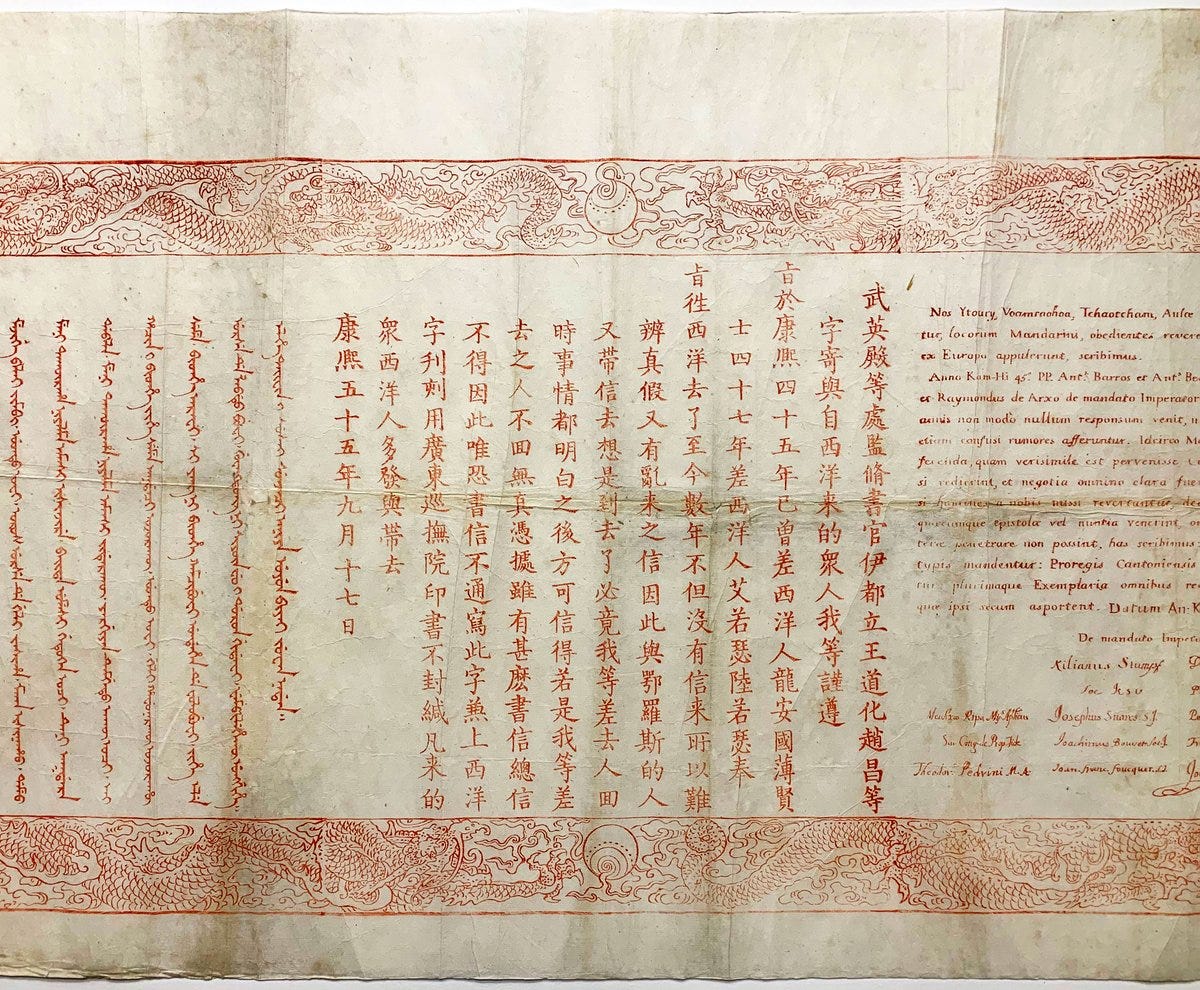
Translation of the “Red Manifesto”:
The supervising editors of the Wuying Hall and related offices—Ituli (伊都立), Wang Daohua (王道化), Zhao Chang (赵昌), and others—have drafted this letter to be conveyed to the Westerners. We respectfully follow His Majesty’s previous instructions: in the 45th year of Kangxi (1706), Westerners Antoine de Barros (龙安国) and Philippe Couplet (薄贤士) were dispatched by imperial order to the West. In the 47th year (1708), another imperial decree sent Westerners Joseph de Mailla (艾若瑟) and Joachim Bouvet (陆若瑟) abroad.
Several years have now passed, yet we have received no letters from them. Thus, it is difficult to ascertain the truth of their journey. Some disordered or dubious letters have appeared, so we also entrusted messages to the Russians (鄂罗斯的人), hoping they might have reached the intended destination.
Ultimately, only when those we sent return and clarify all matters will we be able to trust the information. If they do not return, and we have no reliable proof, then even if there are written letters, they cannot be trusted.
Therefore, out of concern that correspondence may not get through, we have written this letter and printed it with accompanying Latin script. It is sealed with the official stamp of the Guangdong Provincial Administration (广东巡抚院印). The letter is not enclosed in an envelope and shall be distributed broadly among any Westerners who arrive, in hopes they can carry it with them.
Dated: The 17th day of the 9th month, in the 55th year of Kangxi (October 30, 1716).
It symbolized the Qing emperor’s assertion of equal status in directly addressing the highest religious authority of the West and stands as one of the earliest open diplomatic communications from an Eastern monarch to Europe. By repurposing this term, Kangxi sent a clear message: just as the Pope issues decrees to constrain the emperor’s missionaries, the emperor issues his own “ticket” to command all Westerners in China. The contrast carried a tone of deliberate symmetry—an act of rhetorical reciprocity, returning gesture for gesture.
Kangxi’s Red Ticket sparked a significant reaction in Europe. Pope Clement XI, upon realizing the emperor’s steadfastness, recognized the gravity of the situation. According to Western historical records, the Pope soon decided to make a concession. In 1717, he dispatched a new legate, Carlo Ambrogio Mezzabarba, to Beijing with urgency, seeking to mollify the Qing court.
By late 1719, Mezzabarba arrived in China, bearing a handwritten letter from the Pope and what became known as the “Eight Concessions” (八项宽允). These were compromise proposals that, while not publicly contradicting the papal decrees, permitted Chinese Catholic believers to continue certain traditional practices—such as ancestral rites and Confucian ceremonies —under limited conditions.
Out of consideration for the broader relationship between China and the West, Kangxi reluctantly accepted most of the terms. A tacit mutual understanding seemed to be reached between the Qing court and the Vatican. According to Jesuit accounts, Kangxi continued to allow a few churches to remain open in Beijing during his later years, making it clear that as long as foreign missionaries respected Chinese ritual customs, he would turn a blind eye to Rome’s stricter doctrines.
Decline and Historical Amnesia
The Kangxi Emperor passed away in 1722. With him faded the cosmopolitan spirit that had defined a century of Sino-European exchange. His successor, the Yongzheng Emperor (雍正帝, Born in 1678, the 4th son of Kangxi, he ruled China from 1722 to 1735), approached the Jesuits with suspicion. A devoted adherent of Tibetan Buddhism, Yongzheng was personally disinclined toward Christianity, and he viewed the missionaries as having become too deeply embedded within court politics—especially during the succession crisis of Kangxi’s final years, when several princes had close ties with Jesuit advisers.
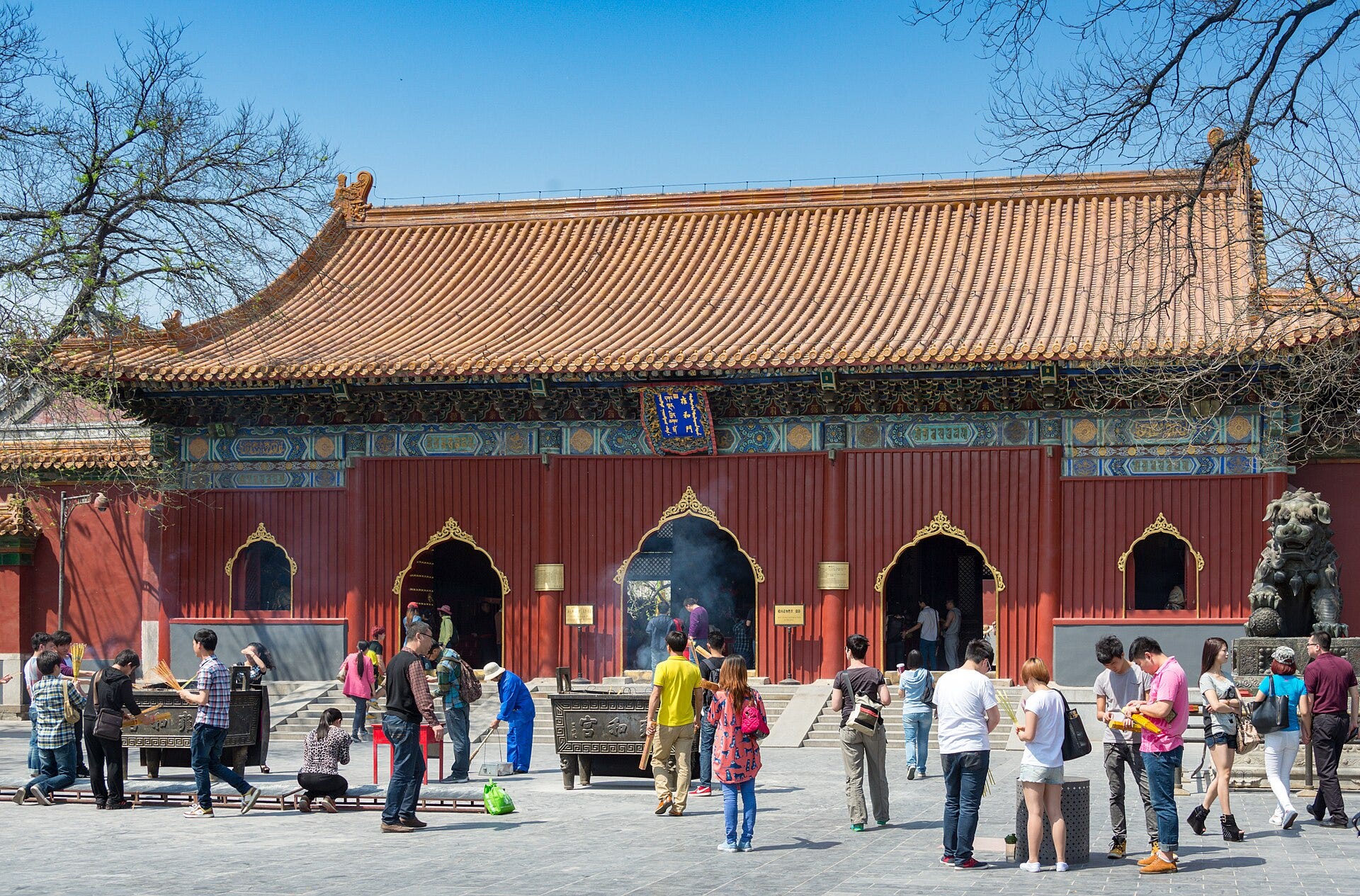
In 1724, Yongzheng issued a formal edict banning Christianity throughout the empire. The decree denounced Catholicism as “heterodox” , forbade conversions, and ordered the closure of churches. However, Yongzheng’s approach was methodical, not fanatical. He avoided mass persecution and granted exemptions for a select group of missionaries—mostly Jesuits—who served in technical capacities such as astronomy, cartography, and medicine. These men were allowed to remain in Beijing but were prohibited from preaching.
The Beijing churches were shuttered or repurposed. Some Jesuits were placed on stipends and confined within imperial compounds, effectively turning them into court artisans or scholars, stripped of their religious functions. They became, once more, “booi aha”—servants of the imperial household, no longer emissaries of Christ but loyal craftsmen of the Qing.
Under the Qianlong Emperor (乾隆帝, Born in 1711, son of Yongzheng, he ruled China from 1735 to 1796 and is often compared to Britain’s George III for presiding over a vast, wealthy empire at its cultural peak while facing the early signs of internal strain and global shifts), this arrangement persisted. Qianlong appreciated Western science and art; Jesuit painters like Giuseppe Castiglione (郎世宁) became court celebrities, fusing Chinese brushwork with European perspective. Jesuit astronomers continued their work in the observatory. Yet religion remained off-limits. The missionaries became cultural vestiges—still valued for their skills, but increasingly peripheral to court affairs and cut off from religious influence.
The final blow came from Europe itself. In 1773, Pope Clement XIV formally dissolved the Society of Jesus under pressure from European monarchies. Without institutional support, the aging Jesuits in China faded away. Their numbers dwindled. Their churches crumbled. Their legacy, once resplendent in court and chapel, dissolved into memory.
A Forgotten Golden Age
In today’s Beijing, the bells of the four churches built by Jesuits still ring. In the Vatican archives, documents bearing Kangxi’s seal still rest under centuries of dust. When Pope Francis—a Jesuit from Argentina—writes letters to Chinese leaders in the 21st century, history seems to echo faintly. A circle begins to close.
The era of Kangxi and the Jesuits reminds us that civilizational dialogue need not be defined by conflict. In the 17th century, Chinese and European minds met not only as conqueror and conquered, but also as collaborators in science, philosophy, and statecraft. Jesuits learned the Four Books and Five Classics; emperors studied geometry and optics. Together, they built observatories, translated books, and charted stars.
What made this moment possible was not just tolerance—it was mutual curiosity and trust. The Jesuits respected Chinese tradition; Kangxi engaged European thought. The Red Manifesto was the ultimate symbol of this ethos: a call for truth, not dominance; a gesture of patience, not propaganda.
If my insights brought you a fresh perspective, please consider supporting me by buying me a coffee. Your generosity fuels my writing.
Acknowledgment
This article draws extensively from Jesuit Mission and Submission: Qing Rulership and the Fate of Christianity in China, 1644–1735 by Litian Swen (中文版《康熙的红票:全球化中的清朝》, 孙立天). The book’s rigorous scholarship, based on Qing palace archives and Vatican correspondence, has been indispensable to reconstructing the detailed, nuanced relationship between Kangxi and the Jesuits. Deep thanks to the author and the original researchers for preserving this extraordinary legacy.
Thanks for filling a vast gap in my appreciation of China’s engagement with early missionaries.