

On November 26th, a dry, windy afternoon, smoke began to pour off the façade of Wang Fuk Court (宏福苑), a government-subsidised housing estate in Tai Po (大埔), in Hong Kong’s New Territories. The estate is under major renovation. Within an hour, flames were racing up and across the exterior of several 31-storey towers. Residents watched from an overpass as the fire seemed to run outside the buildings, devouring the bamboo scaffolding and green safety netting that wrapped the estate like a second skin.
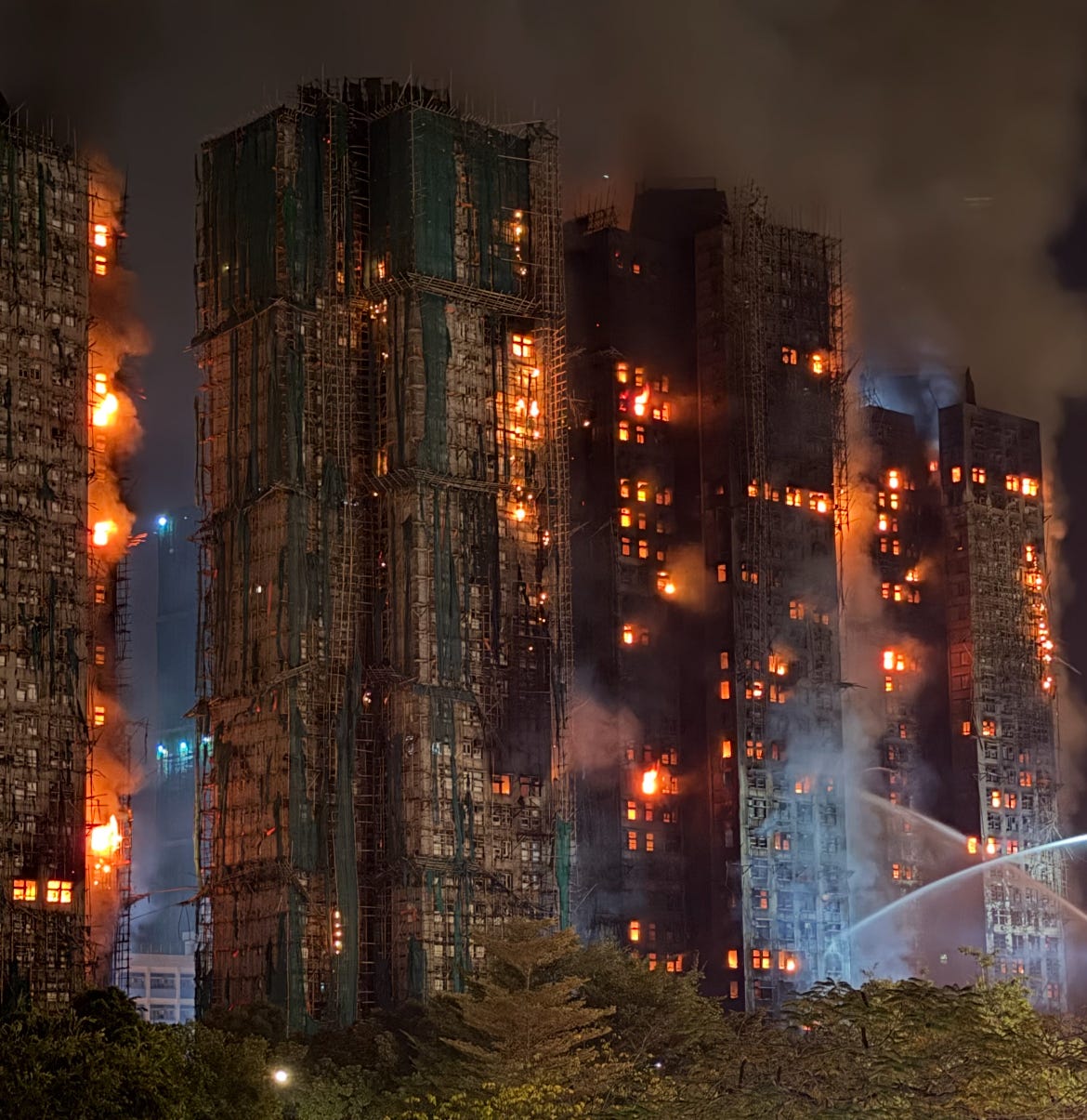
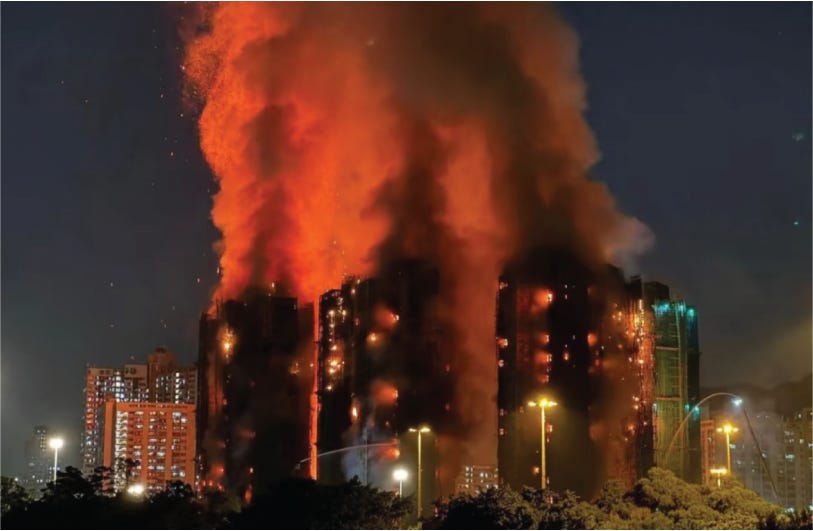
By the night, the alarm had been raised to No. 5, the city’s highest level, and at least 13 people, including a firefighter, were reported dead, with more injured and hundreds evacuated. Officials say the blaze appears to have started on bamboo scaffolding and construction netting on one block, then leapt horizontally to neighbouring towers, driven by strong winds.
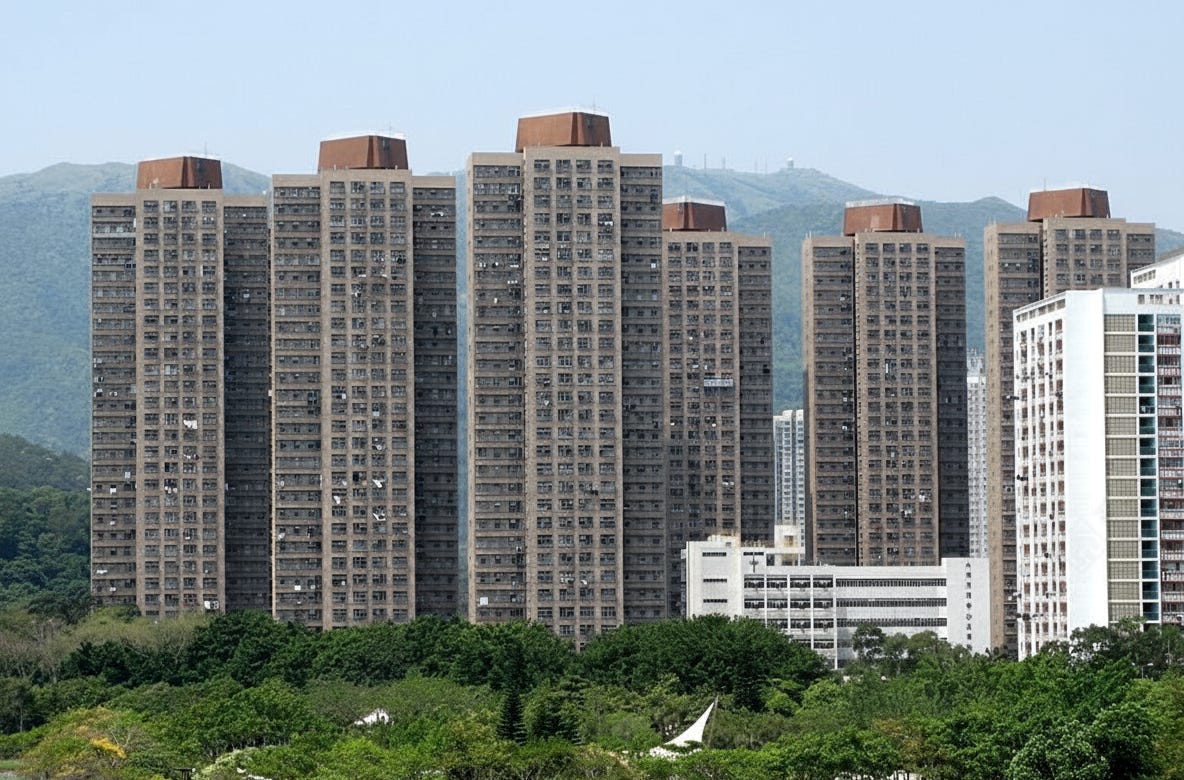
It is a tragedy with a very local texture. Bamboo scaffolding is one of Hong Kong’s most recognisable construction practices. So is the estate itself: Wang Fuk Court is a typical eight-block complex from the 1980s Home Ownership Scheme, with 1,984 small flats and roughly 4,000 residents. In other words, this was not an edge case. It was the built environment of everyday Hong Kong, catching fire in full view.
This piece is about what that blaze reveals: how Hong Kong repairs its aging high-rises, why bamboo is still wrapped around 30-storey towers, and how a maintenance system optimised for cost and speed can concentrate risk across an entire community.
A flammable “second skin”
If you look at photos from Tai Po, what stands out is not a single burning tower, but an entire estate cocooned in green netting and bamboo poles. In several images, flame and smoke travel along the outer “shell” of the buildings rather than from inside individual flats.
Most people imagine high-rise fires as internal events: a kitchen accident, a faulty air-conditioner, a cigarette on a sofa. Those fires spread through corridors, lift lobbies, ducts. Building codes worldwide are built around containing that sort of spread,compartmentation, stair pressurisation, sprinklers.

Here, however, the primary fuel at the start was located outside the buildings, consisting of dry bamboo poles tied together with plastic or nylon straps, large sheets of plastic safety netting, and external fixtures such as air-conditioning units, window grilles, and laundry racks that were positioned just behind the scaffolding.
In effect, the estate had temporarily acquired a highly combustible outer layer. Once ignited, the fire ran along that layer, crossing the gaps between blocks and climbing quickly past flat after flat. The “second skin” that usually signals routine maintenance turned, in minutes, into an expressway for flame.
Why is Hong Kong still using bamboo scaffolding?
Bamboo scaffolding took off in the mid-20th century because it was cheap, light, flexible, and quick to erect in tight urban sites. Skilled scaffolders can wrap an entire tower, 40, 50 storeys, in a dense lattice tied with plastic strips, then cover it in netting to catch debris. A forest of bamboo poles on the skyline is so common that many travel guides now treat it as part of the city’s visual identity.1

Far from being an unregulated craft, it sits inside a dense framework of rules. Hong Kong’s Labour Department has published a Code of Practice for Bamboo Scaffolding Safety since 2001, most recently revised in April 2024, with detailed requirements for design, bracing, inspection, and training.
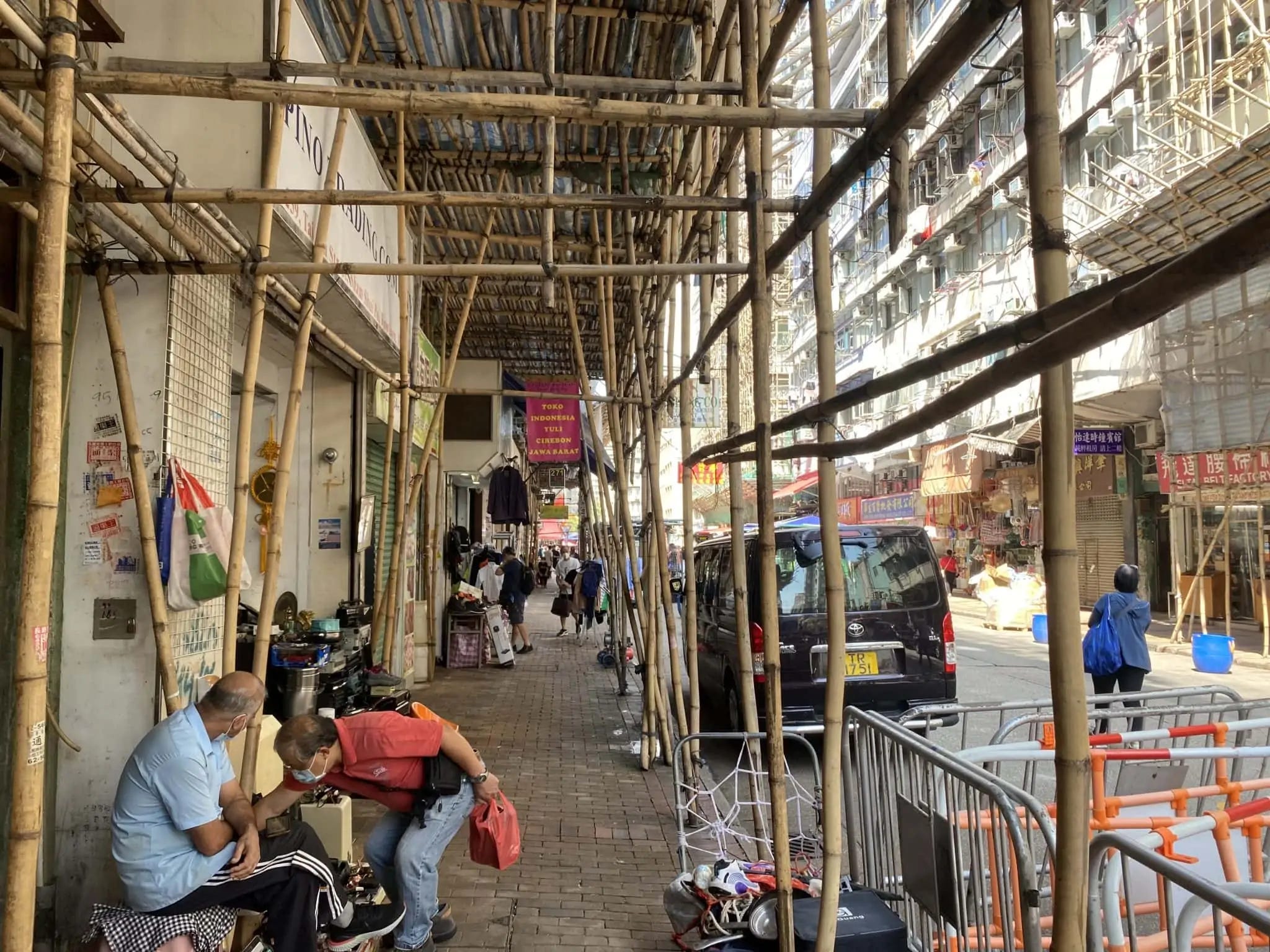
It is also worth being precise about bamboo’s behaviour in a fire. As a natural material it is not the same as petrol on a stick: fresh bamboo has relatively high moisture content, and like timber it tends to form a char layer that can slow down further burning and help it retain some structural capacity for a time. In that sense, bamboo has a degree of fire resistance and is not especially more flammable than many common softwoods.
Metal scaffolding is heavier, slower to adapt to irregular facades, and often more expensive in the short term. For a city where construction margins are thin and timelines tight, bamboo is still, on paper, the efficient default. Officially, the government has only pledged to “progressively” push public works towards greater use of metal, rather than banning bamboo outright.
High-density housing and the maintenance problem
The city is one of the densest urban areas in the world, squeezed between mountains and sea and politically constrained land supply. Much of its working and middle class lives in public rental estates or subsidised ownership schemes like Wang Fuk Court, built in standardised blocks with small flats, here roughly 430–480 square feet each.
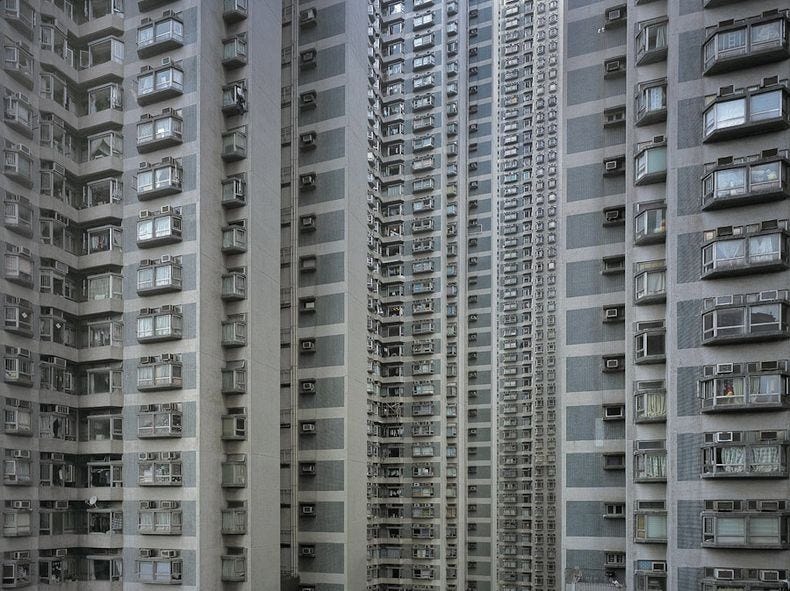
From the 1950s onward, the British governments responded to housing shortages by building high and fast: slab blocks, then point towers, then very tall, slender towers arranged in estates of six, eight, twelve blocks. Land revenue, derived from auctioning development rights, became a core part of the public budget. High plot ratios and small units were a feature, not a bug.
Density itself is not necessarily dangerous. Hong Kong’s fire safety record, given its population, has been relatively strong in recent decades. But density amplifies whatever system you overlay on it, whether that is efficient public transport or, in this case, an estate-wide maintenance strategy.
Most of the big estates from the 70s and 80s are now firmly middle-aged. Concrete spalls, waterproofing fails, pipes corrode, windows age. Government departments issue specifications and guidelines for building maintenance that aim to systematise this work for high-rise residential blocks. Owners’ corporations and housing authorities are told to treat upkeep as an ongoing obligation.
From “block by block” to “all at once”
In many older cities, external repair happens piecemeal: one façade this year, another in five years, depending on money and urgency. In Hong Kong, especially in large public or subsidised estates, there are strong incentives to bundle work.
For an owners’ committee or public authority, it is cheaper and logistically simpler to tender one large contract instead of many small ones, hire a single scaffolding crew to wrap several residential blocks in sequence, and undertake the re-waterproofing of roofs, the repair of façades, and the replacement of windows in a single, coordinated campaign.
Over the past decade, this has produced more “whole-estate” cycles of refurbishment: a wave of scaffolding, netting and works that passes through an estate every 10–15 years, touching thousands of flats in one go. From the perspective of asset management, this is rational. From the perspective of risk, it can be dangerous.
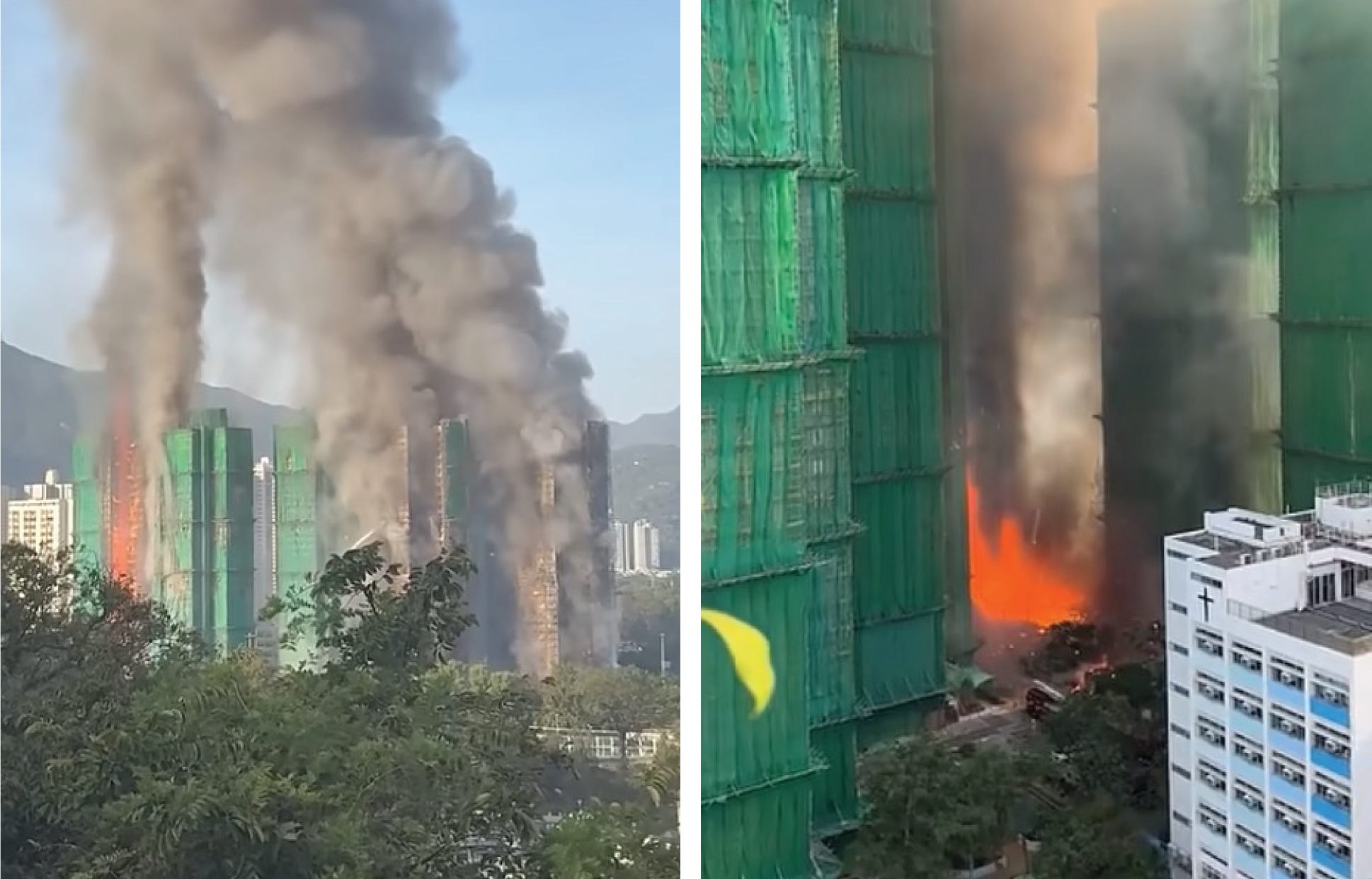
In Wang Fuk Court, several blocks were covered in bamboo scaffolding at the same time. The result was not just one building with a flammable wrapper, but a linked system of wrappers around an entire community.
What might change after Tai Po
It is too early to know exactly how Hong Kong’s regulators will respond. But the questions that emerge are fairly clear.
Do temporary external works need explicit fire-spread provisions?
Building codes could require that scaffolding and netting on high-rise residential façades be:
Divided into fire-stopping zones, with deliberate gaps or non-combustible breaks between towers or at intervals up the height
Made from less flammable materials where practicable, especially for netting
Limited so that multiple blocks in a dense estate are not fully wrapped at the same time, or at least not linked continuously
Each of these has cost and practicality implications, but they are the sort of trade-offs that codes exist to formalise.
How quickly should the city retire bamboo at scale?
There is a genuine trade-off here. Replacing bamboo with metal on public works, as the government now aims to do over time, may improve some safety metrics but raise costs and slow repairs. For older private buildings already struggling to finance maintenance, that matters.
Yet the Tai Po fire will likely shift the calculus. When a technology’s failure scales to 4,000 residents at once, the argument that it is “cheaper” becomes harder to defend.
A question of how high-density cities age
It is tempting to frame this as a story about one traditional material in one city. It is more than that.
Every high-density metropolis in China now faces the same underlying challenge: how to maintain aging towers, often built in a different regulatory era, without displacing the people who live in them or bankrupting the owners. External repair using scaffolds, hoists or platforms is a near-universal solution.
Hong Kong is an extreme case because of its density and its long survival of bamboo scaffolding. But the underlying pattern that maintenance systems designed for efficiency, then scaled across entire estates is common. So is the gap between safety practices that focus on individual sites and the systemic risks that emerge at neighbourhood scale.
Wang Fuk Court was, until the fire, an unremarkable place: a 1983 housing scheme near an MTR station, with modest flats and a view of the Tolo Harbour highway. Its tragedy forces a broader question that applies well beyond Hong Kong.
https://www.hongkonghike.com/how-bamboo-scaffolding-built-hong-kong-and-why-its-disappearing
I was in the building industry for my entire career, with keen emphasis on maintenance and repair of older buildings. Most folks have no idea what's coming in the maintenance and renovation of these very tall cast concrete platform buildings. Even current maintenance practice pales in comparison to what's coming. Hong Kong...or any oceanfront city...has the added (big) problem of its salt water environment.
No one was thinking about the problems of "skyscrapers" because none had ever been built before. Like everything else in the building industry, the real R&D is done on the backs of the next generations.
I heard that the humidity level is super low (close to 30% or even lower) in Guangdong and Hong Kong these days. These coastal cities probably rarely see days so dry, let alone take that into account when designing buildings (like what cities in northern China would do). Such a tragedy.