

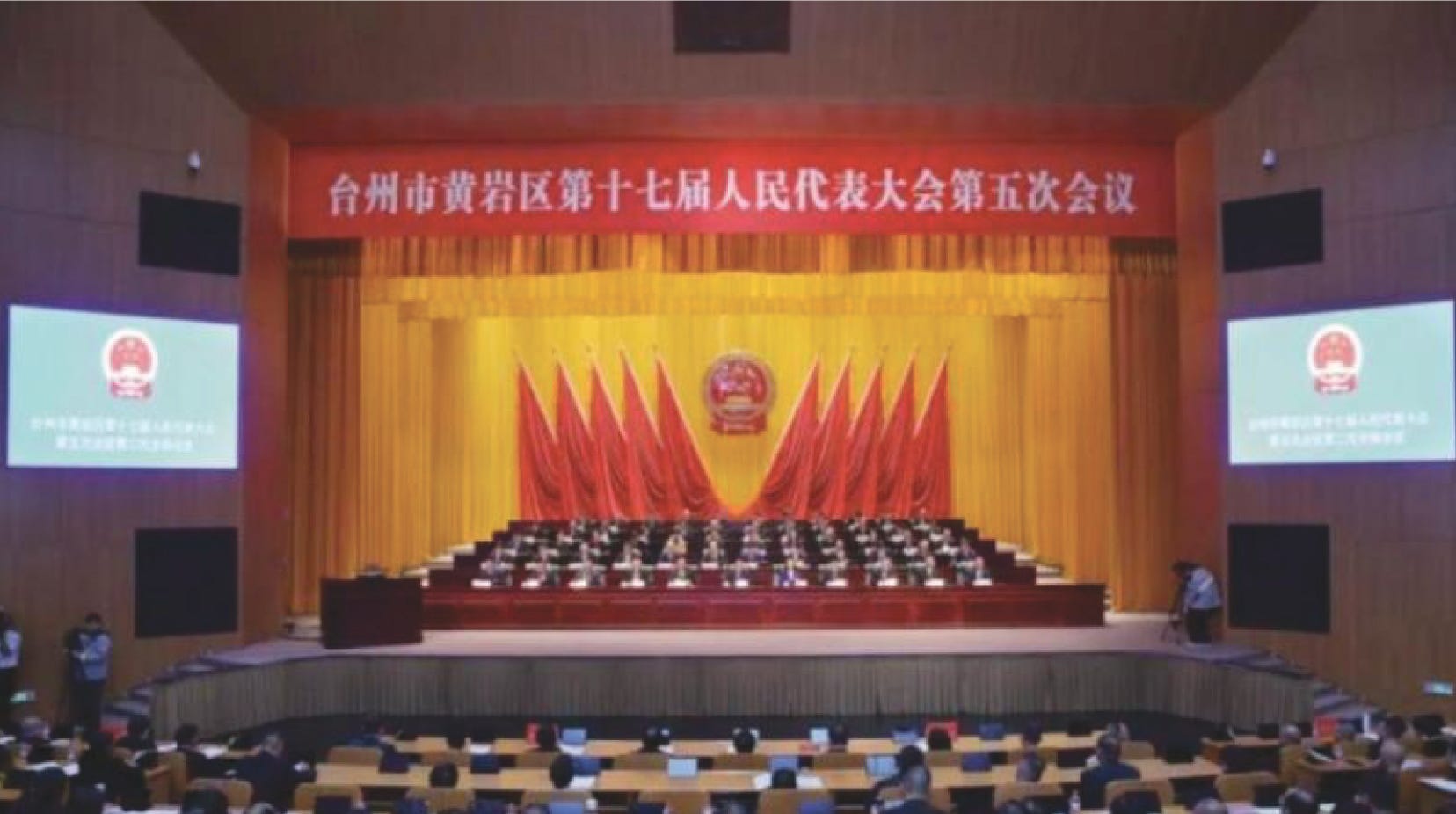
Chinese local congresses rarely reject the projects their governments put before them. On February 4, 2026, one did. At the fifth session of the Huangyan District People’s Congress, in Taizhou, Zhejiang (台州黄岩区), 267 representatives voted on sixteen proposed investment projects. Two were rejected on the spot, each budgeted at more than a billion yuan: a sports complex and a water-control project. The representatives also voted to add a national highway that the government had not put on the list.1
The case drew notice partly because it is uncommon, and partly because of when it happened. Huangyan, like most Chinese districts, is short of money. The vote can be read less as a political opening than as a way to keep officials from committing funds the district does not have.
The vote, and the spending behind it
Under the rules Huangyan adopted, a representative could not vote in favor of a project. The only options were to oppose or to abstain, and if more than half opposed, the project was dropped from the year’s plan. Officials call the method reverse voting. The sports complex drew 214 votes against; the irrigation project, 210.2
The sixteen voted projects carried a combined cost of 10.89 billion yuan in total. The district had planned to invest 740 million across all of 2026 fiscal year. Each rejected project cost more than that annual figure on its own (more than 1 billion yuan). Several representatives questioned whether the sports complex was needed at all, noting that a neighboring district already had an arena twenty minutes away and that the city was building another nearby.
Officials described the change as a move from procedural review to substantive decision, and from “the government decides and builds” to “the representatives decide and the government builds.” One development official said the process forced departments to answer four questions before proposing anything: whether the money should be spent at all, whether the government should be the one spending it, whether the amount was right, and whether the timing was right.
The spending the vote addresses is the product of a longer pattern. For years, local governments have committed money on the expectation that higher level governments would cover any shortfall, known as 支付转移 Transfer Payment Policy. The economist described this as a soft budget constraint: an entity that expects to be rescued has little reason to keep within its means.3 Much of the borrowing ran through local financing platforms, known as chengtou 城投 (local-government financing vehicles), which raised money off the government’s books to build infrastructure that lifted local growth figures. The debt built up this way is large and not fully disclosed.4
The Zhejiang Provincial Congress publicized the Huangyan vote on June 9. But the post was taken down soon after.
Why earlier measures fell short
The central government has spent about a decade trying to make this debt harder to take on. A 2014 revision of the Budget Law, paired with a State Council (central government) directive, set the approach as ‘opening the front door and closing the back door’: local governments could issue bonds openly, while the financing platforms were meant to stop borrowing on the state’s implicit credit.5 In 2024 the center arranged a swap of around 10 trillion yuan to turn hidden debt into formal government bonds, and ordered the platforms to leave the financing business by 2027.6
The results have been uneven. The swap lowered interest costs but raised recorded debt in most regions. Land sales, which once paid for much of local construction, have fallen sharply. Even Zhejiang, a wealthy province, has moved into net repayment.
There is a deeper reason the orders struggle. They run top-down. A local official is judged, and promoted, largely on visible growth, and building things is the most direct way to produce it. A finished road or arena is a record to point to, in a way that an unspent budget is not. The system that tells officials to borrow less is the same one that rewards them for building more. An instruction from above ends up fighting an incentive from above, and the incentive sits closer to the official’s career.
The orders also act late. An audit finds a problem once the funds are gone, accountability follows a loss already on the books, and concrete already poured cannot be taken back.
The Huangyan vote works at a different point, and from a different direction. The check sits at the start of the decision rather than the end. And it comes from outside the hierarchy rather than down through it: from the residents who would pay for the project, not the superiors who reward building it. That is the part the administrative measures could not reach. It limits the spending before it is committed, rather than penalizing it afterward.
Democracy at the grassroots
The representatives who cast that vote sit at a particular point in China’s structure, and it is worth seeing exactly where.
