

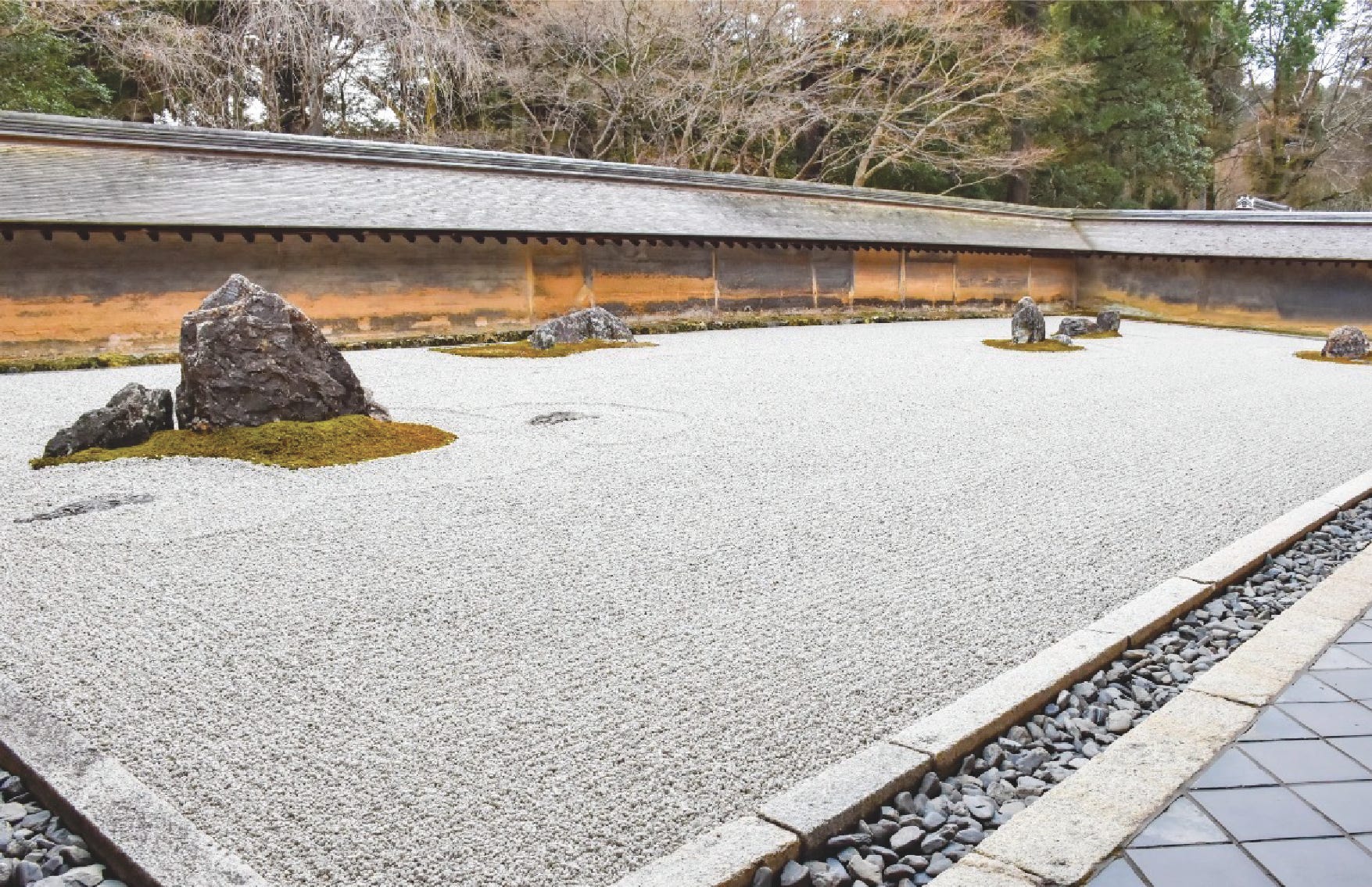
The pilgrim sites of Zen are mostly in Japan. Eihei-ji 永平寺 in Fukui prefecture, the temple Dōgen built when he came home in 1244. Engaku-ji 円覚寺 in Kamakura, where Suzuki sat. Ryōan-ji’s 龍安寺 stone garden in Kyoto. For the modern pilgrim, the map is already drawn: they walk the manicured gravel, sit in the designated hall, and bow at the gate.
They will not, except by accident, ever visit the place Eihei-ji was modeled on. The place where Dōgen actually trained, Mount Tiantong 天童山, in coastal Zhejiang receives almost no foreign Buddhist pilgrims. Nor does the cave where Bodhidharma is said to have faced the wall (at Mount Song 嵩山), or the monastery where Mazu 马祖道一 spoke of ‘the ordinary mind,’ or the hall where Yuanwu Keqin 圜悟克勤 compiled the Blue Cliff Record 碧岩录 in 1125.
The geography of the Western imagination has rearranged the geography of the tradition.
The Tradition That Already Existed
Zen (禅) is Japan’s reading of the character 禪. Its classical pronunciation is chán, a Tang-dynasty abbreviation of chánnà (禪那), the transliteration of Sanskrit dhyāna. By the time Eisai built Japan’s first Rinzai 臨済宗 temple in 1191, the tradition he was importing had already had a six-hundred-year history and had moved through nearly all of its major intellectual phases.
Its legendary founder, the Indian monk Bodhidharma (菩提达摩), is said to have arrived in Guangzhou around 520, then headed to north China and faced a wall at Shaolin 少林 for nine years. Whatever the historical reality, the legend was set in dynastic territory and spread through dynastic-era sources. Two centuries later, Huineng (慧能, 638–713), an illiterate woodcutter from Lingnan, became the Sixth Patriarch and the central figure of the Platform Sutra 六祖坛经, the only text composed outside India to be granted the title sūtra, a designation otherwise reserved for the recorded words of the Buddha himself.
Then came the great Tang masters who gave the tradition its distinctive voice. Mazu Daoyi (马祖道一, 709–788) collapsed the distance between practice and ordinary life with the formula píngcháng xīn shì dào — “the ordinary mind is the way” (平常心是道). His student Baizhang Huaihai (百丈怀海, 749–814) compiled the first independent monastic code, the Baizhang Qinggui (百丈清规), and is remembered for the line yī rì bù zuò, yī rì bù shí , “a day without work, a day without food” (一日不作,一日不食). It became a survival strategy. When Emperor Wuzong launched the Huichang persecution in 845, dismantling more than 4,600 monasteries, almost every other Buddhist school in the empire collapsed. Chan survived because Baizhang’s communities grew their own food.
By the Song, the tradition had organized itself into the Five Houses (五家), Linji (临济), Caodong (曹洞), Yunmen (云门), Fayan (法眼), Guiyang (沩仰), each with its own pedagogical style. The kōan (公案, gōng’àn) literature crystallized in two great collections: the Blue Cliff Record( Biyan Lu, 碧岩录, compiled by Yuanwu Keqin in 1125) and the Wumen Guan (无门关, compiled by Wumen Huikai in 1228). Every paradox the Zen student grapples with, the dog’s Buddha-nature, the sound of one hand, the original face before parents were born, was first recorded in these two books, in classical Chinese, by editors writing for a domestic audience.
By 1228, the tradition was a complete intellectual and institutional system with seven hundred years of history.
The Inheritance Crosses the Sea
What arrived in Japan was the tradition in a near-frozen state.
Eisai (荣西, 1141–1215) crossed to the mainland twice. On his second journey he received Linji-school transmission and returned in 1191 to found Kennin-ji in Kyoto. Dōgen (道元, 1200–1253) followed a generation later, training under Rujing at Mount Tiantong (天童山) in Zhejiang and returning in 1227 to establish what would become the Sōtō school. His masterwork, the Shōbōgenzō (正法眼蔵), reads in long stretches like a sustained meditation on the masters he had read overseas. He quotes them at length. He parses them phrase by phrase. The Five Mountains (五山, Gozan) system that organized medieval Japanese Zen was modeled directly on the Five Mountains and Ten Monasteries (五山十刹) of the Southern Song.
What Japan added in the centuries that followed was real, and it was specific. Hōjō-period samurai patronage wedded the practice to the warrior class. Sen no Rikyū (千利休, 1522–1591) integrated its sensibility into the tea ceremony. Muromachi-era monks designed the dry-landscape gardens, Ryōan-ji, Daisen-in, that would later become the shorthand for “Zen aesthetic.” Hakuin Ekaku (白隠慧鶴, 1686–1769) systematized the kōan curriculum that Rinzai students still follow today.
The Suzuki Construction
Teitarō Suzuki was born in 1870, in Kanazawa, a samurai-class family whose stipend the Meiji Restoration had just abolished. He took the Buddhist name Daisetsu (大拙, “great simplicity”) from his teacher Shaku Sōen at Engaku-ji (圆觉寺) in Kamakura, where he trained in Rinzai kōan practice in the 1890s.
The leverage point was 1897. Shaku Sōen had attended the World’s Parliament of Religions in Chicago in 1893, met the German-American publisher Paul Carus, and recommended his student. Suzuki arrived in LaSalle, Illinois that year to work for Open Court Publishing, and spent eleven years writing English prose for a Western audience. He absorbed the late-Victorian vocabulary of “religious experience” and “mysticism” that William James had just made respectable.
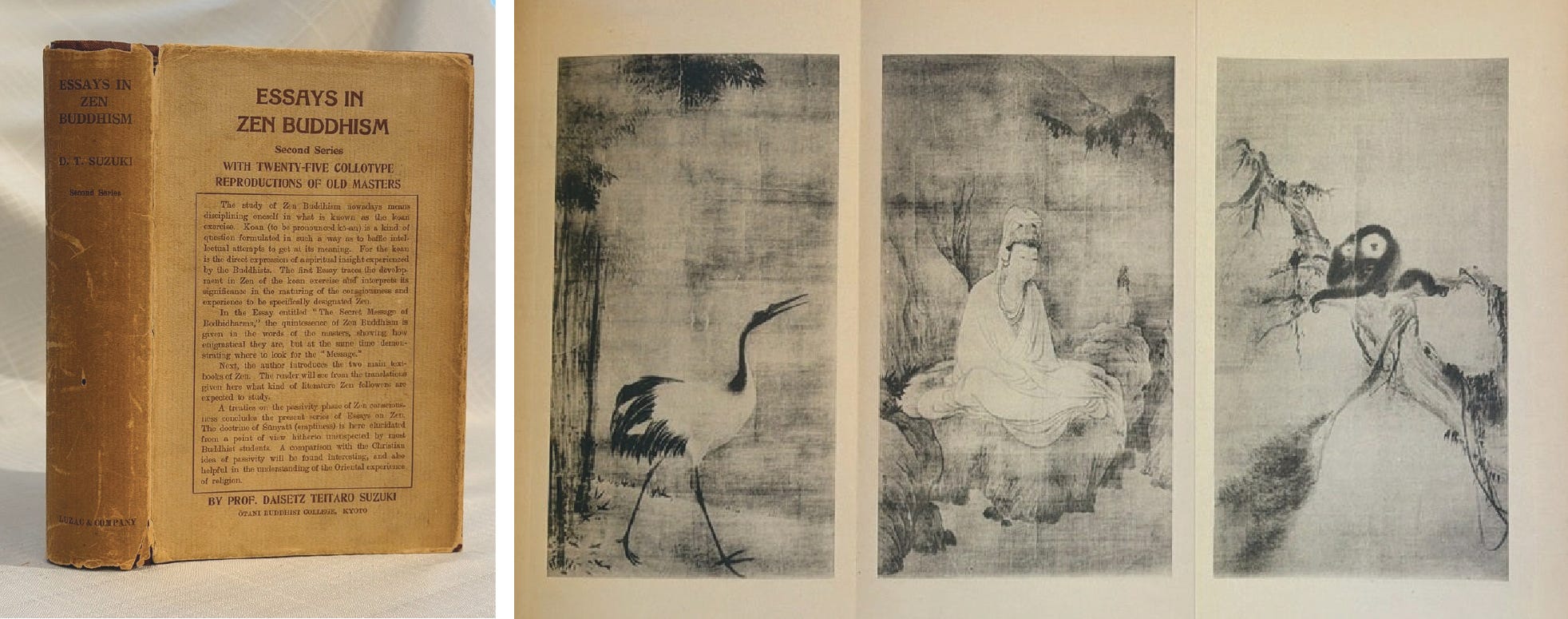
Essays in Zen Buddhism: First Series appeared in London in 1927; two more series followed in 1933 and 1934. These books did something no previous English-language writing on Buddhism had done: they presented Zen as a self-contained, philosophically serious tradition with its own genealogy of patriarchs, its own literature of kōan and mondō (問答, wèndá), its own claim to a kind of direct knowing that bypassed conceptual thought. The genealogy began with Bodhidharma in 6th-century Luoyang, ran through Huineng in 7th-century Lingnan, through the Tang masters of Hongzhou and Hebei, into the Song editors of Sichuan and Jiangsu. Suzuki did not need to insist on where the lineage came from. He simply listed the names.
The second move arrived eleven years later, with Zen and Japanese Culture (1938 in Japanese, expanded English edition Princeton 1959). The title alone is the argument. Across four hundred pages, Suzuki bound Zen to swordsmanship, archery, the tea ceremony, haiku, ink painting, and the samurai ethic. The book contains long, admiring passages on the swordsman Yagyū Munenori 柳生宗矩. It treats the dry-landscape garden, the tokonoma alcove, the rough Raku tea bowl as expressions of Zen consciousness. By the time the reader closes the book, “Zen” has become indistinguishable from a particular vision of Japanese aesthetic identity. The Tang patriarchs are still in the lineage chant. They are no longer in the room.
This was not Suzuki’s invention alone. He was writing inside a Meiji and Taishō 大正 current, Nihonjinron (日本人論, treatises on Japaneseness), theories of Japanese cultural uniqueness, that had spent half a century looking for a non-Western vocabulary in which to assert Japan’s civilizational distinctness from the continent and from the West. Nishida Kitarō 西田幾多郎 and the Kyoto School were producing the philosophical version. Suzuki, Nishida’s lifelong friend, was producing the export version. After 1945, when overt Japanese nationalism was unspeakable in English-language publishing, Zen became Japan’s postwar cultural passport, the part of Japanese identity that could be presented to occupiers and global audiences as universal, peaceful, and beyond politics.
The Western reception was total. Carl Jung wrote the foreword to the 1948 Rider edition of An Introduction to Zen Buddhism. John Cage attended Suzuki’s lectures at Columbia between 1952 and 1957 and rebuilt his musical aesthetic around them. Through Alan Watts, Kerouac, Ginsberg, and Snyder, the vocabulary diffused into the American 1960s. By 1960, the Western image of Buddhism as such, not just Zen, was Suzuki’s image: spontaneous, direct, antinomian, aesthetic, Japanese.
Suzuki curated Zen. He selected the Tang masters for the spiritual genealogy because that was where the genealogy was. He selected Japanese aesthetics for the cultural body because that was the body he lived in. He selected the William James vocabulary of mystical experience for the English-language packaging because that was the only philosophical English his Western readers could hear. The selection was coherent, beautiful, and powerful.
The Voices That Did Not Travel
Taixu (太虚, 1890–1947) was Suzuki’s near-contemporary and his closest analogue in ambition. He invented the slogan rénshēng fójiào (人生佛教, “Buddhism for human life”) that would later evolve into the “Humanistic Buddhism” of Yin Shun, Hsing Yun, and the Tzu Chi 慈济 foundation. In 1928–1929 he toured Europe and the United States, lecturing in Paris, London, and Chicago, founding a short-lived World Buddhist Institute, publishing English-language pamphlets. In international intent and personal energy, Taixu was on Suzuki’s scale. But his project ran in the opposite direction. Taixu was trying to universalize the tradition, to make it modern, social, world-facing, capable of dialogue with Christianity and science. He was not trying to bind Buddhism to a vision of cultural uniqueness. Back in China, the tradition was under siege. New Culture intellectuals had named Buddhism a superstition holding the nation back. Taixu was running a rescue operation, not a cultural export..
Ouyang Jingwu (欧阳竟无, 1871–1943) at the China Inland Buddhist Institute in Nanjing was doing something even more remote from Suzuki’s project: recovering the Yogācāra (唯识) tradition, retrieving texts from Tibetan and Japanese sources to reconstruct the seventh-century scholastic Buddhism of Xuanzang. His argument was that Chan, Pure Land, and Tiantai had drifted from the rigorous Indian original, and that a return to the precise terminology of the Cheng Weishi Lun 成唯識論 was the only honest path. Suzuki was selling intuition. Ouyang was selling rigor.
Master Xuyun (虚云, 1840–1959) was the most genuinely accomplished living Chan master of the period, the only figure in centuries to hold transmission in all five surviving houses. He lived to 120, rebuilt dozens of ancestral monasteries, weathered the Taiping rebellion, the late Qing collapse, the Japanese invasion, and the early years of the People’s Republic. He did not write in English. He did not travel west. He existed inside a way of being that the modern publicity logic had not yet captured.
And then there is Hu Shi (胡适, 1891–1962), and the encounter the article cannot skip.
In 1926, while researching at the Bibliothèque nationale de France and the British Museum, Hu Shi discovered Dunhuang manuscript fragments of Shenhui (神会, 684–758), the disciple who had campaigned to install Huineng’s “Southern School” as the orthodox lineage. Through the 1930s Hu published a sequence of philological papers, Shenhui heshang yiji (神会和尚遗集). He argued that the central narrative of Chan history, the Bodhidharma transmission and the supremacy of Huineng’s sudden enlightenment, was largely an 8th-century sectarian construction by Shenhui to elevate his own teacher’s lineage. Hu was using the methods of European philology what he and his Columbia colleagues had been doing to Confucianism: dismantling the received story by tracing it to specific authors with specific motives at specific moments.
In April 1953, in Philosophy East and West, the journal founded at the University of Hawai’i in 1951 specifically to host such conversations, Hu Shi published “Ch’an (Zen) Buddhism in China: Its History and Method.“ Suzuki replied in the same issue with “Zen: A Reply to Hu Shih.“ The exchange has become the most-cited debate in the modern study of the tradition.
Hu Shi argued that Chan must be returned to the intellectual history that produced it, to the specific dynastic, political, and sectarian conditions in which it took shape. Suzuki replied that Chan, in its essence, could not be reached by the historian’s method at all. Satori 开悟 was prior to history. To historicize Chan was to miss it.
One scholar, in 1953, was demystifying the tradition. The other, in the same pages, was re-mystifying it. Both were writing in English, both addressing the same Western philosophical audience.
It was about the shape of the East that the West had been looking for since the late 19th century, mystical, aesthetic, beyond reason, available as a counterweight to Western instrumental modernity. Japan, since the Meiji period, had been deliberately shaping itself into that form: Okakura Kakuzō’s Book of Tea (1906), Nitobe Inazō’s Bushido (1900), Imagism’s discovery of haiku (1913), and Suzuki’s Zen (from 1927) were not separate projects. They were a coordinated cultural offering, supported by a state that needed a non-political vocabulary of distinctness. The continent in the same decades was offering the West something else: the agonized self-criticism of its own intellectuals, the rural pathos of Pearl Buck’s translations, the warlord chaos of the news reports.
What Remains
The full irony took half a century to surface. After the Ming–Qing transition, Chan in its homeland entered a long institutional decline. Pure Land devotionalism dominated the practice. By the 19th century, many Song-era curricula were better preserved in Japanese monasteries than in their places of origin.
Late 20th-century scholarship, Yanagida Seizan in Kyoto, John McRae’s Seeing through Zen (2003), Bernard Faure’s The Rhetoric of Immediacy (1991), Robert Sharf’s “The Zen of Japanese Nationalism” (1993) b,egan the patient work of dismantling the Suzuki narrative from inside the Western academy. Their work has flowed back into the homeland’s own scholarship; researchers at Peking University, Fudan, and Academia Sinica today read McRae and Faure as foundational. The popular interest Suzuki created funded the academic infrastructure. That infrastructure exposed his construction. The loop is recursion.
If my insights brought you a fresh perspective, please consider supporting me by buying me a coffee. Your generosity fuels my writing.
Thank you very much for this text. Maybe a side comment, partially related to main thread of your thoughts. I’m neither a native English nor Chinese speaker, and for some time I’ve been diving into the concept of xin (heart / heart-mind) across different strands of Chinese thought ( Confucianism, Daoism,Chan) and zen (mostly transmitted via D.T.Suzuki) - while comparing various translations, 95% of which reach me through English into my own language, Polish.
What strikes me is that xin is almost always translated simply as “mind,” which in modern Western usage often evokes something primarily rational, cognitive, and brain-centered. But for me, xin carries a much wider field of meaning: heart, feeling, consciousness, moral intuition, affective awareness, embodied knowing, intention — and probably much more. So somewhere in the western/ anglo-american reception of Japanese zen texts, I feel as if an essential aspect of chan gets partially lost: namely xin as heart-heart/mind rather than merely intellect or cognition.In this sense, I perceive/feel 平常心 (pingchang xin) maybe less as an “ordinary mind” and more as an "ordinary, open, conscious heart" resonating responsively with reality (ganying) — the center of being.
You make a good case for the role of politics in influencing the shape of Western cultural history. I would frame the story a little differently, though. The Nihonjinron (what it means to be Japanese) can be viewed as a reaction to Western imperialism, devised to prevent the Japanese tradition from being swallowed up by the Western narrative of modernity. It is a culturally relativist tale that asserts difference and incommensurability. We are unique and have something that you don't have but we are willing to teach you about it. Western people looking East for spiritual nourishment were buying, and it helped recoup Japanese pride after the defeat in war and the discrediting of the Japanese spirit.
In the 1950s and 1960s, Alan Watts taught a different Zen, one more Chinese in flavor and without a political purpose in mind. He had a much larger audience than Suzuki in the US, even though he called himself merely a "philosophical entertainer."