

Driving down the highway of Quyang (曲阳), a county in Hebei three hours south of Beijing, the first thing that comes to your eyes is the stone statues placed along the road. In these marble yards, carving machines run inside small factories, turning blocks of hanbaiyu (汉白玉), a kind of white marble, into statues that are going to be placed at front gates, in gardens, and as decorations all across northern China.
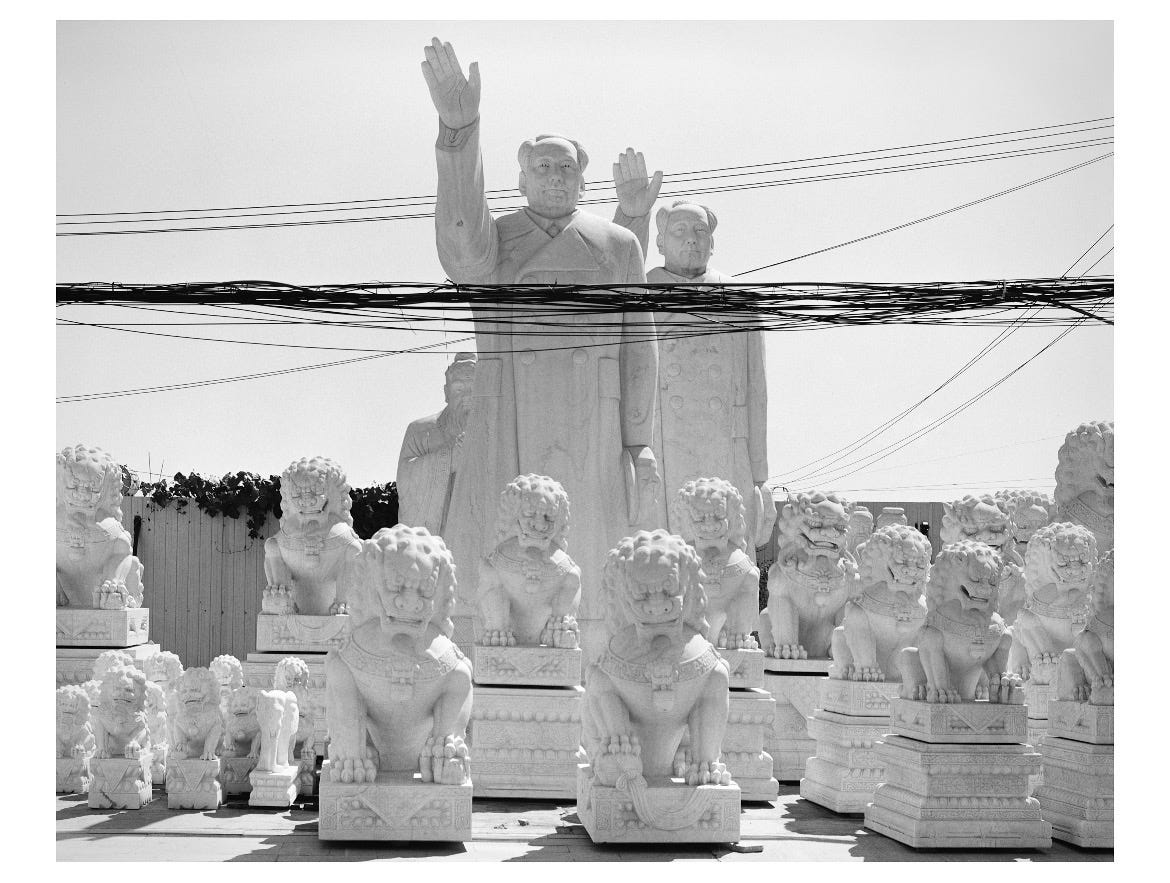
Aside from the statues of Chairman Mao, the most common ones are stone lions, shishi (石狮). As the statues placed by the gate side, stone lions might be the very first symbol that people witness in China. The lion as a cultural symbol widely appears in various types, from the statues at palaces and door fronts to the lion dance, which might be the most iconic event in any Chinatown.
Among all the mysterious creatures in Chinese culture, the lion must be the most unique one. Historically, the natural range of the lion stopped at the plains of northern India and the Iranian plateau. China has never had a native lion. Almost no Chinese artisans had ever seen a living lion. So how did the lion become such a cultural symbol?
What’s more interesting is when I think about how many cultural things were originally from outside, yet somehow turned into and were absorbed into Chinese culture as if they were born this way. No culture is self-sustained. Even though China seems giant, mysterious, and somehow closed to the outside world, it is always absorbing and exporting, just like any other culture.
The Western Mercenary
The lion was first imported into China as diplomatic tribute during the Eastern Han dynasty. In 87 CE, envoys from Parthia (Anxi 安息, modern-day Iran) brought a real lion to the capital of Luoyang 洛阳. Instantly, lion got a good, native-sounding name: shi (狮, originally written as 师, meaning teacher or master), which was an ancient phonetic borrowing from the Middle Persian word šer or the Tocharian ṣecake.
As a beast from the west, the lion was believed to be an auspicious sign for both the emperor and the nation itself. For several hundred years after that, real lions were imported or sent as tribute from the West sporadically, maybe one or two every few decades. They were kept almost exclusively by the royal family as beasts of power and auspiciousness.
However, interestingly, we can still understand how people back then reacted to this rare animal by looking at contemporary Chinese habits, like burning paper iPhones, luxury cars, and even bundles of AI tokens for the deceased during the tomb sweeping. Whatever is the newest, rarest luxury in the living world has to be sent to the ancestors right away. So it is no wonder that we see stone lions show up at the Wu Family Shrines (武氏祠, a shrine in front of Wu family tomb) in Shandong in 147 CE, just a few decades after the first live lion was recorded at court and became the talk of the empire.
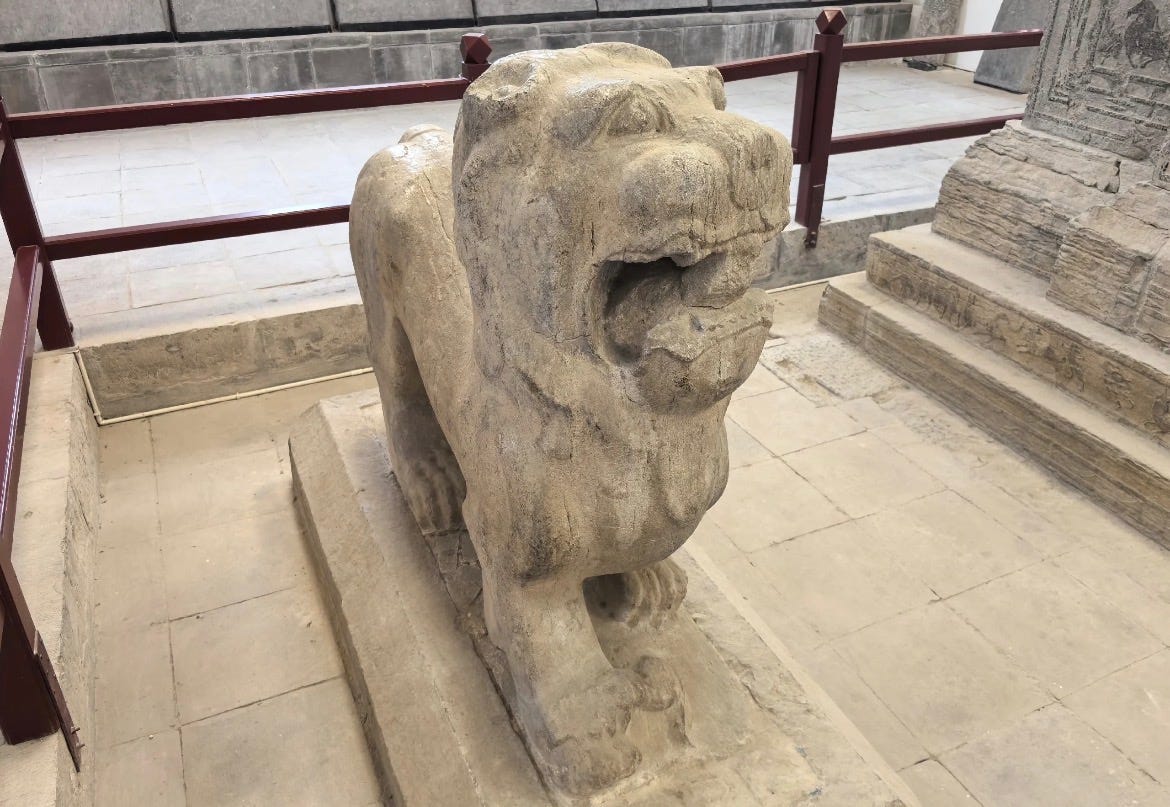
Looking at this earliest surviving stone lion from the Wu Family Shrines, it more resembles a real lion. It stands on four legs, with its mouth wide open and tongue showing. But why did the lion first become a statue at a tomb? Culturally, a tomb in the Han dynasty was an extremely dangerous battlefield between worlds. People believed the underground was full of monsters and wandering ghosts trying to invade the ancestors’ home, so the tomb gate needed the fiercest beast possible to stand guard.
At the same time, putting a stone lion above ground was a very presentable way to show filial piety (xiao 孝). After Emperors Zhang and An, the Eastern Han government promoted the idea of “ruling the empire through filial piety.” People got recommended to be officials through “Filial and Incorrupt” (juxiaolian 举孝廉). Earlier Chinese burial conventions spent huge sums on underground chambers, but local wealthy families soon realized the problem: if you buried all your money underground, your filial piety to ancestors was not visible to living people.
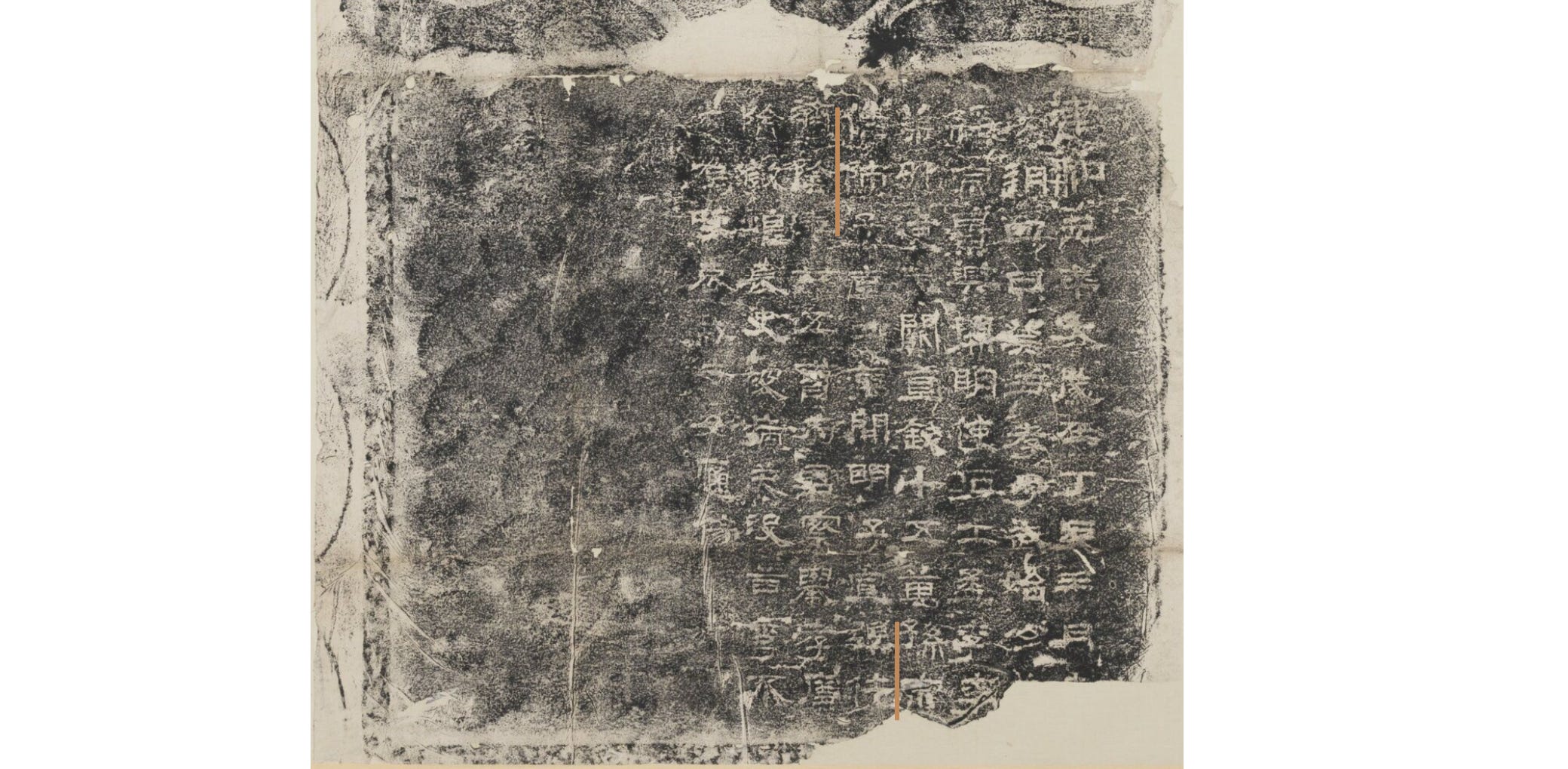
Moving the evidence of spending in front of the tomb solved that. Right on the stone pillar tower next to the lions, the Wu brothers actually carved the receipt of how much they spent on the shrine: “The filial sons Wu Shigong and his brothers Suizong, Jingxing, and Kaiming had the masons Meng Fu and Li Dimao build these gate pillar towers (Que), costing 150,000 coins; Sun Zong made the lions 師子, costing 40,000 coins” (孝子武始公。弟綏宗。景興。開明。使石工孟孚。李弟卯造此闕。直錢十五萬。孫宗作師子。直四萬).
Still, why use a foreign lion to guard the tomb instead of a native animal? The dragon (long 龙) was the symbol of the emperor himself, not available for guarding a door. The Qilin (麒麟) was known as a gentle and moral creature. The tiger (hu 虎) was once used, but since it was a real and familiar animal which carried wild and rebellious energy, it could carry bad spirits. Then, the lion was the perfect foreign mercenary: fierce, exotic, and completely unconnected to local spirits.
A famous story also shows how the lion beat the native tiger. Recorded in Luoyang Qielan Ji 洛阳伽蓝记 in 547 CE, the Northern Wei court got a live lion as tribute from Persia, Emperor Xiaozhuang threw two native tigers and a leopard into lion enclosure to see who would blink. Smelling the foreign beast, the Chinese tigers dropped flat on the ground and clamped their eyes shut (瞑目不敢仰视). The test set up the lion’s status as the one beast that could conquer every other beast in China. For the next several hundred years, the famous winged stone lions (Bixie 辟邪) remained the ultimate mercenaries of the graveyard, guarding the tomb owner from any native threats.
Crowned by the Buddha
For five centuries, stone lions were only placed at tombs. How did the lion leave the graveyard and become the guardian of a house?
The rise of Buddhism made the transformation. It brought a completely new image of the lion other than a real beast. In Buddhist sutras, the lion was a sacred protector of the Dharma. The Buddha sat on the Lion Throne (Simhasana 狮子座), his preaching was called the Lion’s Roar (Simhanada 狮子吼). And lions also guarded the Buddha's Throne. The image of the lion was directly connected to the aura of the Buddha.
During the Tang dynasty, Wu Zetian 武则天 became the first and only female emperor. Since Confucian tradition did not have space for a woman to rule as emperor, Wu Zetian turned to Buddhism to build her legitimacy. She declared herself a Wheel-Turning Sage King (转轮圣王) and the living incarnation of Maitreya Buddha 弥勒. Wu Zetian replaced the symbols of Daoism, the dragon and tiger, which were the symbols of the Li family of the Tang dynasty, and introduced the lion as a new national image. The lion, drawn from Buddhist imagery, was modeled on real lions.
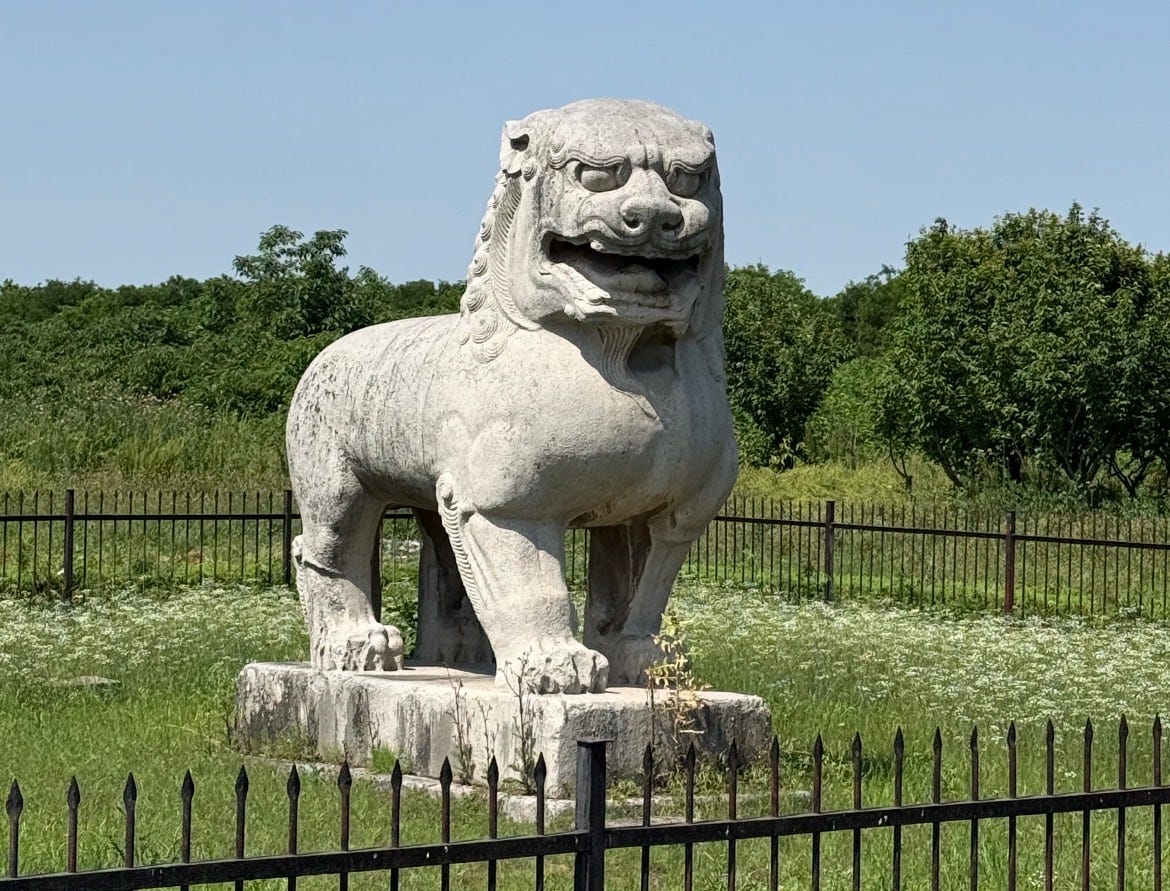
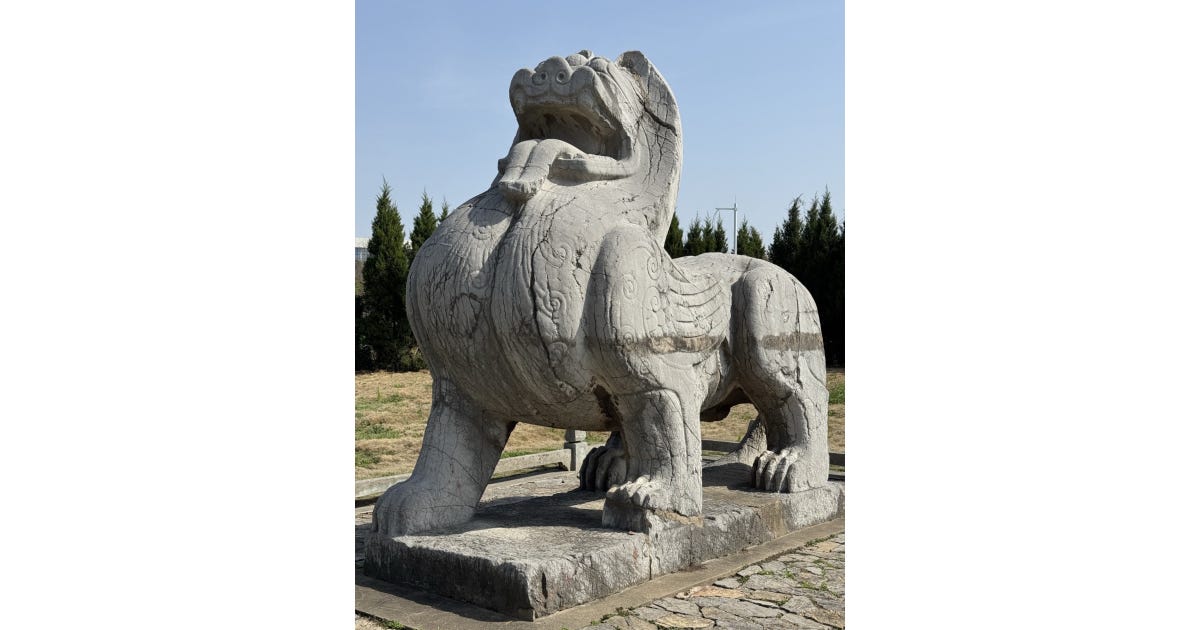
The transformation at Shunling (顺陵) in Xianyang, Shaanxi, is the most visible one. Wu Zetian built it for her mother after founding her own Wu Zhou (武周) dynasty. The “Walking Lion of Shunling” (Shunling Zoushi 顺陵走狮) has completely lost the horns, feathers, and underworld wings of the Bixie, which contained Daoist elements. Instead, its massive head is crowned with neat spiral curls (luofa 螺发), the exact same hair found on statues of the Buddha.
Even though that lion was imbued with a Buddhist aura, it didn’t really become the gate guardian we see today. Lions were still maintained as guardians of tombs and Buddhist temples. The real transformation that brought the lion from the tomb to a living house came from the transformation of the Chinese city.
Collars, Bells, and Lapdogs
During the Song dynasty, the old enclosed city wards (lifang 里坊) broke down, and cities opened up into busy commercial streets. The old enclosed city wards had ward gates and night curfews, so public safety was maintained by municipal authorities.
Once these wards dissolved, mansions, temples, and shops faced the street directly, presenting public facades and entrances. The open gates of private residences now directly confronted oncoming streets, the clamor of the crowds, hostile energies, and impure elements. Folk Feng Shui thus invited the lion, revered in Buddhism for subduing demons and heretics, into the dwellings of the living. People transferred the power once used to guard the tomb passages to the living world for protecting domestic peace. The guardian of the tomb naturally evolved into the guardian of home.
Instead of directly moving the giant lion statue at front gate, the lion for the living place were actually derived from an architectural element, the menzhenshi (门枕石), base of the doorframes. Traditional Chinese wooden doors were heavy and relied on wooden pivots to rotate, which needed stone counterweights at the base of the doorframes to keep the timber posts steady. The lion gradually ‘emerged’ directly from the practical door bolster.
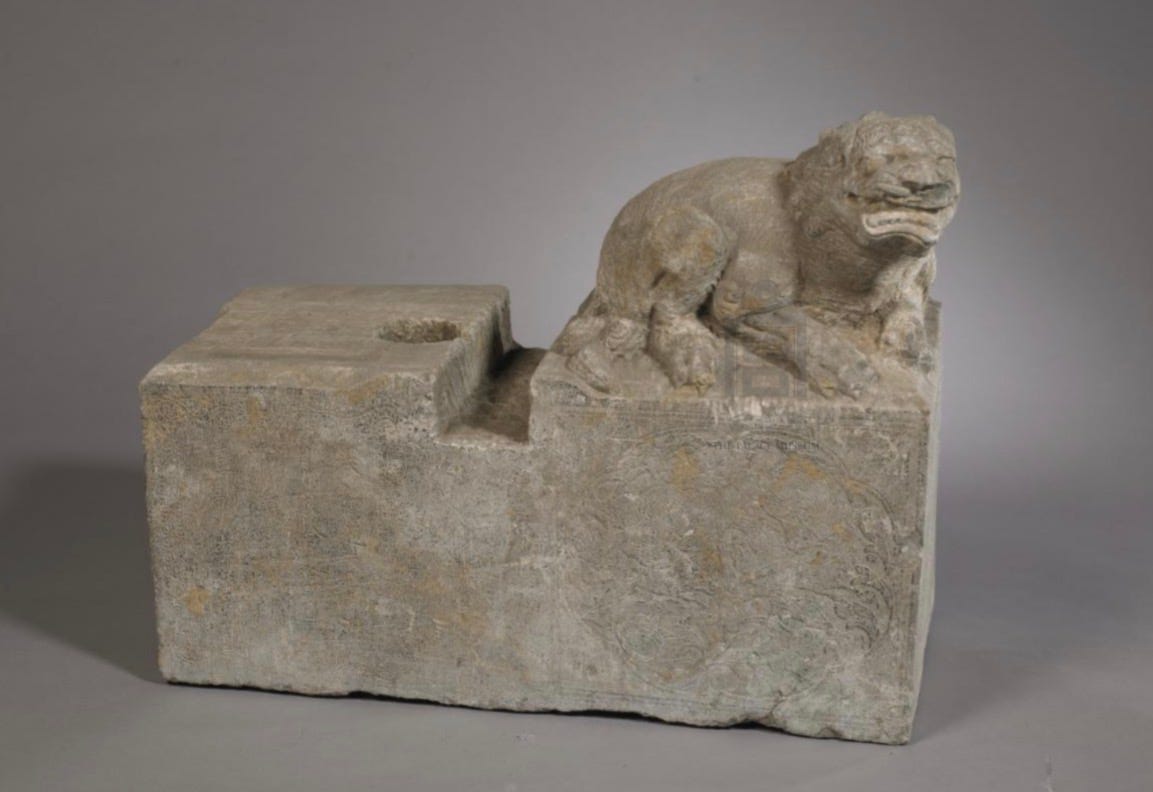
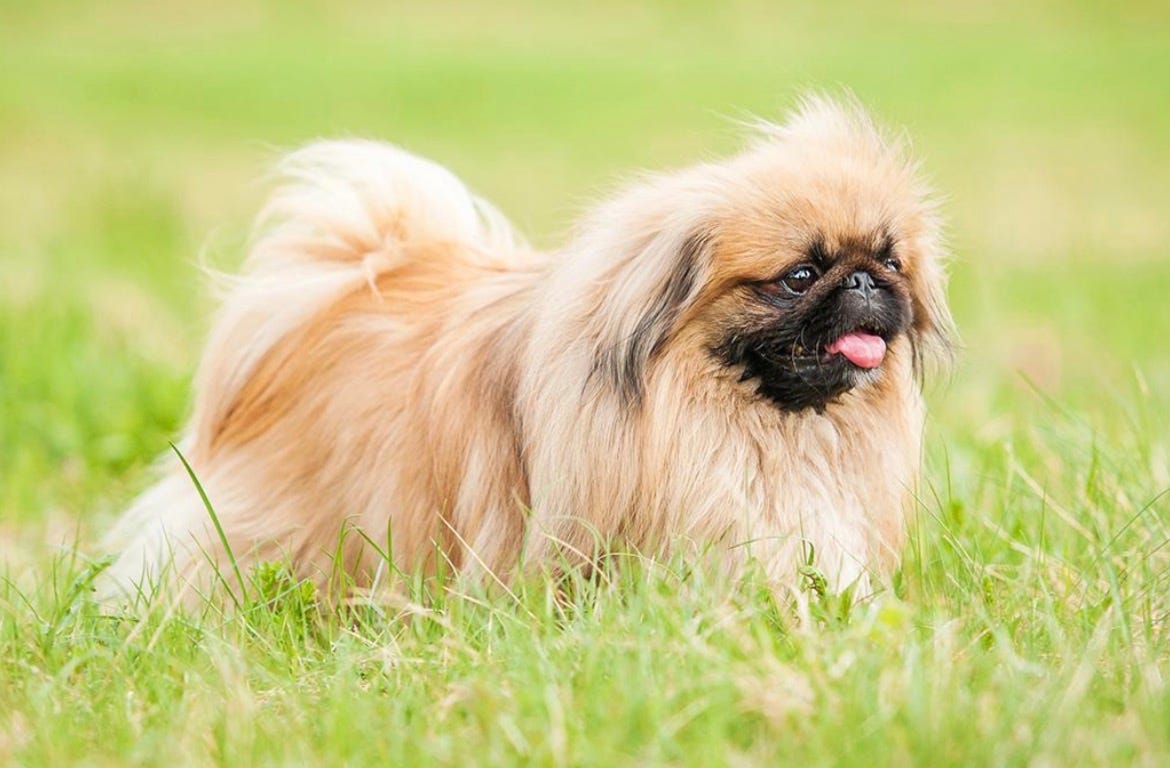
As the lion moved to the household gate, it could no longer be presented as a wild and fierce animal. Moreover, regular artisans who had never seen a real lion started reshaping the lion after something much more familiar. From the Song dynasty onward, the image of the lion gradually turned from a wild animal into something more like a tamed one, with a leather collar (xiangquan 项圈) and a little bell (lingdang 铃铛) carved around its neck. The Pekingese palace dog, Jingba (京巴), with its round face, flat nose, and short legs, was modeled after a tamed lion. The wild mercenary from the West had been tamed into a collared house pet.
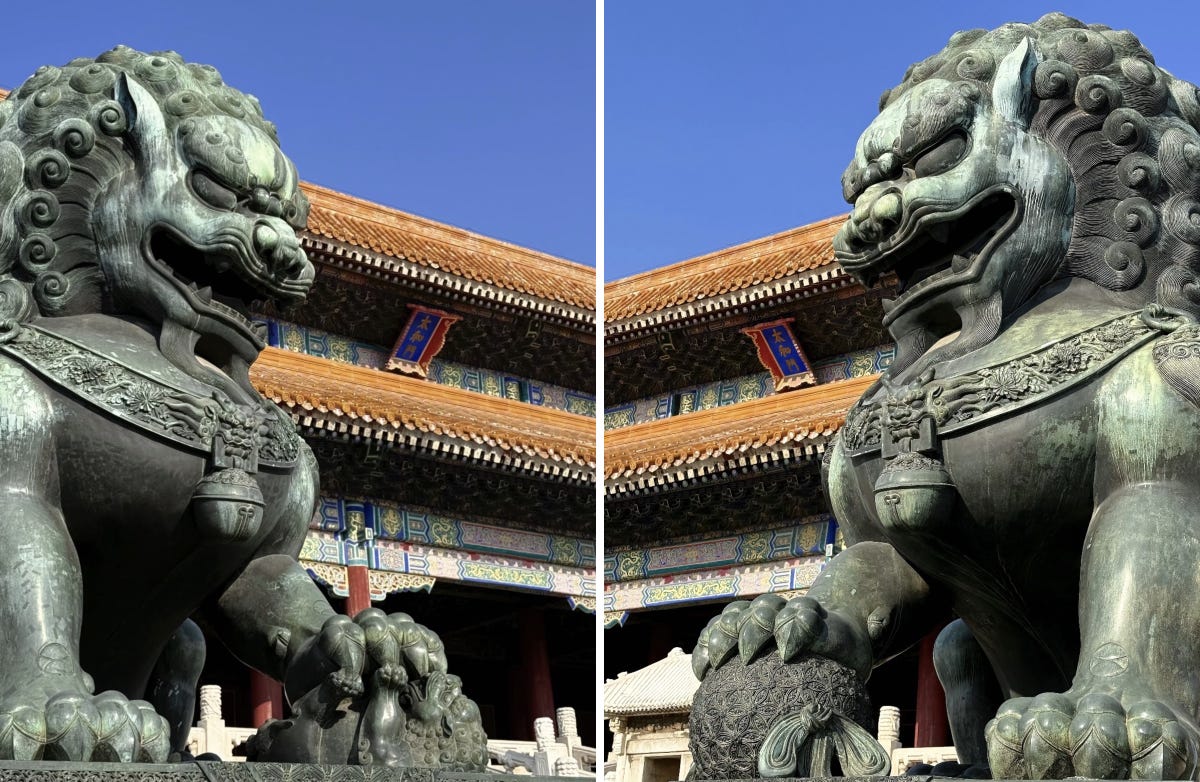
By the Ming and Qing dynasties, having evolved from the decorative carvings on the door bolster, the stone lion was completely integrated into the Chinese bureaucratic system. Ordinary people were forbidden by law from putting large stone lions outside their homes. For officials, the number of tight spiral curls (luofa 螺发) on the lion’s head became a literal rank chart.
Even their posture was coded into Confucian family order. Placed with the male on the left and the female on the right (左雄右雌), the male lion rested his paw on an embroidered ball (xiuqiu 绣球) representing power, while the female held a cub (shaozi 少子) representing family offspring. One mouth stayed open and the other stayed closed, breathing auspicious energy in and out. The lion became a fully ‘domesticated’ animal, culturally.
Full Circle at the Bund
In 1923, when British bankers placed two realistic bronze lions outside the HSBC building on the Shanghai Bund, local people quickly realized that these lions looked different from traditional ones. What became most famous was not their realism, but the interpretation of their open and closed mouths according to Chinese feng shui, which held that money enters through the open mouth and never leaves through the closed one.
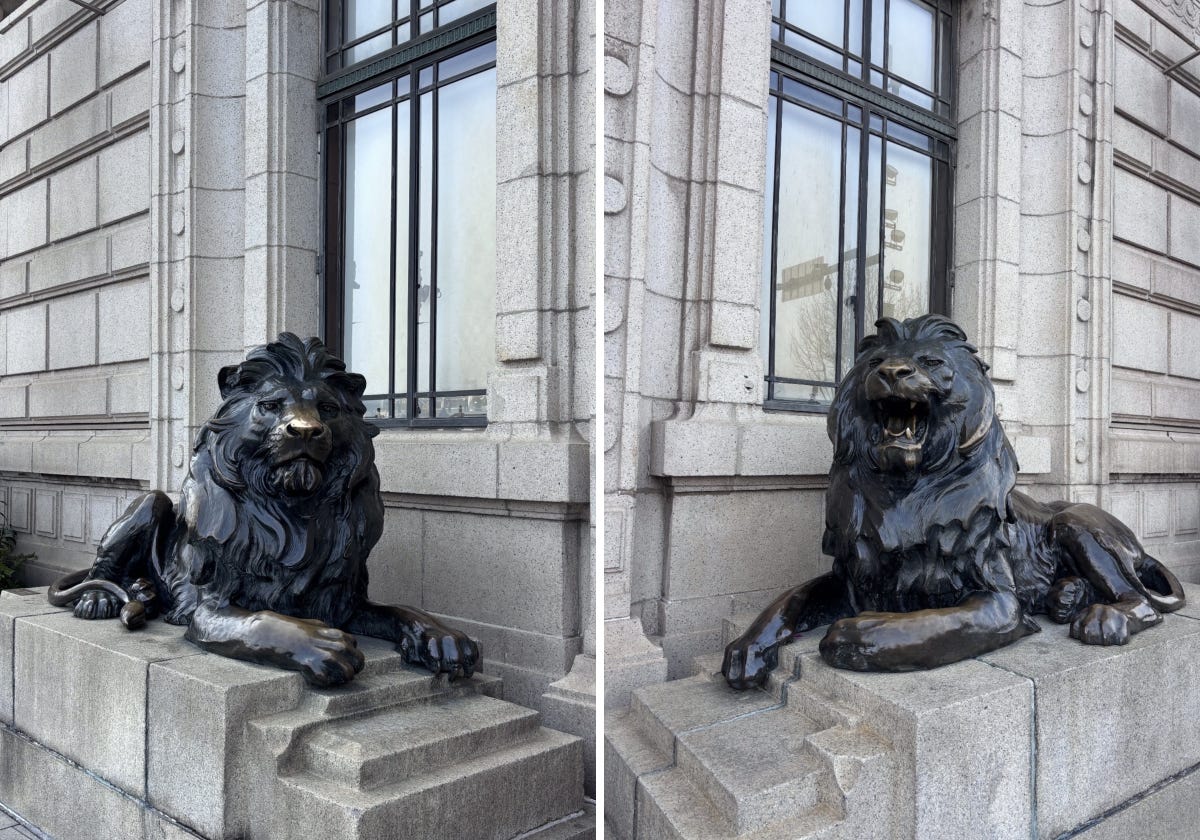
Cultures are not fixed, self-contained boxes. Even the most iconic symbol of a culture can start as a complete stranger from the outside world, slowly being reshaped over time until nobody remembers it was ever foreign at all.
If my insights brought you a fresh perspective, please consider supporting me by buying me a coffee. Your generosity fuels my writing.