

In 2012, when China’s sweeping anti-corruption campaign began, many observers interpreted it as a way to consolidate power and weaken rivals. That interpretation captured an important part of the story. Yet the campaign also struck a familiar chord for many within China: throughout history, rulers who failed to check corruption saw their dynasties decay from within. The initiative was therefore read in two ways—politically, as a means of constraining challengers, and historically, as a gesture toward restoring legitimacy by invoking a principle rooted in China’s past.
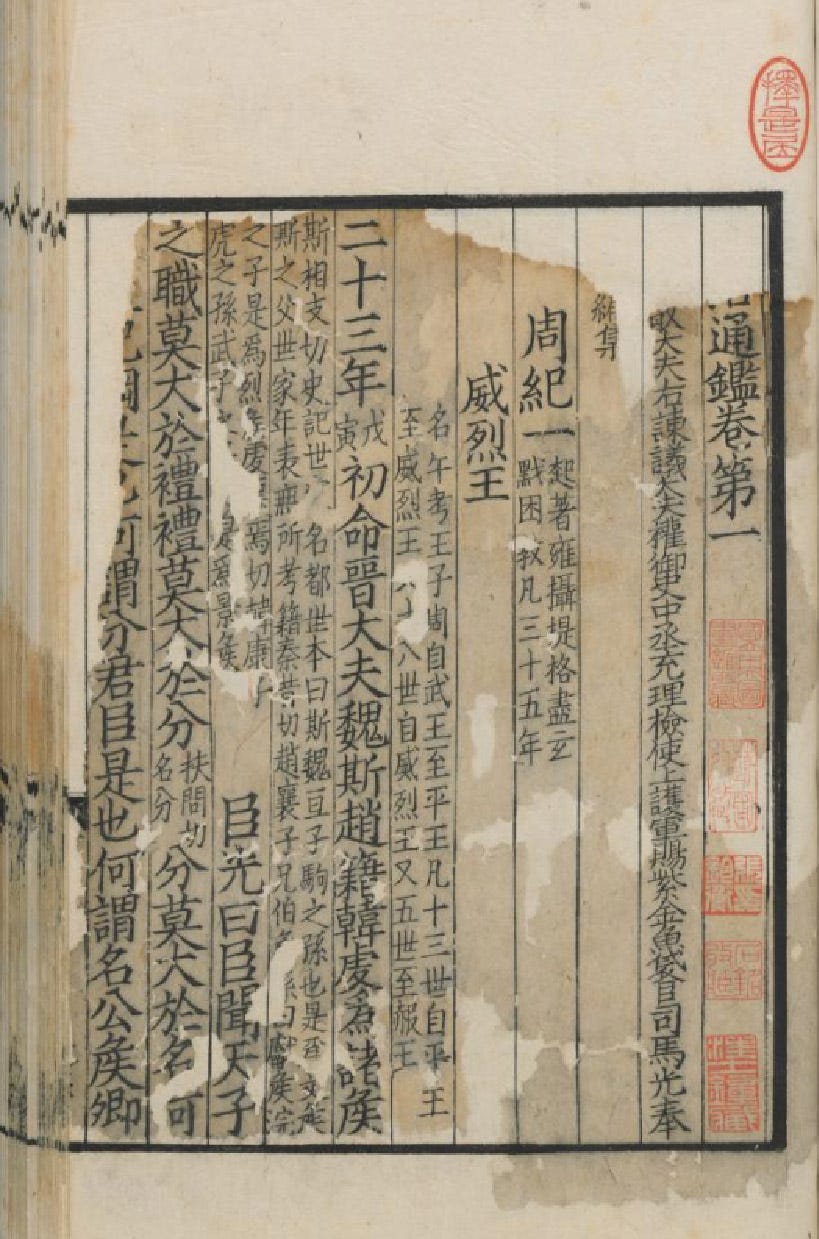
This is the paradox at the heart of modern Chinese politics. Where the West’s constitutions are written, debated, and amended, China’s “constitution” is less a text than a memory—a deep reservoir of dynastic lessons and political taboos. If Americans cite The Federalist Papers and the French invoke Rousseau, China’s political class instinctively reaches for Zizhi Tongjian (《资治通鉴》, Comprehensive Mirror to Aid in Government), the vast 11th-century chronicle compiled precisely to instruct emperors.
The result is a political culture in which legitimacy is measured not against abstract rights or modern theories, but against whether rulers heed or repeat the mistakes etched across two millennia of rise and fall.
History as a Political Manual
“以史为鉴,可以知兴替” (“By using history as a mirror, one can know the rise and fall of states”), the famous maxim—commonly associated with Tang Taizong (reflecting Wei Zheng’s counsel, 魏徵, 580 CE - 643 CE), speaks to a foundational belief in China: that the past holds the keys to the future. Few civilizations have taken that maxim more seriously than China.
For emperors and their advisers, history was not a record but a manual. The Zizhi Tongjian, commissioned by Song Emperor Yingzong (宋英宗, 1063 CE - 1067 CE) and completed by historian Sima Guang, reads like an extended casebook of what to do—and what never to do—if one hopes to keep the Mandate of Heaven.
While Western political modernity grew from revolutions and social contracts, China’s political reflexes grew from this pedagogy of precedent. From the Han to the Qing, rulers studied history less to glorify ancestors than to avoid their catastrophes.
Over centuries, certain recurring “constitutional principles” emerged—not codified in parchment, but inscribed in collective memory. However, none of these patterns operated uniformly or deterministically. Chinese regimes have also borrowed modern legal and institutional forms, and scholarly debate remains active about how much “dynastic memory” versus contemporary incentives explains any given policy. The idea of a “historical constitution” is a heuristic—a way to read political reflexes—not a claim that written law or modern institutions are irrelevant.
Principle #1: Land Cannot Be Left to Oligarchs
Land has haunted Chinese politics since antiquity. In the Warring States era (战国, 475 BCE - 221 BCE), reforms like those of Shang Yang in Qin redistributed land to strengthen the state. By the Han (汉, 206 BCE - 220 CE), however, great families amassed vast estates, squeezing peasants and draining the tax base. Rebellions followed—the Yellow Turbans in 184 CE, the fall of the dynasty soon after.
Every dynasty after knew the danger. The Tang instituted the equal-field system to keep land circulating; the Ming (明, 1368 CE - 1644 CE) founder Zhu Yuanzhang launched violent campaigns against landlords. Even the 20th-century Communist revolution cast itself as the heir to this same principle, with its land reform against “feudal landlords.”
Thus, when government imposes curbs on housing speculation or invokes “common prosperity”, many in China hear echoes of earlier attempts to restrain concentration and preserve the tax base.
Principle #2: Courtiers, Kin, and Eunuchs Must Be Kept in Check
The Han dynasty revealed another recurring pathology: power slipping from emperors to relatives and eunuchs. Empress Dowager Lü dominated early Han politics; later, cliques of eunuchs stoked court factionalism until the dynasty fractured. The Ming, too, became notorious for eunuch-bureaucrat rivalry, with figures like Wei Zhongxian virtually ruling behind the throne.
The “principle” crystallized: a dynasty that lets outsiders—be they in-laws or eunuchs—govern in the emperor’s name invites ruin. Modern Chinese suspicion of “shadow powers” still draws from this template. When contemporary discourse denounces “interest groups” or “powerful families,” it channels this dynastic memory more than any imported political theory.
Principle #3: Beware the Generals
The Tang dynasty’s brilliance was nearly undone by the An Lushan Rebellion, when a trusted frontier general turned his army against the throne. After that trauma, Chinese rulers grew wary of military strongmen. The Song (宋, 960 CE - 1279 CE) institutionalized this fear, placing military power firmly under civil officials—even at the cost of vulnerability.
This principle—that armies must never rival the state—remains foundational. Mao’s famous dictum “The Party commands the gun” condenses a much older anxiety about military strongmen.
Principle #4: Weak Arms Invite Strong Neighbors
If fear of generals defined the Song, its consequence was also instructive: military weakness invites humiliation. The Song paid tribute to Khitan Liao (辽, 907 CE - 1125 CE), Jurchen Jin (金, 1115 CE - 1234 CE), and Mongol Yuan (元, 1271 CE - 1368 CE), until finally conquered outright. Later, the Qing, complacent in power, found itself battered by Western gunboats. The Republic era (1912 CE - 1949 CE), too, was invaded by Japan, a stark reminder of the nation's vulnerability.
Hence the oscillating lesson: suppress military overreach, but never let defenses wither. For the Chinese leadership, this historical mandate is deeply personal. Today’s military modernization is often framed domestically as a safeguard against repeating periods of weakness, even as outside observers interpret it through contemporary power dynamics.
Principle #5: Open the Gates, But Guard the Nation
Trade and openness have long brought both glory and peril. The Tang cosmopolis of Chang’an flourished as a hub of Silk Road commerce, while the Ming voyages of Zheng He (郑和, His major voyages occurred between 1405 and 1433) projected China’s maritime reach. Yet openness also drew invasions—Coastal piracy (the wokou) plagued coastal regions during the Ming dynasty, Western merchants pried open Qing ports.
The oscillation between openness and closure became another “constitutional” rhythm. The late Qing’s failed self-strengthening reforms, the Mao-era Cultural Revolution’s autarky, and Deng Xiaoping’s 1978 “reform and opening” each mark moments when the pendulum swung.
Principle #6: Resist the Compradors
The late Qing and Republican eras added a modern variant: the danger of “买办” (maiban), comprador elites who served foreign powers while enriching themselves. To many Chinese nationalists, these figures symbolized humiliation—China subordinated to external capital. While ‘comprador’ is pejorative in nationalist narratives, historians also note that intermediary elites sometimes facilitated modernization, blurring the line between collaboration and brokerage.
Hence, suspicion of unchecked globalization or foreign capital in sensitive sectors has deep historical roots. Policy debates about “economic sovereignty” or “national champions” are often framed not just in Marxist or realist terms, but in dynastic memory of comprador betrayal.
Principle #7: Corruption Is the Termite of Dynasties
If any single thread binds these dynasties together, it is corruption. The Han emperors (206 BCE - 220 CE) saw their power wane as their courts became entangled in internal decay and decadence. And while Ming founder Zhu Yuanzhang issued draconian punishments against corrupt officials, his brutal measures ultimately failed to stem the tide; corruption continued to metastasize, overwhelming his successors and hollowing out the empire from within.
Many historians highlight corruption and administrative decay among multiple causes of dynastic decline, alongside fiscal strain, frontier pressures, environmental shocks, and succession crises.They view the decline not just as a failure of a single ruler, but as a systemic decay of the moral and administrative fabric. This historical record is a powerful source of legitimacy for new regimes, as each new dynasty can claim to have seized the "Mandate of Heaven" by restoring order and purging the corruption of the previous, failing one.
Contract vs. Chronicle
Constitutionalism in the West is a product of struggle and resistance. From the Magna Carta to the English and American revolutions, it emerged from a series of battles between monarchs, nobles, and common people. The core idea was a social contract: constitutions were written to restrain rulers and protect individual liberty. This memory is prominent in many Western contexts—especially in the U.S.—though its strength has varied across time and place. The urge to participate in political discourse is a deeply ingrained part of the culture, a shared memory that transcends social class or wealth.
In contrast, China’s "constitution" evolved from continuity and scholarly precedent. Rather than limiting power, historical chronicles taught rulers how to maintain order and govern effectively. Power was seen not as something to be challenged, but as a responsibility to be exercised wisely. This has created a different kind of historical memory in China, one shaped by the imperial examination system, where authority was tied to intellectual and scholarly expertise. This legacy has sometimes encouraged deference to credentialed authority, even as modern China exhibits diverse forms of civic and online participation.
Ultimately, this difference can be seen as the contrast between two types of governance: contractual constitutions that limit power and chronicle ‘constitutions’ that teach how to preserve it. Of course, the two traditions overlap: Western states also rely on historical memory, and China’s modern legal system has textual constitutional features.
The Contemporary Resonance
In today’s Beijing, no leader openly cites dynastic analogies. Yet the shadows are unmistakable.
“Common prosperity” evokes the ancient injunction against land oligarchy.
“The Party commands the gun” recalls Tang and Song lessons about warlords.
The anti-corruption campaign channels the dynastic terror of termites in the palace.
The Belt and Road Initiative replays Tang openness without Qing humiliation.
Foreign analysts may parse these as ideological shifts, but to many Chinese they feel like civilizational reflexes. The ghosts of fallen dynasties still whisper warnings.
Why This Matters Globally
Understanding China’s distinct historical perspective is not an academic exercise; it's essential for interpreting its global actions. Where Western observers might see abrupt and unpredictable political campaigns—whether against tech firms, property developers, or corrupt officials—many Chinese audiences see a leader enforcing ancient principles and historical taboos.
This divergence in political memory partly explains why the West often misreads Beijing's motivations. Westerners look for precedents in Rousseau or Locke, principles of individual liberty and the social contract. But Chinese leaders, steeped in their own historical tradition, often refer to the lessons of Sima Guang, seeking to preserve order and avoid the political decay that led to the fall of past dynasties. This is a crucial difference in the very foundation of political thought.
A Living Constitution: Rebellion and Renewal
While China has a formal constitution, its political principles are more deeply rooted in a continuous, evolving historical memory. Unlike Western constitutional traditions, which are built upon permanent documents and legal precedents, China's political philosophy is shaped by the lessons of its dynastic past. This isn't to say the Chinese people are strangers to the fight for freedom. On the contrary, China has a long and powerful tradition of peasant uprisings—like the Dazexiang Uprising, led by Chen Sheng and Wu Guang (against the Qin), who famously declared, “Are kings, lords, and generals born so by nature?”(王侯将相宁有种乎), the Yellow Turban Rebellion (against the Han), and the Taiping Rebellion (against the Qing)—reflects varied motives from tax burdens to millenarian beliefs and local grievances, including demands for justice and relief.
Yet, this deeply ingrained historical view of cyclical rise and fall, with each new dynasty learning from the last, is now being challenged. In China's major cities, some younger readers exposed to global discourses question lesson-based macro-narratives, opening space for more plural interpretations. They are moving towards a more pluralistic and individualistic worldview, one that may eventually lead to a more nuanced political dialogue and a new kind of "constitution"—not one written on paper, but in a evolving historical memory that is both a repository of lessons and a testament to the enduring will for change.
If my insights brought you a fresh perspective, please consider supporting me by buying me a coffee. Your generosity fuels my writing.
This is brilliant, a perfect primer for 外国人 to understand the present. Thanks much.
Thanks for clearly presenting the view that Chinese leaders even today take their lessons from history. In the Chinese case, the alternative source would not be a constitution so much as Marxist-Leninist doctrine, which seems to be on the way out.
I wonder if the structures and systems of the modern world have reduced the ability of any nation to chart its own relatively independent course. How much history have the current generation of Chinese leaders actually imbibed, growing up at a time when the tradition was on the defensive? Another question is whether China, for the first time part of a global civilization, has had little choice but to carry out its modern imperatives: nation-state competition, production and consumption focus at the expense of culture, environmental destruction, increasing social alienation, etc.