

A question that has always haunted me is how the I Ching (Yijing, 易经), a classic used to predict the future, can always be the key classic for Confucians, and at the top of the Five Classics, “五经之首、大道之源.” In most cultures, divination is just a premodern side lineage, and marginalized from the mainstream.
With the modernization of China since the early 20th century, continuous movements also marginalized this ‘mysterious’ tradition, and divination was often dismissed as superstition. Equating it with crystal balls and attempts to turn uncertainty into deterministic facts, I’ve always thought that Chinese divination is just another gadget.
But a recent conversation with a friend, who studied the I Ching and bazi (八字, the Four Pillars of Destiny), changed my mind. Beyond “superstition,” they could be understood as a formal language for describing relationships, tensions, and transitions over time.
Rather than directly predicting the future, it’s a practice that configures the forces and developing tendencies, to tell how things are in relation to one another and where the pressure points lie.
Seen this way, divination becomes a great entry point into how classical Chinese thought models reality itself. Where much of classical Western metaphysics sought to understand the world by isolating substances, Chinese traditions understand the world through relationship (guanxi, 关系), flow (shi, 势), and transformation (bianyi, 变易). That is why the I Ching was historically viewed not as witchcraft, but as the guiding matrix behind Chinese philosophy, statecraft, and medicine.
I-Ching, Sampling the Tension of a Moment
Starting in the Bronze Age as a royal divination manual (Zhouyi, 周易), it was believed to be the guiding divination document when King Wen of Zhou was imprisoned by the Shang dynasty. People prayed to the sky and got prophecies from the ritual. The I Ching was believed to be used to explain and make predictions from the ritual.
A major shift in Chinese culture and history was to align celestial phenomena and prophecy with the moral and political performance of a person, especially a king. Divination is no longer just an independent prophecy from the sky or a god, but a reflection of a person on earth.
Confucius studied the I Ching in his later life, and remarked that if he were granted more years, he would start at fifty to studying the Yi so that he might be free of great faults (五十以学易). He declared that the I Ching was not for fortune-telling, but for “virtue and conduct.” It tells how a person should act within shifting circumstances.
Perceived through a modern concept, the I Ching could be understood as a state-sampling engine. It collapses the moment of inquiry, whether it’s an event or a situation, and casts it into a six-line figure called a gua (卦).
Start from the famous Yin and Yang, which are the two basic states. An unbroken line is Yang, —, (Yang Yao, 阳爻), representing what is active, expanding, or firm. A broken line is Yin, --, (Yin Yao, 阴爻), representing what is receptive, contracting, or yielding.
Then stacking three of these lines (Yao, 爻) together (2 times 2 times 2 equals 8), it generates the eight fundamental building blocks known as the Bagua (八卦, Eight Trigrams):
Heaven (☰) — 乾 (Qián): Initiating
Earth (☷) — 坤 (Kūn): Supporting
Thunder (☳) — 震 (Zhèn): Shaking
Wind (☴) — 巽 (Xùn): Penetrating
Water (☵) — 坎 (Kǎn): Falling into danger
Fire (☲) — 离 (Lí): Clinging
Mountain (☶) — 艮 (Gèn): Stopping
Lake (☱) — 兑 (Duì): Joyfully exchanging
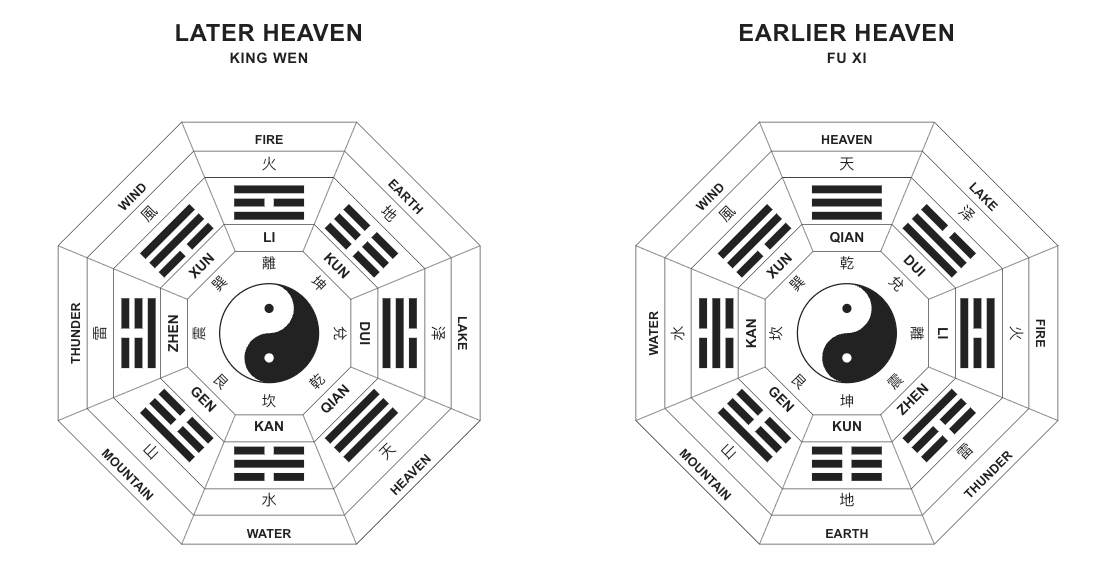
A trigram describes an independent state. But things come in pairs, in relation. Two trigrams stacked together could then be used to represent this interaction, like a person and their environment. The combination of two trigrams then creates a six-line hexagram (chonggua, 重卦), which produces 64 possible states (8 × 8 = 64).
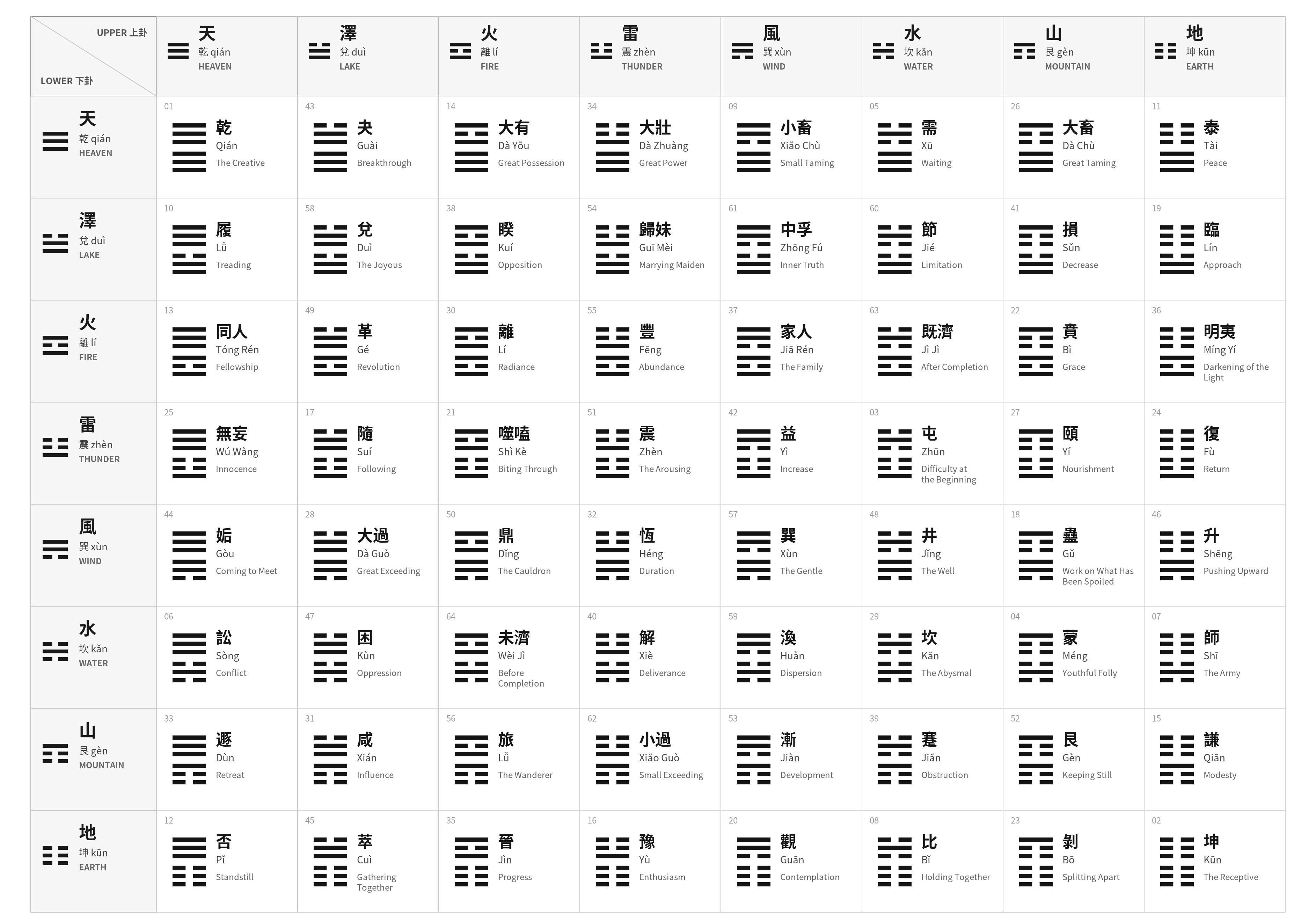
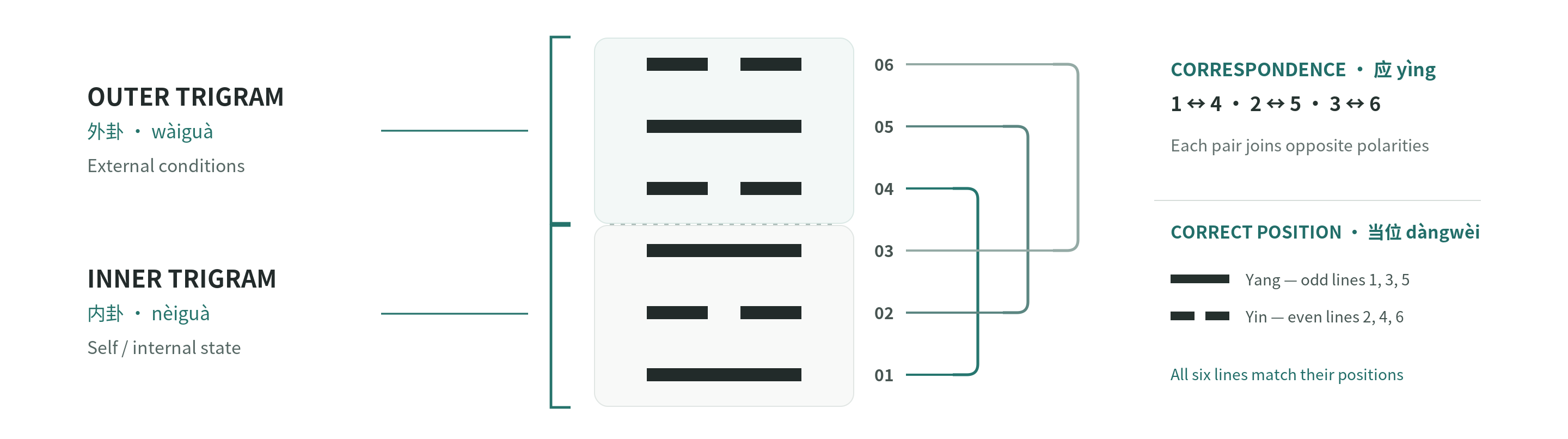
The lower trigram is the Inner Trigram (neigua, 内卦), representing the self or internal conditions. The upper three is the Outer Trigram (waigua, 外卦), for the external environment or circumstances.
Counting from bottom to top, the first line (chuyao, 初爻) marks the beginning. Lines 2 through 5 represent different stages of development. The sixth/top and highest line marks the final stage.
Each position is either Yang (odd positions: 1, 3, 5) or Yin (even positions: 2, 4, 6). When a line matches its position, such as a Yang line (—) in position 1, it is considered correctly positioned (dangwei, 当位). A mismatch suggests tension or instability.
Lines also relate to one another. Each line in the inner has a corresponding line in the outer: 1 pairs with 4, 2 with 5, and 3 with 6. When the pair consists of one Yin and one Yang line, they are considered responsive to each other (ying, 应). When both have the same polarity, this relationship is absent.
From Yin and Yang, it generates 64 variations of status that can represent the nuances of tension and relation. However, each hexagram is a relatively stable status that encodes the condition within. What about the flow? How to foresee the future?
When casting an actual hexagram, there are two states: a starting state (Bengua, 本卦) and a resulting state (Biangua, 变卦). The starting state represents the current situation, including its internal and external tensions. However, during the casting of each line in the hexagram of the current state, each Yin or Yang line is either stable (Young Yin 少阴 / Young Yang 少阳) or moving (Old Yin 老阴 / Old Yang 老阳). This reflects a core observation about reality: when any force reaches its extreme (”Old”), it becomes unstable and mutates into its opposite (物极必反).
With the Old and Young marks on each line during the initial casting (“阳动为圈,阴动为叉” — “moving Yang is marked with a circle, moving Yin is marked with a cross”), the practitioner can then transform the start state to the resulting state by flipping the Yin and Yang of any line that is Old.
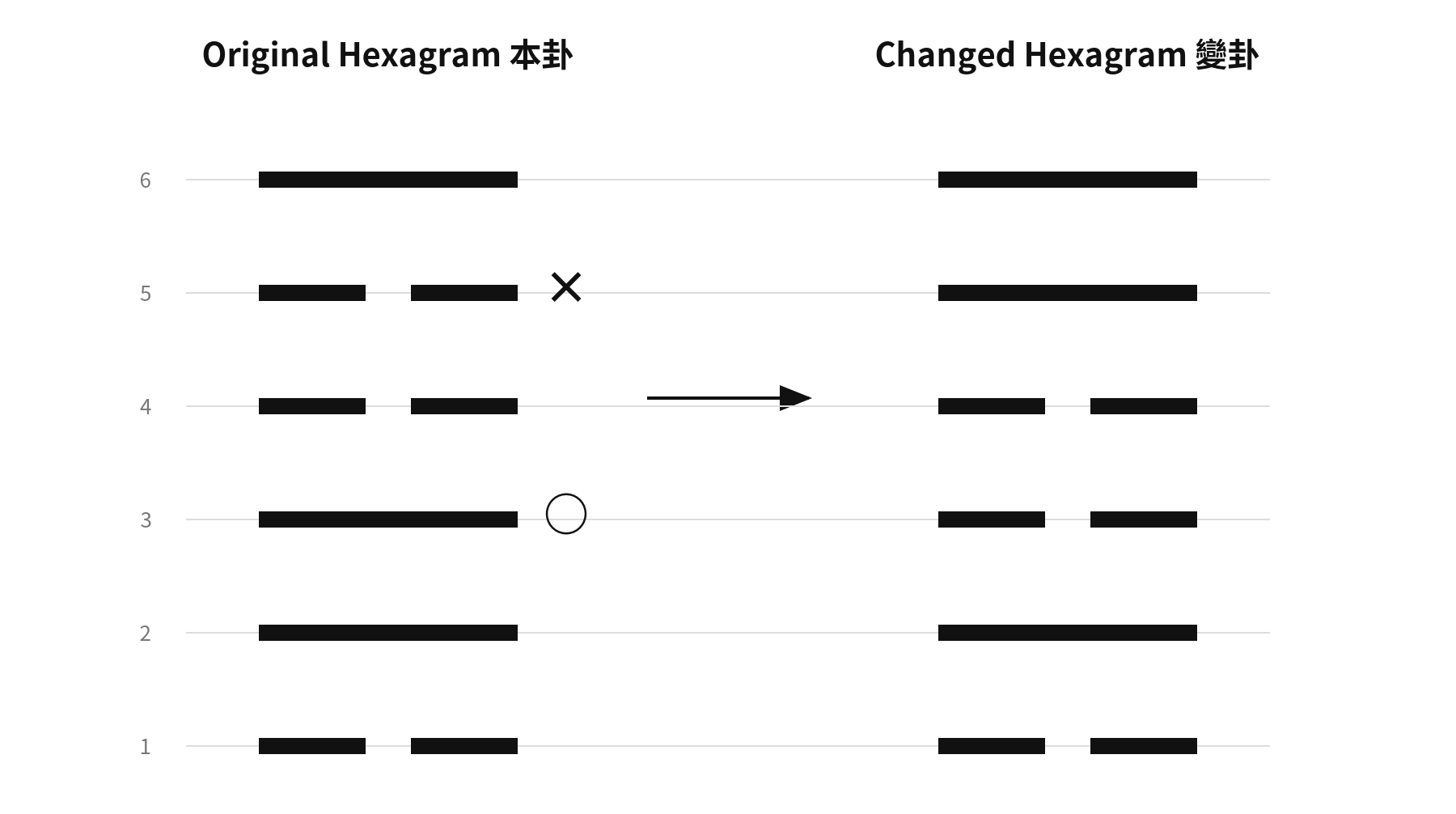
From Yin-Yang, to trigrams, to hexagrams, to the transformation of hexagrams, the I Ching depicts and encodes the relations and tensions in human reality into a computable system. Real-world situations are bounded by a system of internal capacities, external conflicts, and stages of growth and exhaustion.
Bazi, Compiling the Flow of a Life
The I Ching is a cross-sectional snapshot of a single event and tension, like a prediction or a prayer made every time before making a decision. Then the question extends to how to read a longer time span: the entire trajectory of a life.
Starting from how to encode a year in the calendar, the traditional Chinese calendar records time through two sets of symbols:
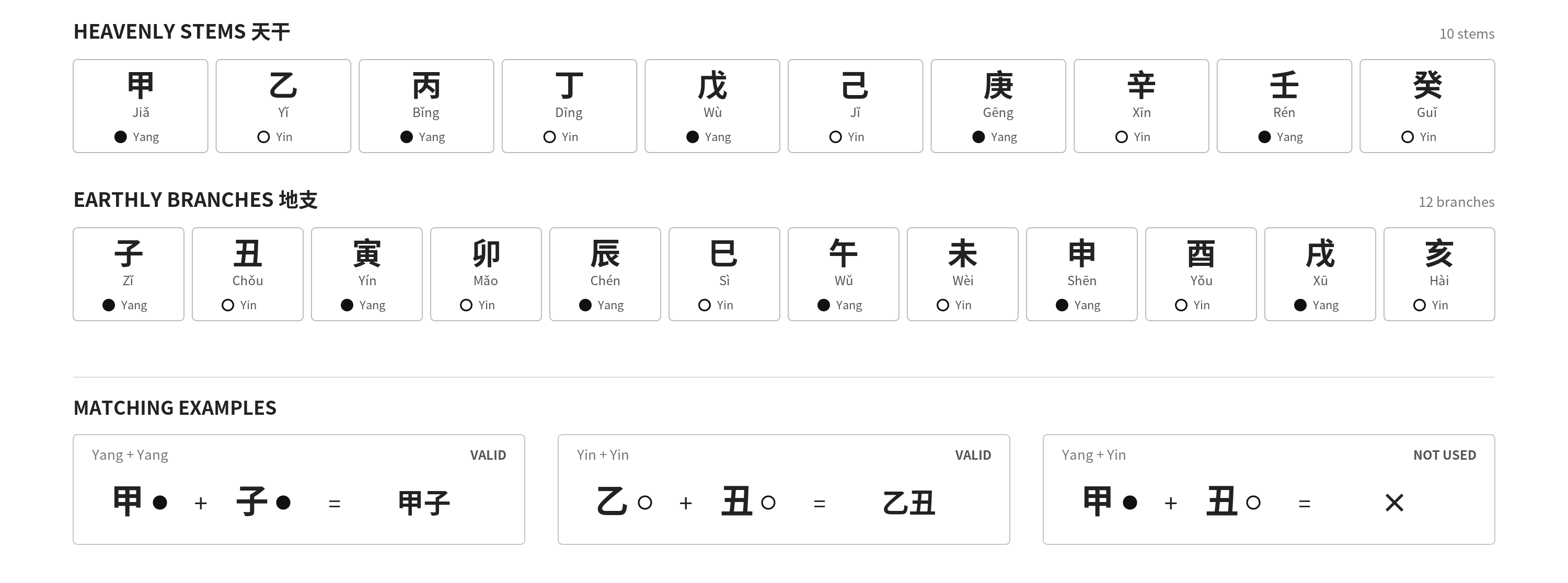
Ten Heavenly Stems (tiangan, 天干): 甲 乙 丙 丁 戊 己 庚 辛 壬 癸
Twelve Earthly Branches (dizhi, 地支): 子 丑 寅 卯 辰 巳 午 未 申 酉 戌 亥
Each character in these two sets of tiangan and dizhi has its own Yin or Yang quality. Only Yin tiangan pair with Yin dizhi (and Yang with Yang). By pairing one stem with one branch at a time following this matching rule, 60 tiangan-dizhi pairs repeat in sequence.
Because this applies to the year, month, day, and hour, any moment can be described by four pairs of characters, locating it within four overlapping cycles of time.
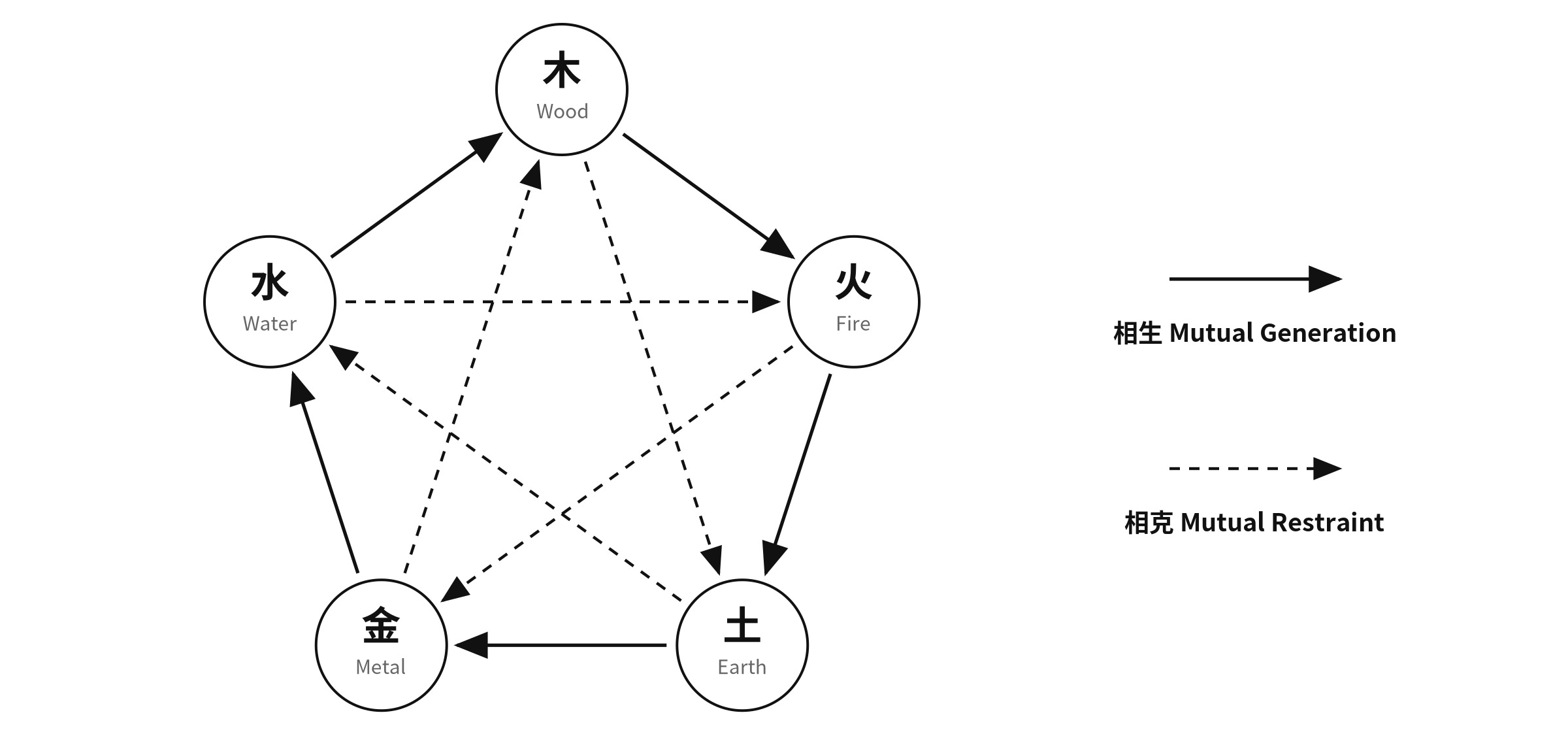
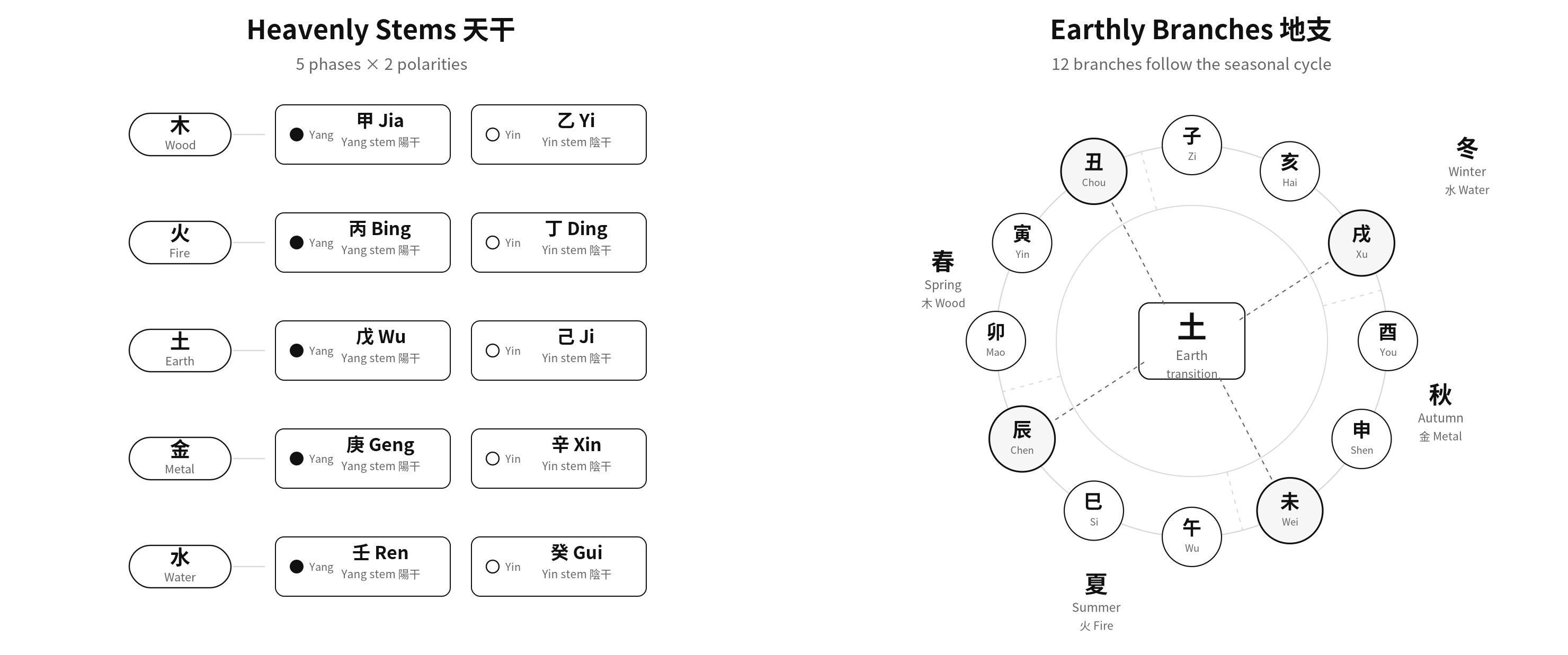
Then is the way of how things are composed of. Chinese cosmology describes the changing qualities of nature through Five Phases (wuxing, 五行): Wood, Fire, Earth, Metal, and Water. Each phase has its own quality and tendency, Wood grows, Fire expands, Earth transforms, Metal contracts, and Water stores.
Similarly, the five phases interact. In the cycle of mutual generation, Wood feeds Fire, Fire burns down to ash to create Earth, Earth concentrates and solidifies to bear Metal, Metal enriches and condenses moisture into Water, and Water nourishes Wood. In the cycle of mutual restraint, Water restrains Fire, Fire melts and transforms Metal, Metal cuts and carves Wood, Wood breaches and depletes Earth, and Earth dams and absorbs Water
Finally, bazi brings these two systems together.
For example, take someone born on January 1, 2000, at 8:00 a.m. Their birth time is converted into four pairs of Heavenly Stems and Earthly Branches
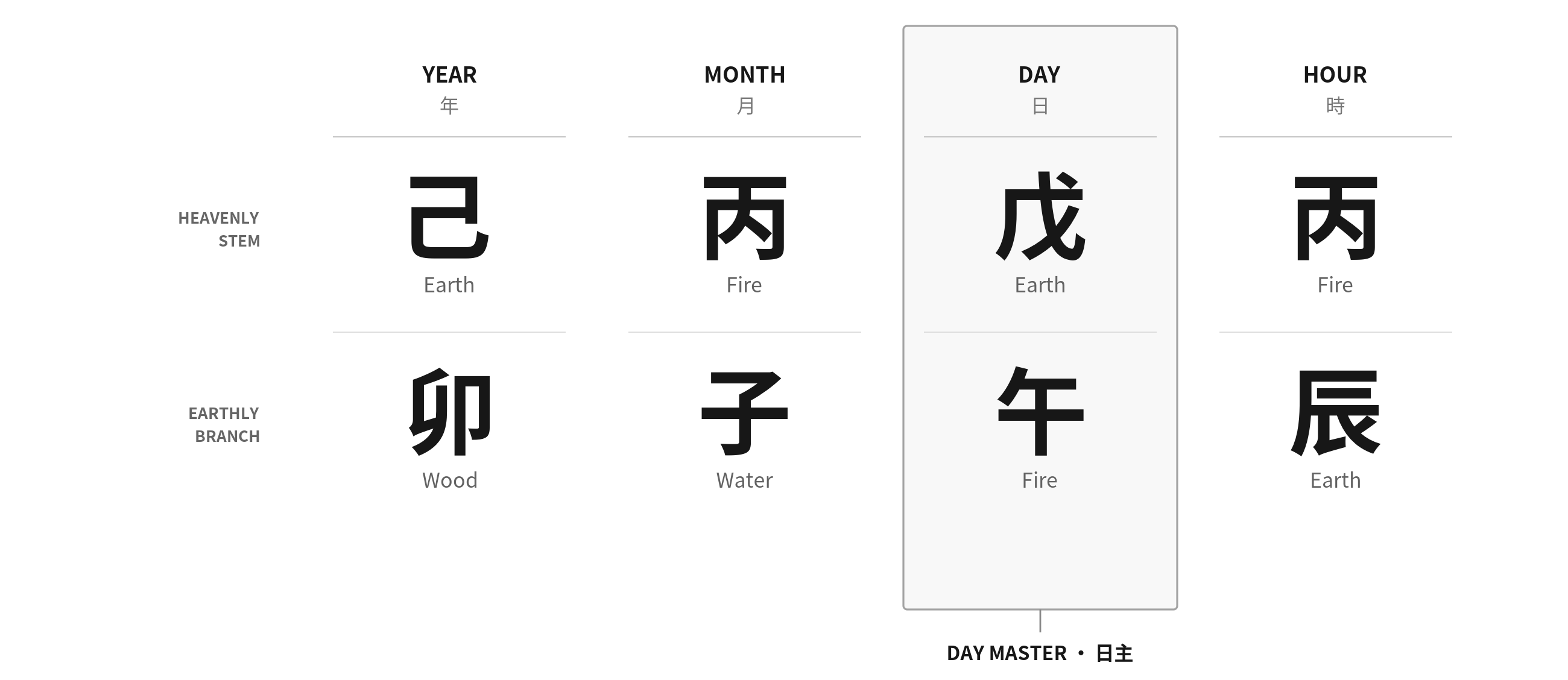
Each column is a pillar (zhu, 柱), representing the year, month, day, and hour of the time of birth. The four pillars contain two characters each, which makes the Eight Characters (bazi, 八字). Each Heavenly Stem and Earthly Branch also contains the energy of the five phases, which is also displayed in the chart. With this, time is associated with the qualities of the world.
As to the importance of the four pillars, the rule is to make Day the center. In the example, the Heavenly Stem of the birth day, 戊 (Wu, Yang Earth), is the key reference point, called the Day Master (rizhu, 日主). The other characters are interpreted through their relationships to it: Fire generates Earth, Wood restrains Earth, and Earth restrains Water.
As the years pass and new combinations of Tiangan and Dizhi characters keep changing over time, the relationship between that specific moment and the person is established. While the birth chart remains the same, the interpretation changes with time. A life is understood as a pattern of relationships unfolding through time.
The Limits of a ‘Perfect System’
Apart from their divination functions, is it possible to categorize the I Ching and bazi as forms of structuralism?
Structuralism in the early and mid-20th century can be understood as a school of thought that sought to understand language and human culture through symbols and their structural relationships. What matters is not an individual symbol, but its place within a system of relationships.
Wood, Fire, or Water takes on different roles depending on what surrounds it. The I Ching and bazi name certain concepts, but neither treats its symbols as having fixed meanings. They use a limited set of elements and rules to describe an enormous variety of situations and changes over time.
They offer a language for these uncertainties and place them in relationships. What once seemed like unrelated events becomes a pattern that can be recognized and discussed. Yet this same comprehensiveness creates a problem, as with any other theory that claims to explain everything.
When everything can be described through the same set of symbols, the system also becomes difficult to challenge. Even when an interpretation fails, another relationship can often be found to explain the result. The interpretation of the I Ching divination result is vague, with no definitive right or wrong, reflecting one’s own expectations.
The danger is that a system designed to explain everything may leave little room for what it cannot yet explain. The search for resemblance can take the place of discovering new causes. A map can help us navigate reality. It can also keep us from seeing what lies beyond its boundaries.
If my insights brought you a fresh perspective, please consider supporting me by buying me a coffee. Your generosity fuels my writing.
Amazing explanation. I still have no idea the depths of the I Ching. It seems complicated but also intuitive at times. I think divination is a mistranslation simply because of its connotation. “Fortune telling”. I much rather prefer the is line of yours:
the I Ching was not for fortune-telling, but for “virtue and conduct.” It tells how a person should act within shifting circumstances.