

In the previous exploration (How to Translate ‘Tao’), we saw how the word “Tao” defies definition. It is a linguistic ghost that refuses to be pinned down as merely “God,” “Nature,” or “Logic.” But the difficulty of the Tao doesn’t stop at language. If translating the word is hard, classifying the tradition has proven to be even messier.
In major bookstores, from New York to London, the Tao Te Ching (道德经, Daodejing) invariably resides in the Philosophy section. It markets as a guide for the intellectual seeking minimalism, a manual for the stressed executive seeking mental peace, or a poetic reflection on nature.
Yet, a visit to Dragon Tiger Mountain (龙虎山, Longhu Shan) or Wudang Mountain (武当山) in China reveals a reality that feels entirely alien to that bookstore shelf. There, priests in elaborate robes chant over smoking incense; red-ink talismans are pinned to doors to ward off invisible demons; grand altars display offerings to a pantheon of deities led by the Jade Emperor; and masters practice taichi or qigong.

One expression of the tradition is abstract, coolly rational, and fiercely individualistic. The other is mystical, ritualistic, and deeply communal. Yet, both claim to represent the same thing: the Tao.
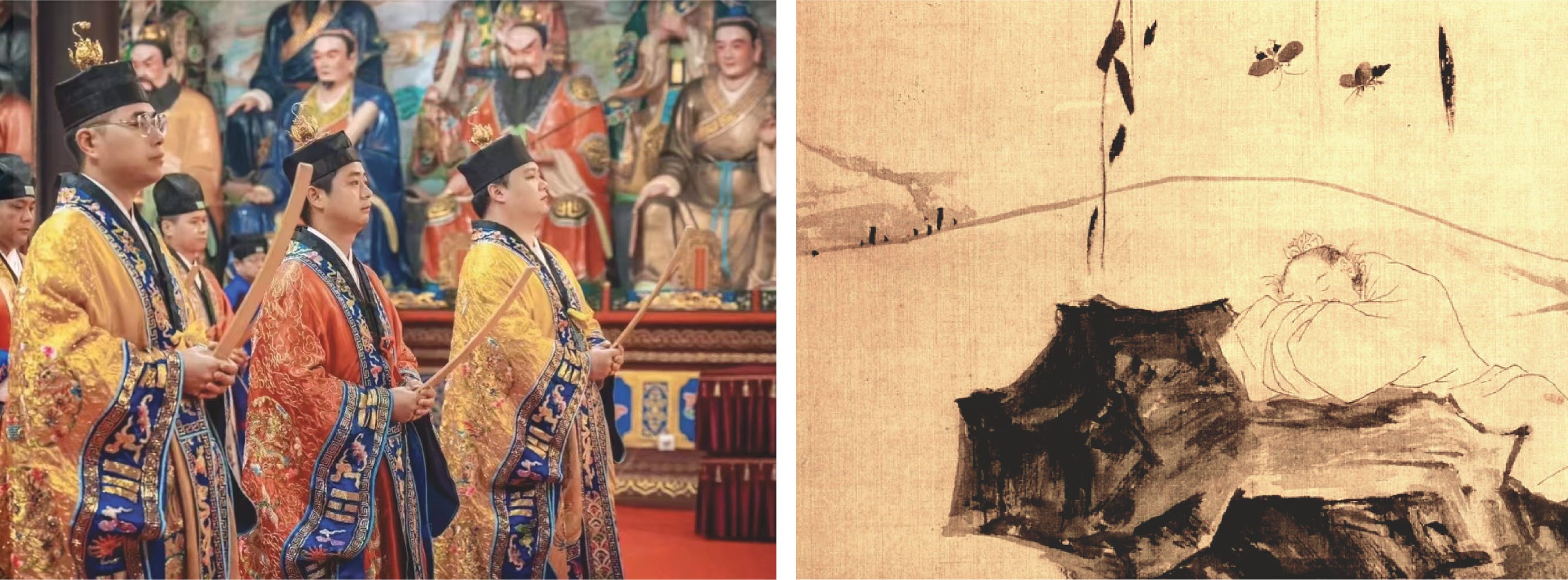
For over a century, standard textbooks have taught that these are two separate rivers: Daojia (道家, Philosophical Taoism) and Daojiao (道教, Religious Taoism). The former is the “pure” source, the pristine wisdom of the sages. And the latter is a “corrupted” folk religion that drifted far from the original message.
But this division is an optical illusion. It is a fiction created not by ancient sages, but by the prism of Modernity.
The Scholar and the Alchemist
To understand the fracture, it’s necessary to return to the “Original Unity.” In pre-modern China, the rigid line between “philosophy” and “religion” did not exist. The Chinese word Jiao (教, teaching) encompassed culture, ethics, ritual, and cosmology all at once. The greatest minds of the tradition were never just thinkers; they were doers.
The story begins in the Warring States Period (战国, 475–221 BCE), a time of blood and chaos. The Tao Te Ching emerged not as abstract metaphysics, but as a survival manual. It taught that in a world of hard weapons and rigid laws, the only way to survive was to be soft, to yield, and to conserve one’s energy.
But as the centuries passed, this desire for “preservation” evolved. By the Han Dynasty, the preservation of the “self” morphed into the preservation of the “body.” The metaphors of Laozi (Lao Tzu), “living long” and “embracing the One”, were taken literally. The philosophical quest for peace became the alchemical quest for Immortality (仙, Xian).
深根固蒂,长生久视之道 Tao De Ching, ch.59
Deep roots and a firm base, this is the Way of long life and lasting vision.载营魄抱一,能无离乎? Tao De Ching, ch.10
Carrying the soul and embracing the One, can you keep them from parting?
The embodiment of this unity is the 4th-century figure Ge Hong (葛洪, 283–343 AD). To a modern classifier, Ge Hong is a paradox. He was a Confucian scholar who upheld strict ethics. He was a Taoist philosopher who wrote eloquent commentaries on emptiness. But he was also an alchemist who spent his nights smelting cinnabar and gold, and a physician who compiled prescriptions for emergencies.
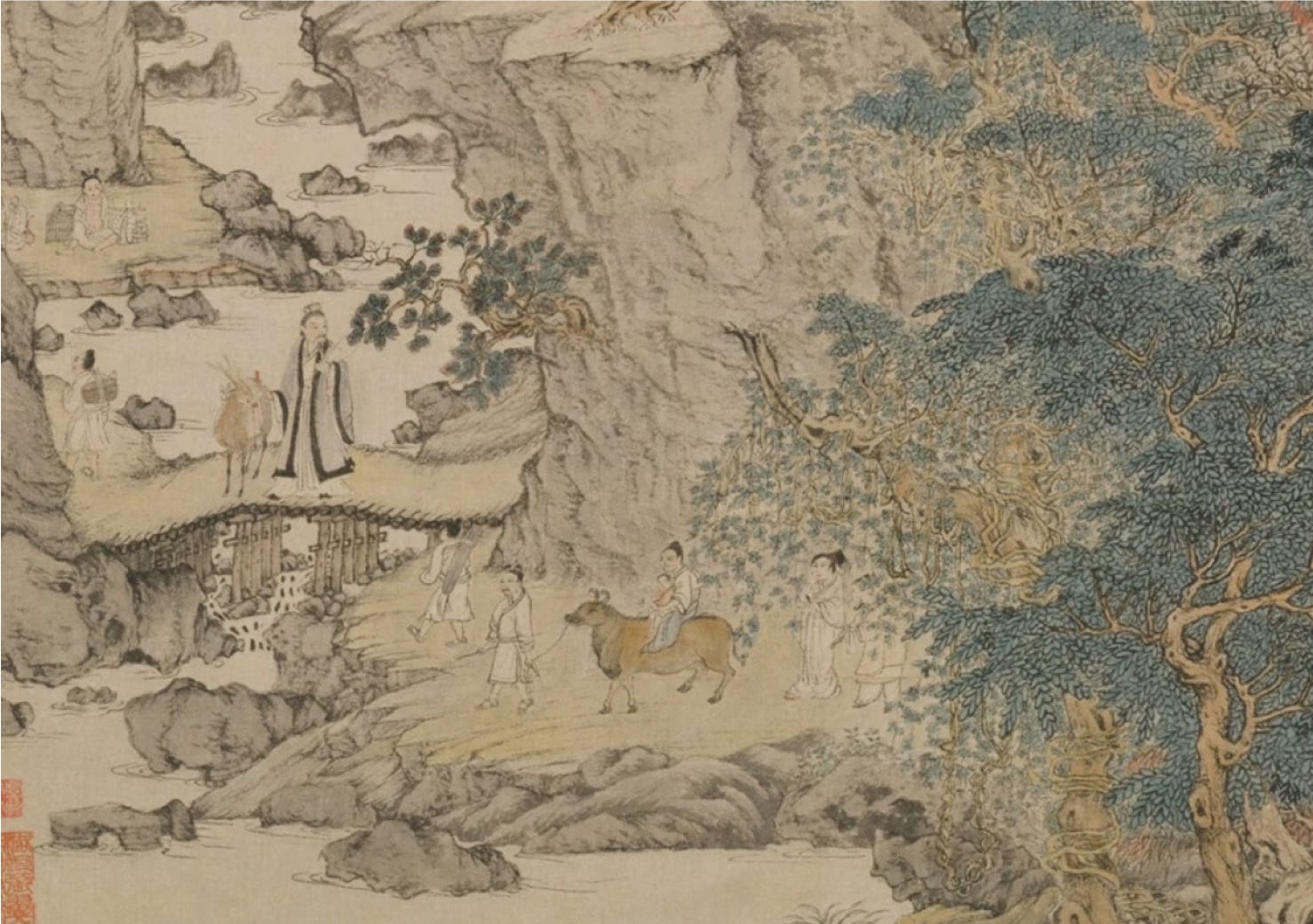
In his magnum opus, the Baopuzi (抱扑子, The Master Who Embraces Simplicity), Ge Hong argued that moral cultivation and physical cultivation were inseparable. You could not achieve the Tao simply by thinking about it; you had to build a body capable of holding it.
形者,神之宅也。|抱朴子·内篇 The body is the dwelling of the spirit | Baopuzi, Inner Chapters
For two millennia, this was the Taoist reality: a continuum. The text provided the theory; the ritual provided the community; the alchemy provided the technology. Taoism cannot be grasped through reading alone. Like surgery, it is an embodied discipline, something to learn by doing.
The Prism of Modernity
The fracture did not begin in China; it began with the Western gaze. Long before the Chinese modernizers began their work, the Scottish Sinologist James Legge (理雅各, 1815–1897) constructed the first optical filter. Translating the sacred texts for the Sacred Books of the East series in the late 19th century, Legge viewed the tradition through a distinct Protestant lens: one that fetishized the Text while obscuring the Ritual.
To Legge, the Tao Te Ching was a “monotheistic” masterpiece that shone with a clear, rational light, hinting at the Christian God. But the actual living religion of Taoism he saw in the villages, with its talismans and exorcisms, he viewed as a murky and grotesque degeneration. He was the first to authoritatively separate the “Pure Light” of Laozi from the “Corrupt Fog” of the priests.
Then came the Chinese Prism. By the early 20th century, China was facing an existential crisis. Humiliated by colonial powers, the intellectuals of the New Culture Movement believed the nation was collapsing under the weight of “backward” traditions. To save China, they needed to embrace the illuminating forces of Science and Democracy.
Influenced by Western academic categories, reformers like Hu Shi (胡适, Hu Shih, 1891–1962) and Feng Youlan (冯友兰, Fung Yulan, 1895–1990) realized they needed to construct a history of “Chinese Philosophy” (哲学, Zhexue) that could shine as brightly as the works of Kant and Hegel. But to do so, they had to filter out the noise of ghosts, alchemy, and folk magic.
For More on Chinese Philosophy

Hu Shi, the pragmatic reformer, was rigorous in this filtration. In his Outline of the History of Chinese Philosophy, he aimed to isolate the logical and evolutionary aspects of Chinese thought. To Hu, the religious elements were not just irrelevant; they were distortions that clouded the rational brilliance of the pre-Qin thinkers.
Feng Youlan, whose work became the standard textbook for Chinese philosophy, codified this optical separation. In his seminal A History of Chinese Philosophy, he drew a hard line, treating the tradition not as a single beam, but as two conflicting wavelengths:
As to Daoism, there is a distinction between Daoism as a philosophy, which is called the Daoist school (daojia), and the Daoist religion (daojiao). Their teachings are not only different; they are even contradictory. Daoism as a philosophy teaches the doctrine of following nature, while Daoism as a religion teaches the doctrine of working against nature.
- A History of Chinese Philosophy
至于道家,它是一个哲学的学派;而道教才是宗教,二者有其区别。道家与道教的教义不仅不同,甚至相反。道家教人顺乎自然,而道教教人反乎自然。
- 中国哲学史
Feng argued that while Daojia (Philosophy) taught following nature, Daojiao (Religion) taught working against nature to seek immortality. He viewed them not as layers of one reality, but as contradictory currents.

This was the Great Refraction. By forcing the unified tradition through the lens of “Modernity,” Hu and Feng successfully split the beam. The “Text” was allowed to pass through as World Wisdom, shining clearly in the university classroom; the “Practice” was bent away, cast aside as the shadow of peasant folklore.
The act of translation had become an act of bifurcation. The unified Tao was no longer a single white light; it had been permanently split into spectral bands.
The Path of the Mind: Portable Philosophy
Stripped of its ritual context and its demands for physical alchemy, the Tao Te Ching became incredibly aerodynamic. It became “portable.” No longer tethered to a lineage or a specific cosmology, it could travel to the West and interface with anything.
We see this in the explosion of Taoist concepts in Western pop culture and self-help. The concept of Wu Wei (无为, non-action or effortless action) has been repurposed as a cure for capitalist burnout. The “Uncarved Block” (朴, Pu) has become a metaphor for psychological integration.
This “Philosophical Taoism” is clean, safe, and profoundly intellectual. It allows a modern individual to access the wisdom of the sages without having to kneel or burn incense.
The Path of the Body: The Wellness Trap
But what happened to the “flesh”? Did the alchemy and the rituals vanish? No. They mutated.
While the intellectuals were busy canonizing the philosophy, the practical, somatic side of Taoism found a new disguise. To survive in a world of atheistic materialism, the “Body Technology” of Taoism shed the language of gods and demons and adopted the language of Health and Science.
Internal Alchemy (Neidan), once a mystical quest to birth an immortal spirit, was rebranded as Qigong (气功, Breathing Skill), a method to improve circulation and reduce stress.
Ritual Combat, once a dance to channel cosmic power, became Tai Chi, a “moving meditation” for balance and longevity.
This transformation has created a fascinating paradox. Millions of people practice Tai Chi in parks. They do so to manage their blood pressure, improve their fascia elasticity, or find “flow.” They view it as a secular, somatic exercise, a “Wellness” practice.
Yet, historically, these movements were theological acts. They were body-prayers designed to align the microcosm of the human with the macrocosm of the universe. When a modern practitioner performs “Cloud Hands,” they are tracing the circulation of Qi just as a medieval priest would have.
We have accepted the technology of the religion while rejecting its theology.
The Refracted Tao
The story of the “Two Taos” is a history of modern survival.
Modernity functioned as a high-powered prism. Upon impact, the unified white light of the ancient tradition was not destroyed, but refracted. The dense, ritualistic wavelengths were bent in one direction, while the lighter, philosophical wavelengths were bent in another. The “Mind” of the Tao was directed toward the university library, while the “Body” of the Tao was directed toward the gymnasium.
In many ways, this spectral separation was a triumph of adaptation. By becoming modular, the essential technologies of Taoism, both mental and physical, were able to survive the collapse of the imperial world and upload themselves into the global operating system.
Yet, for the contemporary observer, the challenge remains. To truly understand the Tao, it is necessary to look past the spectral separation created by the 20th century. The wisdom of the sage (Philosophy) and the sweat of the practitioner (Practice) are not distinct entities, but the dispersed colors of a single source. To walk the Tao is to trace these divergent rays back through the prism, reassembling the scattered light into its original, unified whole.
If my insights brought you a fresh perspective, please consider supporting me by buying me a coffee. Your generosity fuels my writing.
Dont forget the Jesuits who arrived first in China and skewered ancient texts to fit in with their Christian theology.
it may be surprising to many after centuries of misrepresentation but the words dao jia 道j家 and dao jiao 道教 mean exactly what they say. jia 家 is family, and by extension community, and as you mentioned jiao教 is teaching. the community and their teachings go together.
your readers might be interested in my historical unpacking of the term.
https://debraliu.substack.com/p/home-family-a-school-of-thought
Thanks for writing this basic intro.
Remember that Legge and most of the missionaries working in China at the time were also Nonconformists, meaning Fundamentalist Christians. They were not mainline Protestants. Hudson Taylor was an English Baptist (a Fundamentalist Christian). They were even more against icon / idol worship than the Anglicans and Lutherans were.
Meanwhile in England itself and France itself - at exactly the same time - the Oxford Movement worked to bring back ancient Christian "Idolatry" beliefs to the point that Rev. Arthur Tooth was arrested for burning incense. Rev. Gueranger was bringing back the medieval calendar - the western 农历 of a sort - at his monastery, Solesmes in France.
The Evangelicals turned outward toward Asia, and inward toward themselves, at the same time.
That's why Christianity in China is the way it is. In Latin America, many people think nothing of combining ancestor worship (Mexican Day of the Dead) and even their ancient gods, like Pachamama, with Christianity.
Many Chinese Evangelicals have this blank slate idea, this Day One idea the same way modernist Wahhabi Islam is accepted in parts of the world as well. Like I've met Bangladeshis who would rather celebrate Islamic holidays than the Bengali New Year.
http://en.wikipedia.org/wiki/Nonconformist_(Protestantism)