Laozi on Burnout
And Which Tao De Ching We’re Actually Reading
Laozi is genuinely soothing. There is no situation in life for which you cannot find a sentence in the Tao De Jing that lands like a cold cloth on a fever. This week I was curious what Laozi would say about ‘burnout.’ The feeling that accumulation, of work, of knowledge, of productivity, has become the only recognized direction of travel.
The five passages I unpacked this week all responded. Five sentences, five variations on the same counterintuitive claim: you might be moving in the wrong direction. Stop adding. Start removing.
少則得,多則惑: Less brings gain; more brings confusion.
知足不辱,知止不殆: Know sufficiency, avoid disgrace; know when to stop, avoid danger.
為學日益,為道日損: In pursuit of learning, one gains daily; in pursuit of the Tao, one strips excess daily.
天下莫柔弱於水, 而攻堅強者莫之能勝: Nothing under heaven is softer than water, yet nothing surpasses it in overcoming the hard and strong.
大巧若拙,大辯若訥: Great skill seems clumsy; great eloquence seems tongue-tied.
This is the weekly article of Wenyan Decoded - Classical Chinese for the Modern Mind.
Find detailed unpacking of each sentence and character, along with audio for the five passages at the end of the article.
But then a second question surfaced. When seeking answers from a classic, it’s natural to presume a doctrine, a coherent voice of wisdom speaking from a fixed text. Open “the Daodejing,” 81 chapters, roughly 5,000 characters, Dao section 道经 first, De section 德经 second, as if it’s a stable object: the book Laozi wrote before he disappeared through the Hangu pass (老子西出函谷关). Except, which Daodejing are we actually reading? Daodejing may never have been a single book at all.
The Received Text
The Daodejing most people encounter descends from two commentarial editions: the Heshang Gong (河上公) version, associated with the early Han dynasty, and the Wang Bi (王弼, 226–249 CE) edition, which became the dominant standard. Wang Bi was not himself a Daoist. He was a brilliant young commentator who died at 23, and his arrangement of the text became the scaffolding on which almost every subsequent reading was built. For nearly two thousand years, to read the Daodejing was to read the Wang Bi Daodejing and every English translation before the 1990s is downstream of his editorial choices. The 81-chapter structure, the Dao-then-De sequence, even the chapter divisions themselves. There is evidence these were later additions, imposed for the purposes of commentary or memorization, onto a text that was originally more fluid.
The Book Flipped
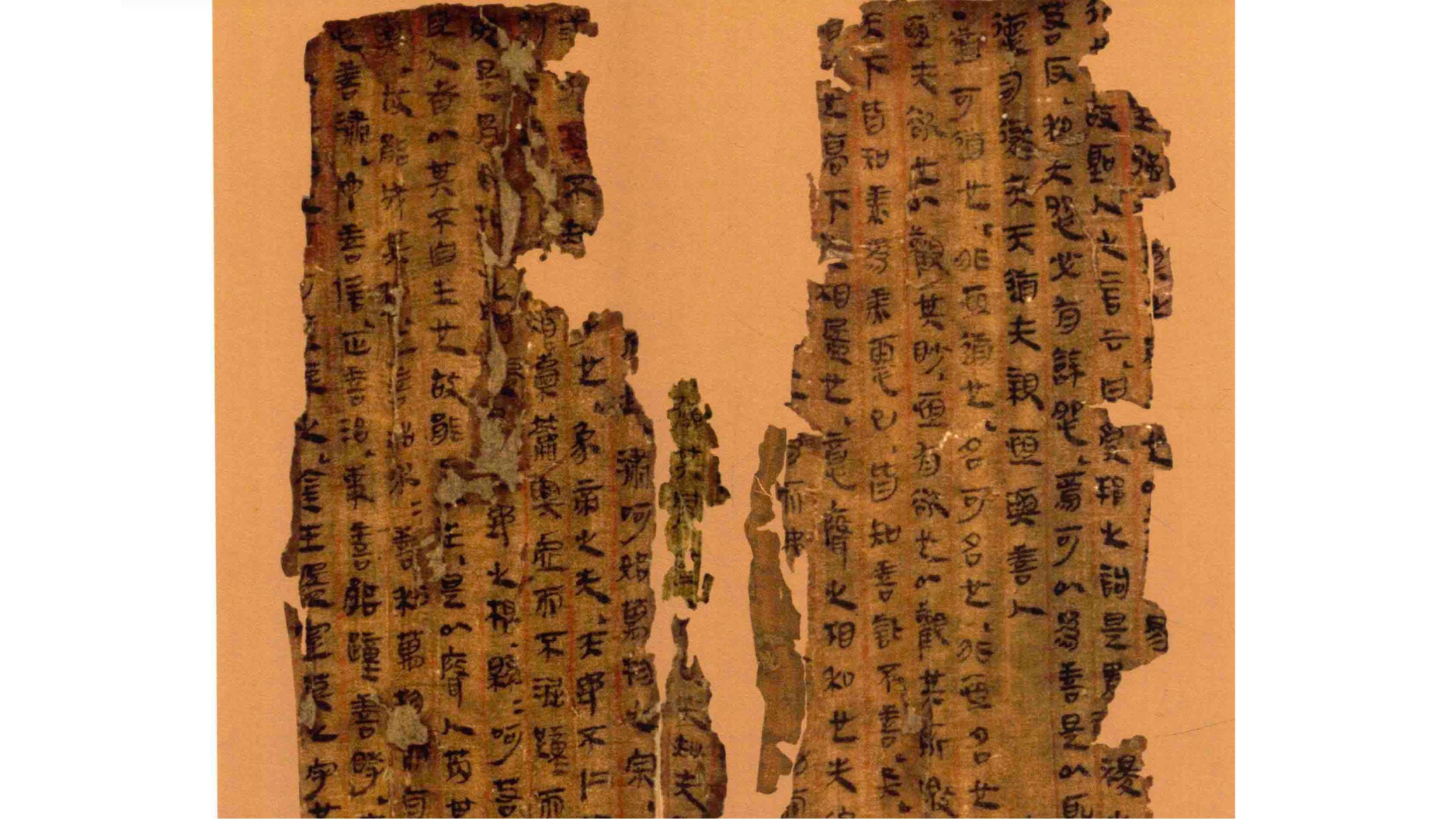
In 1973, two nearly complete copies of the Laozi (Daodejing) were found in a tomb sealed in 168 BCE at Mawangdui 马王堆, near Changsha, Hunan province. Written on silk, they were the oldest complete versions ever discovered and they immediately posed a problem. Both manuscripts placed the De section (chapters 38–81) before the Dao section (chapters 1–37). The Dao-De-Jing, it turned out, was originally, at least earlier, a De-Dao-Jing. Even the internal chapter sequence differed. And the Mawangdui texts were found alongside the Huangdi Sijing (黄帝四经, Four Classics of the Yellow Emperor), political-cosmological writings associated with Huang-Lao Daoism, a tradition that framed the Laozi not as mystical philosophy but as a manual of governance. Same text, different neighbors, different meaning.
The Real Earthquake
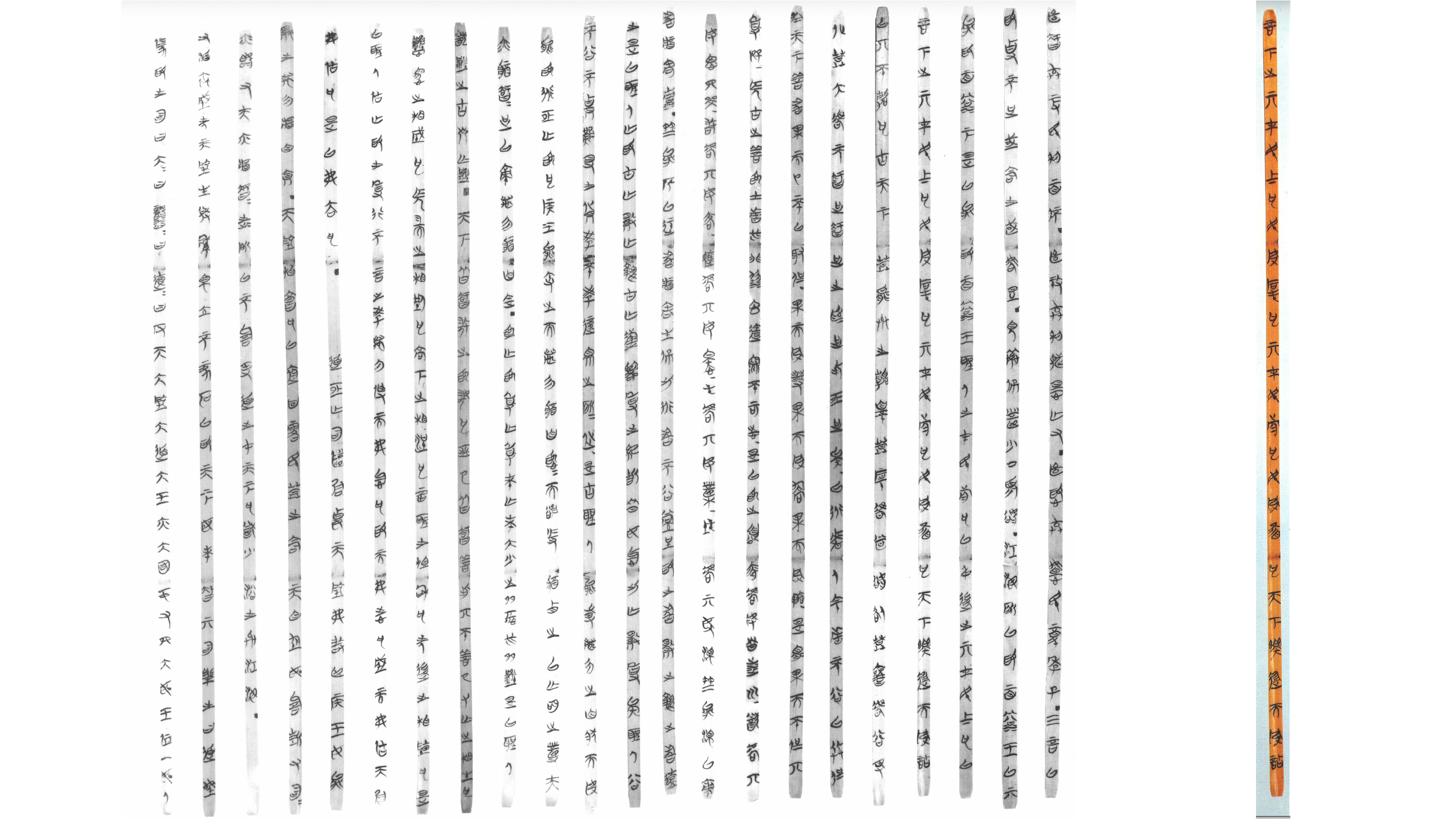
Twenty years later, the ground shifted again. In 1993, 804 bamboo slips were unearthed from a tomb in Guodian 郭店, near Jingmen, Hubei, dated to around 300 BCE, making them over a century older than the Mawangdui silks. The tomb occupant was likely a tutor to the Crown Prince of Chu 楚.
What they found was not the Daodejing. It was something stranger: bamboo strips corresponding to only 31 of the 81 received chapters, bound in three separate bundles with Dao and De themes mixed freely throughout. The two-part division did not yet exist. Chapters 70–81 may not yet have been composed at all. And the content itself carried a different emphasis: more political, more focused on virtue and rulership, less metaphysical than the Mawangdui versions that came later. These fragments are like raw material out of which the work we know as the Laozi would eventually crystallize. Not a shorter version of the same book, but a different selection from a pool of circulating sayings and teachings.
The Doubters
There is a deep irony in how all of this played out in Chinese intellectual history. During the New Culture Movement of the 1920s, a group of scholars known as the Doubting Antiquity School (疑古派), led by Hu Shih 胡适 and his student Gu Jiegang (顾颉刚). They launched a radical assault on the received tradition. They argued that classical texts could not be taken at face value, that layers of myth and later interpolation had been projected backward onto earlier periods. Gu Jiegang believed the Daodejing was composed over three centuries, not by a single sage. Some in the camp went further, arguing the text was entirely a Han-dynasty production.
The Guodian 郭店 find settled one half of that debate. The text clearly existed by 300 BCE, the extreme late-daters were wrong. But the other half of the thesis was vindicated in full: the Daodejing was indeed a compilation, assembled and reshaped over time by multiple editors for different audiences. Current scholarly consensus treats the text not as the work of a single author but as a layered accumulation, typical for long-form works of the pre-Qin period.
Complied daily Wenyan Decoded
Wenyan Decoded – Classical Chinese for the Modern Mind is a new experimental section of Old North Whale Review. Each day, I unpack a single sentence from the Chinese classics, character by character, showing how these ancient texts still shape the way Chinese culture thinks, argues, and feels today.
By the end of each week, I will publish a wrap-up that synthesizes the daily posts into a broader theme. Think of it as another piece from Old North Whale Review, but with a more focused lens on Classical Chinese. The goal is not translation, but connection: ultimately, the aim is for readers to engage with the original text itself, rather than rely on the translation.
少則得,多則惑。 Shǎo zé dé, duō zé huò.
“Less brings gain; more brings confusion.” — 道德经 Ch.22 (Tao Te Ching, Laozi)
Unpacking the sentence:
少 (shǎo) — few, little, less; Stable across 2,500 years. Same character, same meaning. These are rare.
則 (zé) — then, in that case → One of the 18 key “function words” (虚词) of Classical Chinese. It works like a logical hinge: “If X, 則 Y.” Modern Chinese still uses it in formal writing, but in conversation you’d say 就 (jiù) instead.
得 (dé) — to obtain, to gain, to attain → Classical 得 carries a strong sense of attainment — acquiring something of value.
多 (duō) — many, much, more Another stable character.
惑 (huò) — confused, deluded, bewildered → Modern Chinese usually needs a compound: 疑惑 or 迷惑. Classical 惑 stands alone, one character of delusion, no cushion. And it’s stronger than “confused.” It means being led astray, unable to see clearly.
The bridge: Six characters, three per clause, perfectly mirrored. No subject, who gets less? Everyone. No one. It’s universal. No verb of being, no conditional marker. 則 does the work that modern Chinese would spread across 如果...就... (”if...then...”). Laozi doesn’t say “if you have less, then you will gain.” He says 少則得, “Less, then gain.” The compression is the authority. Modern Chinese needs at least ten characters to say this: 如果你拥有的少,你就会获得更多. Laozi does it in three.
知足不辱,知止不殆。 Zhī zú bù rǔ, zhī zhǐ bù dài.
“Know sufficiency, avoid disgrace; know when to stop, avoid danger.” — 道德经 Ch.44 (Tao Te Ching, Laozi)

Unpacking the sentence:
知 (zhī) — to know, to understand, to perceive → Classical 知 stands alone. Modern Chinese almost always pairs it: 知道, 知识. The classical version is closer to “wisdom” than “information.”
足 (zú) — sufficient, enough → Classical 足 meaning “sufficient” can stand alone. Modern Chinese compounds it: 足够, 满足. This is the origin of the idiom 知足常乐 (”know sufficiency, always joyful”) , but Laozi’s original is not about joy. It’s about avoiding ruin.
辱 (rǔ) — disgrace, humiliation → One character of shame, no cushion. Modern Chinese usually compounds it: 侮辱, 耻辱.
止 (zhǐ) — to stop, to cease; the stopping point → The character is pictographic: it originally depicted a foot that has come to rest. Both verb and concept — knowing your limit. Modern Chinese needs 停止 (compound).
殆 (dài) — perilous, dangerous, precarious → One of the most dramatic meaning shifts in Chinese. Modern 殆 also means “almost, nearly” (as in 殆尽 “almost exhausted”). How did “perilous” become “almost”? Through the intermediate sense of “nearly ruined,” the danger was so close it became a synonym for proximity itself. The peril evaporated; only the nearness survived.
The bridge: The structure is surgical: 知X不Y / 知X不Y. Four characters per clause, each beginning with 知 and pivoting on 不. The parallel rhythm forces both clauses into a single breath. 知足 has become a cliché. But Laozi’s original is not gentle wisdom. It’s a threat. He doesn’t say “know sufficiency and you’ll be happy.” He says know sufficiency or face disgrace. The modern version 知足常乐 strips out the teeth. Laozi put them there for a reason.
為學日益,為道日損。 Wéi xué rì yì, wéi dào rì sǔn.
“In pursuit of learning, one gains daily; in pursuit of the Tao, one strips excess daily.” — 道德经 Ch.48 (Tao Te Ching, Laozi)
Unpacking the sentence:
為 (wéi) — in pursuit of; to do; to be; for the sake of; by (passive) → One of the most important in Classical Chinese, key “function words” (虚词). It has at least six distinct functions, and only context tells you which one is active. Here it means “in pursuit of,” a preposition. Modern Chinese split these functions across 是, 为了, 因为, 被. Classical Chinese makes one character do all the work.
學 (xué) — to study; learning; scholarship → The traditional character shows two hands (臼) holding something above a child (子) under a roof — knowledge being passed down. Classical 學 encompasses both the act and the body of knowledge. Modern Chinese usually compounds it: 學习 (学习, in Simplified Chinese).
日 (rì) — daily, day by day → Here 日 works as an adverb: “day by day.” Modern Chinese would say 每天. Using 日 alone for “daily” sounds literary now.
益 (yì) — to increase, to gain, to overflow → The character originally depicted water overflowing from a vessel — abundance spilling over. Classical 益 stands alone as verb and noun. Modern Chinese compounds it: 利益, 益处.
損 (sǔn) — to diminish, to reduce, to pare away → Key meaning shift. Classical 损 is neutral-to-positive: reducing, simplifying, stripping excess. Laozi uses it approvingly — losing is the method. Modern 损 is almost entirely negative: to damage, to harm, 损失 (loss). The character went from describing pruning to describing destruction.
The bridge: Eight characters containing one of the most radical ideas in Chinese philosophy. 为学 and 为道 are parallel — same structure, same particle. But the verbs point in opposite directions: 益 (gain) vs. 损 (reduce). The parallelism forces you to hold both movements at once.
为 here is a preposition meaning “in pursuit of.” This is different from 为 as a copula or a passive marker. Classical Chinese uses the same character for all these functions — which is why 为 is considered one of the most critical 虚词 to watch. Modern Chinese split these jobs across different words. The consolidation in classical means you must always pause at 为 and ask: which one is this?
The anti-productivity manifesto. Modern culture treats learning as accumulation. Laozi says that’s fine for 学, but 道 (understanding, wisdom) works by subtraction. You get closer not by adding more but by removing what’s in the way. Every assumption dropped, every certainty released — that’s 损.
天下莫柔弱於水, Tiānxià mò róuruò yú shuǐ,
而攻堅強者莫之能勝。 ér gōng jiānqiáng zhě mò zhī néng shèng.
“Nothing under heaven is softer than water, yet nothing surpasses it in overcoming the hard and strong.” — 道德经 Ch.78 (Tao Te Ching, Laozi)
Unpacking the sentence:
天下 (tiānxià) — all under heaven; the world → Not “the world” in the geographic sense. 天下 means the entire human order, everything under the sky’s canopy. A moral-political universe, not a planet. Modern Chinese replaced it with 世界 for the physical world, but 天下 survives in literary and political rhetoric.
莫 (mò) — nothing, no one, none → Classical 莫 negates absolutely. Modern Chinese replaced it with 没有 (nothing) and 不要 (don’t). When 莫 appears in modern Chinese, it’s a deliberate literary choice. 莫言 (”don’t speak”) is also the pen name of the Nobel laureate.
於/于 (yú) — than → Classical 於 handles comparisons: X於Y = “X compared to Y.” Modern Chinese invented 比 for this job and mostly retired 于 to formal writing.
而 (ér) — yet, but → A conjunction of extraordinary range. Here: “yet” (contrast). Elsewhere: “and then,” “in order to,” manner marker. Modern Chinese split it across 但是 (but), 而且 (moreover), 然后 (and then).
者 (zhě) — that which; the one who → Nominalizes the preceding phrase: 攻坚强者 = “that which overcomes the hard and strong.” Modern Chinese would need eight characters: 能够攻克坚强的东西. Classical 者 does it in one.
之 (zhī) — it (pronoun) → 莫之能胜 = “nothing can surpass it.” The pronoun 之 comes before the verb 胜. Modern Chinese puts it after: 没有什么能胜过它. This object-before-verb pattern is a signature classical construction. It often appears after negative words like 莫 and 未.
The bridge: This sentence packs four key function words into one line: 莫 (negative pronoun), 于 (comparative), 而 (contrast), 之 (pronoun with inverted word order). A modern translation must unpack each one:
莫...于... → 没有什么比...更... 而 → 但是 莫之能胜 → 没有什么能胜过它
Water doesn’t resist. It doesn’t push back. It doesn’t argue. It goes around, fills whatever space it’s given, and carves through stone. Be the thing that never breaks, because it never resists.
— Wenyan Decoded - Classical Chinese for the Modern Mind is a new experimental daily section of Old North Whale Review. Each day, I unpack one sentence from the Chinese classics, character by character, showing how these ancient texts still shape the way Chinese culture thinks, argues, and feels today. The goal is not translation but connection: by the end, I want everyone reading the original, not the footnote. — Please leave a comment!
大巧若拙,Dà qiǎo ruò zhuō,
大辯若訥。 dà biàn ruò nè.
“Great skill seems clumsy; great eloquence seems tongue-tied.” — 道德经 Ch.45 (Tao Te Ching, Laozi)
Unpacking the sentence:
大 (dà) — great, ultimate, supreme → Same character as modern 大 (big), but classical 大 often carries philosophical weight: “the ultimate form of.” Not “big skill” but “skill at its highest.” Modern 大 is mostly physical or quantitative.
巧 (qiǎo) — skill, cleverness, ingenuity → Fairly stable, but classical 巧 can carry a slight negative undertone of “too clever” — Confucians distrusted 巧言 (clever speech). Laozi rehabilitates it: true 巧 doesn’t look clever at all.
若 (ruò) — to seem, to be like → Another multi-function classical character. Here: “seems like.” But 若 can also mean “if” (conditional) or even “you” (archaic second person). Modern Chinese uses 好像 for “seems” and 如果 for “if,” leaving 若 for literary contexts. The ambiguity here matters: does 大巧若拙 mean “great skill seems clumsy” (deception) or “great skill is like clumsiness” (identity)? 若 holds both readings open.
拙 (zhuō) — clumsy, crude, unskillful → Classical 拙 stands alone. Modern Chinese compounds it: 笨拙. Single-character impact, lost.
辯 (biàn) — eloquence, rhetorical power → Key meaning shift. Classical 辯 means the power of speech, the ability to argue, persuade, move people with language. It’s a capacity. Modern 辩 narrowed to “debate” as a specific activity (辩论). The classical version is bigger: it’s about the fundamental relationship between a person and language.
訥 (nè) — slow of speech, tongue-tied → The opposite of 辯. Confucius praised 訥: 君子欲讷于言而敏于行, “The gentleman wishes to be slow in speech and quick in action.” Laozi goes further: the truly eloquent appear tongue-tied.
The bridge: “Great X seems like Y.” By yoking contradictions together, Laozi forces to hold both poles at once. This is kind of “superposition.” The grammar refuses to collapse into a single meaning. 若 could mean “seems” or “is like” and the sentence changes depending on which you choose. Classical Chinese keeps that door open. Modern Chinese would close it: 最高的技巧看起来笨拙 — “seems” (看起来像), decision made, ambiguity killed.
If my insights brought you a fresh perspective, please consider supporting me by buying me a coffee. Your generosity fuels my writing.


Thank you. Beautiful work.
Indispensable, Jingyu. Both the unpacking and the breakdown of words.