

Say “family” and the image that comes to mind is small and private: a couple, a child, a table, a lease. In Chinese history, the operative unit was often larger and longer-lived. The word most often used in historical writing is zongzu (宗族), which is closer to lineage: a patrilineal descent group that keeps a genealogy (家谱 jiapu), holds rituals for common ancestors, and sometimes controls land or funds in common. A lineage is at once a map of blood, a legal shell for property, a moral school, and a political network. It can be as small as a few related households or as large as a web of thousands of kin scattered across counties and, in the modern era, across oceans.
This essay follows the arc of Chinese lineages across two millennia. It begins with the great families of the Han, moves through the aristocratic politics of the Wei–Jin and Northern–Southern Dynasties, and the famous Sui–Tang clans. It then traces how the imperial state gradually strengthened while local lineages adapted, how landholding and learning created a gentry order, and how the Republican landlord class rose and fell. It explores how land reform and the socialist decades recast kinship, and how the one-child policy reshaped demographic realities—often in different ways in the north and south. Finally, it looks at the present: county-level elite networks, urban middle-class stagnation, coastal small-city fertility, and the uncertain future of lineage in China.
The point is simple: the form of the Chinese family has changed many times, but the grammar—shared surname, place of origin, obligations to kin, and the pull of ancestral memory—has been remarkably durable.
Han foundations: great families beside the throne
Under the Western and Eastern Han (206 BCE–220 CE), power did not flow only from the emperor. The Han crowned same-surname kings and princely kin (封同姓王), and the court relied on outer relatives and ministers drawn from great families with deep roots and long records of service.
The Wei house rose with Wei Qing (卫青), the brilliant cavalry commander who led decisive campaigns against the Xiongnu (匈奴) under Emperor Wu (汉武帝, reigned 141 BC to 87 BC). His ascent was anchored in kinship: Wei Qing’s half-sister, Empress Wei Zifu, was the emperor’s consort and mother of a future ruler. From that same web came the Huo house, embodied by Wei Qing’s nephew Huo Qubing (霍去病), the prodigy general famed for lightning strikes deep into steppe territory and ennobled as the Marquis of Champion. In a single generation, the Wei and Huo lines show how battlefield merit, imperial favor, and lineage could reinforce one another, creating power centers alongside the throne.
A century later, the Wang house offers a different lesson. The family’s position grew through Empress Dowager Wang Zhengjun, whose kin dominated politics across multiple reigns. Her nephew Wang Mang (王莽) eventually usurped the Han, proclaiming the Xin dynasty (新朝, 9–23 CE). Whatever one thinks of his reforms, his rise reveals how a great house, once embedded at court, could convert kinship capital into sovereign authority.
The Han administrative system opened doors to talent, yet the paths to office were filtered through networks of recommendation. Families that could educate sons, maintain reputations for virtue, and mobilize allies had an edge. In a society where written culture signaled rank, libraries, tutors, and reputational capital were as important as fields. The building blocks of later lineage politics—genealogy keeping, ancestor worship, and land-backed solidarity—were already in place.
Ancestor worship and ancestral halls
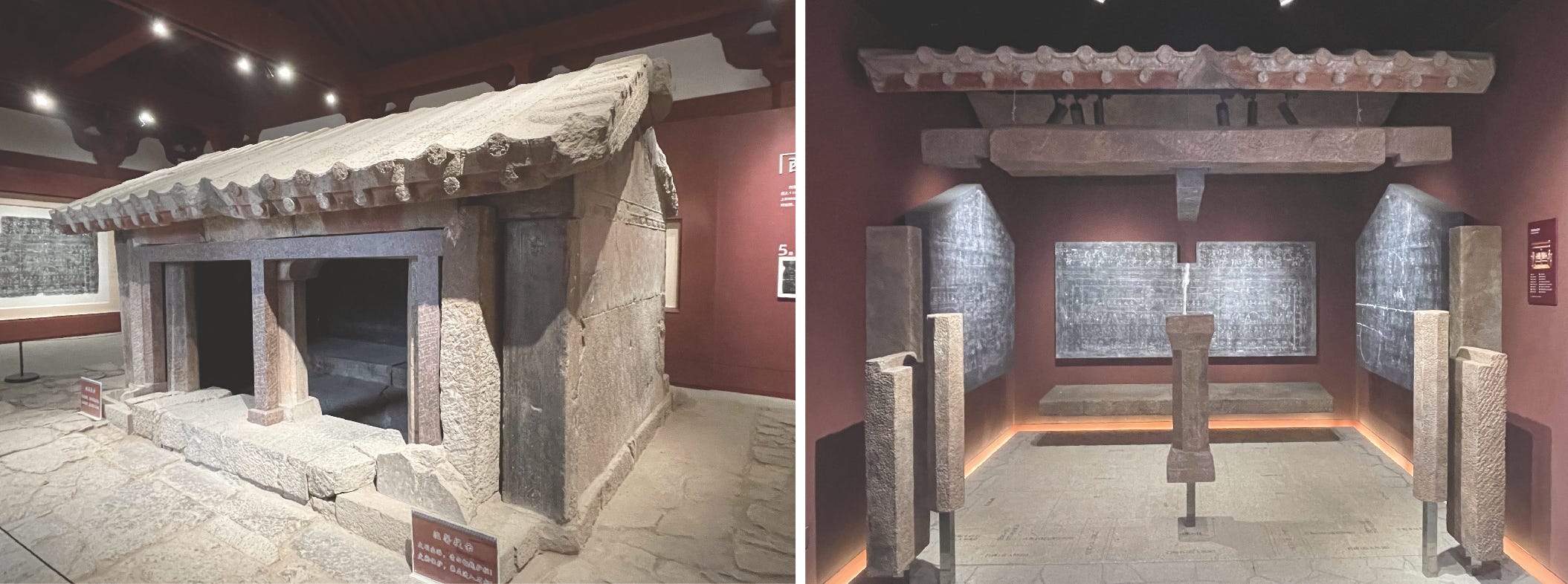
Lineage in China has always been more than blood; it is also ritual. The Han world honored the dead through ancestor worship, performed at tombs and in ancestral halls (祠堂). Two Eastern Han stone shrines in Shandong give us rare, above-ground evidence of how great (and aspiring) families displayed virtue, memory, and rank in permanent form.
Xiaotangshan Guo Family Stone Shrine (孝堂山郭氏墓石祠), near Zoucheng, is often cited as among the earliest surviving above-ground stone architectural constructions in China. Built as a freestanding memorial hall before the burial mound, it functioned as a ritual front stage where descendants could present offerings, read names, and re-enact kinship ties. Its carved reliefs show processions, banquets, and exemplary deeds, turning the Guo lineage’s values into stone pedagogy for anyone who approached. The point was not only to mourn the dead, but to teach the living—to codify what it meant to be a Guo and to anchor that identity in place.
Wuliang Shrine (武梁祠)1, in today’s Jiaxiang County, is another classic Eastern Han complex famous for its dense pictorial reliefs. Panels depict Confucian exemplars, filial piety scenes, chariot processions, mythic creatures, and historical tales. In one building you can see the curriculum of virtue that a lineage claimed for itself. The shrine was both a family temple and a public statement: the Wus were people of culture and moral standing, fit for office and leadership.
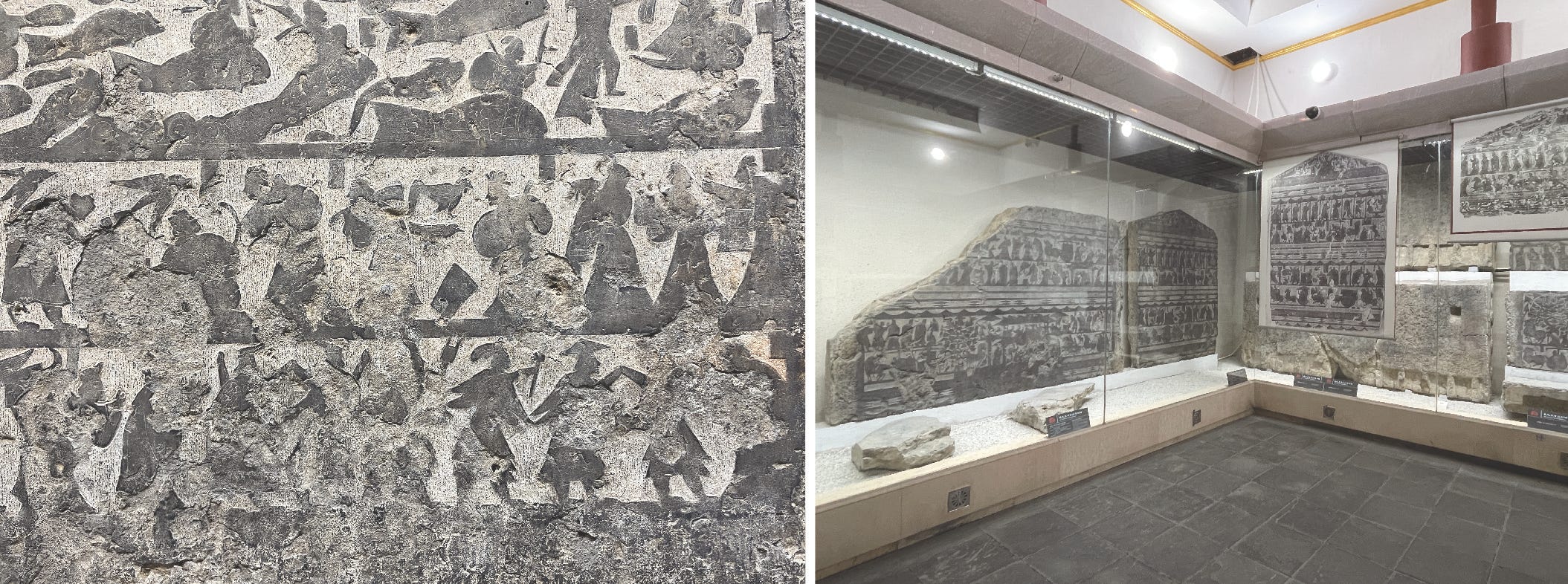
Seen together, ancestral halls show how ancestor worship fused architecture, pedagogy, and publicity into a single technology of lineage: the shrine was a ritual stage that organized memory and obedience; its carved reliefs translated family history into moral instruction aligned with filial piety, loyalty, and learning; and its prominent siting turned private mourning into a public claim of virtue, making the lineage legible to neighbors and officials alike. By fixing names, exempla, and obligations in stone, such halls taught descendants who they were and broadcast to outsiders who ought to lead, converting ritual capital into social authority. As the Han order unraveled after 220 CE, these habits of curated pedigree, didactic display, and visible place-making did not fade; they hardened into a broader politics of great names, the gate-clan mode in which eminent houses and emperors learned to co-rule through pedigree, marriage, and reputation in the long age of division.
Gate-clan politics: co-rule in the age of division
After the Han, China entered centuries of fragmentation. In the Wei–Jin and Northern–Southern Dynasties (220–589), aristocratic gate clans (门阀) dominated court politics. The famous Nine-Rank system (九品中正制) graded candidates by pedigree as much as by merit. Emperors ruled, but they ruled with the great families—often by necessity. Intermarriage between imperial houses and top lineages made co-governance explicit, and civil offices circulated within a limited circle.
These clans were not mere ornaments. They controlled staff appointments, brokered alliances, and offered continuity amid war. They also migrated. As northern courts fell, many aristocratic houses moved south, carrying with them libraries, servants, and cultural prestige. Out of this movement came a socially conservative order in which purity of lineage and classical cultivation were political resources.
The aristocratic mode had a paradoxical effect. It stabilized governance by embedding emperors in a thick web of kin and allies, yet it also limited renewal. Talent from outside the circle struggled to enter. The gate-clan age is thus remembered both for elegant culture and for the sclerosis that made reforms hard.
Sui and Tang: imperial centralization meets great names
The Sui (581–618) reunited the empire and sought to break aristocratic monopolies. Policies like the equal-field system aimed to weaken landed concentrations; early forms of the civil service examinations appeared. Yet reality moved more slowly than law. In the Tang (618–907), the court still depended on powerful lineages, especially in the early reigns.
In the Tang, certain names recur like a refrain—the Cui of Qinghe, the Wang of Taiyuan and Langya, the Zheng of Xingyang, the Lu of Fanyang, the Pei of Hedong, and the imperial Li of Longxi threaded marriages through this web, binding throne and aristocracy into a single fabric. Power worked by mixture rather than monopoly: imperial kinship lent legitimacy, great houses supplied land, learning, and clients, and the examinations opened a narrow but widening channel for talent. The blend shifted with reigns and crises, but the effect was stable enough to make governance a partnership between palace bloodlines and pedigreed elites, with merit beginning to press from below.
As the century turned and fiscal strains mounted, that pressure grew: exam cohorts thickened, equal-field landholding frayed, and hereditary privilege lost some of its grip. The result was not an overnight revolution but a slow turn that prepared the Song world, where literati lineages would eclipse old aristocracies and the state’s merit pathways would become the main road to office.
Song transformation: the fall of hereditary nobility and the rise of literati lineages
The Song (960–1279) marks a decisive turn. The state expanded the keju (civil examinations), multiplied schools, and staffed government with degree-holders. Hereditary aristocracy faded. In its place rose a broad literati-gentry whose status rested on education, office, and moral reputation rather than blood alone.
This did not kill lineage; it rewired it. In the south, especially in Fujian, Guangdong, and Jiangxi, lineages organized around ancestral halls, corporate estates, and schools. They compiled genealogies, regulated marriages, and pooled resources to push promising sons through the exam system. In the north, where villages were more scattered and warfare more frequent, lineages tended to be looser.
Land and learning now moved together. A successful degree could bring office; office brought stipends and connections; these could be converted into land and school endowments back home. The lineage became a ramp to state service and a safety net when fortunes dipped. The state grew stronger at the center, but local society, which was mediated by lineages, grew more organized.
Yuan, Ming, and Qing: the mature lineage order
Under the Yuan, and especially in the Ming–Qing period (1368–1911), the lineage reached its classical form. Ancestral halls multiplied; genealogies were updated; lineage rules governed property and conduct. Corporate land (祠产) funded rituals and village schools; lineage trusts could support widows, repair bridges, and end lawsuits. In southeastern China’s rice economies, dense settlements, irrigation, and trade favored large, cohesive kin groups.
The imperial state alternated between tolerating and restraining lineage power. It needed local elites to collect taxes, run schools, and keep order; it feared any private authority that could rival the throne. In practice, a division of labor emerged. The court defined law and appointed magistrates; gentry lineages mediated everyday life. Where the state was far, lineages were near.
Over the long run, two problems accumulated: land concentration and rank rigidity. Examinations opened a channel for mobility, but degree-holding families, which was gentry rather than old aristocrats, often stayed on top for generations. In times of population growth and tight land, tenant relations sharpened. The result on the eve of the twentieth century was a countryside rich in social organization but heavy with inequality.
The Republican decades: landlord class and lineage politics
The fall of the Qing and the rise of the Republic of China (1912–1949) did not erase lineages overnight. In many regions, especially in the south, lineages remained key to rural finance, schooling, and security. Landlord-gentry households rented out land, managed tenants, and funded schools and militias. In places with intense lineage competition, disputes over land, water, and temple property could spark long feuds.
At the same time, new forces pressed in: warlord armies, markets, Christian missions, and modern courts. Some lineages modernized their schools; others invested in transport and light industry. As overseas migration expanded, diaspora remittances financed ancestral halls and village improvements. The Republican countryside was, in short, a hybrid: old kin institutions working with, and sometimes against, new national ideas.
Land reform and the socialist decades: erasing the landlord, not the surname
After 1949, the People’s Republic of China launched radical land reform. Landlords were stripped of holdings; class labels marked families for decades. Cooperatives and then communes reorganized village life. Many ancestral halls were repurposed as schools, barns, or offices. In the north, where lineages had often been weaker and villages more dispersed, large kin groups faded quickly. In parts of the south and
southeast, where lineage institutions were thicker and overseas ties stronger, kinship survived beneath the surface. Rituals continued in muted form; genealogies were tucked away; remittances flowed quietly from abroad.
The socialist work unit (单位) in cities and large state farms in the north and interior detached livelihoods from kin. Jobs, housing, and medical care were channeled through the state rather than through family property. This did not abolish the family, but it de-leveraged it: one’s uncle could help less, one’s work unit chief could help more.
One-child, two Chinas: how policy met economy
The one-child policy, launched nationally around 1979, reshaped the demography of kin. Its enforcement varied. In urban and state-sector settings, concentrated in the north and in provincial capitals, rules tended to be stricter and compliance tied to jobs and promotion. A single child became the norm. In many rural areas, especially in southern provinces with large private-sector economies, enforcement was more flexible, with common exceptions for second births and a thriving gray zone of local practice.
The results were uneven. In many northern cities, respected officials or professionals still had only one child, which capped the size of their future kin network even when they held significant power. In parts of the Chaoshan region of Guangdong and in
