

In the Black Myth: Wukong, one of the game’s most visually stunning “sets”: a cavernous, celestial hall crowded with dynamic, colorful figures, is not a fantasy, but a meticulous digital homage to a real place: Xi’tian (小西天), the Little Western Heaven.

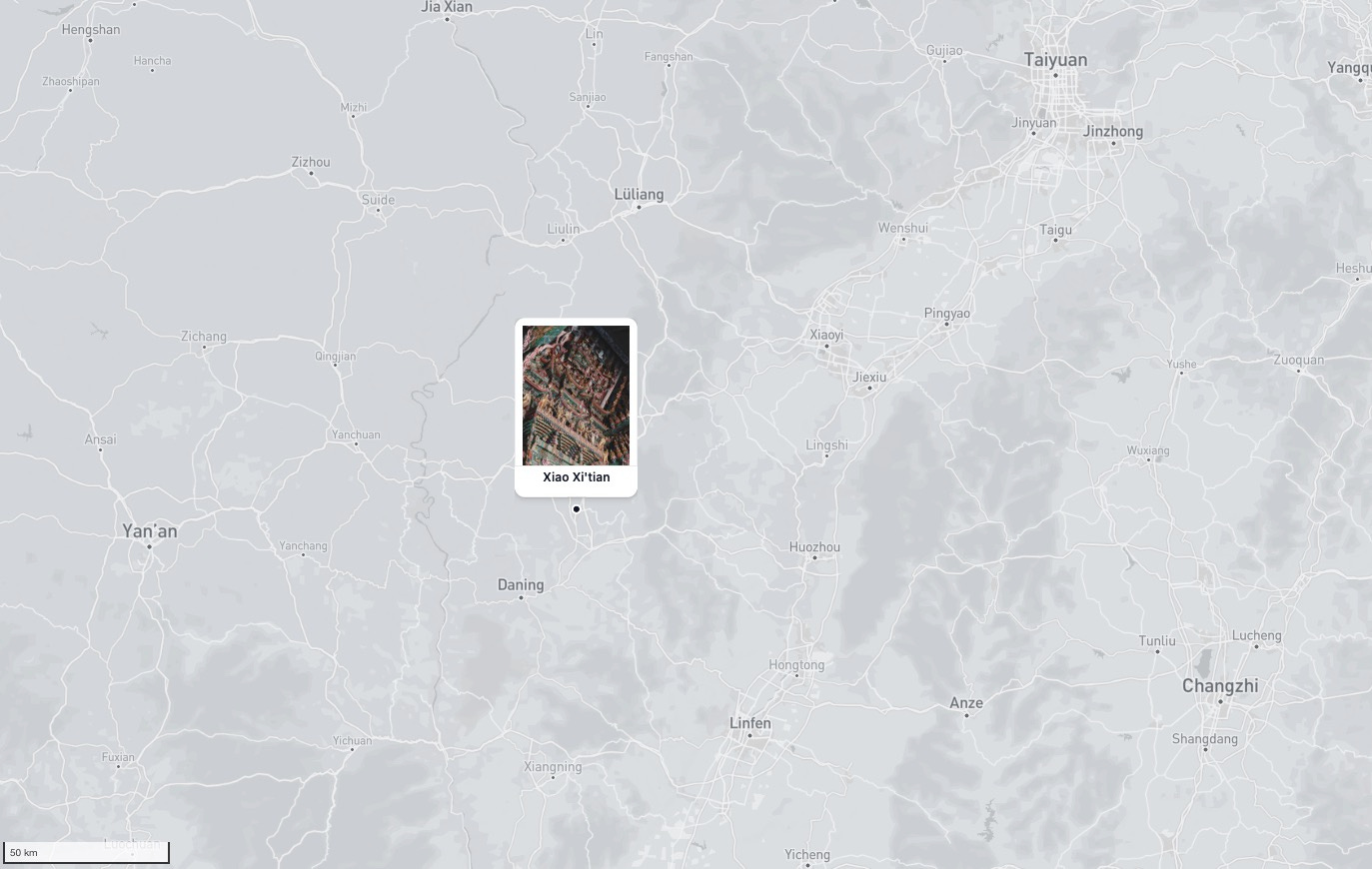
Nestled in Xixian (隰县) county within the Linfen prefecture of Shanxi province1, this Ming and Qing dynasty Buddhist complex is far more than a cultural inspiration for a modern gaming phenomenon; it is a foundational testament to the Chinese spiritual imagination. The name itself directly references the Western Pure Land of Ultimate Bliss (Xitian Jile Shijie 西天极乐世界), the paradise of Amitābha Buddha. By faithfully constructing this celestial vision on earth, Xi’tian offers a tangible entry point into the enduring faith and artistic genius that continues to shape Chinese culture.
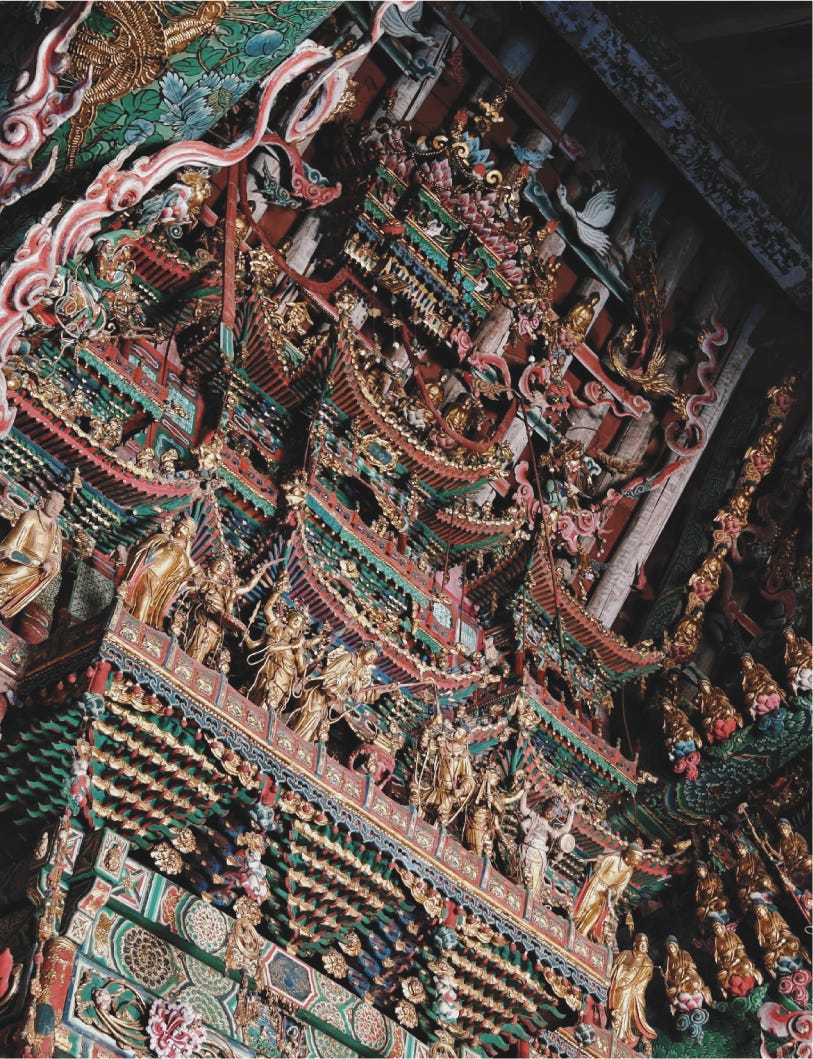
The site is a vital repository of Pure Land Buddhism, known in Chinese as Jingtu Zong (净土宗)2. This school of Mahayana Buddhism centers on the belief that salvation is attainable through deep, sincere devotion to Amitābha Buddha (阿弥陀佛). Pure Land practitioners believe that by sincerely chanting the Buddha’s name, especially the nianfo (念佛) mantra: ”Namo Amitābha Buddha”, they can be reborn in this blissful realm, escaping the cycle of suffering.
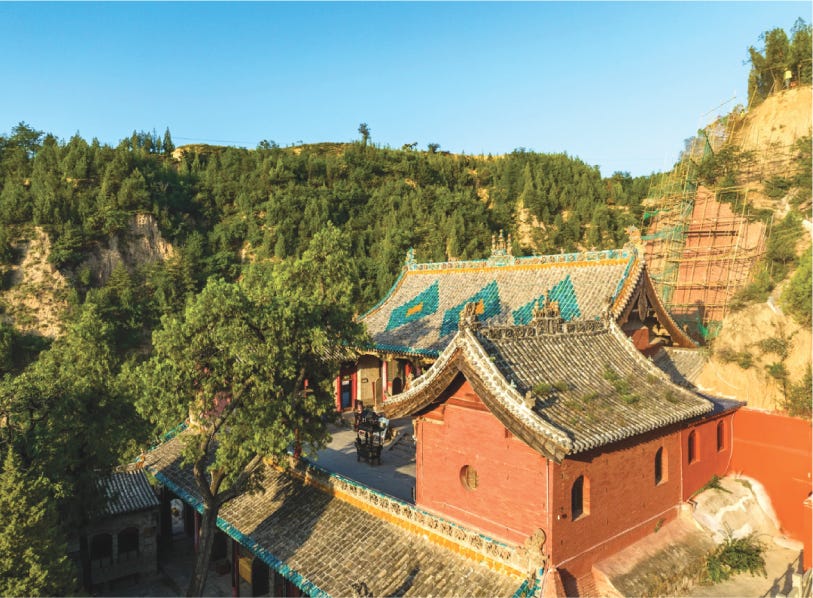

Xi’tian’s main halls are completely dedicated to visually representing this celestial vision. The most famous feature is the incredible collection of over a thousand vivid, sculpted clay figures dating back to the early Qing dynasty (mid 17th century).

Across the 170-square-meter space, a densely packed arrangement of 1,673 clay figures of various sizes creates a magnificent and awe-inspiring vision of the Buddha’s celestial realm. The entire collection of painted sculptures is broadly divided into three sections: the main rear wall and the south and north side walls. These three areas collectively form a complete divine world, densely populated with Buddhas and deities.
The south and north side walls feature simpler content, each divided into upper and lower tiers. The lower tiers each feature five of the Buddha’s principal disciples, which combine to represent the Ten Great Disciples of Śākyamuni Buddha. The upper tiers are composed of intricate pavilions, towers, and palaces, alongside numerous figures of Buddhas, Bodhisattvas, and celestial musicians (Jile Tian), crafting a panorama of the Pure Land realm.
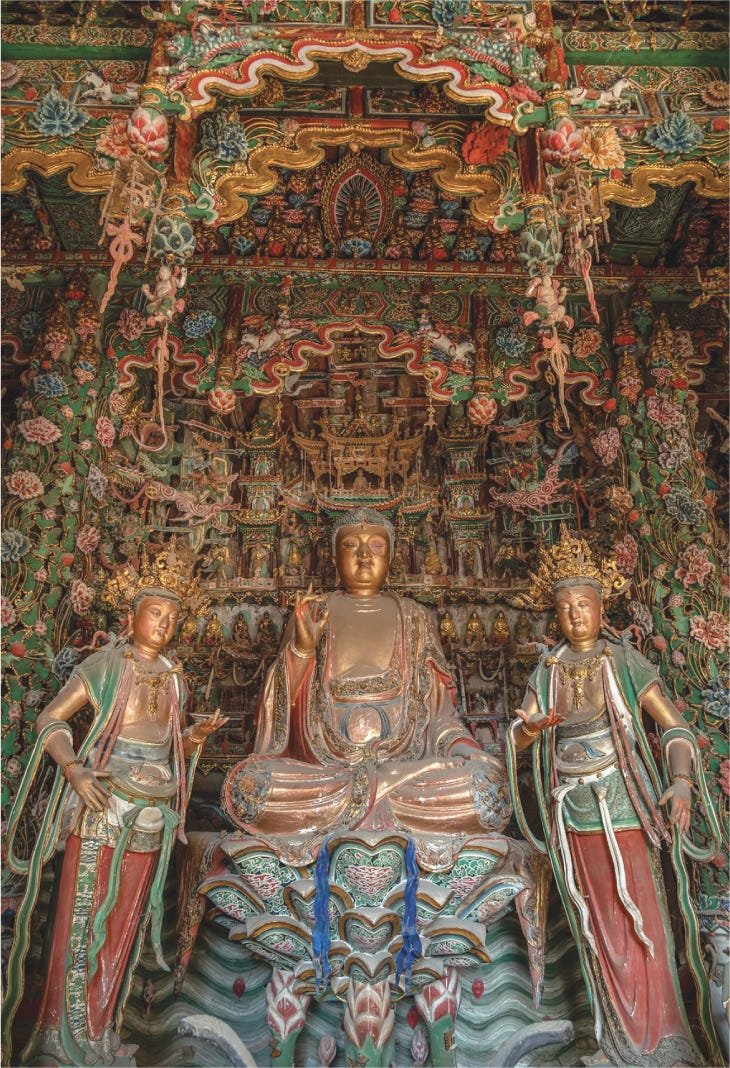
The lower section of the main rear wall contains five interconnected niches. Each niche enshrines a sculptural grouping of one Buddha and two Bodhisattvas. The specific combination of deities in each niche can be identified by the plaque above the main Buddha. The five groupings, running from south to north, are the Medicine Buddha Triad, the Western Triumvirate, the Śākyamuni Triad, the Huayan Triad, and the Maitreya Triad. This means the central Buddhas are, sequentially: Medicine Buddha, Amitābha Buddha, Śākyamuni Buddha, Vairocana Buddha, and Maitreya Buddha.
Above the five niches, mirroring the upper sections of the side walls, is a dense arrangement of layered pavilions, halls, and numerous divine beings. This upper section similarly represents the celestial palace and immortal realm of the Buddha’s Pure Lands. When viewed together with the content of the main wall’s lower section, the overall theological meaning becomes clear: Although the five niches on the main wall appear to be vertically separated, the upper and lower sections of each niche should be understood as an integrated whole. The lower section represents the Buddha, and the upper section represents the specific Pure Land realm he presides over.
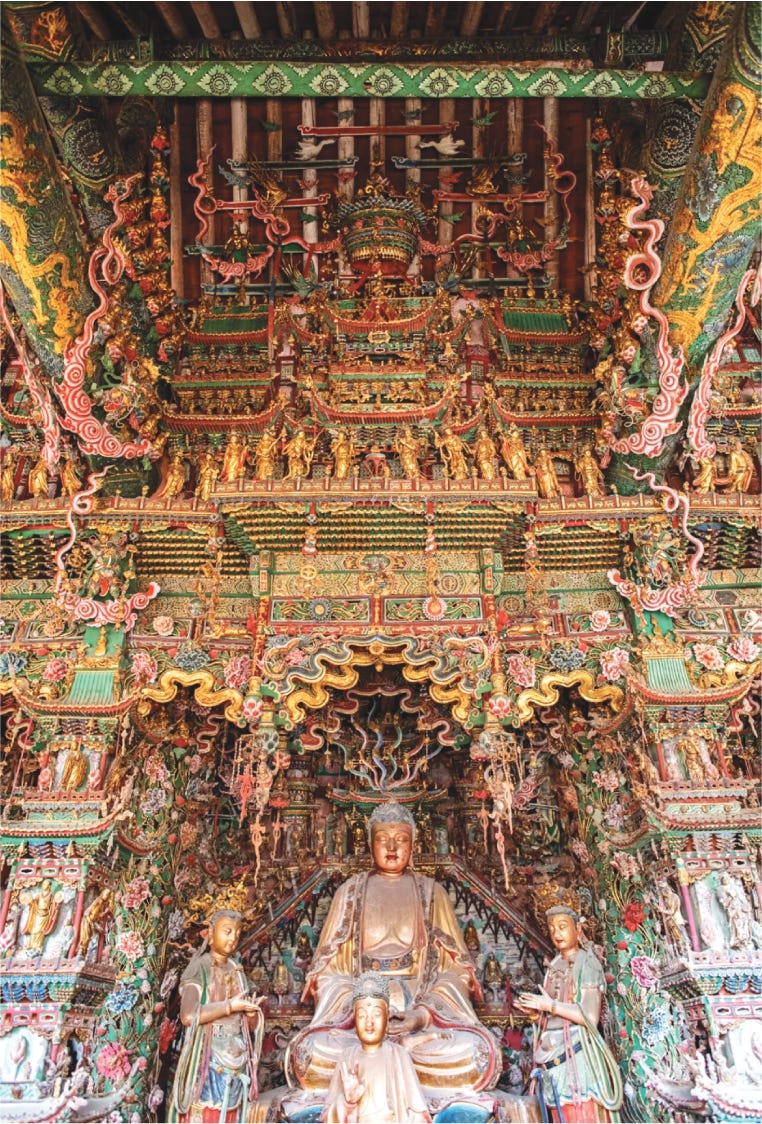
From south to north, these five integrated realms are the Eastern Pure Land (of the Medicine Buddha), the Western Pure Land (of Amitābha Buddha), the Sahā World (of Śākyamuni Buddha), the Lotus Treasury World (Huazang Zangtu, of Vairocana Buddha), and the Maitreya Pure Land. The central niche, featuring the Śākyamuni Triad in the Sahā World, corresponds in Buddhist scripture to the realistic world we currently inhabit. Here, the Sahā World acts as a spiritual bridge connecting the four Pure Lands, conveying to the faithful that by worshipping here, they may be reborn into one of the other Pure Lands after death.
For centuries, this artwork has been the primary theological text for the local populace. It’s a testament to how traditional Chinese religion integrates art and worship, transforming a remote monastery into an immersive spiritual experience.
Black Myth: Wukong has created an unexpected sensation. With the game’s release, the stunning scenes inspired by Xi’tian’s ancient architecture became an instant tourism phenomenon, drawing visitors from across the nation to this historically remote site.


For more on Linfen 临汾, a brilliant piece by David Fishman, who explores life in China’s “Most Median City”
For more on Chinese buddhism
2000 Years of Chinese Buddhism

Can you imagine that in 2025, you can practice yoga, browse an art exhibition, or even dance with a cocktail in hand—inside a centuries-old Buddhist temple in Beijing? Once solemn spaces for meditation and monastic discipline, many temples across China have been reimagined as wellness retreats, cultural hubs, or lifestyle destinations.
Another great piece today, thanks much. This winter, I'm going to Xixian County with a friend. I hope to see Xi'tian