

Note on names: I use Nanking for the Republican capital in the 1930s. I use Nanjing for the city today. The two names mark two different layers of time.
Every year on September 18, at ten in the morning a long call rises over many Chinese cities. People stop. Cars wait at green lights. The sound is an air defense siren, and it is not a real warning. It is a memorial to the Mukden Incident (918事变) of 1931, when officers of the Kwantung Army staged a railway explosion near Shenyang, Liaoning and used it to seize Manchuria. This ritual tells a simple story. The war did not begin in a single battle. It seeped into daily life, then it took cities, then it took the capital. We can see the same pattern of escalation and expansion appearing in war zones all around the world nowadays.
The names we use also carry memory. Travelers see Nanjing on maps and train tickets. Readers see Nanking in many books about the war. I keep both here with care. Nanking belongs to a capital, a decade, and a winter that still lives in testimony. Nanjing belongs to a living city with schools, heritage, and skyline. The split is not cosmetic. It helps us look clearly at how history turns into politics, and how politics shapes what people remember.
December 1937
In the autumn of 1937 the Japanese Army fought through Shanghai after months of street by street combat. The army then moved upriver and took Nanking, the capital of China, on December 13. What followed was not chaos alone. It was a program of killings, rapes, and looting that lasted for weeks. Missionaries and doctors filmed and wrote. Foreign correspondents wired dispatches. Early English reports did not always use the word massacre. Many used the phrase The Rape of Nanking1 to capture the assault on a city as a whole. The intent was to break resistance by breaking the capital. The logic was simple and cruel. If the enemy watches its seat of power degraded, the spirit to fight may fail.
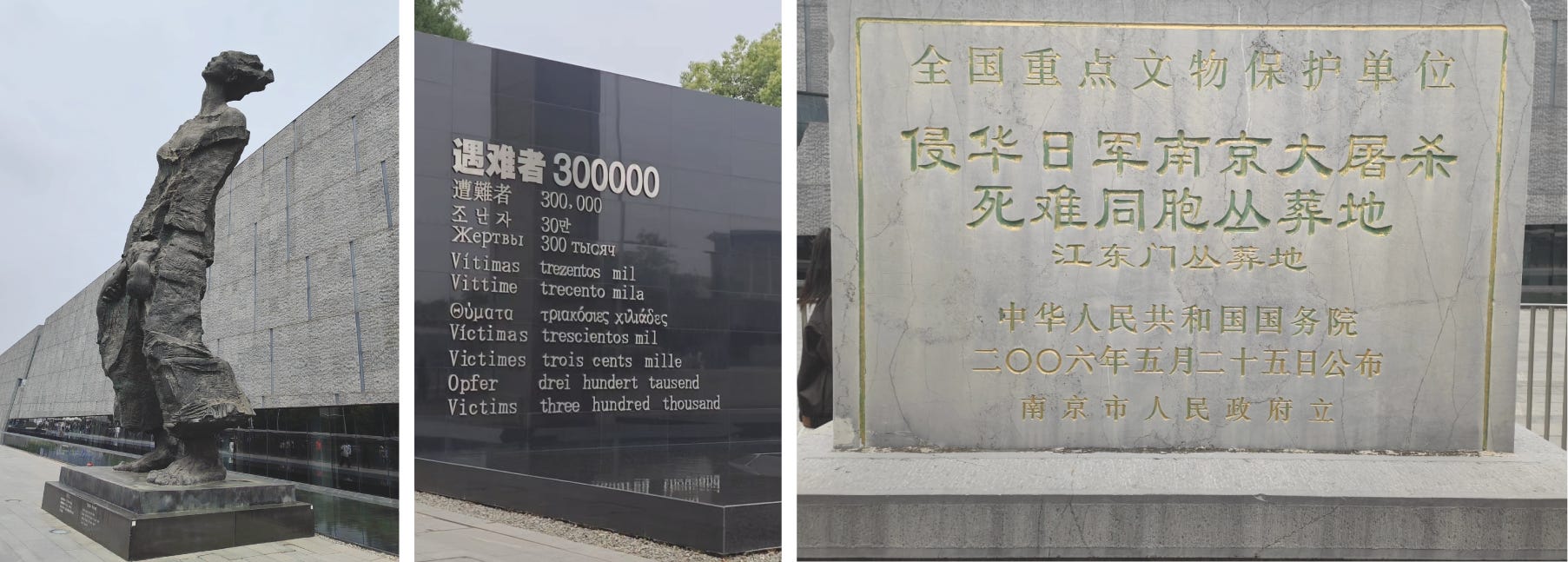
The number has become part of the ground. In public memory within China the figure is about three hundred thousand dead. Burial records, tribunal evidence, and survivor accounts shape this claim. The exact count is not the heart of the matter for families who lost people. The scale is the heart. Prisoners were shot in groups. Bodies filled the river. Neighborhoods were burned out and then emptied. The atrocity took place not in a border village and not in the confusion of a retreat. It took place inside the national capital.
This last fact matters more than many official texts will say aloud. Cities are symbols as well as places. When an enemy takes a capital and commits mass crimes in its streets, the violence reaches far beyond the city’s walls. It sends a message to every province and every court abroad. It says that the state is unable to protect its own house. That is one reason why Nanking sits at the center of East Asian memory. The word carries a weight that other names cannot match.
How Memory Went Quiet, and How It Returned
After 1949 the new state moved its center to Beijing. Shanghai became the window to the world. Nanking became Nanjing, first a centrally administered city, then the capital of Jiangsu Province. In the international arena it turned into a reference point on the way to somewhere else. There is an old test room joke. In a TOEFL warm up that asks “describe the city you live in,” many voices in one hall would begin, “I am from Nanjing, the city near Shanghai.” The line is practical. It also shows how a once central city had to explain itself to foreign ears.
In the first decades of the People’s Republic the Nanjing Massacre did not stand at the center of public commemoration. The reasons were mixed. Nanking had been the capital of the old regime. The political narrative of the new state stressed other fronts and other heroes. The government that had ruled in Nanking had moved to Taiwan and spoke about returning. Memory of the atrocity did not vanish, but the weight of official ritual fell elsewhere.
The late 1970s changed that landscape. In 1978 Yasukuni Shrine (靖國神社) in Tokyo enshrined men who had been convicted as Class A war criminals by the Tokyo Tribunal.2 News reached the public the next year. The list included wartime leaders tied to the war in China. It included figures linked by command responsibility to the crimes in Nanking. Visits by Japanese leaders to the shrine drew protests in China and Korea. As the rank of visitors rose, the response in China rose as well. Nanjing began to build large scale commemoration. The Memorial Hall of the Victims of the Nanjing Massacre opened in 1985 at Jiangdongmen, near sites where mass burial pits had been found. Concrete walls, open sky, and a severe ground plan created a language of grief that the public could walk through. In 2014 the state set December 13 as a National Memorial Day for the victims. Each year schools and work units watch the ceremony. Leaders speak of mourning the dead and seeking peace.
A thought experiment helps frame why this pattern persists. Imagine a cathedral in Cologne. Imagine portraits of men who ran Auschwitz set in a secret side niche. Imagine a chancellor entering to pray for them. You can picture the reaction in Europe. The comparison is not perfect. East Asia has different faiths and a different map of guilt and mourning. The thought still helps. It shows why the word Yasukuni opens an old wound whenever it returns to the news.
Why Nanking Holds Special Place
China has many museums and sites of memory for the war with Japan. Shenyang has the September 18 museum. Harbin keeps the story of Unit 731 and its experiments. Near the Marco Polo Bridge (卢沟桥) in Beijing stands a national war museum. Many provinces built local memorials for massacres, forced labor, and bombings. Outside China, when people hear the word massacre in this setting, they often think first of Nanking. It is not only because the number is large. It is because the atrocity took place in the capital. That quiet detail gives the word its international charge. Chinese public scripts do not always stress this political point. The museum texts speak about victims, evidence, and peace. The capital factor sits under the surface like bedrock. It shapes how every new dispute is read.
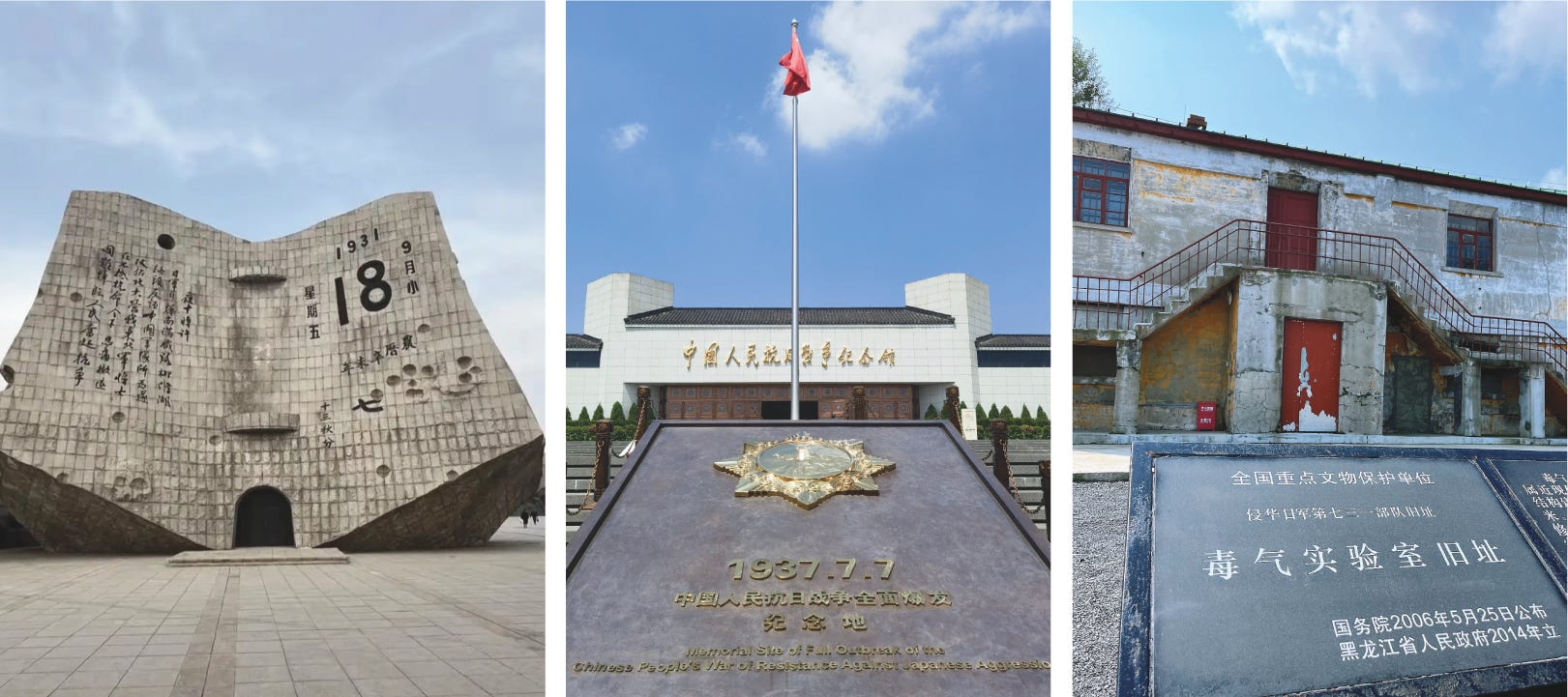
The land itself is part of this archive. Old residents avoided parts of the west bank for years, an area marketed today as Hexi New Town. The ground had a reputation for heaviness. Excavation and construction exposed mass graves and human remains from the occupation period. The main memorial now stands nearby. Bridges and towers rise over the district. Sports venues and shopping streets fill the map. The soil below still keeps a ledger in bones and ash.
The City of Stone and Pine
Nanjing is a city of wounds, but it is not only that. It has been a capital many times. In Chinese history, when the north fell to foreign invaders, the court often retreated south to Nanjing to regroup and defend. The Six Dynasties placed their courts here. The Ming defeated the Mongol Yuan Dynasty in Beijing and first chose Nanjing as their capital, only later moving north to guard the frontier.
The Taiping Heavenly Kingdom (太平天国) also made Nanjing its palace city, presenting itself as the heir to the Ming and as a challenge to the Manchu rulers of the Qing. After the 1911 revolution, the Republic of China chose Nanking as its seat, repeating the same pattern of southern refuge and renewal.
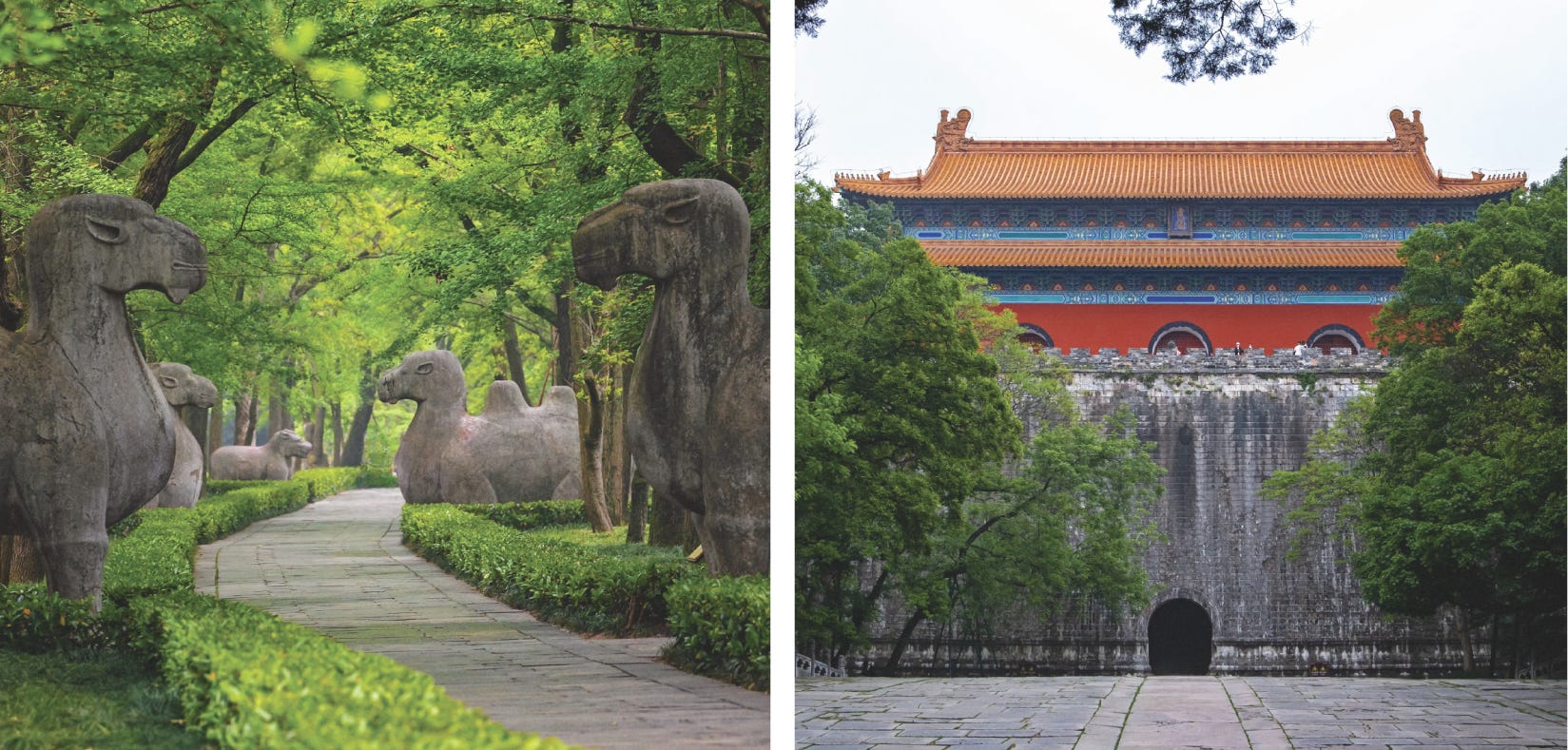
Each of these eras left walls, arches, tombs, and gardens. The great Ming city wall still circles much of the city, one of the best-preserved in the world. Ming Xiaoling (明孝陵), the tomb of the dynasty’s founding emperor who defeated the Yuan and restored Chinese rule, remained respected even by the Qing emperors and later by Japanese occupiers. On Purple Mountain (紫金山), temples and lakes mark the slopes with a quieter memory.
The Republican period brought another layer. Leaders tried to define a modern Chinese style. The Sun Yat-sen Mausoleum, with its long stair rising through pines to a roof of blue tiles, combines grandeur with restraint. Inside the sacrificial hall, the ceiling holds the emblem of the early Republic—the Blue Sky with a White Sun. Visitors today, carrying different passports and political loyalties, still stand under it. In the Linggu scenic area stands the Linggu Pagoda, built in the 1930s to honor fallen soldiers of the National Revolutionary Army. Stonework in nearby halls still bears the emblem of the Kuomintang. These marks survived the fall of governments, wars, and campaigns. They remain as quiet witnesses to a century that tried to invent a new nation and then saw that nation broken.
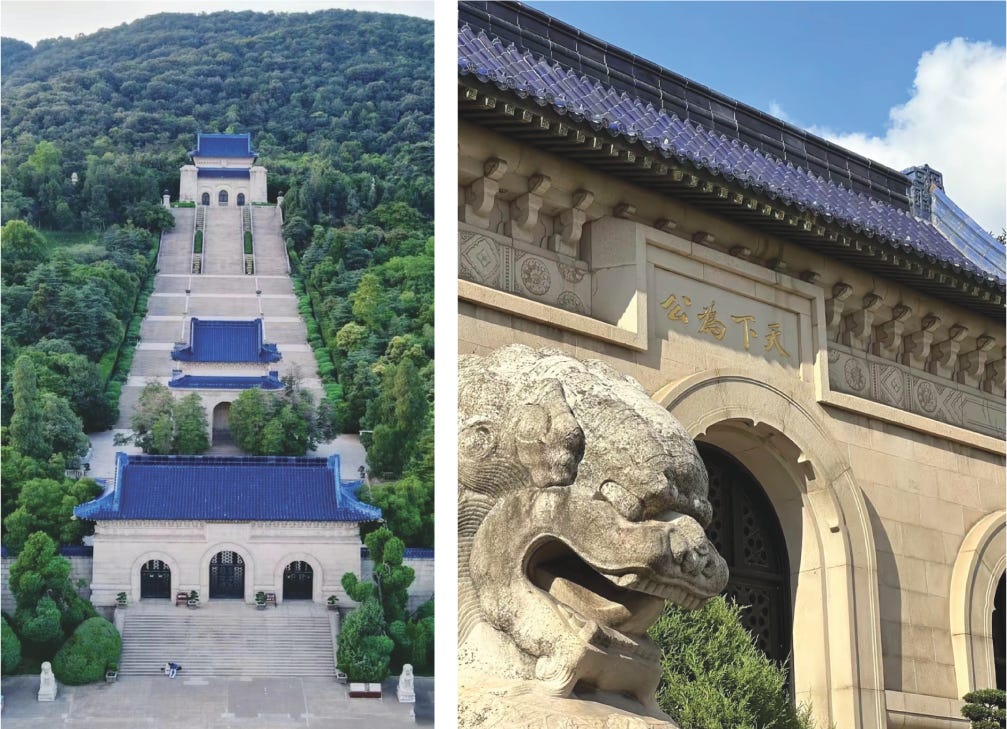
Walk across this landscape in a single day and the layers come into focus. At Jiangdongmen, the Memorial Hall to the Nanjing Massacre stands open to the sky, its walls stark and heavy. A short ride brings you to Purple Mountain, where the long stair leads to Sun Yat-sen. The emblem above reminds you that Nanking was not only a place of loss but also of hope. Another path leads to Linggu, where the pagoda recalls young men who died before peace. In a compact space the city offers a lesson: how modern China was imagined, destroyed, and then reimagined.
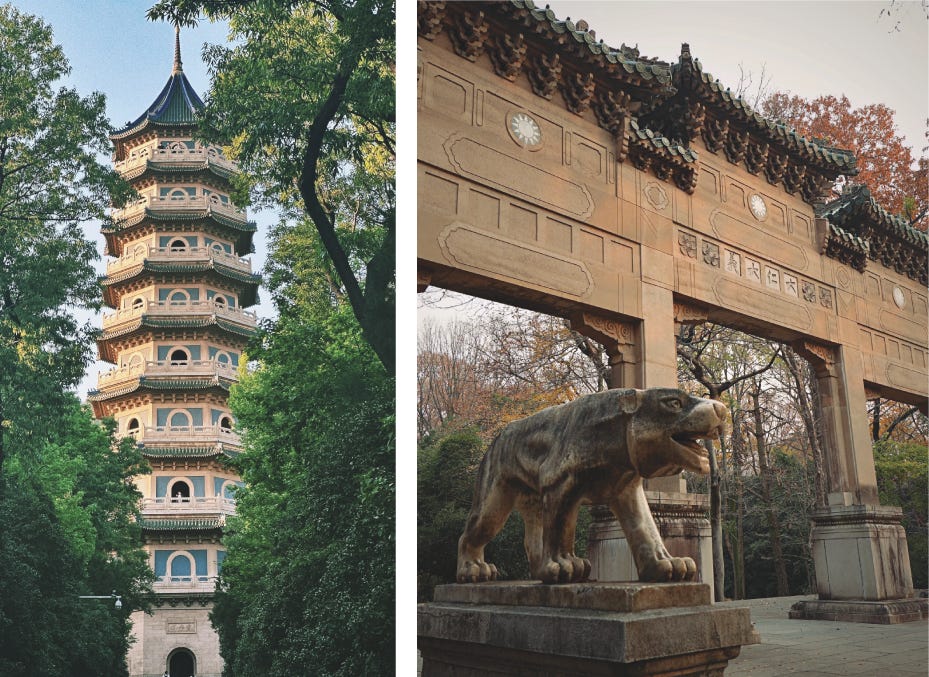
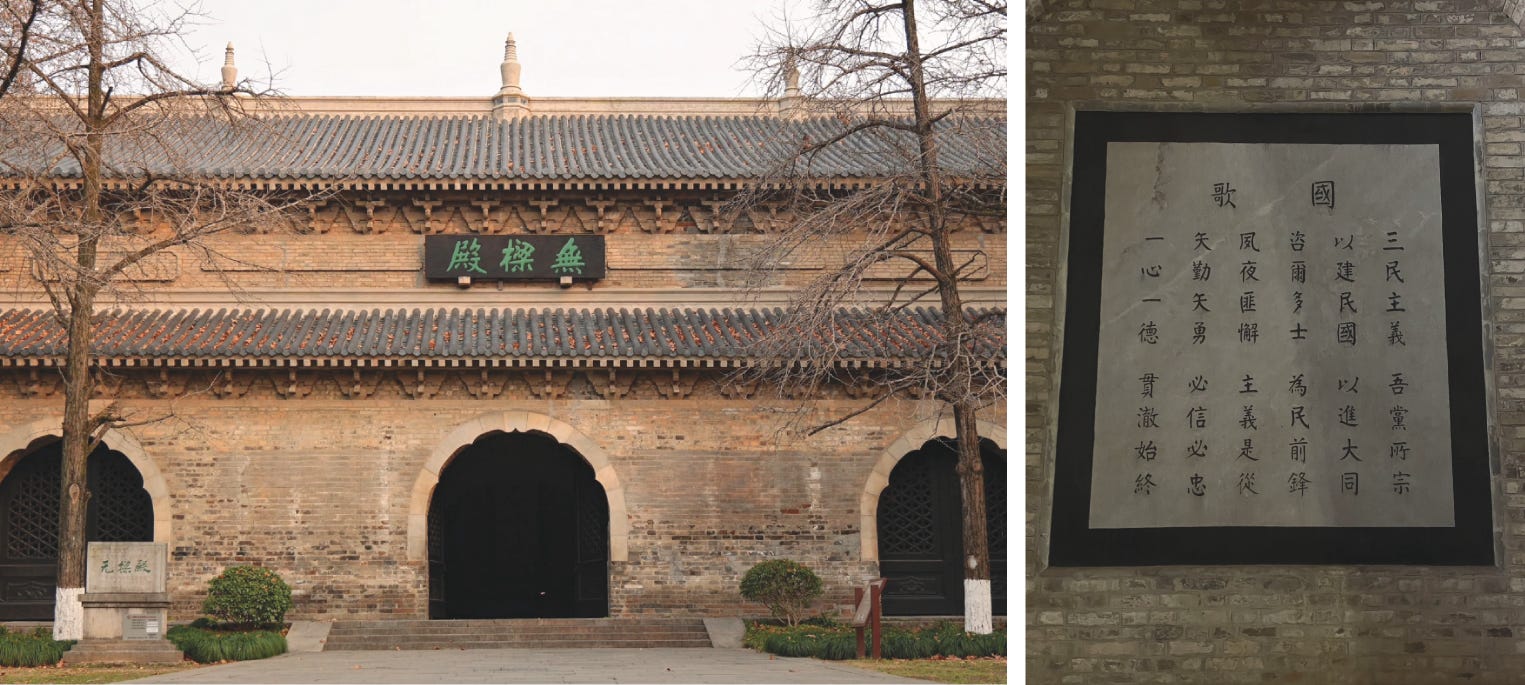
Nanjing, its name meaning South Capital, compresses into one place a mirror of Beijing, the North Capital. To walk its hills and walls is to feel both the weight of tragedy and the endurance of renewal.
Memory as Daily Weather
The way a country remembers a war changes the way it reads the present. China and Japan trade at scale. Tourists cross the sea in both directions. Students fill classrooms in Tokyo, Kyoto, Nanjing, and Shanghai. Yet news of a textbook change or a leader’s visit to a shrine still triggers old reflexes in both places. The islands that Japan calls Senkaku and China calls Diaoyu remain a point of friction at sea. Coast guard ships watch each other at close range. Each new encounter draws power from old memory. You can feel this if you stand in the plaza at Jiangdongmen and read names carved in stone. Security debates sound different when you can touch a wall of names.
This is what collective trauma looks like when you step away from theory. It is not only a medical term. It is a pattern of ritual and recall that sits under daily life. The September 18 siren trains a habit of attention. The December 13 ceremony gathers images and words. Classroom films show missionaries who hid people in safety zones. Museum exhibits show diaries and burial maps. The content of these practices changes over decades, yet the direction is steady. The lesson is to remember the dead and affirm national dignity. The official tone often adds a second clause. Seek peace and avoid hatred. The two clauses exist in tension, and the tension is part of the civic message.
Why Tension Persists
People often ask why China and Japan still struggle to trust each other. The short answers are about strategy and law. There are disputes at sea and treaties on land. There are alliances and elections. Behind those answers sits memory that no treaty can cancel. A capital was taken in 1937. Its people were abused and killed. Survivors told their stories. Foreigners wrote what they saw. Courts judged some of the responsible men. Others were never judged. The dead do not return, and the ground does not forget.
When the siren sounds next September many will stop again. They will think of 1931 and 1937. They will think of a capital with two names. They will resume their day after three minutes. Memory will not move on. It will sit where it has sat for almost ninety years. It will sit in Nanking. It will sit in Nanjing.
The Nanking Atrocity: Still and Moving Images 1937–1944
https://www.cogitatiopress.com/mediaandcommunication/article/viewFile/145/101
Japan’s Wartime Leaders Enshrined https://www.washingtonpost.com/archive/politics/1979/04/21/japans-wartime-leaders-enshrined/184bad9a-2f3c-4056-bc6f-9a763a2174ee/
Enshrinement Politics: War Dead and War Criminals at Yasukuni Shrine https://apjjf.org/akiko-takenaka/2443/article
A moving explanation for a period and events that many struggle to understand.
A good and poignant read!