

Every year around early June in China, Millions of teenagers walk into guarded schoolyards. Streets are cleared of noise. Police cars block traffic around exam centers. Parents wait outside with bottles of water and good luck charms. Some hold banners that say Victory in Gaokao. Inside the classrooms students sit in rows, heads bent over test papers that will decide their futures. For two days the nation holds its breath. The college entrance exam, or gaokao (高考), is the largest synchronized exam in the world. More than ten million young people take it each year.
This is not a new story. For two thousand years Chinese society has used exams to decide who rises and who falls. From the earliest dynasties to the present, examinations have been the ladder to power, wealth, and honor. They shaped China’s bureaucracy, its philosophy, and its culture. Today the obsession with testing has produced vast industries of tutoring and preparation. Yet it has also brought exhaustion, inequality, and doubt. The story of exams in China is not just about schools. It is about how a civilization has defined merit, legitimacy, and hope.
Recommendation and virtue
Long before standardized tests, the Han dynasty (206 BCE to 220 CE) tried to select officials based on virtue. Local governors were asked to recommend men of filial piety and honesty, the system known as ju xiaolian (举孝廉). In theory it gave recognition to moral character. In practice it often favored local elites and families with connections. Still, it set a precedent. The state could reach beyond bloodlines and look for talent.
This was the beginning of meritocracy, however imperfect. The idea that study and personal conduct could open the way to office became part of China’s political imagination. Later dynasties would try to build something more systematic, something that did not depend only on recommendation. Out of this came the civil service exam, or keju (科举).
The Imperial Exam Machine
By the Tang dynasty (618 CE to 907 CE), exams were no longer local recommendations but written tests held by the state. At first they covered poetry and classical knowledge. Over time they became the main path to the bureaucracy. The system lasted more than a thousand years, reaching its peak under the Ming (1368 CE to 1644 CE) and Qing (1644 CE to 1912 CE).
The exams were brutally competitive. Candidates studied for years in small rooms, memorizing the Confucian classics. At the highest level only a few hundred were chosen from tens of thousands. The winners became scholar-officials, members of the ruling elite. Passing the exam meant more than a job. It meant honor for the family and prestige for the village.
The system had several levels. The xiangshi (乡试), or provincial exam, was the first great hurdle; passing it gave the title of juren (举人). The next was the huishi (会试) in the capital, and finally the dianshi (殿试) held in the imperial palace before the emperor himself. Success brought privileges far beyond office. A juren could be exempt from corvée labor and some taxes, and his family shared in the prestige. At the highest level, a jinshi (进士) not only entered government service but also gained social status equal to nobility. In villages and towns the celebration of a new juren or jinshi was like a festival, with arches, parades, and ancestral honors. The exam titles gave power, security, and honor that lasted for generations.

The format also narrowed thought. By the Ming dynasty, the eight-legged essay (八股文, meaning Stereotyped Writing / Stylized Writing) dominated. This rigid style demanded that every answer follow set patterns. Innovation and personal voice were punished. Zhu Xi (朱熹, 1130 – 1200), the great Neo-Confucian thinker of the Song dynasty, had his commentaries elevated as the official interpretation of the classics. The exam froze his words as the single path to success.
Yet the system brought stability. It allowed poor but talented men to dream of office. It gave China one of the earliest large-scale merit-based bureaucracies in the world. The imperial exam shaped a culture where study was not only self-improvement but the gateway to power.
Learning as Morality
The imperial exams did more than train administrators. They tied knowledge to virtue. To memorize the classics was not only to pass a test. It was to absorb a moral system. Neo-Confucianism taught that personal cultivation and social order were linked. Reading, writing, and reciting were acts of self-discipline.
At the same time, the rigidity of the exams created tension. Scholars often complained that real thought was stifled. Poetry declined, philosophy narrowed. In the late Ming dynasty, Wang Yangming (王阳明, 1472 – 1529) challenged the dominance of Zhu Xi. He argued that true knowledge came from within the heart, not from memorizing texts. His idea of the unity of knowledge (知行合一) and action gave room for personal moral insight. A student should not only recite but also live out what he learned.
Still, the image of the upright scholar, brush in hand, became China’s cultural ideal. The shi dafu (士大夫), the class of scholar-officials, stood as the model of what it meant to live with dignity. He was expected to master the Confucian classics, serve the state with loyalty, guide society with moral clarity, and retreat into poetry or teaching when politics turned corrupt. His robes, calligraphy, and calm posture represented a life where learning and virtue were joined. For centuries this figure shaped how families imagined success: not through wealth alone, but through becoming a cultivated person who could rule, write, and act with honor. Learning was not only useful. It was noble.
Collapse and Reform
In 1905, under the pressure of reform and Western influence, the Qing dynasty abolished the civil service exam. After more than a millennium, the great machine stopped. Modern schools began to replace academies. New subjects like science and engineering appeared. But the habit of linking exams with state power did not disappear.
The Republic of China went so far as to create an Examination Yuan (考试院), one of five branches of government. Sun Yat-sen (孙中山), the founding father of the republic, admired the Western principle of separating powers into the executive, legislative, and judicial. Yet Sun argued that a modern Chinese republic should not simply copy the West. It should build a system that reflected both imported ideas and native institutions. The result was the so-called five-power constitution (五权宪法). In addition to executive, legislative, and judicial branches, Sun added two more: the Examination Yuan to oversee civil service recruitment, and the Control Yuan (监察院, also derived from traditional Chinese Censorate institution) to monitor government integrity.
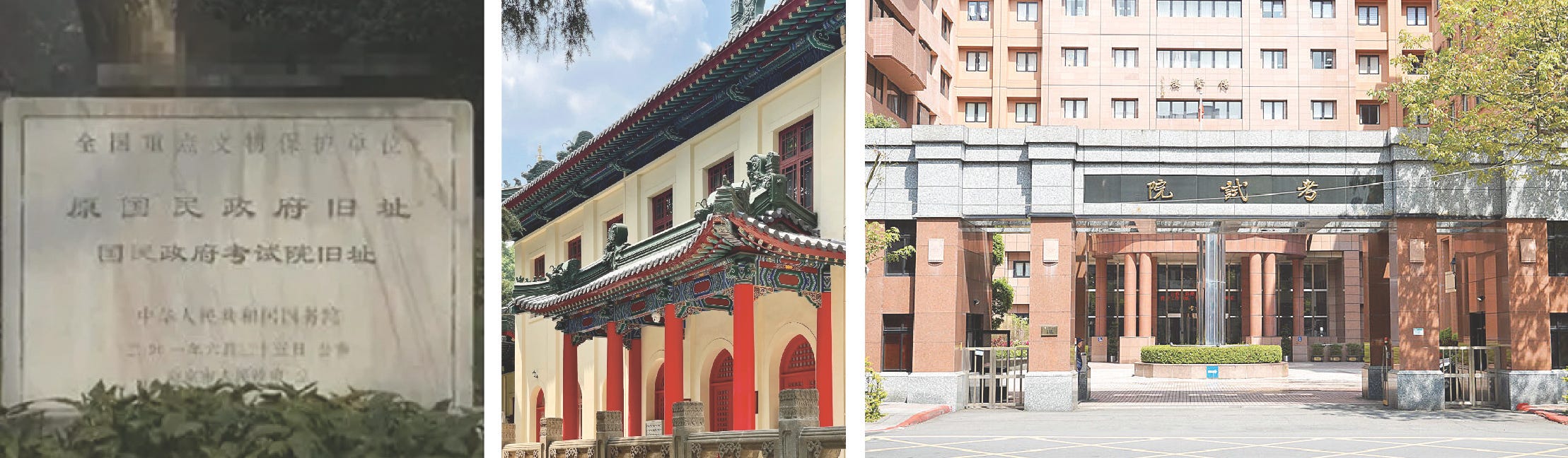
The Examination Yuan carried forward the legacy of the imperial exams, now dressed in modern bureaucratic form. In theory, it professionalized the state, making entry based on merit rather than favoritism. In practice, it also showed how deeply the exam culture was woven into Chinese political life. Even in a new republic inspired by Western ideals, the logic of testing remained part of the structure of government itself.
The Gaokao and the People’s Republic
After 1949, the new People’s Republic of China built its higher education system on the Soviet model. Universities were specialized. One school trained engineers, another trained teachers, another trained doctors. Exams sorted students into these tracks.
During the Cultural Revolution from 1966 to 1976, the gaokao was suspended. Universities admitted students based on class background and political loyalty. For a decade, intellectual life was silenced.
In 1977, Deng Xiaoping restored the gaokao. The announcement shocked the country. Millions of young people who had been sent to farms and factories rushed to prepare. Some were in their thirties, studying by kerosene lamp. That first exam after the Cultural Revolution became a national drama. It symbolized the return of merit, the return of hope.
Since then the gaokao has been the central ritual of Chinese education. It is a test of endurance and memory, covering Chinese, math, and a foreign language, plus sciences or humanities. For many families it is the single most important event in their child’s life.
The Industry of Preparation
Around the gaokao grew a vast world of preparation. Cram schools, tutoring centers, and after-school programs flourished. Companies built business empires on test prep. Giants like TAL Education (好未来, NYS: tal) and New Oriental (新东方, NYS: edu), both listed on Nasdaq, became symbols of China’s tutoring industry — enterprises that sold not just education but the promise of advantage in an exam-driven society. Parents spent huge sums, believing that extra lessons could raise scores by a few points that might change a child’s fate.
The culture became known as chicken-baby (鸡娃), where children were pushed like little chicks being stuffed with food. Even elementary students faced endless homework and mock exams. The stress produced both excellence and exhaustion.
The government tried to intervene. In 2021 the double reduction policy limited tutoring and banned for-profit after-school classes in core subjects. But demand did not disappear. Families found underground tutors. The exam culture proved stronger than regulation.
University Expansion and Cheap Tuition
From the late 1990s China expanded its universities at record speed. Enrollment multiplied. Campuses spread across cities and towns. Almost every student who passed gaokao could now find a seat somewhere.
Tuition remained low compared to global standards. This was a legacy of socialism. The state covered much of the cost. It is often the case that the better the university, the lower the tuition. Peking University, considered one of the best universities in China, charges undergraduate tuition of around 6,000 yuan per year (about 830 US dollars) for domestic student. Dormitory rent is heavily subsidized at roughly 2,000 yuan per year (about 280 US dollars). Students also receive additional subsidies for meals in the campus canteens.
University was seen as a public right, not a private commodity. A degree promised a good job and social mobility. Families sacrificed everything for it. But expansion brought new problems. Degrees became common. A bachelor’s diploma no longer guaranteed prestige. Employers began to demand master’s degrees, then overseas study. The value of credentials declined. Meanwhile, universities have started to raise tuition, eroding one of their old advantages.
A Turning Point
The exam culture even reshaped the housing market. For years the phrase xuequ fang (学区房) — school-district housing — drove up real estate prices in big cities. Because primary school admission was tied to family residence, parents poured millions of yuan into small, old apartments known as lao po xiao (老破小), just to secure a spot in a top elementary school. These purchases combined the education race with the real estate boom. In recent years the legend has broken. Families now weigh the soaring costs against the uncertain rewards, as stories circulate of graduates with elite schooling who still struggle to find jobs.
Today Chinese students and parents still value education deeply, but cracks are visible. Some young people speak of lying flat (躺平), choosing to give up on fierce competition. Others turn to vocational training or overseas paths. The cost of education is rising. The guarantee of success is fading. The old bargain — hard study for a secure future — is less certain. Yet the belief in exams remains. Families still see them as the fairest, if harshest, way to distribute opportunity.
The story of exams in China is a story of faith and doubt. For two thousand years people believed that the way to rise was through study. That belief built a nation of exam. Now the nation stands at a crossroads, asking whether exams can still carry the same promise in a changing world.
The rise of artificial intelligence sharpens the question. Machines can already draft essays, solve math problems, and translate texts in seconds. The very skills once measured by exams — memory, calculation, recitation — may soon lose their value. If AI makes these old measures obsolete, then the system that built generations of merit may need to reinvent itself. For families and students, the challenge is not only to prepare for the next test but to imagine what kind of learning matters when machines can already pass with perfect scores.
The dream of rising through study still endures, but it no longer feels unshakable. A nation of exam is now pressed to rethink what merit means in the age of algorithms.
If my insights brought you a fresh perspective, please consider supporting me by buying me a coffee. Your generosity fuels my writing.
I love your essays. They are so on point. I wonder if you thought about writing about ancestor worship, lineage and the clan.
https://substack.com/@nealshultz1/note/p-174332584?r=k7ywv&utm_source=notes-share-action&utm_medium=web