

Inside the Forbidden City there is a small side room behind the Hall of Mental Cultivation (养心殿). With its lower ceilings, tighter space, and area of only eight square meters, it feels more like a modest study than an imperial hall. In the eighteenth century, this west warm chamber had a different name: Sanxi Hall (三希堂), the Hall of Three Rarities.
On a desk in that room, the Qianlong emperor (Reign 1735-1796) kept three sheets of paper he valued more than almost anything else in the palace. They were short letters written more than a thousand years earlier by three members of the Wang family:
Wang Xizhi’s Kuaixue Shiqing Tie ( 王羲之, 快雪时晴帖, “Timely Clearing After Snow”),
Wang Xianzhi’s Zhongqiu Tie (王献之, 中秋帖, “Mid-Autumn”),
Wang Xun’s Boyuan Tie (王珣, 伯远帖, “Letter to Boyuan”).
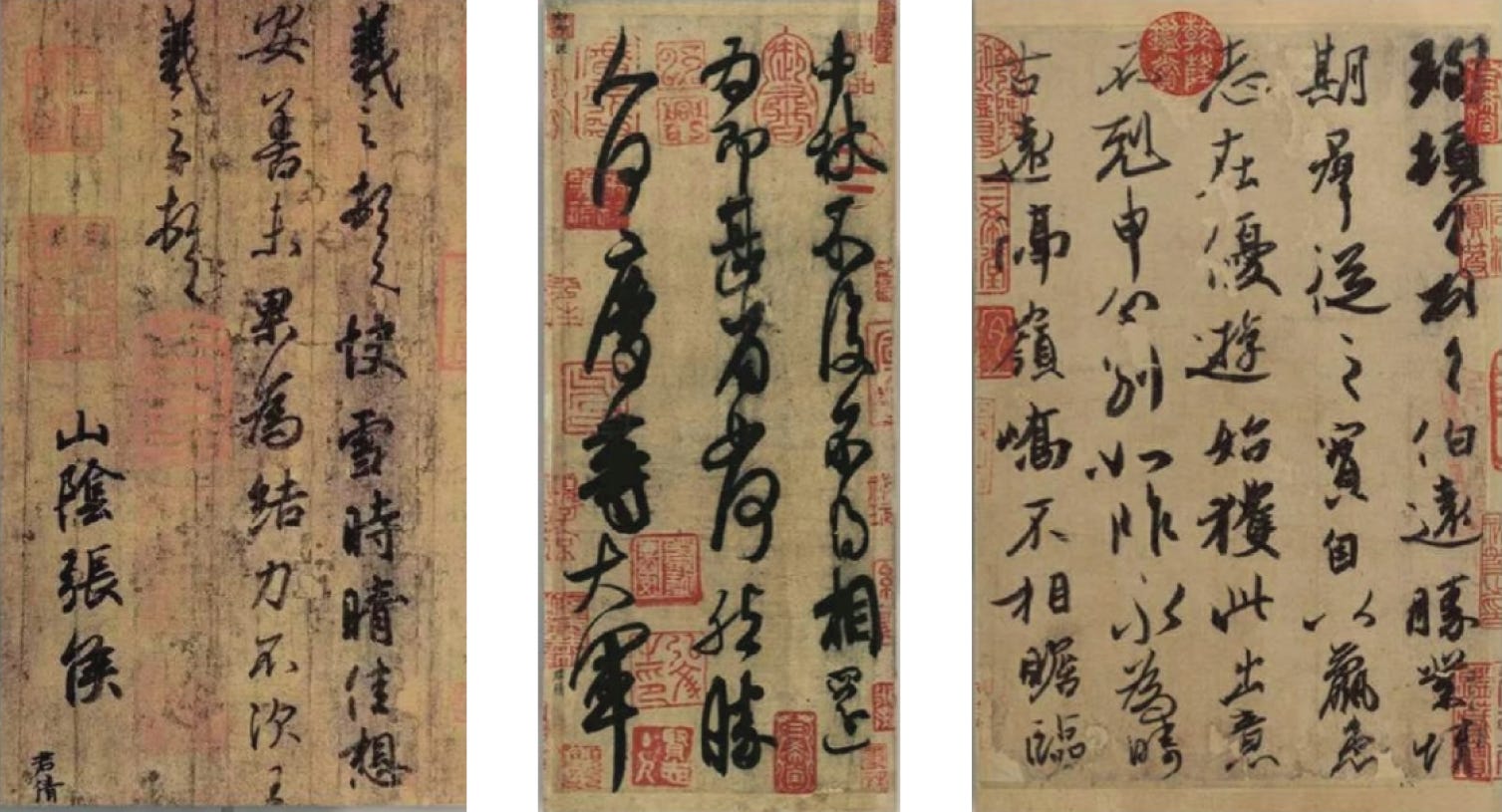
Qianlong called them the “Three Rarities.” Sanxi Hall (Hall of Three Rarities) took its name from these pages. In an empire full of huge halls and heavy ritual objects, his most prized works of art were three pieces of paper that fit in one hand.
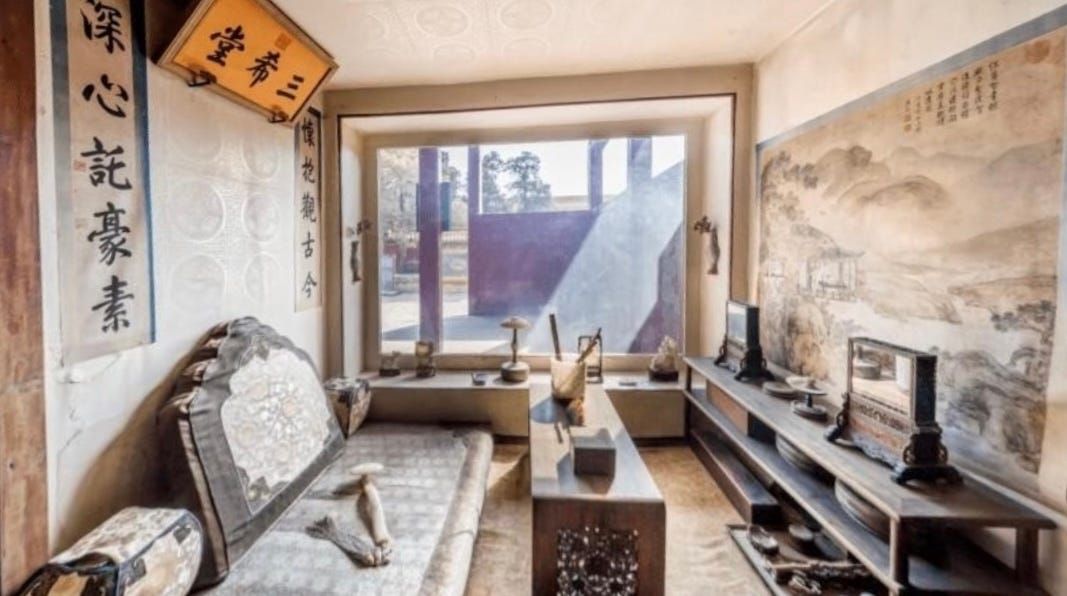
Today, those three works no longer sit in the same room.
After the 1911 Revolution and before Puyi was finally expelled in 1924, Zhongqiu Tie and Boyuan Tie were kept not in Sanxi Hall but in a quiet corner of the Inner Court: Shoukang Palace, the residence of the Dowager Consort Jingyi 敬懿皇贵妃. When Puyi was forced out of the Forbidden City, Jingyi took the two scrolls with her. They passed through her relatives to antique dealers and then to a private collector. Only in 1950 did they reappear on the Hong Kong art market, In 1951, on Premier Zhou Enlai’s instructions, they were bought back and deposit in the Beijing Palace Museum.
Kuaixue Shiqing Tie, the third of the trio, took a different route: it traveled with the Nationalist government and is now a star of the National Palace Museum in Taipei.
That split is a miniature of a larger story: how one palace collection was divided by war, revolution, and geography, and how it became two different institutions that both call themselves, the “Palace Museum.” One has the palace. The other holds many of the palace’s most carefully chosen treasures.

A palace that outlived its rulers
For nearly five hundred years, the Forbidden City in Beijing was the nerve center of the Ming and Qing empires. It is a diagram of power made out of stone and wood.
Then, in 1912, the emperor stopped ruling, but the palace did not stop existing. Puyi (the last emperor) abdicated yet remained inside the inner court as a kind of well-kept prisoner. The outer court opened in awkward, semi-public ways. The palace had lost its political function but not yet gained a new one.
By that point, the imperial collection was already leaking out. The great catalogues of court painting and calligraphy—the Shiqu Baoji 石渠宝笈 volumes that had once served as Qianlong’s “treasure list”—describe works that, by the late Qing and early Republic, were largely flowing out of the Forbidden City. Some left through formal imperial gifts. Others disappeared in fires and foreign looting in the nineteenth century.
After 1912, eunuchs smuggled objects into Beijing antique shops, and when their theft was nearly exposed in 1923, they set fire to the Palace of Established Happiness, destroying or dispersing thousands of Qianlong’s favorite pieces. Later, Puyi himself joined the trade, secretly moving paintings and antiques out through his brother, and even using palace treasures as collateral to borrow money from banks. So when people talk about the Palace Museum “inheriting” the Qing court’s collection in 1925, they are talking about what was left after a long, messy hollowing out.
In 1924, after a coup in Beijing, Puyi was finally expelled from the Forbidden City. For the first time since the early 1400s, the palace had no resident emperor. The following year 1925, officials established the Palace Museum in Beijing. Drawers were opened; storerooms were inventoried. Objects that had been private extensions of the throne, Seals of State, ritual bronzes, jade ornaments, inkstones, albums of painting and calligraphy, were recast as “national treasures.”
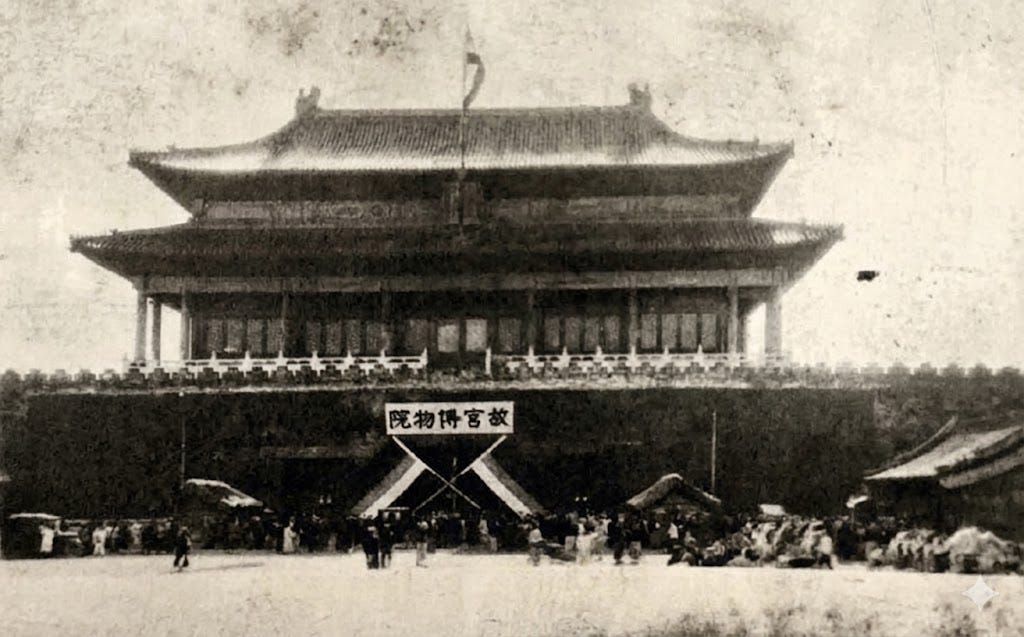
It was a quiet revolution. The Republic was unstable and often violent, but in this one move it did something profound: it declared that the emperor’s house and the emperor’s things belonged to the public. If history had calmed down there, we might now speak of only one Palace Museum. But the twentieth century had other plans.
How to move a civilization?
In 1933, with Japanese troops pressing into North China, the people running the new museum faced a question that has no good answer: What do you save when you cannot save everything?
The Forbidden City is a small city. You cannot uproot its walls, pavements, and throne halls and load them onto trains. You can, however, lift paintings off shelves, wrap porcelains, and box up bronzes and jade. So they drew up lists.
Curators argued over which scrolls and which books counted as “absolutely essential.” Carpenters built heavy wooden crates. Porters carried out the most delicate things the palace had ever owned, one stack of boxes at a time.

Trains took the first batches south, toward Shanghai and Nanjing (China’s capital at the time). When those places became unsafe, the crates went further inland: to warehouses in Wuhan, to caves and storehouses in small towns in Sichuan and Guizhou, to any building that could be locked and might survive a bombing raid.
After 1945, when the war against Japan ended, the crates did not simply go home. The civil war between Nationalist and Communist forces escalated, and once again the people responsible for the collection had to decide what to do. Leaving everything scattered inland was not an option. Sending everything back to Beijing felt risky.
In 1948–49, they made another choice that would permanently redraw the map of the palace collection.
Crossing the strait
A portion of the wartime crates, roughly three thousand, were selected to move again, this time by sea. They contained what curators and officials judged to be the most irreplaceable items: masterpiece paintings, early bronzes, imperial seals, rare books, court archives, pieces like Kuaixue Shiqing Tie.
The crates went by rail to the coast, then onto ships bound for Taiwan. There was no ceremonial procession, no imperial symbolism, just cargo holds and port paperwork and the hope that the ships would not be sunk.
From one side, this looked like looting: removing part of the national collection at the moment of regime change. From the other, it looked like rescue: saving the heart of the palace collection from an uncertain future under a new government.
Either way, the result was the same. The crates that did not make that last journey stayed on the mainland. The ones that did would eventually become the core of the National Palace Museum in Taipei. Back in Beijing, the Forbidden City still stood. Its walls, halls, and most of its artifacts remained. But its shelves were now missing some of the things the Qing court itself had prized the most.
In Taiwan, which had never been an imperial capital, the crates gradually emerged from storage, first in temporary facilities in the countryside, Beigou 北溝. Then in the 1960s, a new museum exhibiting treasure from the Forbidden City was built on a hillside in Taipei. The “palace” there had no throne room and no imperial city, but it did have the Qianlong emperor’s favorite handscrolls.
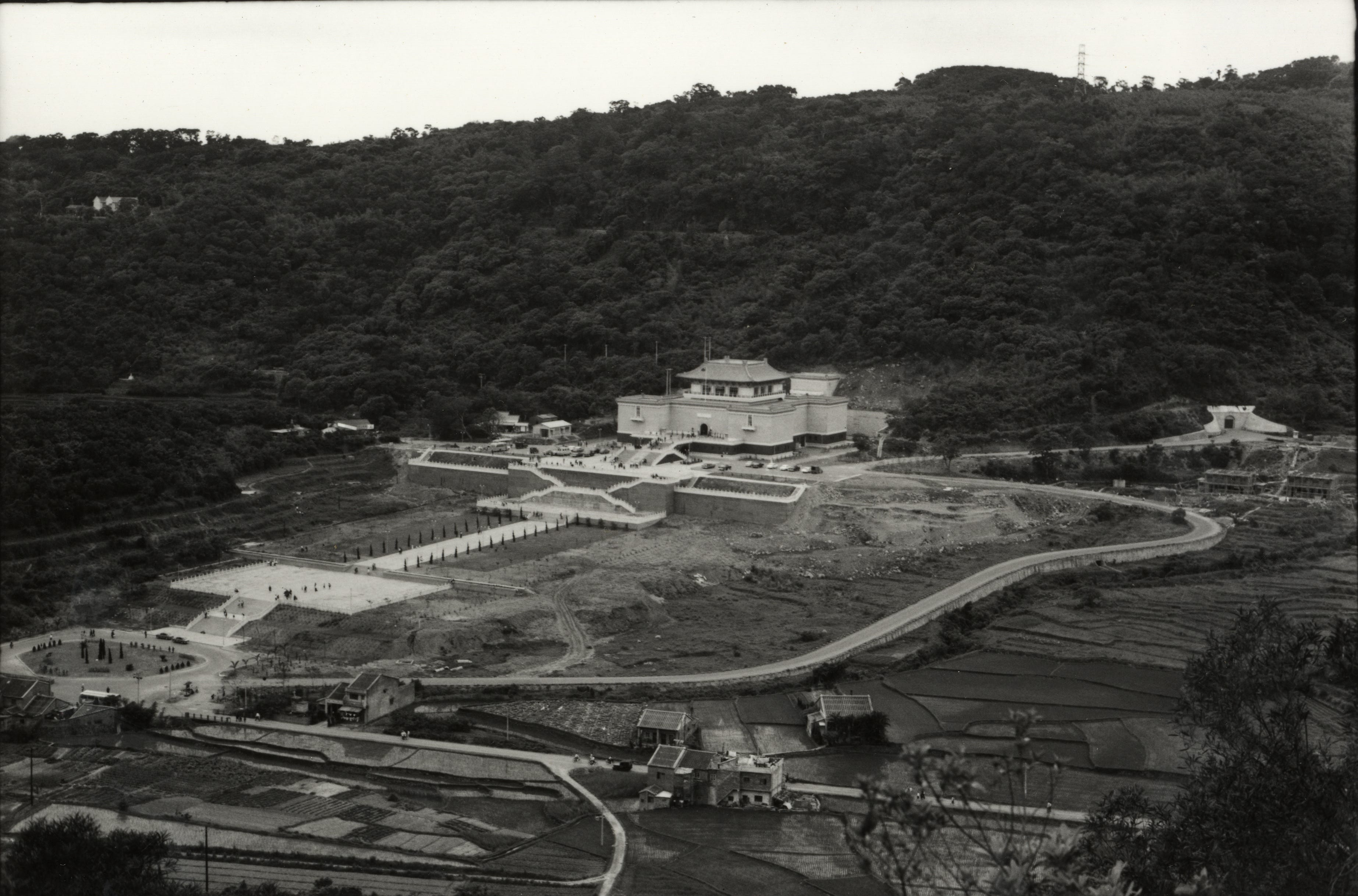
Sanxi Hall had effectively been split: two “rarities” in Beijing, one in Taipei.
A museum without a palace
The National Palace Museum in Taipei is a complex of buildings with green-glazed roofs and white balustrades, framed by subtropical hills. To many visitors, the first impression is slightly off-balance. This is the Palace Museum? Where is the old palace? In Taiwan’s case, the palace was never the point. The crates arrived first. The building had to be designed around them.
Inside, the experience is all about the objects. Moving from room to room: Shang and Zhou bronzes to the Mao Gong Ding, a Western Zhou tripod whose 500-character inscription is one of the longest on any ancient bronze.
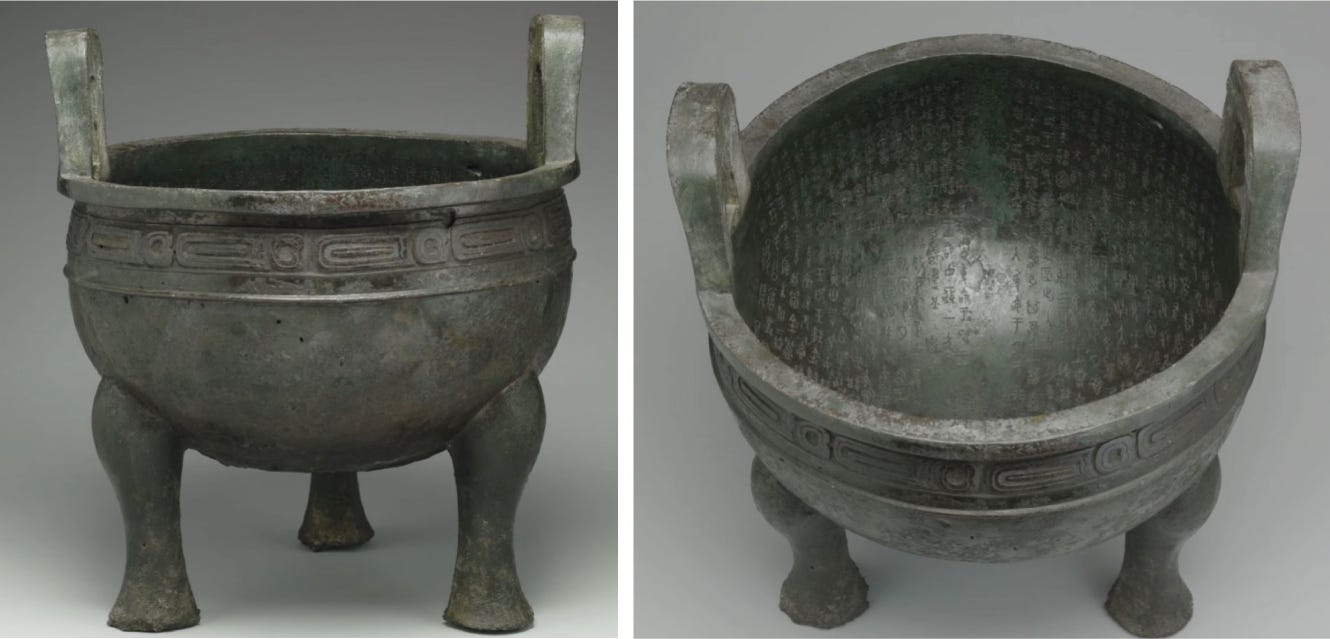
Then into painting galleries that bring out Song landscapes like Fan Kuan’s Travelers Among Mountains and Streams and Guo Xi’s Early Spring, works so fragile they can only be shown for a few weeks at a time.
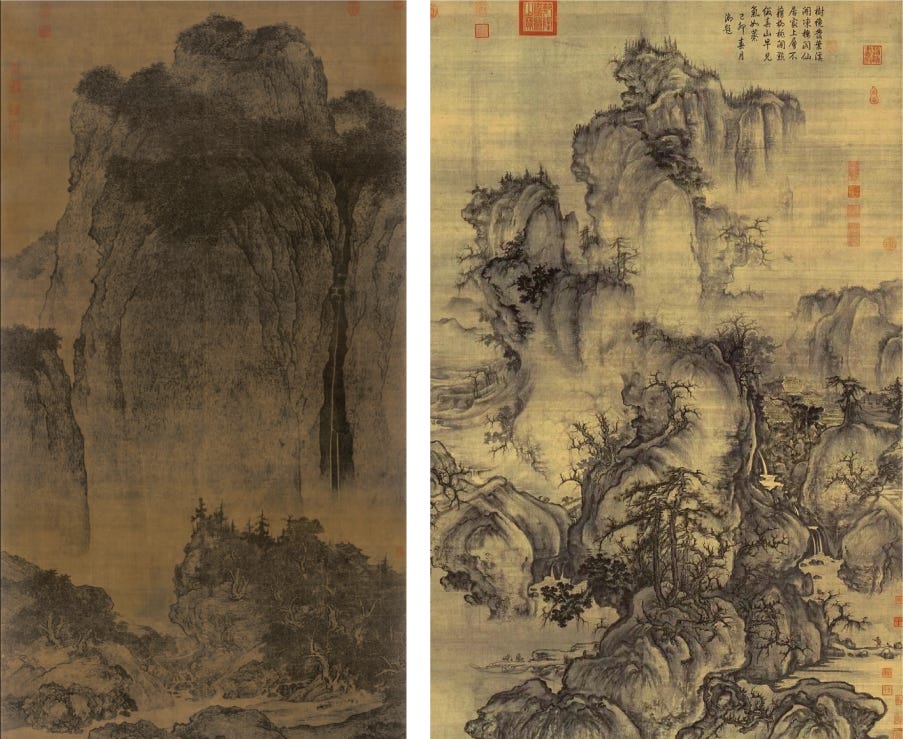
Finally the crowd-pleasers: the Jadeite Cabbage with Insects and the Meat-Shaped Stone, jade and jasper carved so convincingly they look like a real vegetable and a piece of braised pork, now marketed together with the Mao Gong Ding as the museum’s modern “Three Treasures.”
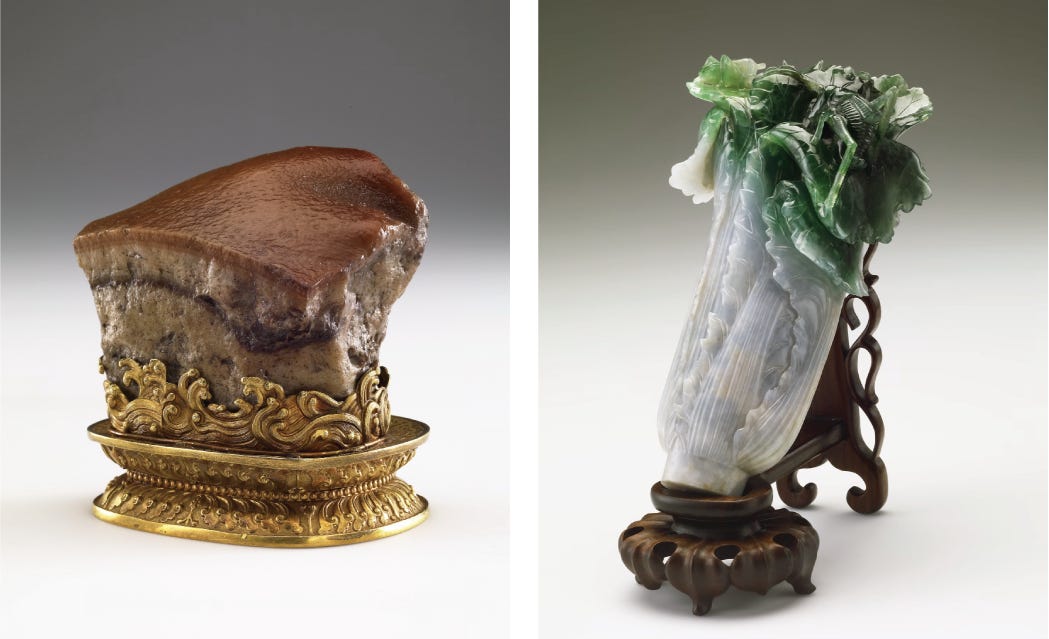
The rhythm is that of a dense anthology. Each gallery is a footnote to what emperors and their curators decided to collect, copy, and keep. The building is new, but the taste it reflects is deeply old. What counts as “refined.” What is worth annotating and mounting and storing.
The palace as the main artifact
In Beijing, the emphasis is reversed. Visitors can spend half a day in the Palace Museum without ever entering a gallery. Walking under the Meridian Gate, crossing the outer court, with its stone bridges over the Golden Water River, visiters finally reach to the Hall of Supreme Harmony, the center of the Forbidden City and also the center of the famous north–south city axis, lined with gates, all the way toward the Drum and Bell Towers.
The objects in vitrines: jade belts, dragon robes, court paintings, are important. But they have to compete with the experience of the architecture itself. The real collection is spatial: walls, courtyards, stairways, throne platforms.

Galleries are scattered through side halls and refurbished storerooms. Some focus on the mechanics of the court: clocks imported from Europe and refitted by palace workshops; lacquer boxes; ritual vessels for altars long gone. Others tell the story of the institution itself: how the palace turned into a museum, how the staff evacuated the core collection during war, how they catalogued what remained.
On certain days, you can even walk past Sanxi Hall, now another marked site on the tourist map. You cannot sit where Qianlong sat, and the “Three Rarities” he kept nearby no longer live together. Two are in a safe room within a few hundred meters. One is in another country. The hall is a location; the heart of it migrated.
One story, two vantage points
In Beijing, the Forbidden City presents itself as the physical core of the story: the intact palace, the long north–south axis, the throne rooms that once structured the empire’s politics. It invites visitors to see the People’s Republic as the state that now owns, maintains, and narrates this space. When you stand on the marble terrace of the Hall of Supreme Harmony and look down toward Tiananmen, the line from dynasty to modern capital feels unbroken.
In Taipei, the National Palace Museum leans on the authority of the crates: on the idea that the most refined parts of the imperial collection, Qianlong’s favorite handscrolls, rare bronzes, Ru wares, archives and albums—traveled with the Republic of China and took root on another shore. When you look at Kuaixue Shiqing Tie in a quiet gallery there, you are also looking at a claim that cultural legitimacy can survive exile.
Both stories are partial. Each museum has gaps that only the other can fill. Together, they make visible something that often stays hidden in discussions of “China”: that the material remains of the old empire are already divided, that there is no single, uncontested custodian of its past.
Further Reading
Traditional Chinese Art is a Modern Invention

Walk into any museum wing labeled “Chinese Art” and you meet a tidy universe: bronzes, ceramics, scroll paintings, calligraphy, ink landscapes, maybe a room for Buddhist sculpture, perhaps a “contemporary” gallery at the end. Common as it is, that Chinese art gallery feels timeless. It isn’t. The very idea that these practices belong to one thing called “art”, a bounded field with schools, genres, museums, departments, and degrees, is a modern construction that arrived in China in the late nineteenth and early twentieth centuries. China has an immense, sophisticated
I really appreciate this education and comparison all in one place. 🙏🏻 I've seen the Taipei Palace Museum in 1997, the Beijing Palace Museum in 2000, and recently in 2024. Thank you for doing this!
This is a wonderful explanation. I did not know about the three scrolls. Thank you.