

The year 1966 presented one of the most surreal and tragic juxtapositions. In Beijing, Mao unleashed the Cultural Revolution, a campaign to eradicate the “Four Olds,” old ideas, old culture, old customs, and old habits. Temples were smashed, ancient texts and books were burned in the streets, and millennia of intellectual heritage were subjected to violent destruction.
Meanwhile, just across the Taiwan Strait, an entirely different spectacle was unfolding. Observing the chaos on the mainland, Chiang Kai-shek seized what he perceived as a historic and strategic opportunity. In November 1966, the Kuomintang (KMT) government in Taipei officially launched the “Chinese Cultural Renaissance Movement” (中華文化復興運動). If the mainland was determined to sever its roots, Taiwan would position itself as the sole, legitimate sanctuary of traditional Chinese civilization.
The Battle for Orthodoxy
When the Nationalist government retreated to Taiwan in 1949, it brought with it an existential anxiety. Geopolitically isolated and ruling over an island with its own complex history, Chiang Kai-shek’s regime faced a severe crisis of legitimacy. The claim to represent “All of China” was looking increasingly fragile.
The outbreak of the Cultural Revolution on the mainland provided a desperately needed ideological lifeline. By initiating the Chinese Cultural Renaissance, the Kuomintang (KMT) was attempting to secure the Daotong (道統): the orthodox transmission of truth and philosophical lineage that dates back to Confucius. It was the ultimate rhetorical weapon, allowing Taipei to position itself globally as the civilized, traditional “Free China” (自由中國), acting as the direct counterpart to the mainland’s destructive “Red China.”
It was a massive, top-down engineering of society. The initiative was formally institutionalized with the founding of the Committee for the Promotion of the Chinese Cultural Renaissance Movement (中華文化復興運動推行委員會), with Chiang himself commanding the effort as its director.
The movement quickly permeated daily life. The government issued the “Code of Everyday Life for Citizens” (國民生活須知), dictating everything from personal hygiene to social manners through the lens of Confucian ethics. This behavioral framework was anchored in the heavy promotion of the Siwei Bade (四維八德, the Four Anchors and Eight Virtues), explicitly drilling citizens on moral imperatives like li yi lian chi (禮義廉恥, propriety, righteousness, integrity, and a sense of shame). Simultaneously, traditional painting, calligraphy, and Peking opera were heavily subsidized and elevated to the status of state crafts.
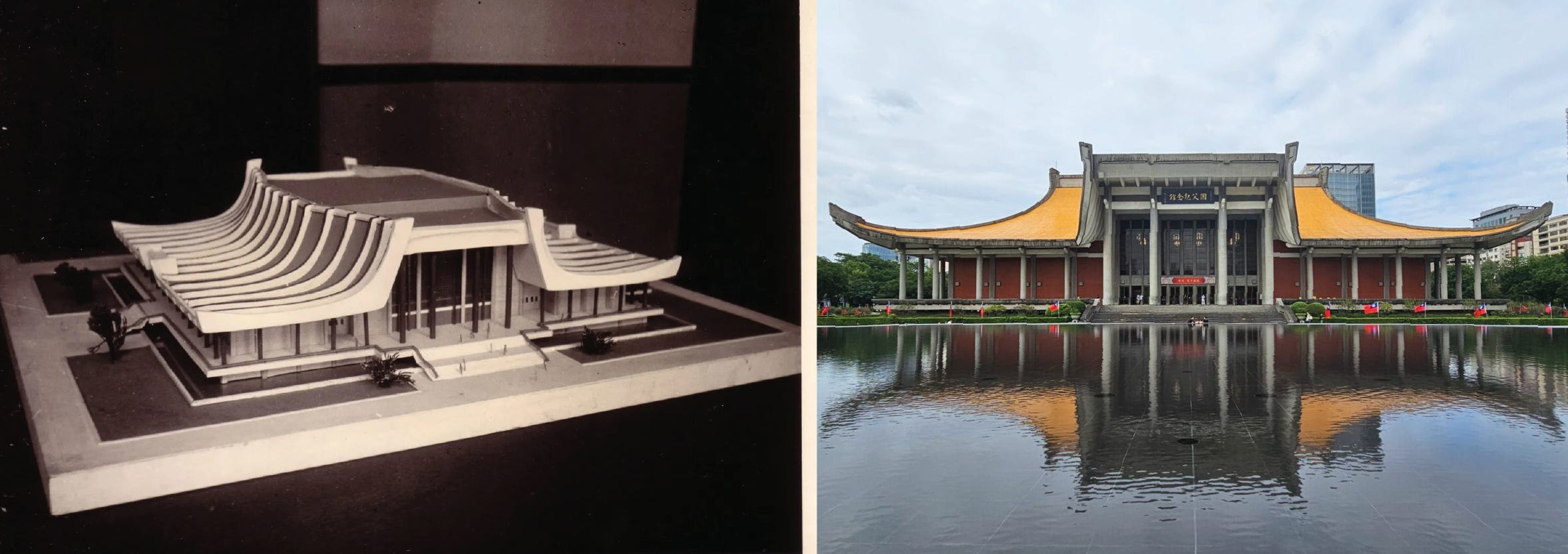
Even the spatial reality of the island was rewritten to reflect this ideology. Streets and districts were systematically renamed, transforming the map of Taiwan into a daily pedagogical tool for Chinese morality and nationalist aspiration. To this day, the main arteries of Taipei and cities across the island bear names from this era: Fuxing (復興, Renaissance), Jianguo (建國, Nation-Building), Ren’ai (仁愛, Benevolence), and Xinyi (信義, Honesty and Righteousness).
The writing system itself was weaponized. Historically, the Nationalist government had actually initiated its own character simplification scheme in 1935 while still on the mainland. But in the context of this new cultural Cold War, that history was quietly buried. As Beijing aggressively rolled out Simplified Chinese (簡體字), Taipei abruptly halted any orthographic reforms. There was an uncompromising preservation of Traditional characters (繁體字), and strategically rebranded as Zhengti zi (正體字, “Orthodox characters”). It was elevated from a linguistic preference to a sacred political duty, turning the very strokes of the characters into a visual frontline of the campaign.
However, architectural facades and civic codes are ultimately superficial. The ultimate vessel for securing the Daotong was the minds of the next generation, which meant the state had to dominate education—specifically, the mandatory study of Wenyanwen (文言文, Classical Chinese). It was here, in the pedagogical methodology of teaching ancient literature, that the cross-strait “Cultural Cold War” left its most enduring, and perhaps most surprising, legacy.
Two Paths of Wenyanwen
Mainland China: The Prism of Modernity
In the 1950s, Mainland China fundamentally restructured its educational system, heavily borrowing from Soviet models. The pedagogical approach to language was dominated by the “Grammar-Translation Method,” a highly structured system originally designed for teaching foreign languages like Russian or English.
When applied to Classical Chinese, this method fundamentally altered the nature of the text. Wenyanwen was stripped of its sacred aura and treated as objective, historical data. The approach severed itself from the tradition of language immersion and embraced a method of refraction through the “prism of modernity.”
Just as a prism splits white light into discrete, analyzable bands of color, the mainland pedagogical system took holistic, deeply rhythmic ancient texts and refracted them through the rigid categories of modern linguistics. In a mainland classroom, a student does not simply read a text; they parse it.
The curriculum focuses intensely on structural mechanics. Students are drilled in identifying “inverted sentences” (倒装句), recognizing when an object precedes a verb or when a modifier is placed unusually. A massive emphasis is placed on “lexical flexibility” (词类活用), the ancient habit of using nouns as verbs or adjectives as causative verbs. Furthermore, the translation process becomes an exercise in rigorous one-to-one mapping. Every classical functional word (虚词) must be accounted for and mapped to a specific modern preposition or conjunction. The most common functional words, such as zhi 之, hu 乎, zhe 者, and ye 也, which dictate the breathing rhythm of ancient Chinese, each have several “functions” based on specific rules or conditions.
This is a process of linguistic reverse engineering. Students act as decoders, taking the incredibly high-density, context-reliant information of Classical Chinese and unpacking it into the lower-density, logically explicit grid of modern spoken Chinese (白话文, Baihua wen).
The advantage of this refraction method is its immense analytical power. It equips students with a highly efficient, standardized toolkit for reading complex historical documents. It demystifies the past, making it accessible through logic rather than relying on elusive “feeling.” However, the cost of passing traditional literature through this modern prism is steep: the original vibe (气韵), the rhythmic flow, the emotional resonance, and the aesthetic unity of the text are scattered and lost in the process of structural analysis.
Taiwan: The Ecosystem of a Living Tradition
Across the strait, the pedagogical philosophy took a markedly different turn during the Chinese Cultural Renaissance Movement. In alignment with its broader cultural agenda, Taiwan’s educational authorities did not simply preserve classical texts as heritage; they positioned them as a living core of Guowen (國文, National Literature). Rather than subjecting Wenyanwen to heavy structural or linguistic reframing, the curriculum maintained a mode of transmission closer in spirit to the late imperial sishu (私塾, traditional Chinese private academies): continuity over rupture, habituation over analysis.
Within this framework, Wenyanwen was not primarily treated as a foreign system requiring systematic decoding, but as the senior register of a linguistic tradition students already inhabited. The pedagogical task, therefore, was less to translate across an unbridgeable distance than to reduce that distance, to cultivate familiarity where opacity might otherwise arise. Classical texts were approached not as objects external to the language, but as extensions of it, even as annotation and explanation remained necessary in practice.
Methodologically, this produced a classroom centered less on formal grammatical abstraction and more on the formation of yugan (語感): an intuitive, embodied sense of the language’s rhythm and structure. Recitation and chanting (吟誦) played a central role: through repeated vocalization, students absorbed parallelism, cadence, and rhetorical pattern as lived experience rather than analytic knowledge. The maxim “书读百遍,其义自现” (“Read a text a hundred times, and its meaning will naturally emerge”) captures the underlying assumption: comprehension arises from immersion, not dissection.
Because the integrity of the text was preserved, instructional emphasis could shift upward from mechanics to meaning. Classroom attention gravitated toward moral argument, historical perspective, and literary form, treating classical prose as a vehicle for intellectual orientation rather than merely a linguistic puzzle.
This system did not confine Wenyanwen to passive appreciation. It sustained a productive expectation: students were encouraged for mobilizing classical diction, syntax, and allusion within modern writing. Taiwan’s university entrance exams, students who can seamlessly integrate classical syntax, vocabulary, or historical allusions into their modern essays are highly rewarded. In this sense, Wenyanwen functioned not as an archival layer of the language, but as an active reservoir of expressive authority, continuously available to those trained to access it.
The Double-Edged Sword
Taiwan’s immersive approach successfully preserved a deep appreciation for the aesthetic and moral dimensions of classical Chinese. It is largely responsible for the preservation of traditional characters and the generally perceived politeness and historical literary fluency found in Taiwanese society. However, this “preservation” was not a purely benign cultural phenomenon; it was enforced by an authoritarian regime with a specific political agenda.
To maintain the absolute supremacy of this “Orthodox” Chinese ecosystem, the KMT government ruthlessly suppressed Taiwan’s native linguistic landscape. Hakka and Indigenous languages were banned in schools and marginalized in public life. Classical Chinese was weaponized as a tool of cultural hegemony. Traditional culture was inextricably bound to political loyalty to the state.
Conversely, the mainland’s decision to pass classical culture through the prism of modern linguistics created a distinct form of cultural rupture. By treating ancient texts merely as data to be parsed using Soviet-inspired grammar rules, generations of students were alienated from the emotional and philosophical heartbeat of their own history. The text became a cadaver for study rather than a living dialogue with ancestors.
Yet, it would be a mistake to dismiss the mainland approach entirely. The rigorous, structurally obsessive method of teaching Wenyanwen cultivated a high degree of analytical literacy. It trained students to meticulously unpack complex, dense information. It is a cognitive skill that translates remarkably well into modern disciplines. They may have lost the poetry, but they gained an incredibly sharp tool for structural deconstruction.
The Illusion of Orthodoxy
In Taiwan, the democratization and localization movements of the 1990s shattered the KMT’s authoritarian monopoly on identity. Taiwan no longer bears the heavy, self-imposed burden of representing the “Orthodox” center of the entire Chinese nation. Consequently, the role of Wenyanwen in education has become a site of fierce debate.
The ongoing controversies over the exact percentage of classical texts required in high school textbooks are not merely arguments about curriculum; they are negotiations of national identity. Classical Chinese is slowly being untangled from the past. It is transitioning from being a mandatory totem to becoming one of many threads, alongside indigenous cultures, Dutch colonial history, and Japanese influences, which forms a pluralistic modern Taiwan identity.
On the mainland, a fascinating reversal is attempting to take shape. Recognizing the spiritual and cultural void left by decades of radical modernization and the Cultural Revolution, the state has recently sponsored a massive revival of “Guoxue” (国学, National Studies). There is a top-down push to reintroduce traditional culture, poetry, and Confucian ethics back into the public sphere.
However, this revival frequently encounters a structural paradox. The educational apparatus, which was fundamentally designed to refract and deconstruct it, hasn’t changed. It’s hard reconstruct the holistic beauty using the very tools that separated it. The result is often a performative embrace of tradition by memorizing texts for televised poetry competitions or wearing traditional Hanfu clothing. The organic connection with the philosophical depth remains unnatural.
Chiang Kai-shek’s “Chinese Cultural Renaissance” was undoubtedly a political maneuver in a Cold War fought over legitimacy. Yet, perhaps by sheer accident of history, by insisting on the traditional, immersive pedagogical methods of the private academies, It allowed Wenyanwen to survive not as a museum exhibit, but as a living, breathing ecosystem, quietly shaping the conditions for the cultural vitality that emerged in the 1990s and 2000s.
If my insights brought you a fresh perspective, please consider supporting me by buying me a coffee. Your generosity fuels my writing.
Taiwan is one of the last places where traditional Chinese characters are still in everyday use — making it the best place in the world to learn them as a living script, not a museum piece.
Your presentation of the two approaches shows that the analytical method reflects modern demands and the holistic grasp is a product of an earlier epoch. Now that appreciation of holistic, right-hemisphere knowledge is making a comeback, there should be room for it without denying the validity of the low-context, logical approach. I wonder how such a plural or integrative stance would be implemented in language learning.