

Two decades ago in Beijing, a child could hardly walk a block without seeing a swing set. The structures were simple: an iron A-frame fixed to concrete or packed earth, chain ropes, and a wooden plank or old tire for a seat. Safety features were nonexistent. Still, for a generation of Chinese kids, nothing matched the thrill of flying upward, clutching the chains as momentum sent them skyward. Bruises and the occasional bloody scrape were part of the deal. Falls were common—sometimes head-first onto hard ground—but teachers and parents saw them as everyday mishaps, not legal issues. Before the 2000s, playground accidents in China rarely led to lawsuits. This stood in contrast to America’s more litigious environment, where in rare cases of severe harm or negligence, playground injuries have led to multi-million-dollar settlements or verdicts, though most are far more modest. Chinese back then often joked about U.S. jury awards, imagining that if courts at home were so generous, a tumble from a swing could make one rich overnight.

At the time, Chinese law offered little support for playground injury claims. The 1986 General Principles of Civil Law (《民法通则》) broadly stated that anyone who causes harm through fault must compensate the victim, but it did not spell out safety duties for schools or public venues. Parents of an injured child had to prove that the playground owner was at fault—a vague and difficult standard. Legal scholars note that before the 2000s, tort law in China relied on general principles that “lacked direct provisions on the safety obligations of public-place managers,” making substantive injury lawsuits hard to pursue. In practice, most cases never reached court; those that did often collapsed for lack of clear evidence. Large payouts for “pain and suffering” were virtually unheard of, and compensation sums remained modest. Families typically accepted minor mishaps as part of growing up rather than matters for lawyers. In short, swings sailed above hard concrete, with little fear of liability holding them down.1
When the Legal Pendulum Swung Toward Safety
That began to shift in the early 2000s. As cities modernized, public expectations of safety grew, along with awareness of legal rights. A turning point came in 2003, when the Supreme People’s Court issued a landmark interpretation on personal injury compensation. For the first time, it formally recognized the “safety guarantee obligation” of public venues. From then on, if a business or school failed to take reasonable precautions and someone was hurt, the venue itself could be held liable. The rule even covered third-party harm: if one customer injured another, the victim could sue the venue for not preventing the incident. The venue would then bear “supplementary liability,” though it could later seek reimbursement from the actual wrongdoer. What mattered was that victims no longer had to pursue an individual with no money—they could claim against the deeper pockets of the establishment.2
This principle soon entered law. The Tort Liability Law, effective in 2010, codified the safety obligations of schools, parks, and malls. A decade later in 2021, the new Civil Code carried these provisions forward (Articles 1198–1199), stating clearly: if an operator or manager fails to provide “reasonable safety assurance” and someone is injured, they must compensate. For China’s once free-for-all playgrounds, this was a legal revolution. Suddenly every swing set and schoolyard carried a clear duty—keep children safe, or pay the price.
Schools, in particular, took notice. The Supreme Court had made them presumptively liable for injuries to pupils in their care. If a child was hurt during class or daycare, the school had to pay unless it could prove it had met its duty of supervision and safety. The burden of proof had shifted.
A 2017 case in Hubei drove the point home. A three-year-old boy fell from a swing at a private early-education center when the swing’s front safety bar came loose. He fractured his jaw. The center claimed the boy’s grandmother had pushed him too hard, but the court was unmoved. Citing the Tort Law’s presumption of school liability, judges noted the center had no evidence that the swing met safety standards or was properly maintained. The loose bolt that caused the accident was squarely its responsibility. The ruling: the center must cover the child’s medical bills and related costs.3 Cases like this sent a blunt message to educators nationwide: if a child is injured on your grounds, you will likely be held accountable—unless you can show clear, documented proof of diligence.
Swift Justice, Low Costs – and a Lawsuit Boom
Legal reform was only part of the story. Just as important was the growing speed of China’s courts. Unlike in some countries where civil trials can drag on for years, Chinese law sets strict timelines. Under the Civil Procedure Law, a first-instance civil case should be wrapped up within six months, and a summary case in as little as three. Small claims can finish in two.4 In practice, many playground injury suits, say a child breaking an arm, were handled through summary proceedings and resolved within a few months. For parents, that speed mattered. A clear judgment and compensation arrived quickly, reducing the uncertainty that might otherwise discourage them from suing.
Another factor was cost. Filing fees for personal injury suits in China are minimal—often just ¥50 to a few hundred yuan ($10–$50 USD). Lawyer fees are also modest. Many charge a flat rate plus a small percentage of damages, usually 5–7%.5 That meant a playground injury case worth tens of thousands of yuan might cost only a few hundred upfront. For parents, it was an affordable gamble. By contrast, American plaintiffs often face steep hourly legal bills or must find a contingency lawyer who will take a sizable cut. In China, the “low-cost, low-hassle” system made litigation accessible even to middle- and working-class families. By the 2010s, a playground scrape was no longer just bad luck—it could be the basis of a lawsuit.
Just as important, the broader governance climate was shifting toward strict accountability. Local officials and school principals were bound by ever-tighter responsibility systems (责任制). A single serious accident could derail a career; in workplace safety, the “one-vote veto” meant that one major mishap could ruin an official’s performance review.6 This ethos trickled down to schools and community parks. A child’s injury might cost a principal his job. Neighborhood committees and park managers, too, were judged on spotless safety records. And the simplest way to guarantee “zero accidents” was to eliminate the risks altogether.
And so the swings began to vanish. Without ceremony, schools and public parks across China quietly phased out swings, seesaws, and other “high-liability” equipment through the 2000s and 2010s. Parents noticed that the once-ubiquitous flying swing (荡秋千) became rare. In city schoolyards, playgrounds grew tamer: low slides, foam blocks, the occasional spring rider—but no soaring swings. When an old set broke, it was usually dismantled, not replaced. Few new ones went up.
The playground was domesticated. Children still played, but under closer supervision and on safer ground. Risky fun that might end in a bruise or a lawsuit was quietly engineered away. Public spaces entered an era of “safety by subtraction,” where classic play equipment disappeared not for lack of joy, but for fear of liability and reprimand.
It was a quiet cultural loss. Swinging had been part of Chinese life for centuries, celebrated in spring festivals and painted into art. In The Picture Album of Ladies in the Moon by Chen Mei, women are shown joyfully flying through the air—a reminder that the thrill of the swing was once woven deep into tradition. Today, that thread has frayed, and a pastime that once connected generations has all but slipped away.

By removing swings, managers reduced their legal exposure—but at a cultural cost. Childhood play was sanitized, stripped of its wild edges. Where were the squeals of children soaring sky-high? Where was the simple delight of a swing on a warm afternoon, a rite of passage shared across generations worldwide?
By the late 2010s, many Chinese parents had begun to notice the gap. Travel and the internet exposed families to colorful, adventure-style playgrounds abroad—filled with climbing nets, zip lines, and, of course, swings in every form. Back home, public play spaces felt stark and uninspired. The pendulum of caution had swung too far. In protecting children from risk, cities had also robbed them of exhilaration, of the healthy trial-and-error that play provides. And with birth rates falling, the stakes felt higher. A shrinking generation of children was being raised in bubble wrap. For a society anxious about its future, the question was no longer just about liability—it was about balance. How to keep kids safe without suffocating the joy out of childhood?
Child-Friendly Cities and the Swing’s Comeback
Enter the 2020s with a new policy buzzword: 儿童友好, or “child-friendly.” With the youth population shrinking and family life under strain, planners decided it was time to put fun back into childhood—safely. In 2021, the national government launched a flagship Child-Friendly Cities initiative, led by the National Development and Reform Commission (NDRC, the country’s top economic planning agency, functioning as a powerful macroeconomic management body that sets national strategies, allocates major investments, and oversees long-term development goals) alongside 22 other ministries.7 The guidance urged cities to “place children’s needs first” in urban planning, to “view the city from a one-meter height” (the eye level of a child), and to provide safe, accessible places to play and explore. Crucially, it struck a balance: “enrich play while ensuring safety.” That meant indoor and outdoor activity areas with soft flooring, buffered zones, and better oversight. The new mantra: bring back the fun, but engineer away the worst dangers.
Local governments quickly joined in. Shanghai, the country’s biggest city, rolled out a Three-Year Action Plan (2023–2025) to build 50 new child-friendly parks. These parks are designed to blend play with nature, combining sandpits, slides, climbing frames, and green space. The plan requires every large park—over 3,000 m²—to set aside dedicated play areas, while even pocket-sized neighborhood parks must reserve space for children. In practice, empty lawns and adult exercise corners are being retrofitted with playground equipment—and yes, swings. Other cities are following, promising a new generation of play spaces where safety and joy are meant to coexist.

Importantly, recent implementation guidelines for these fitness facilities explicitly state that at least half of new public exercise equipment should cater to the elderly and children. This means that alongside the ubiquitous senior-citizen tai chi wheels and walking machines, communities must install child-friendly play gear – including slides, seesaws, and swings – to meet the quota.8 It is a quiet but remarkable reversal of the earlier swing purge. Now local park managers might actually get in trouble for not providing swings, whereas a decade ago the opposite was true.
Designing Away the Danger
The swing’s revival in China comes with both a technological upgrade and a legal safety net. Officials are not suddenly relaxed about risk; instead, they are relying on stronger design standards and clearer liability rules to manage it. Today’s swings are nothing like the rusty rigs of the past. They are built to rigorous specifications under tightened national standards. A new mandatory code, GB 19272-2024, sets strict requirements for the design, manufacture, installation, and upkeep of public fitness and play equipment. Modern swings now sit above soft rubber mats or sand, with backstops to limit their arc and posted rules on age or weight limits. Park staff are expected to conduct regular inspections and keep written records—a “leave traces” approach that provides evidence of diligence if disputes arise.
The law has evolved in parallel. Under China’s Civil Code (effective 2021), liability is explicitly shared among manufacturers, operators, and guardians. If equipment fails because of a defect, the manufacturer faces strict product liability (Article 1202) and must compensate. A school or park that bought the equipment could be sued too, but it has the right to recover losses from the maker. If, however, the equipment is sound and harm comes from misbehavior or a chance collision, the venue bears only limited liability—responsible only if it lacked basic safeguards such as warning signs or supervision. In many cases, responsibility falls partly on guardians, or on no one at all if the incident is deemed a true accident.
A 2024 case in Shenzhen illustrates the new balance. A seven-year-old girl was struck in the eye when a younger child on a swing collided with her. Neither child’s parents were present. The court found it was an innocent accident, faulting both families for failing to supervise. Crucially, the property manager was not held liable, since the playground itself was safe and properly maintained.9
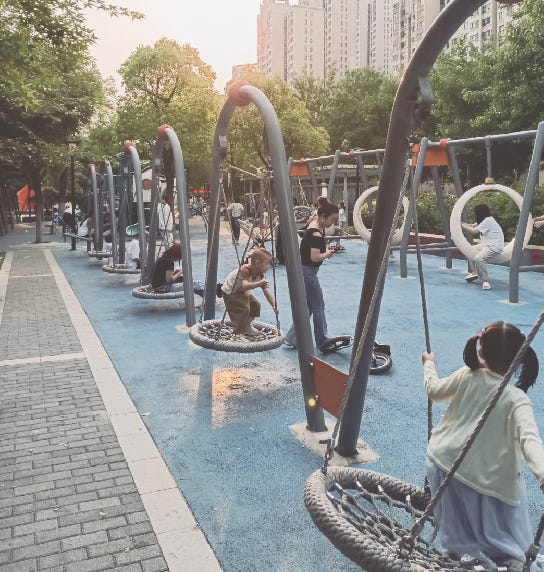
This more balanced liability framework gives park managers some breathing room. If they “build to standard and manage diligently,” they can avoid being automatically blamed for every mishap. No longer does a single accident have to trigger the removal of all swings. Instead, managers can point to compliance with national standards and documented oversight. Increasingly, judges accept that defense. Recent rulings have cleared venue owners of liability where evidence showed the playground met safety norms and the injury stemmed from unforeseeable misuse or the ordinary risks of play.
In short, China is finding a new equilibrium: protect children, but also protect those who provide for them. The old fear-driven approach—“one strike and you’re out”—is giving way to a more measured one: fix the problem, don’t junk the equipment. That shift is allowing swings, long exiled, to return to playgrounds not as reckless relics, but as carefully engineered, legally supported features of childhood once again.
Balancing Fun and Risk
China’s swings story—from ubiquity to near-extinction and now a cautious revival—mirrors the country’s broader social policy journey: a constant recalibration between growth and risk, between collective good and individual responsibility. At times, the pendulum has swung too far toward risk elimination, stripping away the very experiences that make childhood memorable and cities livable. The early 2000s brought sweeping legislation to protect citizens from harm and efficient mechanisms for redress. Yet in the process, accountability hardened into avoidance, with officials and managers concluding that the safest playground was one without swings at all.
Now, with demographic pressures mounting and quality of life a national priority, China is engineering a correction. It is trying to build a society that is both safe and fun for children – a place where a swing can swing, with neither lawsuits nor skull fractures as inevitable outcomes. The law now provides the tools to apportion blame more fairly (supplementary liability, contributory fault of guardians, product liability for manufacturers). This more balanced approach is precisely what allows a swing to be installed rather than removed. For children, this balance could not come sooner. A generation grew up largely without swings – the next may grow up with them once again, albeit swings that are shorter, safer, and supervised.
Today, demographic pressures and shifting priorities are forcing a correction. China is working to make its cities not just safe, but welcoming for families—a place where a child can swing high without turning play into peril or liability into ruin. The law now spreads responsibility more fairly: product defects to manufacturers, supervision failures to guardians, and safety lapses to operators. This balance is what makes installation possible again, replacing fear with confidence.
For children, the change is overdue. An entire generation grew up without swings; the next may grow up with them again—shorter, safer, supervised, but still capable of delivering that timeless rush of air and laughter.
If my insights brought you a fresh perspective, please consider supporting me by buying me a coffee. Your generosity fuels my writing.
https://law.pkulaw.com/falv/167199.html
https://www.sdcourt.gov.cn/jnanjyfy/379390/379391/6934340/index.html
https://www.sohu.com/a/351682580_259523
https://www.gzhzcourt.gov.cn/news/50007721.cshtml
https://www.chinalegalexperts.com/news/court-fees-china
https://www.gov.cn/zhengce/2018-04/18/content_5283835.htm
https://www.gov.cn/zhengce/zhengceku/2021-10/21/content_5643976.htm
https://www.gov.cn/zhengce/zhengceku/202306/content_6884623.htm
https://law.cnr.cn/gzsp/20240523/t20240523_526715443.shtml