

At the corner of a busy street in any Chinese cities, the lottery booth is almost always the same size: barely bigger than a phone kiosk, bright enough to look sterile at night. Behind the glass are stacks of slips, a stamp pad, and most distinctive a wall of “trend charts”: grids of past winning numbers. People linger longer than the purchase requires. They don’t just buy; they study, trying to coax a pattern out of randomness.
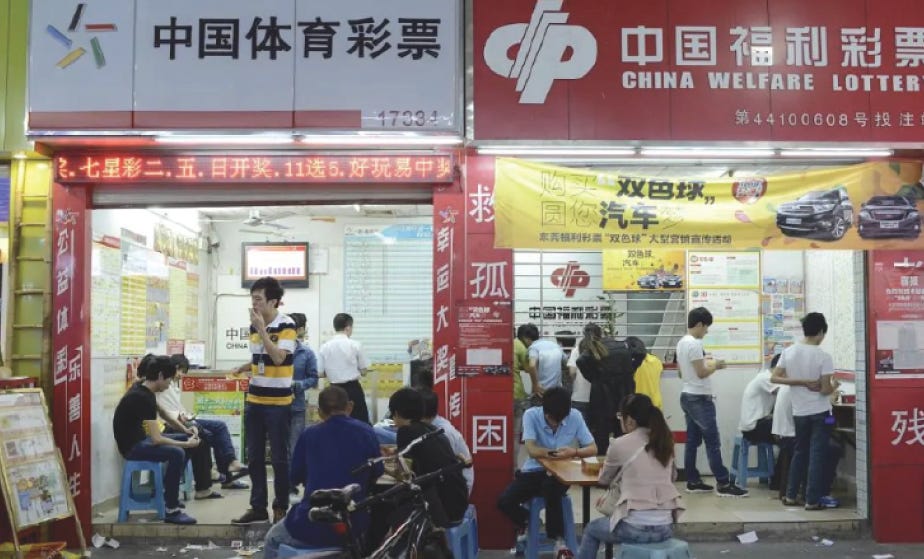
And now, the center of gravity has shifted. The booth still prints number-pick tickets, but the more common scene is the scratch-off cards counter: “Guaguale” (刮刮乐) , coins scraping silver latex, dust on fingertips, a two-second pause before the reveal. It’s faster, more tactile, more repeatable. It is a dopamine vending machine.
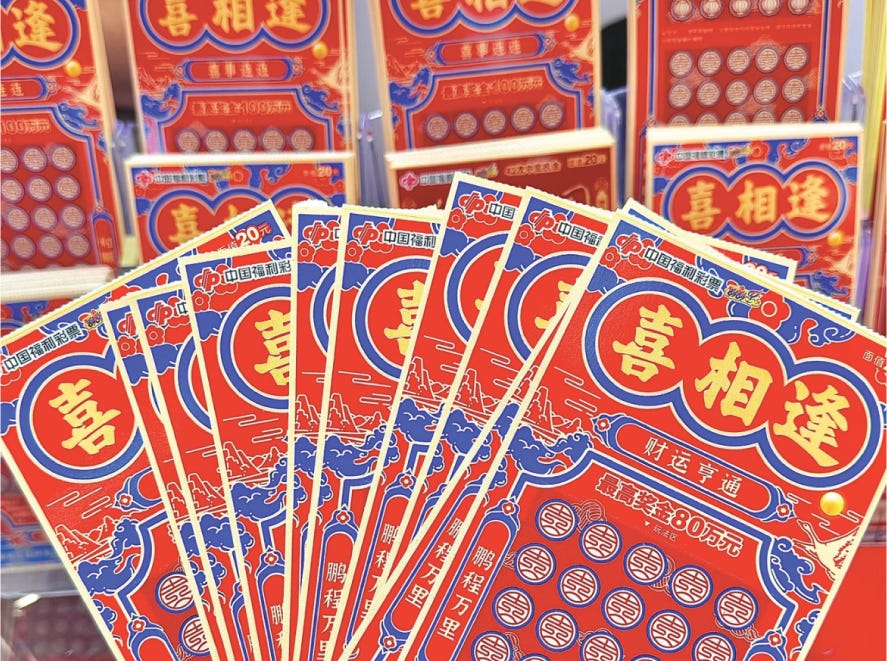
In most of mainland China, that small window is doing something far bigger than selling entertainment. It is the country’s most ordinary portal into something otherwise forbidden: the closest thing to a legal, everyday gamble.
The Monopoly of Hope
China’s lottery system is unique not because of the game itself, but because of the vacuum it fills. In China, gambling is a moral and legal pariah. Cross the border to Macau, and you find the “Las Vegas of Asia,” a glittering cathedral of high-stakes baccarat. But within the mainland, the hammer falls hard on underground casinos, mahjong dens with stakes too high, and offshore betting sites.
The lottery is the sole exception, a state-franchised monopoly built on a fascinating contradiction. Under the “Lottery Management Regulations,” the system is defined not as gambling, but as a mechanism to raise “social public welfare funds.” The State Council authorizes only two entities: the Welfare Lottery and the Sports Lottery. Any other form of wagering is “illegal gambling.” In the eyes of the law, the lottery is not a market category; it is a permission.
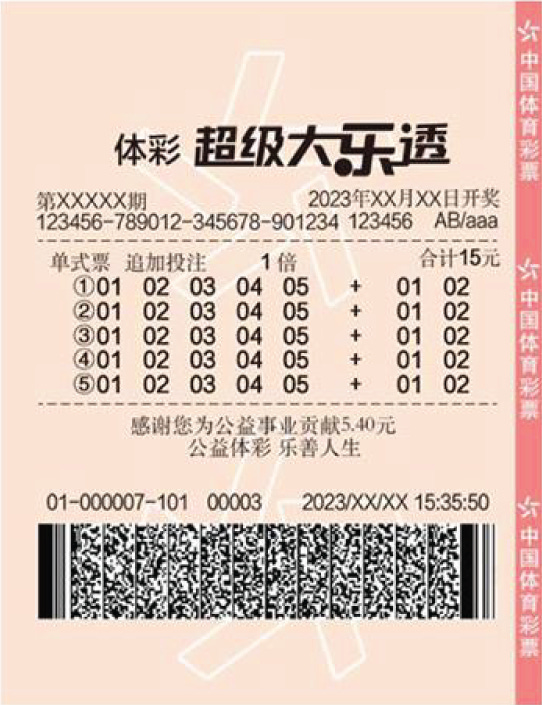
This creates a peculiar social contract. When the state closes all other doors to “luck,” the lottery becomes more than a game. It becomes a pressure valve. It is where superstition, desperation, fantasy, and habit are condensed into a two-yuan slip of paper.
The 1987 Pivot: From “Capitalist Vice” to “Socialist Welfare”
The history of the Chinese lottery is a mirror of the country’s Reform and Opening-up era. After 1949, lotteries were largely banned as “capitalist remnants” that encouraged “unearned income.”
But by the late 1980s, the fiscal reality of a modernizing nation set in. The state needed a way to fund social welfare and sports infrastructure without the political friction of direct taxation. In 1987, the “Social Welfare Lottery” was born. The Sports Lottery followed in 1994.
The branding was ingenious. To make the lottery palatable to a socialist public, it was framed as an act of “philanthropy.” Every ticket sold was a “contribution.” Even today, the slogans on the booths rarely scream “GET RICH QUICK.” Instead, they murmur: “For the public good, for the beautiful life.”
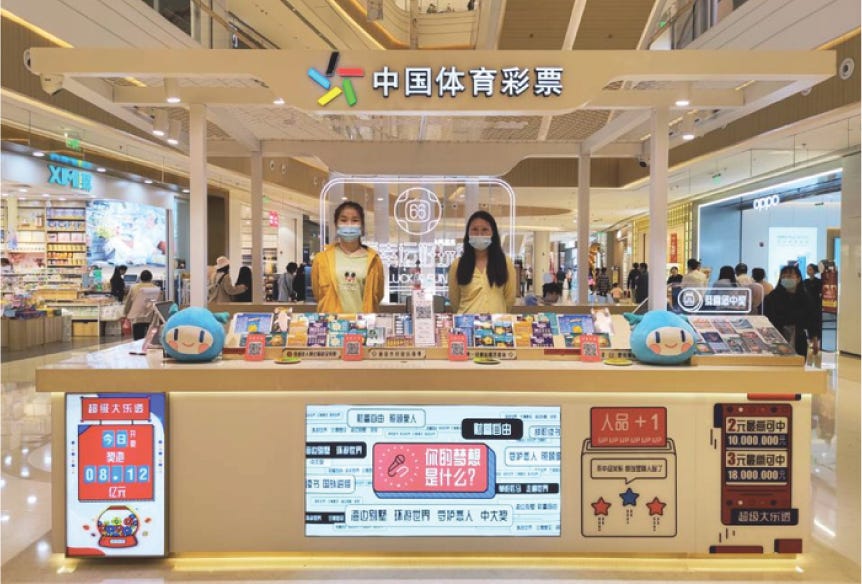
For decades, this worked. The lottery was a niche hobby for the elderly or the working class. But in the 2020s, something shifted. The “public welfare” mask is still there, but the players have changed. In 2023, lottery sales in China hit a record high of 580 billion yuan (roughly $80 billion), a 36% increase year-on-year. In 2024, lottery sales rose 7.6 percent year-on-year to 623.49 billion yuan ($86.96 billion).
Why the sudden surge?
The “Tax on the Hopeless”
The lottery is often called a “tax on the poor.” It is increasingly being described as a “tax on the hopeless” , or at least, the “stalled”.
For the post-90s and post-00s generations, the traditional ladders of success, high scores, prestigious degrees, and grueling “996” work schedules, are no longer guaranteeing the middle-class dream. With youth unemployment hitting record highs and the property market cooling, the dream of buying a home and raising a family feels increasingly like a statistical improbability.
When the macro-economy feels like a game you can’t win, a 10-yuan scratch-off feels like the only game you might. It’s the thirty seconds between buying the card and scratching it, ticket buyer could be technically a potential millionaire. That thirty seconds of ‘maybe’ is the cheapest therapy in the city.
This is the “dopamine vending machine” in action. It is a micro-escape from involution, the sense of being trapped in a hyper-competitive race that yields no progress. If hard work no longer scales, then luck is the only variable left to worship.
The Secret Math of the Scratch-Off Bag
To the casual player, a “Guaguale” (scratch-off) is a game of pure randomness. To the booth owner, it is a game of inventory management.
In China, scratch-offs are typically distributed in “bags” or “books” with a fixed total value, for example, a pack worth 500 RMB. Within that specific pack, the total “return” (the sum of all winning tickets) is statistically managed and often effectively guaranteed. If you buy an entire unopened pack, you are almost certain to “win” back roughly 50% to 60% of your money.
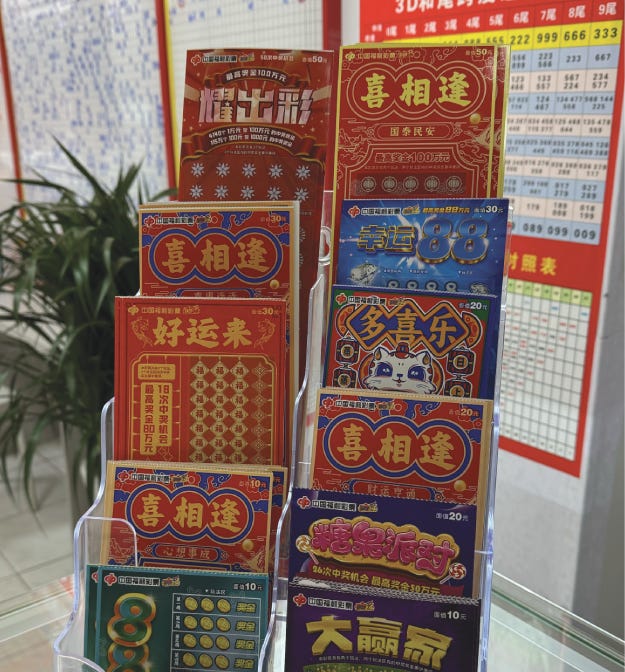
This leads to the “Single Ticket Trick”, the first bit of tension any serious player encounters at the booth. Experienced owners often know when a “hot” pack has already yielded its top-tier prize. If a customer buys half a pack and hits a 500 RMB win, the owner knows the remaining tickets in that specific bag are statistically “dead”, filled only with “thank you” notes or tiny 5-yuan pittance wins. An unscrupulous owner might then mix these “dead” tickets with a fresh pack or push them onto unsuspecting novice buyers.
For the booth owner, the house never loses, it knows which pile of paper is ‘empty’ before the customer even touches a coin. This creates a strange atmosphere at the counter: a silent battle of wits where players try to guess which bag is “fresh” and owners try to clear out the “junk” inventory.
The “Welfare” Mandate and the Trust Gap
The lottery in China is divided into two pillars: the Welfare Lottery (established in 1987) and the Sports Lottery (1994). Officially, these are not gambling enterprises; they are “public interest” tools. However, for a system built on “public welfare,” it has been rocked by very private greed. The tension between the “moral” mission and the sheer volume of cash involved has occasionally led to spectacular collapses in public trust.
In the late 2010s, a series of high-profile corruption scandals sent shockwaves through the system. Investigative reports and state audits revealed that top officials within the China Welfare Lottery Management Centre had embezzled or mismanaged staggering sums, some estimates suggested billions of yuan in “public welfare funds” had vanished into private pockets or unauthorized projects.
When news of these scandals broke, the mathematical skepticism of the public turned into a systemic one. On social media, users joked that the jackpot wasn’t determined by a ball-drop machine, but by a “director’s meeting.” While the state has since engaged in massive crackdowns to “cleanse” the leadership, a shadow of doubt lingers. In a society that values order, the most “random” thing: luck, is often the thing people suspect is the most “managed.”
The Grand Reveal
The Chinese lottery is more than a game; it is a complex social contract. It is where the state’s need for non-tax revenue meets the individual’s need for hope.
The state finds itself on a tightrope. It needs the lottery funds to build nursing homes and stadiums, but it doesn’t want a “Lottery Culture” to replace a “Work Culture.” It wants the lottery to be a “snack” something small and frequent rather than a “meal” that replaces the dignity of labor.
As night falls, the booths stay lit, small, bright islands in the urban landscape. The scratch-off dust on a worker’s fingertips is the residue of a search for an exit. In a world where the path to the top is blocked by economic gravity, the lottery ticket is the last ladder that hasn’t been pulled up yet. It allows a person, for a few seconds, to stop being a cog in a giant machine and start being a favorite of the gods.
Thank you for the explaining. I always had the impression that Chinese interest in gambling was like a taut rubber band - just once let it go and gambling would blast off into uncontrollable levels.
That's a good take on an intractable problem. It's the only game in town for a lot of folks.