

Ray Dalio says the world is reverting to China’s ancient order of kowtows and hierarchy, the tribute system.1 In his account, it runs on deference, not force: lesser powers acknowledge a dominant center, and in return get trade and protection. It’s an order held together by prestige and pressure, not war. He has the system right and the capital wrong.
Look at how the tribute system was actually theorized, and how it actually worked, and the labels turn out to be in the wrong places. The power now collecting tribute looks like Washington. The power now writing the contracts looks like Beijing. The tribute-versus-treaty binary that John King Fairbank (费正清) built in the 1940s to explain how China met the modern West, has quietly rotated. It now points the other way.
This is a claim about posture, not about national character. And the posture is not a fixed one. It is a practical, flexible choice.
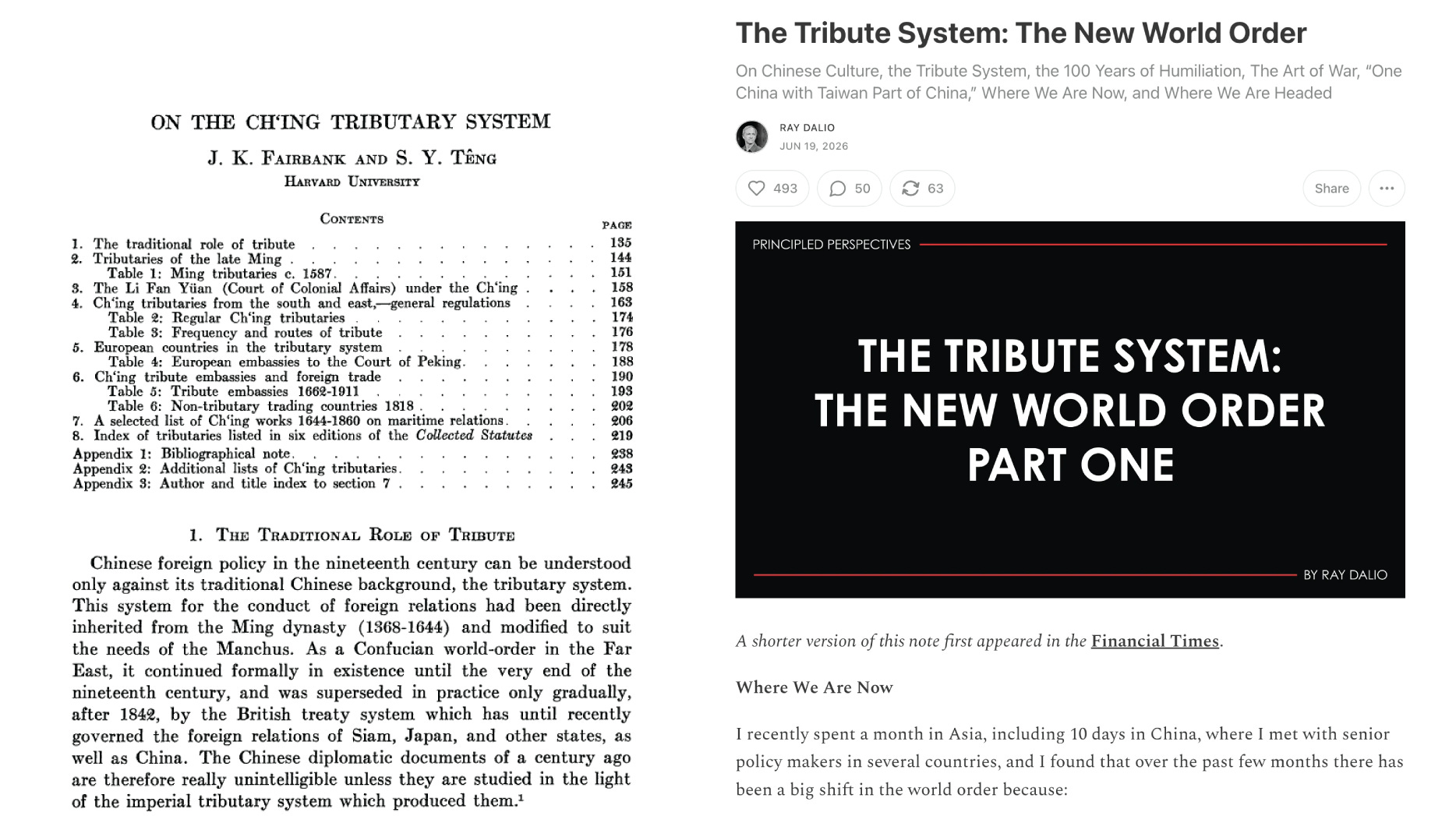
The Binary Fairbank Built
The word 朝贡 (cháogòng, “to present tribute at court”) is old. The research on it is relatively new. It grew up within the China scholarship of the Harvard-Yenching Institute, in the early 1940s, as Japan’s war on China drew the United States and China toward alliance and Americans grew hungry to understand a country about to become a partner. The idea of “the tribute system” was first introduced in a 111-page article by Fairbank and Têng Ssu-yü (邓嗣禹) in the June 1941 Harvard Journal of Asiatic Studies.2
What did Fairbank say the system was? In a phrase: the Confucian social order and hierarchy, turned outward, China at the top, the rest of the world owing deference. The decisive feature was that no outsider could meet China as an equal. A foreign state could enter relations only by taking a lower rank within a single hierarchy crowned by the Son of Heaven 天子, and the kowtow was the act that sealed it. He named the binding force “supernationalist sanctions derived from the Confucian world order”: the system did not negotiate between states so much as fold outsiders into China’s own moral-cosmic order, where to trade with the Middle Kingdom 中国 was, by that very act, to grant its centrality.
Fairbank built “the tribute system” as the foundation of his real subject, which was how the Western treaty system replaced China’s old way of handling foreigners after the Opium War (1840s), the project that became Trade and Diplomacy on the China Coast (1953).3 To tell that story, he first had to reconstruct what the treaties replaced. So he built the tribute system as the “before.”
The book’s structure gives the game away. Part One is called “China’s Unpreparedness for Western Contact.” Its chapters run from “The Problem of China’s Response to the West” to “Tribute and the Growth of Trade,” the second built straight on the 1941 article.
The tribute system was framed, from the start, as the thing the West would break. It was the static, ritual-bound “before,” there to make Western modernity the dynamic “after.” This became the master idea of postwar American China studies: “impact–response,” the picture of a sealed Confucian civilization that could only enter history once the West shocked it awake. Fairbank founded Harvard’s research center and trained much of the field. The concept ran for two generations, until Paul Cohen attacked it in Discovering History in China (1984) as a Western-centric story that cast China as the passive, backward party, waiting to be acted upon.4
Tribute: Chinese, old, hierarchical, ritual, hungry for recognition, closed. Treaty: Western, modern, contractual, equal between sovereigns, commercial, open. One was the past, and China. The other was the future, and the West.
Fairbank noticed that the two sides of a tribute relationship wanted different things. For China’s rulers, what mattered was the moral value of tribute. For the foreigner, the material value of trade. He saw the split clearly. He just read it as Chinese rigidity, a myth China clung to until it ruined the Confucian state.
What the Tribute Court Actually Wanted
Start with a typical tribute mission, a 朝贡 (cháogòng). A foreign embassy arrived with local goods, presented a written memorial, and bowed. The court performed 册封 (cèfēng, investiture): it formally recognized a foreign ruler, the king of Chosŏn Korea, of Annam, of Ryukyu, as legitimate. That recognition fixed the two as ritual superior and subordinate. Trade ran on 勘合 (kānhé), split tally-certificates that licensed and capped each mission, and on 互市 (hùshì), the frontier markets where the real commerce happened.
