
The Tribute System Isn’t Returning to China
Tribute versus treaty, and how an empire chooses which one to use.

Ray Dalio says the world is reverting to China’s ancient order of kowtows and hierarchy, the tribute system.1 In his account, it runs on deference, not force: lesser powers acknowledge a dominant center, and in return get trade and protection. It’s an order held together by prestige and pressure, not war. He has the system right and the capital wrong.
Look at how the tribute system was actually theorized, and how it actually worked, and the labels turn out to be in the wrong places. The power now collecting tribute looks like Washington. The power now writing the contracts looks like Beijing. The tribute-versus-treaty binary that John King Fairbank (费正清) built in the 1940s to explain how China met the modern West, has quietly rotated. It now points the other way.
This is a claim about posture, not about national character. And the posture is not a fixed one. It is a practical, flexible choice.
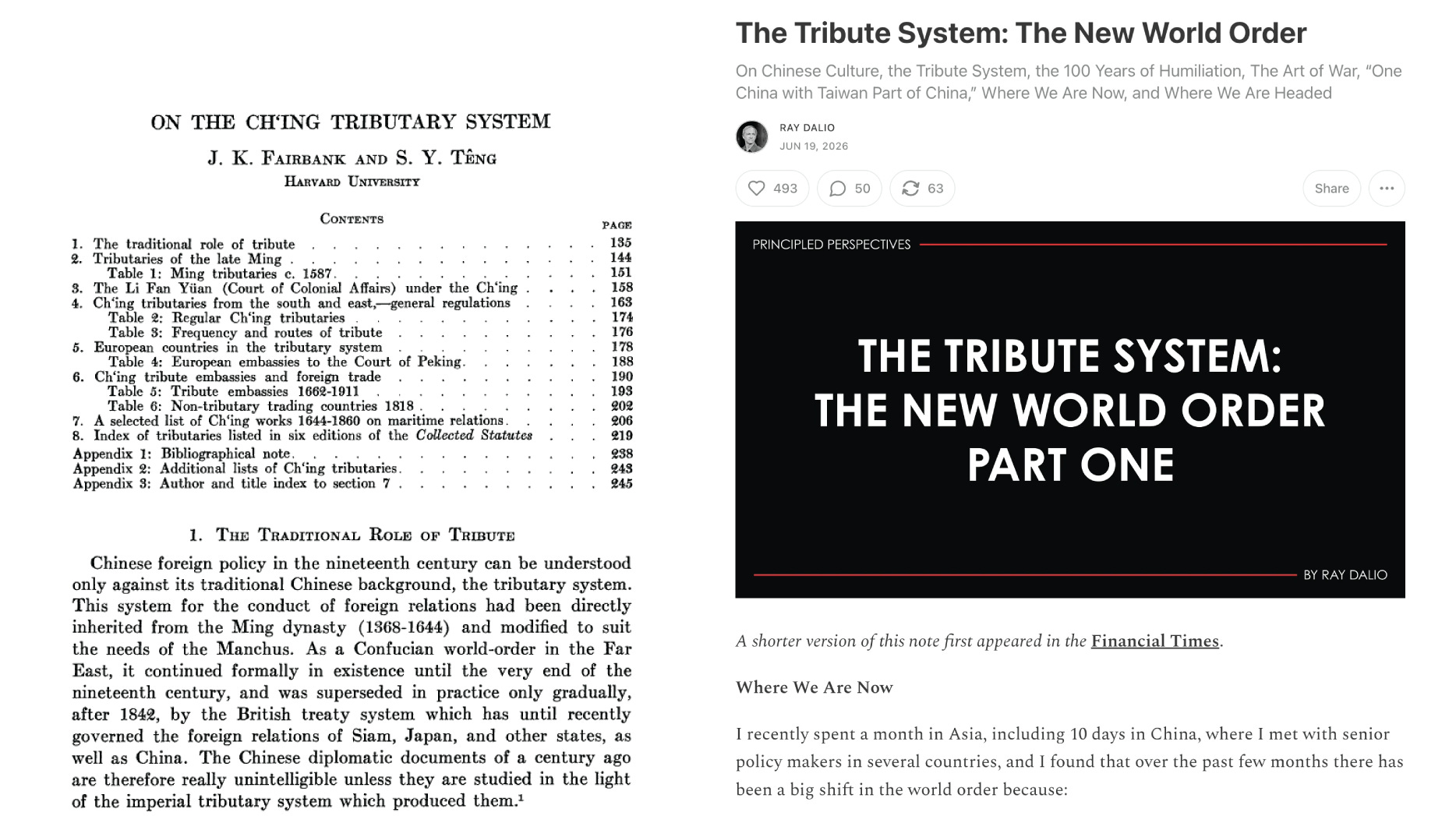
The Binary Fairbank Built
The word 朝贡 (cháogòng, “to present tribute at court”) is old. The research on it is relatively new. It grew up within the China scholarship of the Harvard-Yenching Institute, in the early 1940s, as Japan’s war on China drew the United States and China toward alliance and Americans grew hungry to understand a country about to become a partner. The idea of “the tribute system” was first introduced in a 111-page article by Fairbank and Têng Ssu-yü (邓嗣禹) in the June 1941 Harvard Journal of Asiatic Studies.2
What did Fairbank say the system was? In a phrase: the Confucian social order and hierarchy, turned outward, China at the top, the rest of the world owing deference. The decisive feature was that no outsider could meet China as an equal. A foreign state could enter relations only by taking a lower rank within a single hierarchy crowned by the Son of Heaven 天子, and the kowtow was the act that sealed it. He named the binding force “supernationalist sanctions derived from the Confucian world order”: the system did not negotiate between states so much as fold outsiders into China’s own moral-cosmic order, where to trade with the Middle Kingdom 中国 was, by that very act, to grant its centrality.
Fairbank built “the tribute system” as the foundation of his real subject, which was how the Western treaty system replaced China’s old way of handling foreigners after the Opium War (1840s), the project that became Trade and Diplomacy on the China Coast (1953).3 To tell that story, he first had to reconstruct what the treaties replaced. So he built the tribute system as the “before.”
The book’s structure gives the game away. Part One is called “China’s Unpreparedness for Western Contact.” Its chapters run from “The Problem of China’s Response to the West” to “Tribute and the Growth of Trade,” the second built straight on the 1941 article.
The tribute system was framed, from the start, as the thing the West would break. It was the static, ritual-bound “before,” there to make Western modernity the dynamic “after.” This became the master idea of postwar American China studies: “impact–response,” the picture of a sealed Confucian civilization that could only enter history once the West shocked it awake. Fairbank founded Harvard’s research center and trained much of the field. The concept ran for two generations, until Paul Cohen attacked it in Discovering History in China (1984) as a Western-centric story that cast China as the passive, backward party, waiting to be acted upon.4
Tribute: Chinese, old, hierarchical, ritual, hungry for recognition, closed. Treaty: Western, modern, contractual, equal between sovereigns, commercial, open. One was the past, and China. The other was the future, and the West.
Fairbank noticed that the two sides of a tribute relationship wanted different things. For China’s rulers, what mattered was the moral value of tribute. For the foreigner, the material value of trade. He saw the split clearly. He just read it as Chinese rigidity, a myth China clung to until it ruined the Confucian state.
What the Tribute Court Actually Wanted
Start with a typical tribute mission, a 朝贡 (cháogòng). A foreign embassy arrived with local goods, presented a written memorial, and bowed. The court performed 册封 (cèfēng, investiture): it formally recognized a foreign ruler, the king of Chosŏn Korea, of Annam, of Ryukyu, as legitimate. That recognition fixed the two as ritual superior and subordinate. Trade ran on 勘合 (kānhé), split tally-certificates that licensed and capped each mission, and on 互市 (hùshì), the frontier markets where the real commerce happened.
And specifically for the ritual: 三跪九叩 (sān guì jiǔ kòu), three kneelings and nine head-knockings, the kowtow during the Qing (17-20th century), and 五拜三叩 (wǔ bài sān kòu) five bows and three knockings, under the Ming (14-17th century). Even the kowtow was not fixed across dynasties.
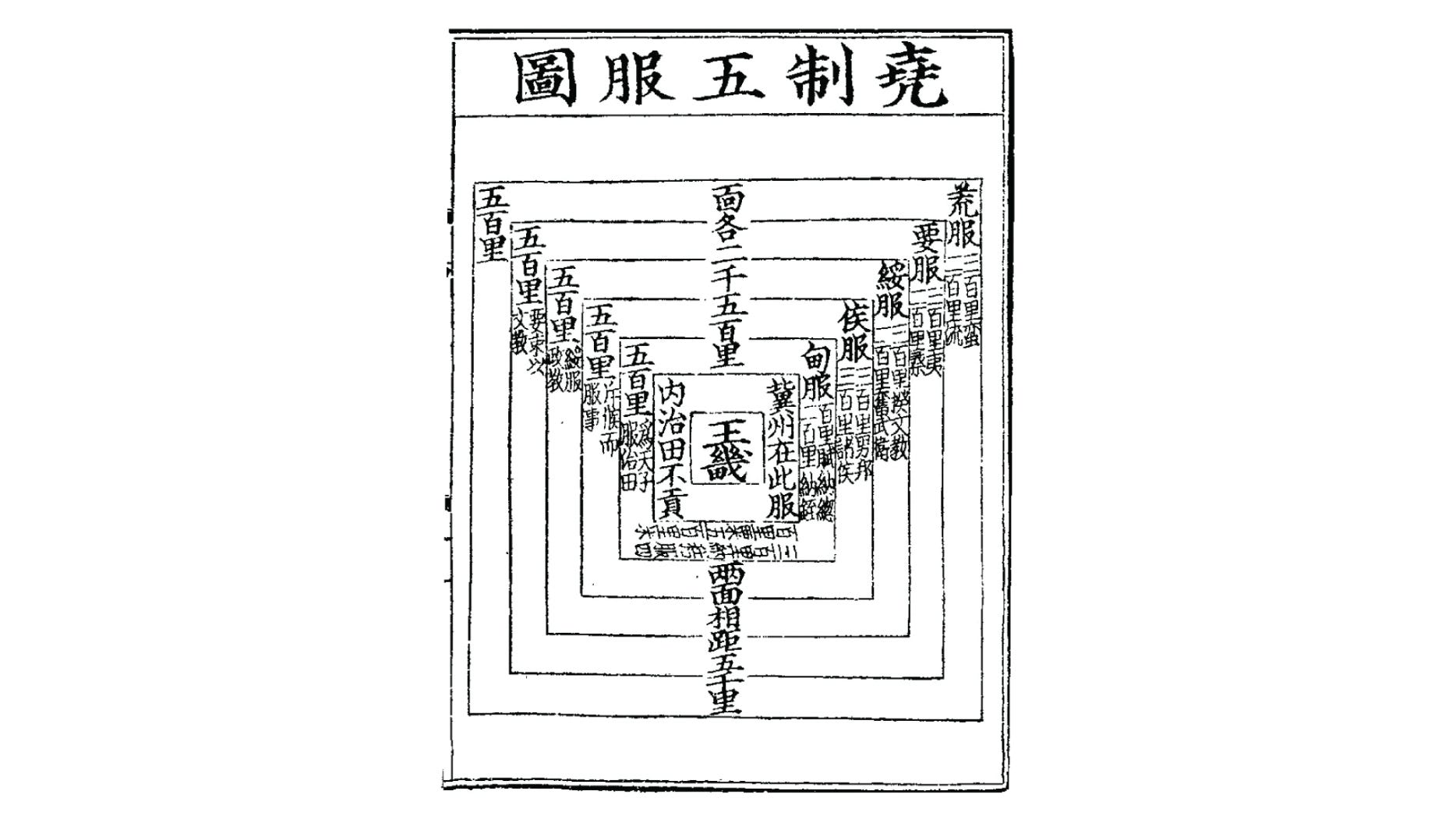
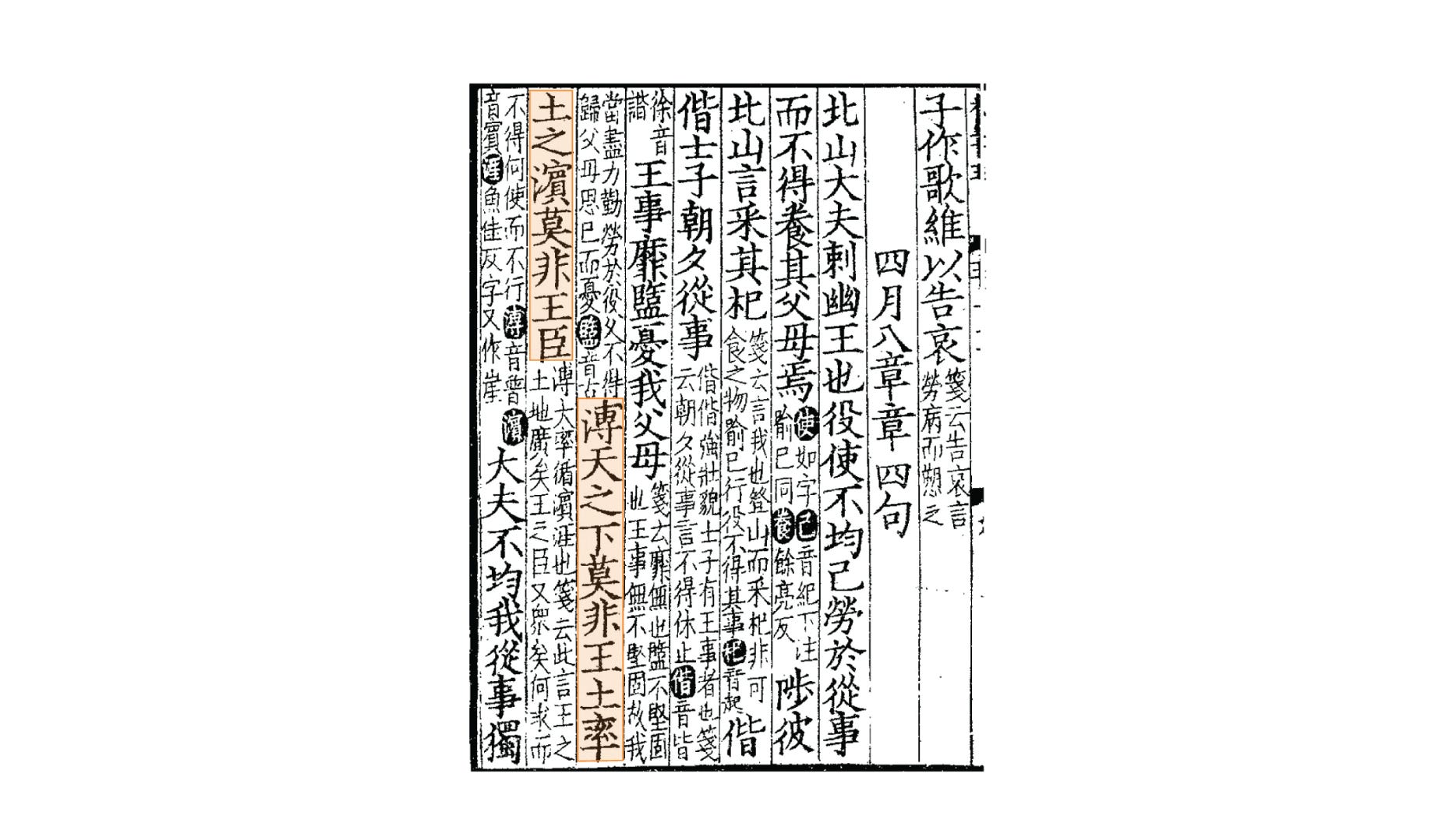
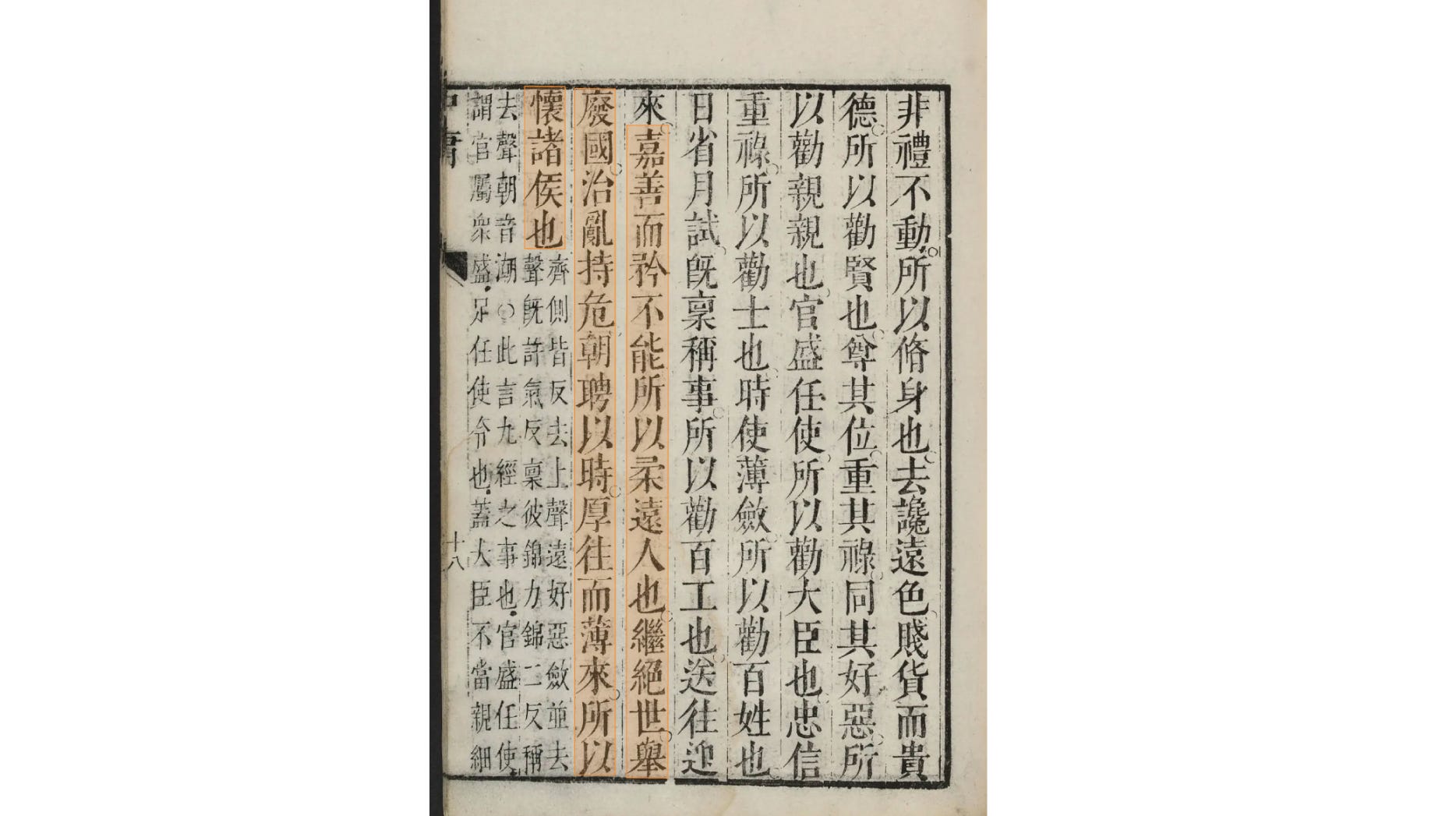
None of this began as foreign policy. The tribute system was the Confucian order at home, projected outward. Inside China, 礼 (lǐ), ritual propriety, sorted everyone into a hierarchy of reciprocal duty: ruler above subject, father above son, elder above younger. Turn it outward and the world takes the same shape, with one 天子 (tiānzǐ), Son of Heaven, at the moral center and everyone else placed by their distance from him. The classics had drawn the map a thousand years before the Ming. The Book of Documents 尚书 divided the realm into 五服 (wǔfú), five concentric zones that sent tribute less and less often as they lay farther out. The Book of Odes诗经 declared that under the whole of heaven, no land is not the king’s (溥天之下,莫非王土). And the Doctrine of the Mean 中庸 told the ruler how to handle the world beyond: cherish the men from afar (柔远人), and give much and take little (厚往薄来) , , the way one cherishes the lords. The court’s famous generosity was the mandate by scripture.
So “tribute” did not mean taking. The court followed the principle of “send much, receive little,” and the emperor’s return gifts were meant to exceed the tribute. In cash, the tributary usually came out ahead. A system built to dominate should not, as policy, lose money to its subordinates. So what was the court gaining?
It was gaining recognition from audience at home. The emperor claimed to rule 天下 (tiānxià, “all under heaven”) and to hold 天命 (tiānmìng, the Mandate of Heaven). That claim needed proof: distant peoples, visibly acknowledging him. 名分 (míngfèn), correct status, was not foreign policy. It was domestic legitimacy, performed for the Chinese elite and written into the record. The kowtow was theater for the people back home.
The tribute court paid in silver and was repaid in symbolism. It taxed itself to buy recognition. Underneath that ritual, though, ran something the symbolism half-hid. The economic historian Hamashita Takeshi 濱下武志 argued that, read up close, the tribute system was less a hierarchy of deference than the institutional skin of a vast trade network, settled in silver, with China as its clearing-house.5 The court treated tribute as a status expense; the economy beneath it ran a surplus.
Ritual as the Last Asset
In 1793, Lord Macartney’s embassy reached the Qianlong emperor
In the widespread version, the British envoy refused the full kowtow. The proud Qing court, unable to imagine equals, turned him away. Trade was denied. The road to the Opium War opened. China just could not understand the modern world. Qianlong’s reply to George III is the usual exhibit:
天朝物產豐盈,無所不有,原不藉外夷貨物以通有無。
The Celestial Empire possesses all things in abundance and lacks nothing within its borders. There is no need to import the goods of outside barbarians.
James Hevia took this apart in Cherishing Men from Afar (1995).6 His argued that meeting was not a modern state against a backward one. It was two expanding empires, each with its own sophisticated way of building rank and sovereignty. The kowtow was not Chinese stupidity. It was a rival method for making a relationship real. The “China could not grasp equality” story was not history. It was the orientalism baked into the tribute-system concept, read backward.
The Qing dug in hardest on ritual just as its real position began to slip. By the second British embassy, Amherst’s, in 1816, the fight over the kowtow was so total that the envoy never got an audience at all.
A hegemon grips ceremony hardest when its real leverage is draining. Ceremony is the asset that depletes last. Recognition is what you demand when you can no longer command.
Conquer the Defiant, Cherish the Compliant
The beam holding up Dalio’s whole account is non-violence: a way to order the world without conquest, all pressure and ritual. To subdue the enemy without fighting is the acme of skill. The trouble is that the dynasties we romanticize as open, cosmopolitan, tribute-receiving golden ages are the most violent ones.
Yuan-kang Wang tested the pacifist claim against six centuries of history in Harmony and War (2011).7 It failed. China acted like a normal great power: aggressive when strong, careful when weak. The Confucian talk of restraint tended to appear as the excuse of the weak, dressed up afterward as virtue.
Take the Tang, the favorite of the cosmopolitan story. In 630 the emperor Taizong was hailed as 天可汗 (Tiān Kèhán, “Heavenly Khan”) by the peoples of the steppe, the very image of open, multi-ethnic kingship the myth loves. He earned the title by destroying the Eastern Turkic Khaganate: his general Li Jing captured its ruler and some 120,000 of its people. Ten years later the Tang did not even use the tribute register on the oasis kingdom of Gaochang (高昌, Turfan, ruled by the Qu house since 498). In 640 the general Hou Junji conquered it and the court annexed it outright, and made it Xi Prefecture (西州), ran a census, imposed the standard land system. Then came the Anxi Protectorate (安西都护府) and its Four Garrisons across the Tarim Basin; the Western Turks destroyed by 657; Gao Xianzhi sacking Tashkent and carrying off its king in 750; the rout at Talas in 751. To the east, Baekje fell in 660 and Goguryeo in 668.
The “Heavenly Khan,” the universal monarch the Tang myth celebrates, was the product of conquest. Nearby and sinicized got swallowed. Far and strong got managed and qualified as tribute state.
The pattern repeats at every peak. The early Ming under the Yongle emperor invaded Đại Việt in 1406 and ‘reclaimed’ northern Vietnam as a province, holding it by force for twenty years. The same reign sent Zheng He’s fleets to seize a pirate fleet at Palembang and carry a captured king home from Ceylon. And the High Qing, the self-proclaimed master of harmony, exterminated the Zunghar Mongols during decades of conquest wars with the Zunghar Empire.8
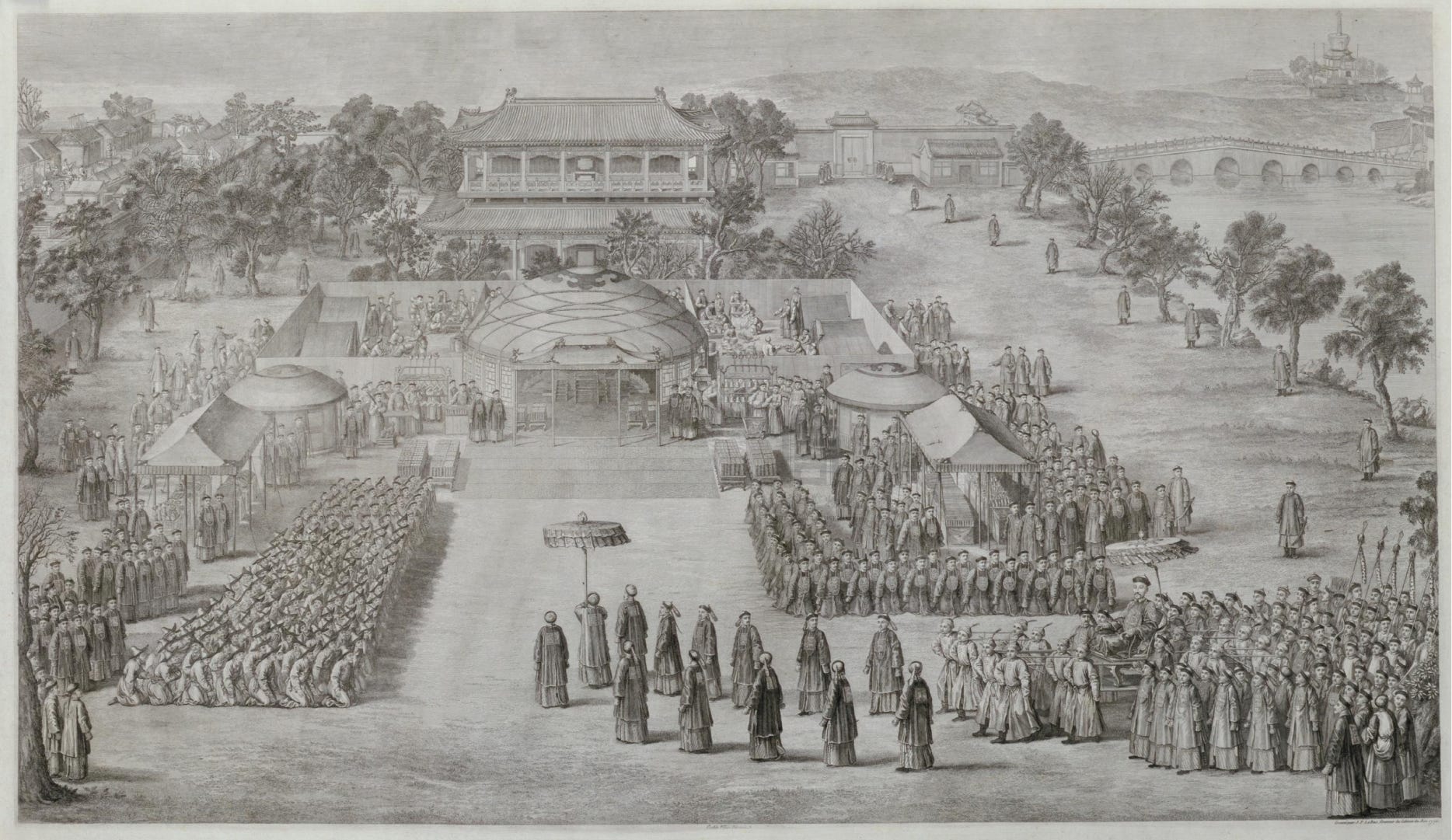
The benevolent face and the conquering face were never opposites. They were two tools the same need for recognition kept in reach, cherish the compliant, crush the defiant. Which tool came out depended on what the audience at home would read as legitimacy. Tribute is just what dominance looks like once it has been turned into ritual.
China Among Equals
Fairbank’s model states that no foreign state could meet China as an equal. But the historians who came after found something far looser. The word 贡 (gòng), “tribute,” meant a gift from a lesser to a greater in any relationship, not a term reserved for foreign affairs; and in practice the dynasties ran many different kinds of tributary ritual, not one. Peter Perdue’s charge is that Fairbank took a flexible practice with many meanings and froze it into one over-formalized system.9 Feng Zhang’s is that the model is a static frame, reflecting less how the region worked than the world order the Chinese court liked to imagine.10 Fairbank had mistaken the throne’s flattering self-portrait for the machinery itself.
Look at how it actually worked, and the single hierarchy comes apart. In 607 the court of Japan wrote to the Sui emperor as one Son of Heaven to another: the ruler where the sun rises greeting the ruler where the sun sets, and the Sui court took offense precisely because the letter assumed parity. Three centuries later the Song dynasty signed the Treaty of Chanyuan (1005) with the Khitan Liao as “brother states,” two empires of equal rank, and it was the Song, the supposed Middle Kingdom, that paid: a hundred thousand taels of silver and two hundred thousand bolts of silk a year, hauled to the frontier for the Liao to collect. And much of Song foreign dealing was not tribute at all but plain commerce, run through border markets and merchant ships, no kowtow required. The hierarchy ran in both directions, and sometimes in none. The historian Morris Rossabi titled his book among these centuries China Among Equals.11
So the tributary hierarchy was never China’s nature. It was one tool in a kit. China reached for it when it was strong, and when it needed the show of supremacy for its home audience. It met others as equals when it faced a power it could not dominate. It paid tribute upward when it was weak. It ran plain trade when it only wanted the goods. The mode tracked power and need, not some fixed civilizational soul, which is, in the end, how an empire chooses which one to use.
Equality Was a Members’ Club
Nineteenth-century international law did not hand out sovereign equality to the world. It ran a tier list, the “standard of civilization,” anatomized by Gerrit Gong in 1984.12 At the top, full sovereigns: Christian and European. In the middle, the half-recognized: China, Japan, the Ottomans, given partial standing and saddled with extraterritoriality and unequal treaties. At the bottom, the colonized, with no sovereignty at all. Antony Anghie went further in Imperialism, Sovereignty and the Making of International Law (2005): sovereignty itself was defined against the colonized.13 The law was not a club of equals that happened to exclude some. It was built out of the colonial encounter.
The unequal treaties are the proof. They used the form of a contract between equals - signatures, articles, reciprocal clauses - to lock inequality into durable, legal, enforceable shape: indemnities, fixed tariffs, foreign courts, most-favored-nation ratchets. Nominal equality was not the softening of the hierarchy. It was the tool that laundered it and locked it in. It used the language of equality to make the taking permanent.
Strip the treaty system of its costume and you get the mirror of the tribute machine. The treaty logic binds others through contract, debt, and market access. Its currency is material. And it wants your signature and your repayment, not your kowtow. The tribute hegemon taxes itself to buy recognition. The treaty hegemon extracts wealth and rations recognition. Two machines, two currencies, opposite directions.
The Inversion
Here is the reassignment. The United States is sliding into the tribute logic. China is sliding into the treaty logic. Fairbank’s binary, built to explain China’s encounter with the West, now points at Washington.
The tribute system was always about recognition 名分, not about wealth or contracts. It was propaganda that staged for a home audience: proof to the Chinese elite and the dynastic record that the Son of Heaven sat at the center of all under heaven. A ruler needs that theater only when his right to rule depends on being seen as the center. China no longer rules on that claim. Its legitimacy runs on growth and delivery, and a port concession is worth far more to it than a foreign president’s bow. So it takes the contract and skips being the center. The power that still needs to stage supremacy for its own people, because its politics now runs on being seen to win, is not China.
In 2013 the political scientist Yuen Foong Khong argued that the United States had long run its own tributary system. It demanded two tributes for its global exertions: recognition as the number-one power, and adoption of its political model.14 That is the recognition 名分 demand exactly, acknowledge my rank, take my form. Now add the present. An administration that prizes loyalty over rules. That will tear up the rules-based order it built to pull deference and payments out of allies. That tells client states to fund their own protection.
That is the Qing court of the 19th century. An empire that no longer wants to fight, but still wants to be acknowledged, gripping the ceremony harder as the power behind it drains away.
Now watch China take the treaty power’s chair, and this is not a compliment. The treaty powers were imperialists. The Belt and Road runs on contracts, currency-swap lines, debt, port concessions, and market access. It clears more and more in RMB. It does not ask about the regime and does not levy the second tribute. It does not require to adopt its model, hold its kind of elections, or love it. It requires to sign, build, and repay. That is the logic of the treaty powers, not of a returning sage-king. China is stepping into the chair of Britain in 1860, not the chair of Qianlong in 1793.
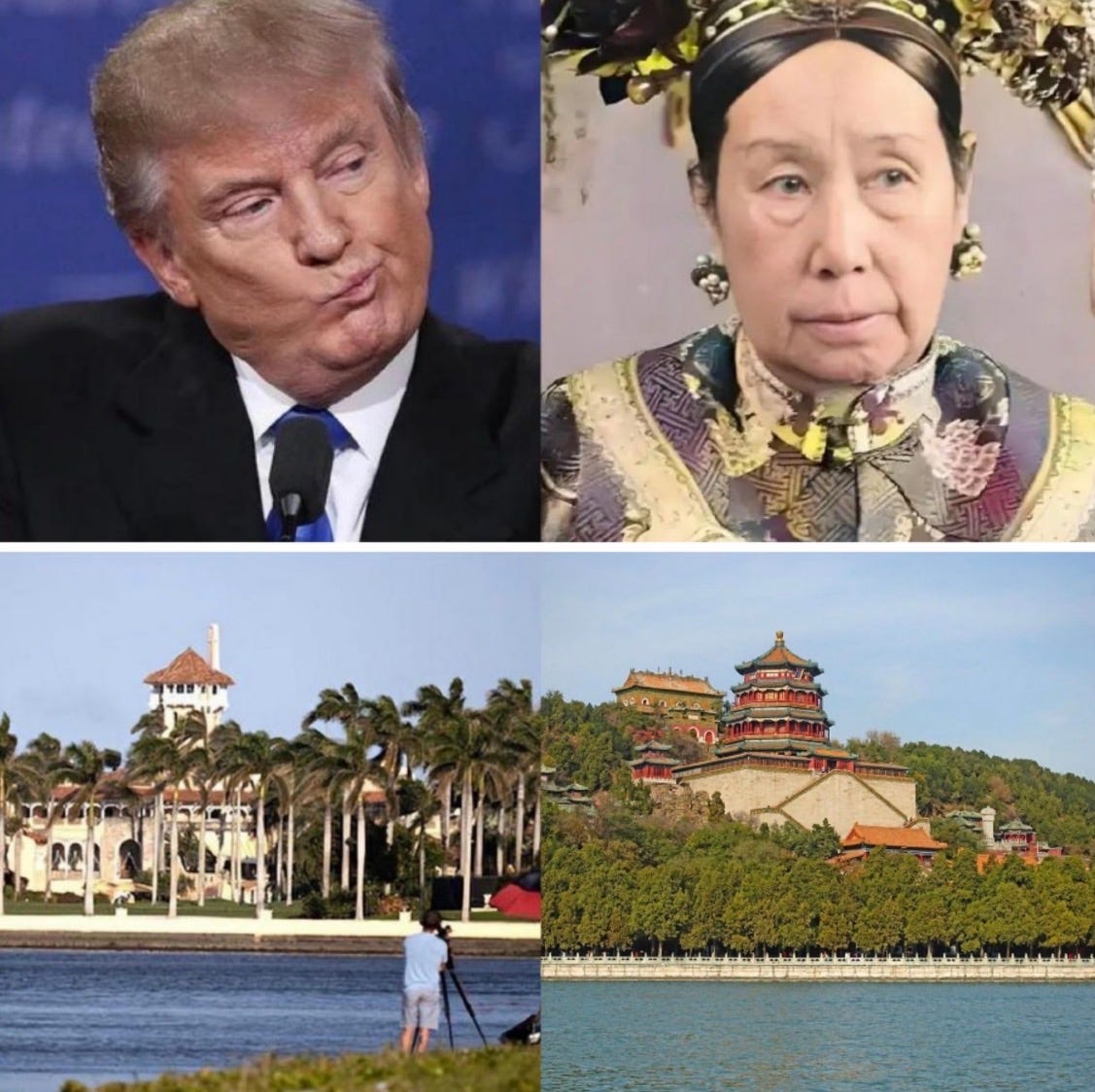
The sharpest read on all this came from the Chinese internet. In June 2026, after Washington blockaded Iran over the Strait of Hormuz and then signed a memorandum of understanding with Tehran, lifting the blockade, unfreezing Iranian assets, and pledging at least $300 billion toward Iran’s reconstruction, Chinese netizens began calling Trump a reincarnated 慈禧 (Cíxǐ), the Empress Dowager who ruled the dying Qing until 1908. They gave the two rulers the same four pastimes: 办寿宴, throwing oneself lavish birthday galas; 修园子, building pleasure-palaces. Cixi was charged with draining the navy’s budget to rebuild the Summer Palace, and Trump wants a Great-Hall-style ballroom for the White House; 签条约, signing treaties, which is what the memorandum looked like to them; and 赔款, paying indemnities, which is what the Iran money looked like. The inversion did not need a historian. The meme already had it.
A Pattern, Not a Character
Tribute and treaty were never civilizations. They are postures of power, and they migrate. The recognition-hungry, war-shy, ceremony-clutching posture attaches to the hegemon on the way down. The contractual, extractive, regime-blind posture attaches to the power on the way up. In the nineteenth century the rising contractual power was British and the declining ritual one was Manchu. The roles did not come back to China. They changed occupants.
The tribute system was named in the age of orientalism, as the thing that set China apart from the West. That was the first mistake: taking a mechanism any empire can run and writing it down as a national character. It was never a Chinese trait. It was a pattern, and patterns travel.
So when Dalio says the world is returning to the tribute system, the honest translation is not that China is becoming its ancient self. It is that the hegemon who paid for the world’s recognition is losing the will to keep paying, and a power that can still afford the bill is taking over the contract. Dalio looked at that empire: war-shy, ceremony-hungry, paying to be called first, and named it China. The Chinese internet looked at the same empire and named it Cixi.
If my insights brought you a fresh perspective, please consider supporting me by buying me a coffee. Your generosity fuels my writing.

John King Fairbank and Ssu-yü Têng, "On the Ch'ing Tributary System," Harvard Journal of Asiatic Studies 6, no. 2 (1941): 135–246.
John King Fairbank, Trade and Diplomacy on the China Coast: The Opening of the Treaty Ports, 1842–1854 (Cambridge, MA: Harvard University Press, 1953). The tribute-vs-treaty framing, the "supernationalist sanctions" phrase are drawn from here (esp. p. 24).
Paul A. Cohen, Discovering History in China: American Historical Writing on the Recent Chinese Past (New York: Columbia University Press, 1984).
Takeshi Hamashita, Chōkō shisutemu to kindai Ajia [The Tribute System and Modern Asia] (Tokyo: Iwanami Shoten, 1997).
James L. Hevia, Cherishing Men from Afar: Qing Guest Ritual and the Macartney Embassy of 1793 (Durham, NC: Duke University Press, 1995).
Yuan-kang Wang, Harmony and War: Confucian Culture and Chinese Power Politics (New York: Columbia University Press, 2011).
Peter C. Perdue, China Marches West: The Qing Conquest of Central Eurasia (Cambridge, MA: Belknap Press of Harvard University Press, 2005).
Peter C. Perdue, "The Tenacious Tributary System," Journal of Contemporary China 24, no. 96 (2015): 1002–1014.
Zhang Feng, "Rethinking the 'Tribute System': Broadening the Conceptual Horizon of Historical East Asian Politics," The Chinese Journal of International Politics 2, no. 4 (2009): 545–574.
Morris Rossabi, ed., China Among Equals: The Middle Kingdom and Its Neighbors, 10th–14th Centuries (Berkeley: University of California Press, 1983).
Gerrit W. Gong, The Standard of 'Civilization' in International Society (Oxford: Clarendon Press, 1984).
Antony Anghie, Imperialism, Sovereignty and the Making of International Law (Cambridge: Cambridge University Press, 2005).
Yuen Foong Khong, "The American Tributary System," The Chinese Journal of International Politics 6, no. 1 (2013): 1–47; and "The American Tributary System Revisited," The Chinese Journal of International Politics 19, no. 1 (2026): 83–99.