

When translating the word “Law” into the modern Chinese term fǎlü (法律), it operates under the comforting illusion of equivalence. It assumes that both words point to the same foundational concepts: a social contract, the protection of individual rights, and an impartial shield against the arbitrary power of the state. They do not.
Beneath the surface of modern legal dictionaries lies a profound cultural and linguistic chasm. The Western legal tradition, rooted in Roman law and the Enlightenment, views the law as a mechanism to protect the individual. The traditional Chinese legal framework, shaped by millennia of agrarian, state-centric governance, views the law as a tool to discipline the subject and maintain cosmic and social harmony.
To understand how China governs itself today, and why its legal system frequently confounds Western observers, it has to strip away the translated terminology, to examine the ancient etymology of Chinese law, the hidden history of its grassroots litigators, the massive linguistic rupture of the late Qing Dynasty, and the insights of modern legal scholars like Xu Zhangrun 许章润, who argue that China is still searching for a legal language that truly speaks to its soul.
However, modern China possesses a highly sophisticated, written legal system largely modeled after Continental European civil law. Stepping into a Chinese law school, students are studying contracts, torts, and constitutional theories just as their Western counterparts do. However, this essay is not about the “law on the books.” It is about the cultural subconscious, the enduring, unwritten legal intuition of the ordinary populace when confronted with authority and injustice.
Fa (灋) vs. Jus and Lex
The Western tradition frequently divides the concept of law into two distinct spheres: Jus (justice, divine or natural principle, and individual rights) and Lex (specific, written statutes enacted by a state). In this framework, Lex remains subordinate to the higher principles of Jus.
The Chinese concept operates within a different paradigm.
The ancient, orthodox character for law is Fa (灋). It is a highly pictorial ideogram composed of three elements:
Water (氵): Symbolizing a surface “smooth and level as water,” representing absolute impartiality.
The Beast Zhi (廌): A mythical creature capable of distinguishing right from wrong, believed to ram the guilty party during disputes.
To Remove (去): Signifying the expulsion or elimination of the guilty from society.
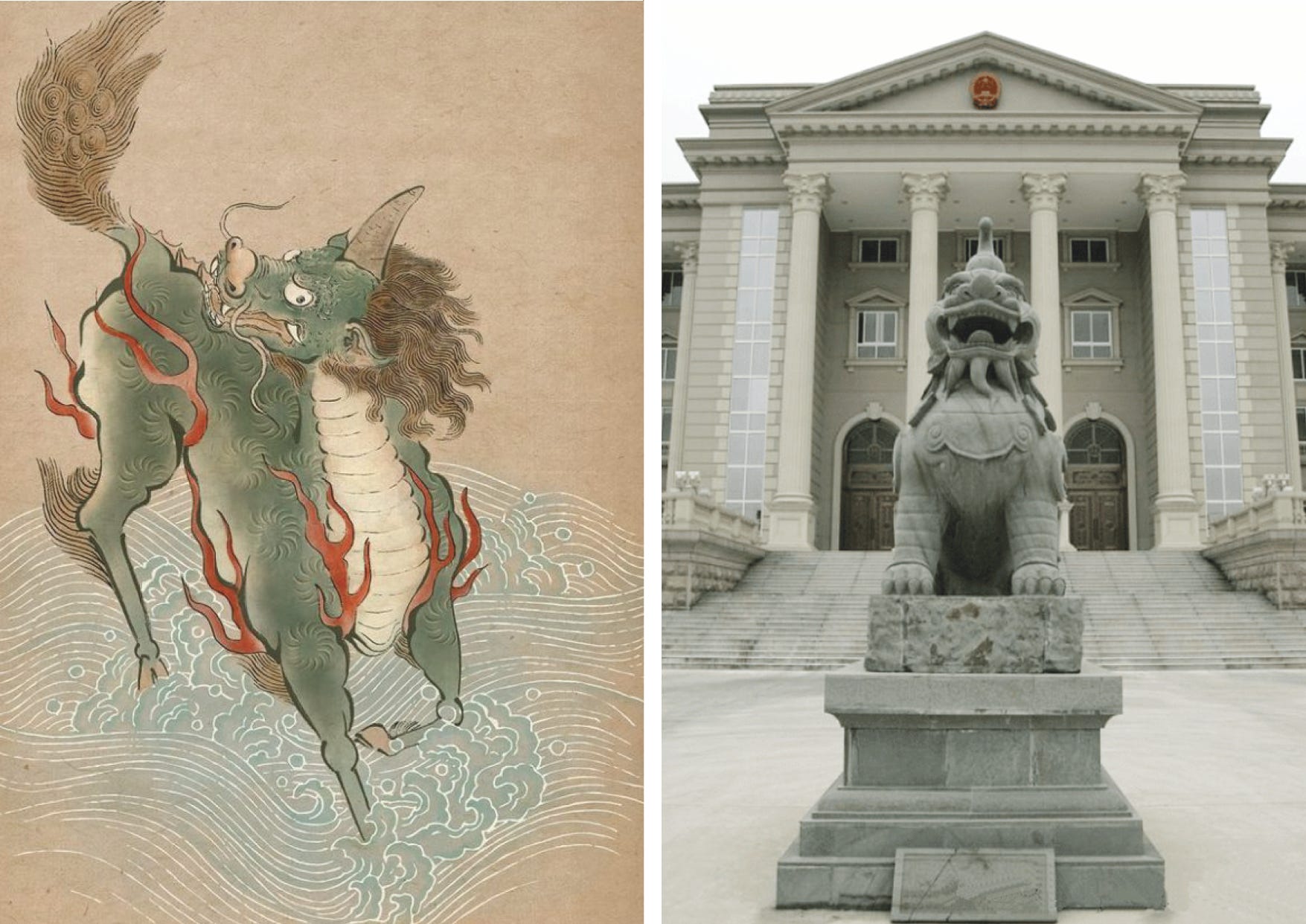
From its genesis, Chinese “law” (Fa) was intrinsically linked to punishment, statecraft, and top-down arbitration, rather than the defense of individual liberties. Complementing Fa is Lü (律), a term originally referring to the bamboo pitch-pipes used to standardize musical tuning. It evolved to mean codified rules of behavior and the corresponding mathematical scales of punishment. Traditional law served as the ruler’s measuring stick for discipline, not a shield for the citizen.
The “Non-Litigious” Society
Because traditional Chinese law functioned primarily as penal law. Even civil disputes over land or marriage could result in physical punishment. Orthodox Confucian ideology promoted the ideal of wusong (无讼), a society without lawsuits. This fostered an enduring myth that traditional China was a purely harmonious, relationship-based society devoid of legal conflict.
Historical reality diverged significantly.
By the Ming Dynasty (1368–1644), commercial expansion created complex societal structures, notably in Huizhou (徽州). Huizhou merchants operated across the empire, relying heavily on written contracts for land sales, lineage trusts, and trade partnerships. This reliance generated a highly litigious culture (健讼, jiansong). When property and capital were at stake, the populace willingly engaged local magistrates’ courts.
