

On the morning of January 3, 2026, U.S. President Donald Trump said American forces carried out a “large scale strike” in Venezuela and that President Nicolás Maduro and his wife were “captured and flown out of the country.” Details are still emerging, with Caracas rattled by explosions and Venezuela’s officials demanding proof of life and denouncing an “imperialist attack.” 、
Whatever one thinks of Maduro, or of U.S. policy, a moment like this has a strangely old feeling to it, older than the vocabulary of international law, older than cable news.
It’s the oldest political problem in the book:
What happens to a state when the person who embodies it is suddenly… gone?
Not dead. Not resigned. Just… taken.
That’s why today’s headlines snapped my mind back to a scene from Ming China, 1449, when an emperor rode out to war and vanished into enemy hands. The event has a melodramatic name, the Tumu Crisis, 土木堡之变, but its afterlife was administrative, not romantic. It became a manual for something most regimes prefer not to practice in public: how to keep governing when the “center” has been physically removed.
1449: The day the emperor became a bargaining chip
In 1449, the Ming Zhengtong (Yingzong) Emperor personally led a campaign against the Oirat Mongols. It was a catastrophic decision. At Tumu Fortress, the Ming army collapsed; the emperor was captured alive. In Beijing, panic spread. A captured emperor is not just a military problem—it’s a constitutional crisis in human form.
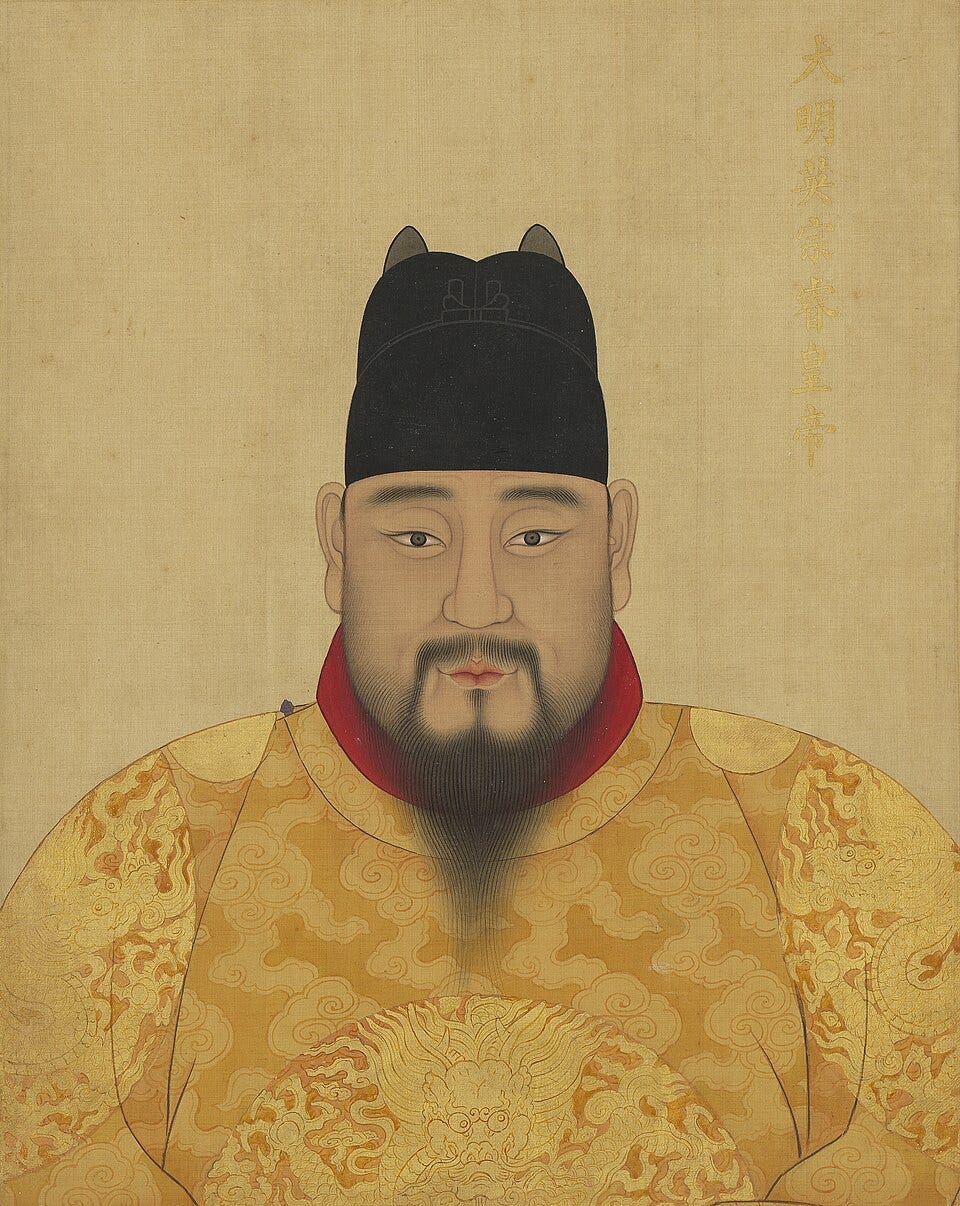
And then came the fork in the road. Some officials proposed moving the capital south (to Nanjing), an instinct that sounds “rational” in the abstract: preserve the court, regroup, avoid the enemy’s next move. But the key minister at the moment, Yu Qian 于谦, opposed it, arguing that retreat would shred legitimacy and invite permanent loss. He pushed instead for a defense of Beijing.
The Ming court enthroned a new emperor, the captive emperor’s brother (the Jingtai Emperor), and reduced the captive to an honorific “retired emperor.” In plain terms: they tried to strip the hostage of his hostage-value.
