

China in Chinese, 中国 (Zhōngguó), means “Middle Kingdom.” For most of its history the country believed it. But for several centuries the imported Buddhism told a different story: that the Chinese lived at the rim of the world, and that the true Middle Kingdom was in India.
Around 400 CE a Chinese monk named Faxian (法显) traveled to the Ganges plain and found himself standing at the real ‘Middle Kingdom,’ the Sanskrit Madhyadeśa: “the middle land.” It was the Buddhist name for the region where the Buddha was born, taught, and died. Buddhist geography placed the center of the world there. Everything beyond it was borderland.
When Faxian reached the Jetavana monastery in Śrāvastī, where the Buddha had lived and preached the longest, the Indian monks were stunned to see a Chinese face. His Record of Buddhist Kingdoms (佛国记) records their reaction, “How remarkable, people from the borderland can actually come seeking the Dharma here. Our teachers, and our teachers’ teachers, have never seen a Chinese monk in this place.” (彼众僧叹曰:奇哉,边地之人乃能求法至此。自相谓言:我等诸师,和上相承,未见汉道人来到此地也) Faxian was moved to tears. He saw the flourishing Dharma at its source and thought of the incomplete, fragmented scriptures back home. The distance was not just geographic. It was a gap in authority, in access to the truth itself.
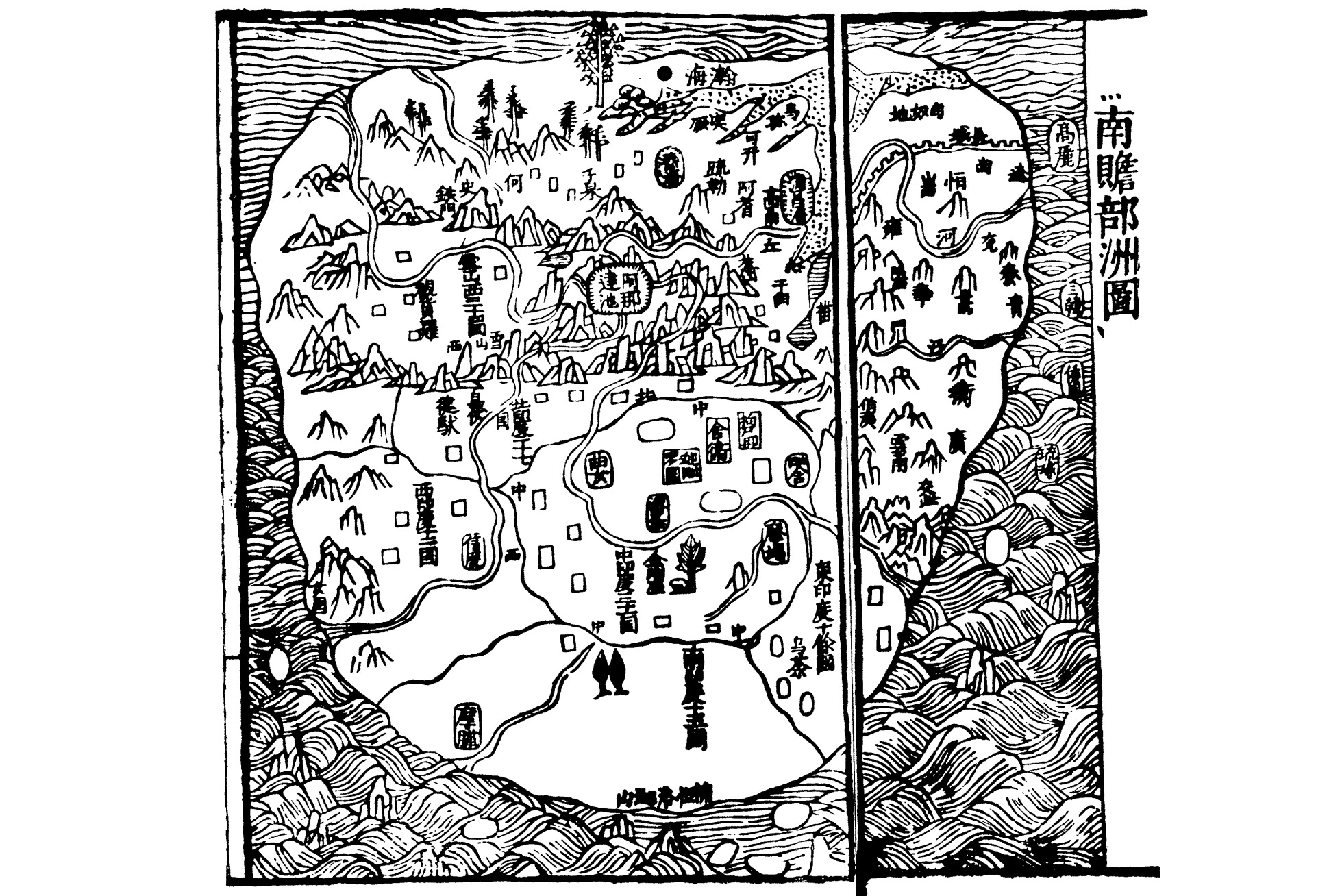
The story of how China dealt with Buddhism looks, in outline, like the story of how China is dealing with the modern West. How the first one ended may tell us something about the second.
Born in the Borderland
Buddhist texts list the 八难 (bā nàn), the eight conditions under which a person cannot properly hear or practice the Dharma. Birth in a borderland (Uttarakuru) is one of them. The disadvantage was even procedural: in India, the Vinaya (毗奈耶, 律) required ten monks to confer full ordination; in a borderland, because you could not gather enough, the rule was lowered to five. The edge was not condemned. It was under-resourced, the way a provincial outpost has fewer teachers and thinner libraries than a capital.
The Italian sinologist Antonino Forte gave this feeling a name: the “borderland complex.” Chinese monks, he argued, carried a genuine sense of being outsiders inside their own religion. They felt like latecomers, at the wrong end of the earth, dependent on texts and teachers who were always somewhere else. Faxian felt it firsthand. When he reached the Buddhist heartland, an Indian monk looked at him with something like pity.
The anxiety carried its own remedy, though: if the teaching was strongest at its source, then the way to escape the borderland was to reach the source.
The Journey to the West
Xuanzang (玄奘, 602?–664) is remembered mostly through the pilgrim of Journey to the West. The real reason he left is less magical and more revealing. By the early seventh century, Chinese Buddhism was at war with itself. Rival schools read the difficult Yogācāra texts in incompatible ways, and the translations they argued from were partial, inconsistent, and in places simply wrong. Xuanzang concluded that the dispute could not be settled in China, because the documents needed to settle it existed only in India. The edge had the argument but not the evidence; the center had both.
In 629, defying an imperial travel ban, he slipped out of the capital. The road ran for thousands of miles across deserts and mountain passes where other pilgrims had died. He went anyway, because no authority in China could end an argument that only original classics could end.
He was gone more than a decade, much of it at Nālandā, the great monastic university. He returned in 645 with hundreds of texts and the authority of a man who had reached the center and mastered it. The emperor received him. He spent his remaining years translating.
The Buddhism Xuanzang carried home was the most faithful version China had ever received. But Chinese buddhism could not digest it. His Faxiang (法相) school barely outlived him; his leading disciples fell out, and within two generations it had faded. The schools that flourished instead: Chan (禅), Tiantai (天台), Huayan (华严), were the ones that had quietly become Chinese. Their teachers argued, implicitly or openly, that Indian Buddhism’s textual and ascetic methods were expedient measures suited to a particular time and place, and that Chinese practitioners could reach further toward direct awakening, without the apparatus.
Moving the Mountain
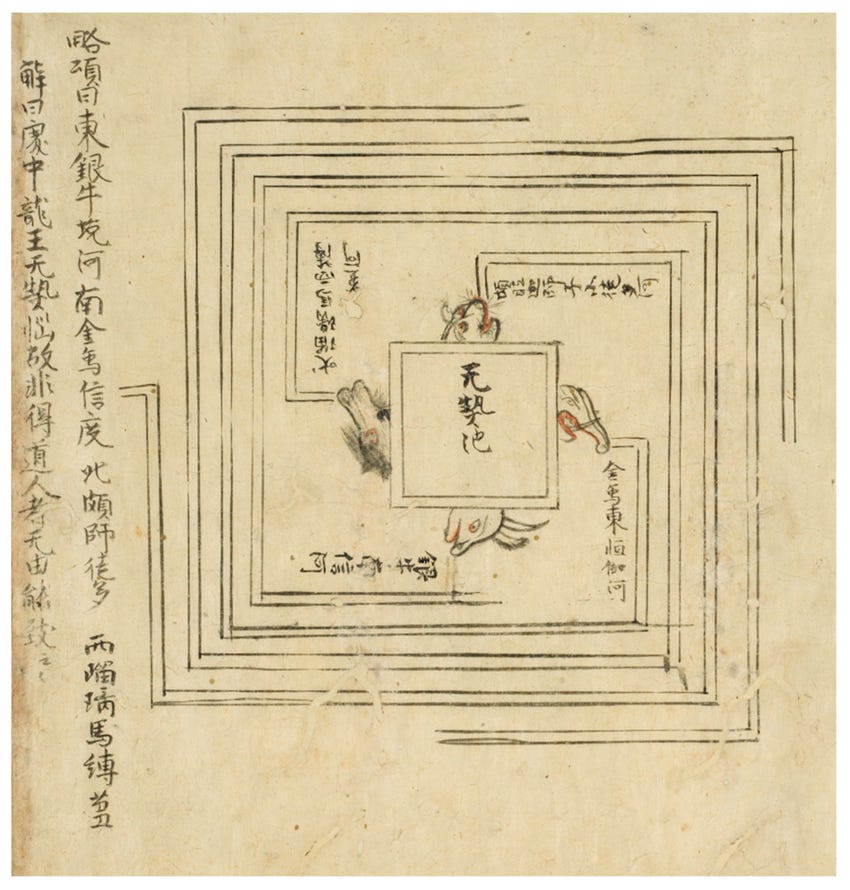
A generation after Xuanzang, the monk Daoxuan (道宣, 596–667) redrew the map. In his Shijia fangzhi (释迦方志), he sewed India and China into a single sacred landscape. Sumeru, the cosmic mountain at the center of the Buddhist world, he identified with Kunlun (昆仑), the mythic peak of Chinese tradition. The Yellow River, he wrote, rose from Lake Anavatapta (阿耨达池), the lake at the center of the same world. India remained the center but China was now tied to it by the same mountains and the same waters, no longer adrift at the edge.
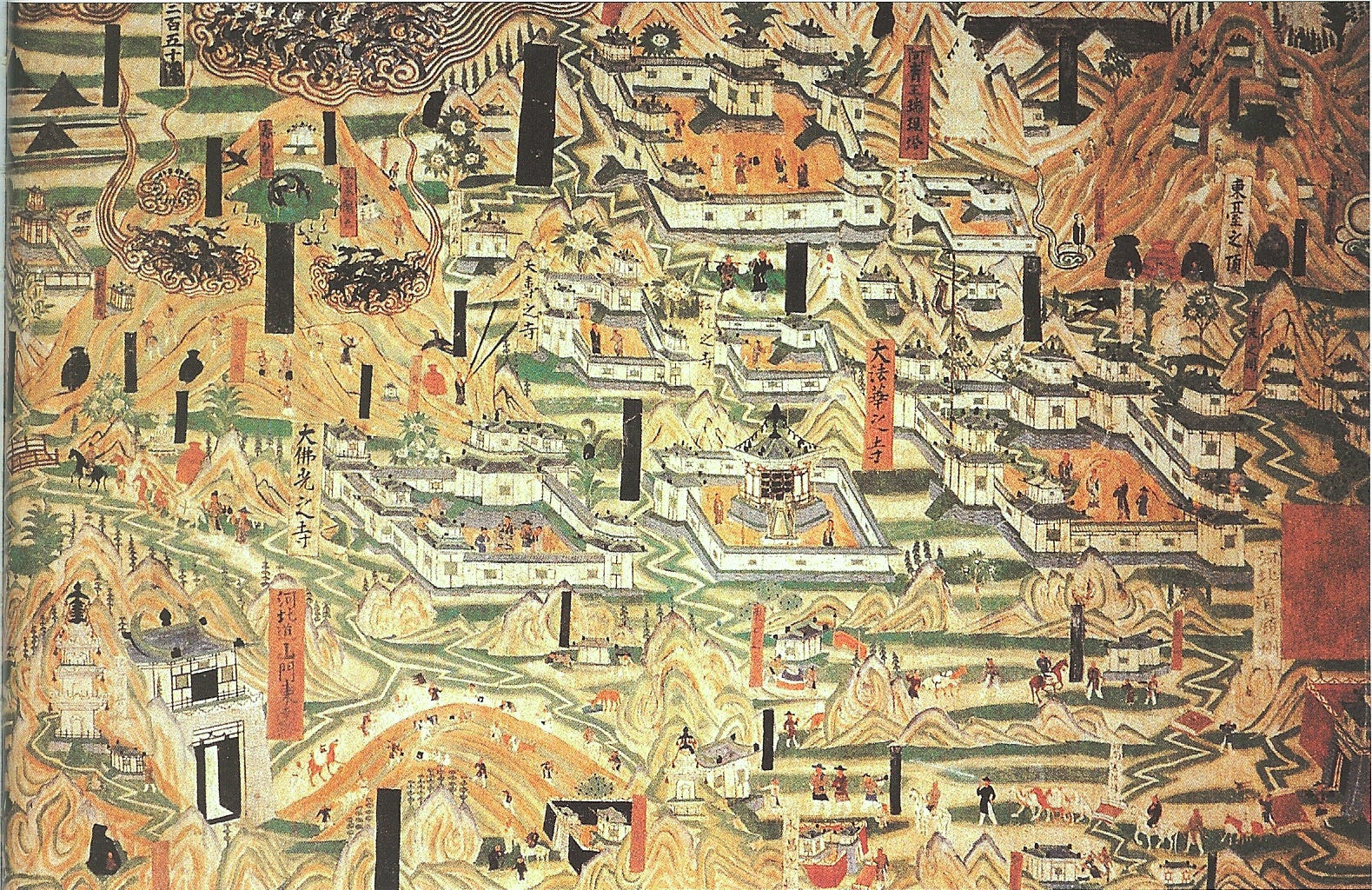
The same instinct built holy ground at home. Mount Wutai (五台山) was established as the earthly seat of the bodhisattva Mañjuśrī, a pilgrimage site that required no journey out of China. The scholar Jinhua Chen has shown how East Asian Buddhists overcame the borderland complex in exactly this way: by manufacturing sacred sites and holy lineages on their own soil. If the center would not come to you, you could build one.
There’s No Borderland
But the deepest answer was philosophical.
Huineng (惠能, 638–713) grew up fatherless in Guangdong, the deep south, about as borderland as a Chinese monk could be. He was illiterate. He sold firewood to feed his mother. One day, delivering wood to an inn, he overheard a guest reciting the Diamond Sutra 金刚经. Something in the words stopped him. He asked what the text was and where it came from. The guest told him it was taught at the monastery of Hongren 弘忍, the Fifth Patriarch of Chan, far to the north. Huineng left his mother a small sum and walked hundreds of miles to find him.
When he arrived, Hongren looked at the young southerner and said: you are a 獦獠 (gělǎo), a barbarian from the south. How can you become a Buddha? It was the borderland doctrine applied within China itself: the edge produces no awakening. Huineng answered:
人虽有南北,佛性本无南北。獦獠身与和尚不同,佛性有何差别?
“People have south and north, but Buddha-nature has no south or north. The body of a southern barbarian is not the same as a monk’s. But what difference is there in the Buddha-nature?”
Hongren said nothing more and sent him to the kitchen to hull rice. Months later, when the patriarch asked his monks to write a verse demonstrating their understanding, the senior disciple Shenxiu 神秀 wrote: the mind is like a bright mirror on its stand, polish it constantly, do not let it gather dust (身是菩提树,心如明镜台,时时勤拂拭,莫使惹尘埃。). Huineng, who could not write, dictated his own: there is no mirror, there is no stand, where would the dust alight? (菩提本无树,明镜亦非台,本来无一物,何处惹尘埃。) Hongren recognized the deeper insight. He transmitted the dharma to Huineng in secret, at night, and told him to flee south before the other monks turned on him.
Huineng’s teaching dissolved the borderland question at its root. If awakening is already present in every mind, the whole geography of center and edge collapses. India has no monopoly. The borderland has no handicap. You do not need to cross a desert to reach the truth, because the truth is not in a place. The Platform Sutra (六祖坛经), recording his teaching, became the only text by a non-Indian figure in the Buddhist canon honored with the title “Sutra.” The edge had produced its own scripture.
The Traffic Reverses
Nālandā, the great university where Xuanzang had spent years studying, once held as many as ten thousand students and two thousand teachers. Buddhism in India had been declining for centuries, losing royal patronage, blurring into Hindu practice, retreating into fewer and fewer monasteries. In 1193 a Turkic general named Bakhtiyar Khilji rode into Bihar with a cavalry force and mistook the walled university campus for a fortress. He sacked it. The library, one of the largest in the ancient world, was burned. Thousands of monks were killed. The center of the Buddhist world no longer existed as a place buddhists could travel to.
The land route was closing too. The Tangut 党项 state of Xi Xia (西夏) held the old Silk Road corridor, and the Song–Xia wars turned the northwest into a frontier. The early Song still tried: the founding emperor sent some three hundred monks west in 966. But such missions withered as the road and the destination both gave out.
The deeper change was directional. The historian Tansen Sen has pointed out that during the Song dynasty, more Buddhist monks traveled from India to China than Chinese monks had traveled west during the Tang. The traffic had reversed. By the tenth century the monk Zanning (赞宁) could write of Chinese Buddhism as something independent of its origin. The province had become a capital.
Refuse to Be the Borderland
The wider Confucian world never accepted that China was anyone’s borderland.
The first major attack came in the late fifth century. The scholar Gu Huan (顾欢) wrote On Barbarians and Chinese (夷夏论). Buddhism, he argued, was medicine designed for barbarians. The Buddha preached world-renunciation and asceticism precisely because the Indians were violent and hard to civilize 强悍难化. They needed strong medicine. But the Chinese already had Confucius and Mencius. They were already moral. Why would a civilized people abandon their own sages to imitate the ways of the uncivilized? “To drop the Chinese and copy the barbarian: where is the sense?” 舍华效夷,义将安取.
Buddhist monks fired back. The monk Sengmin (僧敏) argued that Gu Huan’s categories of barbarian and Chinese, only applied within Tianxia 天下, the political world under the emperor. But the Dharma operated at the level of 天地, Heaven and Earth. Truth does not respect political borders. Other defenders argued that the Buddha taught with one voice and all beings understood according to their nature, the teaching was universal, not local.
Three centuries later, Han Yu (韩愈, 768–824) made the sharpest version of the case. In 819, when the emperor arranged to receive a finger-bone of the Buddha with elaborate ceremony, Han Yu sent up a memorial calling it a filthy foreign object and Buddhism no more than “one of the practices of the barbarians” 夷狄之一法. The Buddha, he wrote, “did not know the duty between ruler and subject, nor the feeling between father and son.” It nearly cost him his head. He was banished instead. But his argument won the longer war. A generation later, in the Huichang persecution of 845 会昌灭法, tens of thousands of temples were stripped and vast numbers of monks forced back into lay life. Buddhism survived, but never again as a rival for the loyalty of the ruling class.
Go Native
And yet Buddhism did not disappear. It became Chinese, and China became partly Buddhist, and eventually it was hard to tell who had absorbed whom.
On the Buddhist side, the transformation was already complete by the Tang. The imported Indian orthodoxy had died, like Xuanzang’s Faxiang school. What survived were the schools that had grown up in Chinese soil: Chan, with its emphasis on direct awakening over textual study; Tiantai and Huayan, with their grand systems of classifying all Buddhist teaching into a single hierarchy.
On the Confucian side, the absorption was quieter and never acknowledged. Buddhism had forced Chinese thinkers to ask questions Confucius never asked, about the nature of mind, about the relationship between principle and phenomena, about whether awakening was sudden or gradual. The Song dynasty Neo-Confucians answered those questions in Confucian language. Zhu Xi (朱熹) built his system on 理 (lǐ, principle) and 气 (qì, material force), a framework that mirrors the Buddhist Huayan school’s distinction between principle and phenomena, though Zhu Xi insisted he found it in I Ching. The Buddhist idea that all beings possess Buddha-nature became the Confucian idea that all humans possess innate moral knowledge (良知). Buddhist meditation became Confucian quiet-sitting (静坐), reframed as clarifying the moral mind rather than escaping the world. Neo-Confucianism reclaimed the 道统 (dàotǒng, “the transmission of the Way”) for China, while the substance of what it transmitted was partly Buddhist.
Borderland in the Modern World
As the historian Ge Zhaoguang has argued, after Buddhism, China’s sense of itself as the center was not seriously shaken again until the Jesuits arrived with their world maps, a thousand years later. And then it was shaken completely.
The Opium Wars, the unequal treaties, and the century that followed put China back on the edge, the far east. This time was not of the Buddhist world but of the modern one. A different center, a different west, but the same structure: the source of authority was elsewhere. The standards for what counted as civilized were set in Europe and America, parliamentary government, individual rights, the scientific method, the open market. China was again the ‘borderland.’
The question people ask today that why China hasn’t adopted universal values sounds new. But the mechanism underneath it might be old. “Universal values” occupy the same position Buddhism once did: a system that claims to be true everywhere, imported from a place that assumes it is the center. And the responses look familiar too. Some say the teaching is foreign medicine for foreign people, and China has its own sages. Some say truth has no borders and China should import the whole package. Some say the foreign teaching is already being absorbed, quietly, under different names, whether the center notices or not.
If the Buddhist precedent suggests anything, it is not that universal values will be rejected. Buddhism was not rejected. It is that they will be absorbed, translated, and made Chinese. The version that survives may not look like what the source intended. The imported orthodoxy will fade. The homegrown version will thrive. And a generation later, it will be hard to tell who absorbed whom.
If my insights brought you a fresh perspective, please consider supporting me by buying me a coffee. Your generosity fuels my writing.
Further Reading
Modern scholarship
Antonino Forte, “Hui-chih (fl. 676–703 A.D.), a Brahmin Born in China” — the essay that coined the term “borderland complex”
Jinhua Chen 陈金华, “The Borderland Complex and the Construction of Sacred Sites and Lineages in East Asian Buddhism,” in Victor Mair ed., Buddhist Transformations and Interactions
Tansen Sen, Buddhism, Diplomacy, and Trade: The Realignment of Sino-Indian Relations, 600–1400
Erik Zürcher, The Buddhist Conquest of China — the standard work on early Chinese Buddhism and the 夷夏 debates
Malcolm David Eckel, To See the Buddha — on the pilgrims and their relationship to the Buddhist center
Ge Zhaoguang 葛兆光,《宅兹中国:重建有关”中国”的历史论述》(Here in ‘China’ I Dwell, 中华书局 2011; English: Brill 2017) — on how Buddhism challenged but did not fundamentally shake the Sinocentric worldview
Primary texts
Faxian 法显,《佛国记》(Record of Buddhist Kingdoms)
Xuanzang 玄奘,《大唐西域记》(Great Tang Records on the Western Regions)
Daoxuan 道宣,《释迦方志》(Record of Śākyamuni’s Land)
Huineng 惠能,《六祖坛经》(Platform Sutra of the Sixth Patriarch)
Gu Huan 顾欢,《夷夏论》(On Barbarians and Chinese), preserved in《南齐书·顾欢传》
Sengmin 僧敏,《戎华论》, and other Buddhist responses in Sengyou 僧祐,《弘明集》
Han Yu 韩愈,《论佛骨表》(Memorial on the Buddha’s Bone)
Oh this is a fantastic read! Thank you.
really interesting, thank you. i believe that china has favored the liang qichao approach of keeping the chinese soul and augmenting it with western techniques, over the more total westernizing sought by the may 4th movement including lu xun - quite a contrast to meiji japan and south korea. it makes sense that the chinese self-conception and gravity of the civilization would mean any foreign influence would struggle to displace the core, and only get synthesized at best. but this is a great analogy i hadn't thought of - buddhism x china as the prelude to western thought x china of the past century or so