

For centuries, Western missionaries arriving in China faced a intellectual void. The problem was not that the Chinese were godless, but that the universe had no ontological slot for the Christian God.
How to translate a transcendent, monotheistic Creator into a civilization built on cyclical cosmology, ancestral lineage, and bureaucratic ritual?
In the late 16th century, the Jesuit Matteo Ricci attempted an elegant solution. Adopting the dress and ethos of a Confucian scholar, he immersed himself in classical texts and searched for a linguistic bridge to Christian theology. He drew on terms such as Shangdi (上帝), an ancient high deity of early Chinese tradition, arguing that China’s earliest thinkers had grasped a conception of a supreme moral order akin to the Christian God. After Ricci’s death, however, this accommodationist approach became embroiled in the Chinese Rites Controversy, and the Vatican ultimately rejected the use of such terms, decisions that fatally undermined the Catholic mission in China.
Three centuries later, a village teacher in southern China attempted his own translation. He was not a learned Jesuit, but a repeatedly failed civil service examinee from the marginalized Hakka community. His name was Hong Xiuquan 洪秀全.
Hong did not try to compromise with Western orthodoxy. Instead, he hacked it. He declared that Jesus Christ was the Elder Brother, and that he, Hong, was the ‘Second Son of God’1.
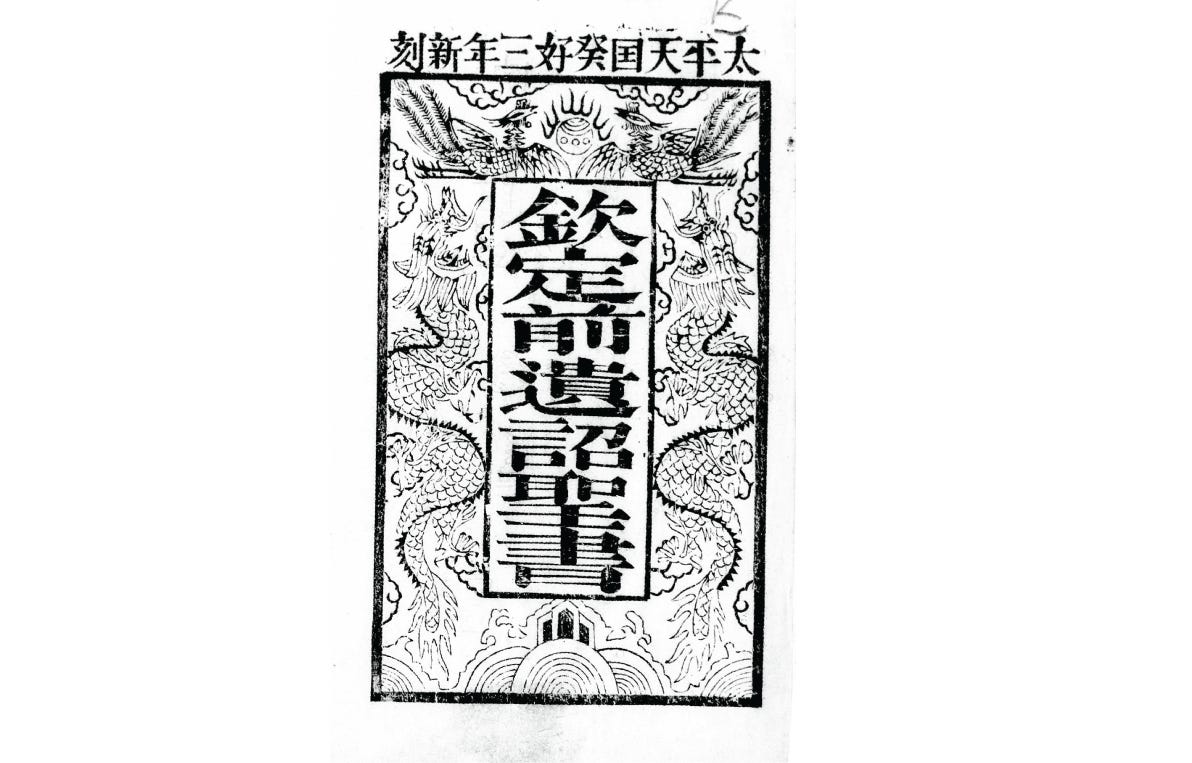
To the Western world, this was grotesque blasphemy. But to dismiss Hong as a mere lunatic is to miss the profound linguistic and cultural logic of his madness. The Taiping Rebellion, a fourteen-year civil war that claimed over 20 million lives, was one of the most violent acts of cultural translation in human history. Hong’s “heresy” reveals the hurdles of translating the Divine into the Chinese context.
The Taiping Rebellion (1850–1864) was a massive civil war against the Qing dynasty, launched by the God (Shangdi) Worshipping Society (拜上帝教), a syncretic and militant Christian sect founded by Hong Xiuquan.
The Rebellion almost toppled the Qing dynasty. Sun Yat-sen, the founding father of the later Republic, praised Hong highly in his early years.
Naming the Unnamable
It began with the very word Ricci had popularized: Shangdi.
When Hong Xiuquan read a localized Protestant tract, he didn’t encounter the abstract Greek Logos or the ineffable Hebrew Yahweh. He encountered Shangdi, the “High Sovereign.”
In the Western mind, God is a transcendent father. But in the Chinese political imagination, Shangdi is a Cosmic Emperor. And an Emperor cannot exist in a vacuum. He requires a court, a hierarchy, a bureaucracy, and most importantly, a succession plan.
By using the term Shangdi, the translators inadvertently dragged the Christian God out of the metaphysical realm and seated Him on a Dragon Throne.
Therefore, Hong’s “Second Son” doctrine was not a theological error; it was a bureaucratic necessity. If Shangdi is the Heavenly Emperor, and Jesus is the Crown Prince (residing in the West), then for China to be governed effectively, there must be a local ruler. There needed to be a biological representative of the Imperial Family to manage the Eastern hemisphere. Hong was simply filling a void created by the translation itself.
The Melchizedek Maneuver
As a village teacher trained in the rigorous textual analysis required for imperial exams, Hong was a man obsessed with texts. He did not simply pull his divine title out of thin air; he “translated” it out of the Bible through a process of forensic, albeit highly creative, exegesis.
His smoking gun was found in the Epistle to the Hebrews, Chapter 7.

The mysterious biblical figure Melchizedek (麦基洗德), in orthodox theology, is a priest-king who foreshadows Christ. Hebrews 7:2 describes Melchizedek as the “King of Salem,” meaning “King of Peace.” Hong seized upon this. His own kingdom was the Taiping (太平, Great Peace) Heavenly Kingdom. The linguistic bridge was set.
More crucially, Hebrews 7:3 describes Melchizedek as being “…without father, without mother… having neither beginning of days nor end of life, but made like unto the Son of God.”
Hong’s logic here is a masterclass in theological hacking:
The text says Melchizedek resembles the Son of God. Therefore, he cannot be Jesus, because one does not resemble oneself.
If there is a divine figure who looks like Jesus, possesses eternal divine status, but is not Jesus, who is he? He must be the younger brother.
Hong argued that his spirit was the pre-existent Melchizedek, living in Heaven before descending to earthly parents in Guangdong. Through this translation maneuver, Hong successfully inserted himself into the Biblical canon. He was no longer a Hakka rebel; he was a returning character, hiding in plain sight in Chapter 7, waiting to be correctly decoded.
The Trinity vs. Filial Piety
Beyond textual mechanics, Hong had to translate Christian ethics into a society structurally resistant to them.
Orthodox Christianity is built on a vertical axis: the believer is a child of God, a bond that supersedes all earthly ties. Jesus famously declared that to be his disciple, one must “hate father and mother” (Luke 14:26).
In Confucian China, this is not just confusing; it is moral anarchy. Chinese society is anchored by Filial Piety (Xiao, 孝). The family lineage is the metaphysical bedrock of the universe. To abandon your earthly father for a spiritual one is to sever your root, making you less than human.
Hong Xiuquan solved this translation error not by destroying the family, but by expanding it.
By declaring himself the biological brother of Jesus, Hong integrated the abstract Holy Trinity into the Chinese clan system. He supplied the heavenly order with lineage, introducing a Heavenly Mother, and in some accounts extending the divine family further. Western missionaries mocked this as grotesque parody. But to a Chinese peasant whose universe was built on kinship, a solitary deity lacking a consort or lineage was culturally unintelligible.
Hong transformed the incomprehensible Trinity into a tangible, recognizable Patriarchal Clan. Under his rule, worshipping God was no longer a betrayal of Chinese values; it was the ultimate, cosmic act of Ancestor Worship.
Further on Filial Piety and Family Lineage

Guilt vs. Transactional Shame
Another massive hurdle for Christianity in the Chinese context is the concept of Sin.
In the Christian tradition, “sin“ is a spiritual transgression, a stain on the soul that requires redemption through grace. In the Chinese tradition, morality is often framed around Shame (脸面, Face) and Ritual Propriety (礼, Li). Wrongdoing is a disruption of social harmony. It is external and transactional (though internal reflection remains crucial to the Confucian tradition).
Hong Xiuquan’s Christianity radically subordinated the idea of grace to obedience, transforming Christian ethics into a legalist code. The Ten Commandments were enforced not as moral exhortations but as military law. Violation did not merely grieve the Holy Spirit, it invited execution.
It reflects a broader tendency in Chinese folk religion: Transactionalism. One does not necessarily “love” the gods. One bribes them or respects their power. Hong Xiuquan offered a new contract: Worship the Heavenly Father, destroy the idols, and I will give you land and food (天朝田亩制度, The Heavenly Land System). This was grounded in the daily reality of the peasants, whereas ‘justification by faith alone’ remained a theological abstraction beyond their reach. It stripped Christianity of its mystery and turned it into a pragmatic tool for survival.
From Heretics to Proto-Marxist Heroes
The supreme irony of Hong Xiuquan’s legacy, however, is that he was ultimately subjected to one dramatic act of translation by modern Chinese historiography.
If you stand in the center of Tiananmen Square today and gaze at the Monument to the People’s Heroes, the second of its eight massive marble bas-reliefs portrays the Jintian Uprising of 1851, the flashpoint of the Taiping Rebellion.
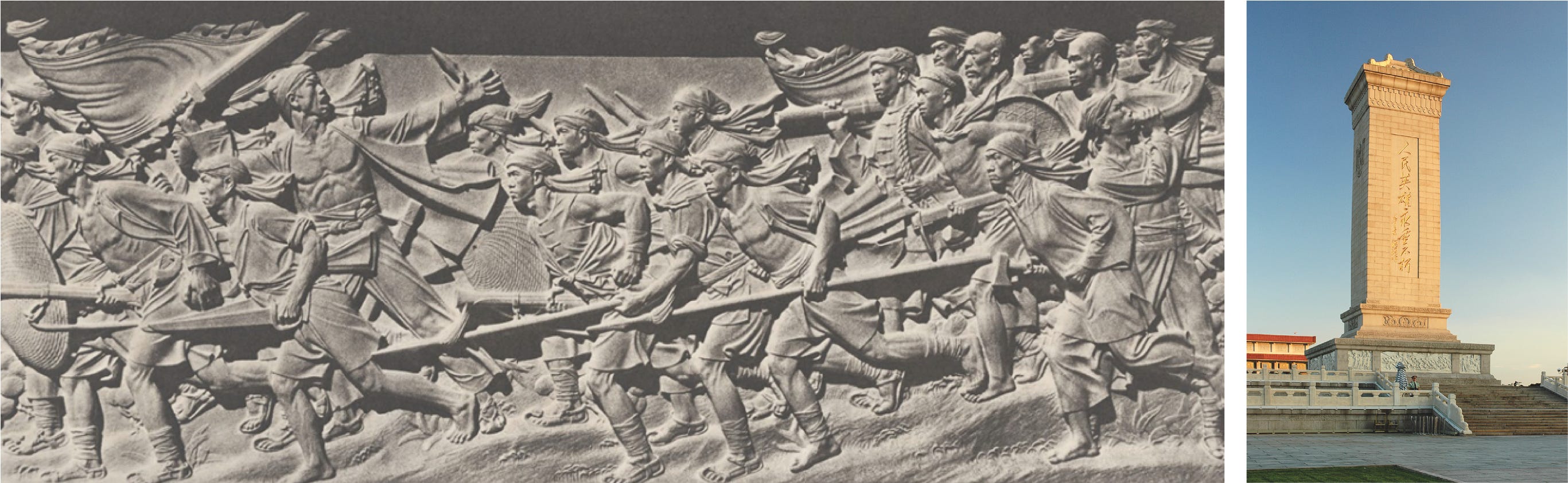
In mainstream contemporary Chinese narrative, those theological hackings was often politely dismissed as “the historical limitations of the peasantry.” Instead, orthodox historiography canonizes the Taiping movement as a righteous, anti-feudal, and anti-imperialist peasant revolution.
Beneath the theological eccentricities, the Taiping Heavenly Kingdom introduced genuinely radical, progressive social reforms that terrified the conservative Qing establishment just as much as their “heresy” terrified the West. Driven partly by Hakka traditions, they championed early forms of gender equality. They strictly outlawed foot-binding, allowed women to serve in the military and administration, and even instituted civil service examinations for women. They banned opium, gambling, and prostitution.
Just as Hong Xiuquan translated the Western God into a Chinese Patriarch to mobilize the masses, modern Chinese historiography translated Hong’s religious holy war into the secular language of class struggle. The “truth” of the original text was overwritten yet again to serve the political needs of a new era.
Christianity That Never Was
The Taiping Rebellion was ultimately crushed in 1864 by Qing armies, aided by Western powers who decided that a pagan Emperor was preferable to a heretical “Christian” brother.
But what if they had succeeded? What if Hong Xiuquan’s forces had taken Beijing, toppled the Qing, and established the Taiping Heavenly Kingdom as the new orthodox dynasty of China?
History suggests that the “Second Son” theology might not have remained a bloody heresy forever. Instead, it might have evolved into a permanent, uniquely Chinese branch of Christianity.
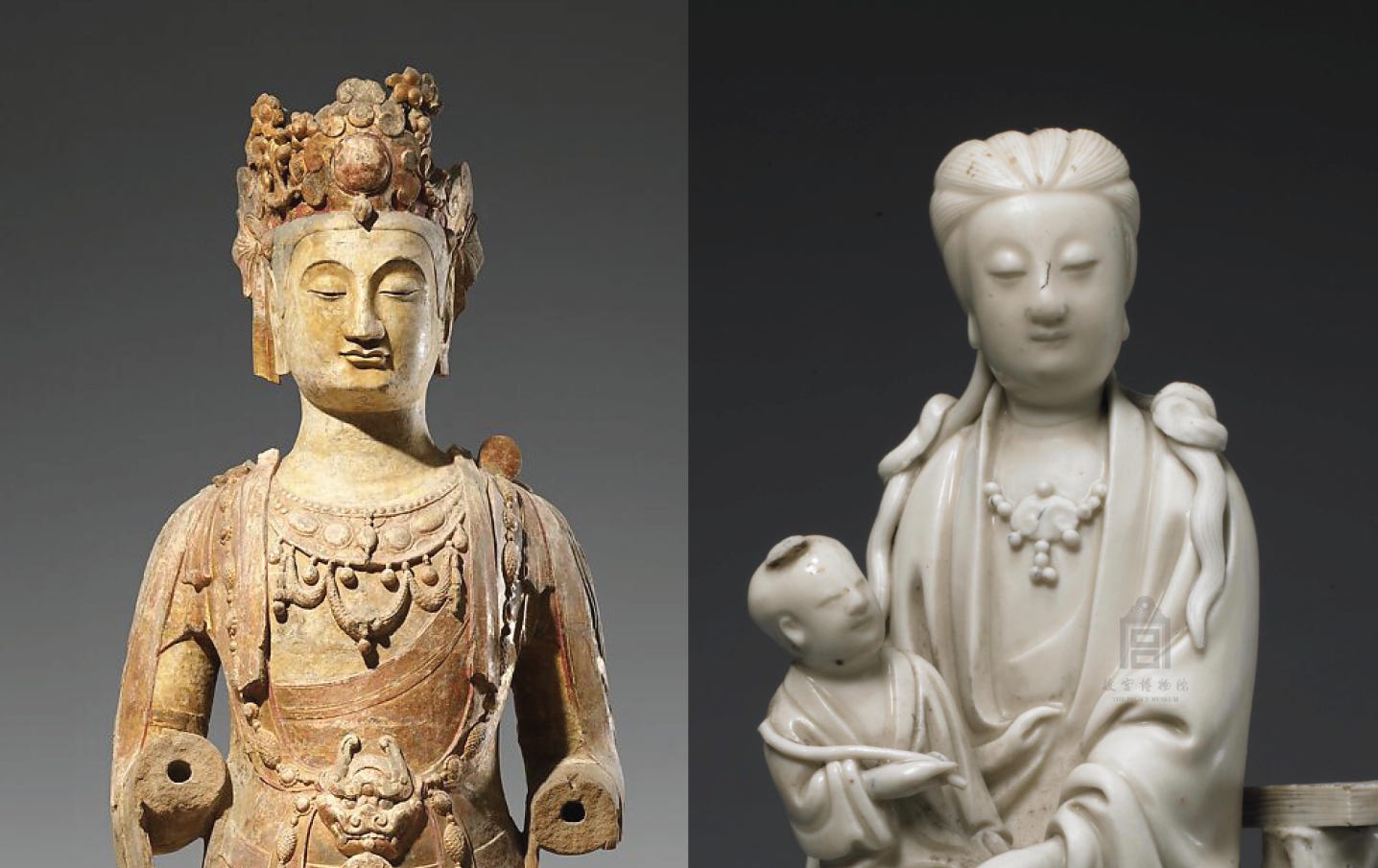
To understand how this could happen, look at Buddhism. When the Indian Bodhisattva Avalokiteśvara first arrived in China, he was depicted as a muscular, sometimes mustachioed male figure. But the Chinese cultural ecosystem demanded a deity of maternal compassion and fertility. Over centuries of “translation,” this Indian prince was entirely transformed into Guanyin, the Goddess of Mercy. A female figure venerated as the “Child-bringing Guanyin” (送子观音). She became arguably the most beloved deity in East Asia, thoroughly Chinese, yet undeniably Buddhist in origin.
If my insights brought you a fresh perspective, please consider supporting me by buying me a coffee. Your generosity fuels my writing.
This piece builds upon the historical groundwork laid by Jonathan Spence in God’s Chinese Son. While Spence chronicles the “what” and “how” of Hong’s religious empire, this essay leans into the “why”, by examining the Taiping Rebellion through the specific lens of cultural translation.
This is a very fascinating article. When we discuss Hong Xiuquan’s claim to be the Son of God in daily conversation in China, we generally do so in a mocking or playful tone. In contemporary China, although freedom of religious belief is legally recognized, in practice people tend to regard religion as backward thinking, and it has been largely discarded in mainstream discourse.
A few days ago, while looking at the syllabus for a History of Medicine course at Johns Hopkins University, I accidentally noticed that the syllabi for most History of Medicine courses at Chinese universities are almost identical—except that they completely omit the section on the influence of religion on the development of medicine. Later, when I searched on Google Scholar, I found that there is actually a great deal of research in Western medicine on the relationship between religion and clinical medicine, which I found quite astonishing.
China’s indigenous religions and theologies emerged from primitive astronomy, and were closely bound up with agricultural production and the rule of ancient emperors. From the very beginning, they bore a distinctly pragmatic character: if they could not serve a practical function in real life, ordinary people would not believe in them.
Wow, so interesting. Contrary to Kurt, I read this as corroborating Bertrand’s thesis that China had no need for a transcendent being to sustain a moral order. To fit Christianity into China, the transcendent Logos became Shangdi, the heavenly emperor, not transcendent over the natural world, but now a part of the natural world, having a role to play, duties to discharge. The Chinese moral order essentially transcends Shangdi, not the other way round. At least that’s my reading. Cheers.