

In Shanghai there is a joke about Tilanqiao Prison 提篮桥监狱 that has circulated in financial circles for at least two decades. The walled compound in Hongkou, opened in 1903 by the foreign-administered International Settlement, for a time the largest prison in East Asia, is in fact the country’s ‘most prestigious’ institution of higher financial learning. ‘中国最高金融学府, ‘ ’China’s highest academy of finance.’ The nicknames have proliferated. ‘上财分校,’ ’the branch campus of Shanghai University of Finance and Economics.’ ‘提篮桥总裁班,’ ‘the Tilanqiao executive program.’ ‘会计进修学院,’ ‘the accounting refresher academy.’
The joke survives because it captures a perception. Inside Tilanqiao’s cell blocks were accountants who had cooked the books, brokers who had run pump-and-dump schemes, branch managers who had falsified compliance reports, fund employees who had front-run their own clients. Many came from the major finance schools, Shanghai University of Finance and Economics, Fudan, the returnees with American MBAs. They were the ‘small fry.’
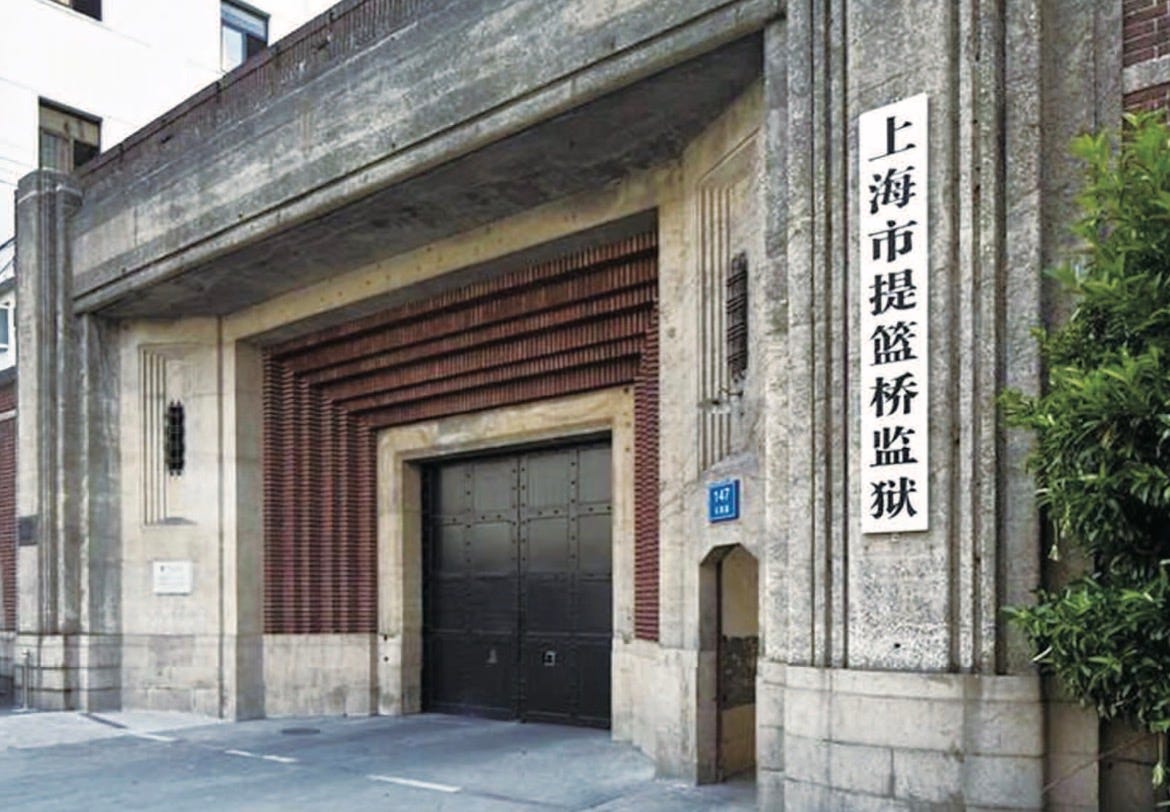
Above them, in the public imagination, sat the apex. Yang Rong 仰融, who built Brilliance Auto 华晨汽车 and fled to the United States in 2002 ahead of charges. Huang Guangyu 黄光裕, once China’s richest man through the Gome 国美 retail empire, sentenced in 2010 to fourteen years for insider trading and bribery. Zhou Zhengyi 周正毅, the Shanghai property tycoon, imprisoned twice. Wu Xiaohui 吴小晖 of Anbang Insurance 安邦保险, eighteen years in 2018 for fundraising fraud and embezzlement. Xiao Jianhua 肖建华, abducted in Hong Kong in 2017, tried in Shanghai in 2022, sentenced to thirteen years; his Tomorrow Holding 明天系 conglomerate fined fifty-five billion yuan, the largest corporate fine in Chinese history back then. Not all of them served at Tilanqiao. But the prison’s name had absorbed the entire pattern.
The names will keep being added. The pattern does not change. Build a financial empire, hit a certain scale, disappear.
A Casino at Pudong
The Shanghai Stock Exchange opened on 19 December 1990. The Shenzhen exchange followed days later. For decades, Exchange was compared to casinos, a label so persistent that retail investors are still called GuMin 股民, “stock people,” never investors.
Recent years have compressed the pattern. On 3 November 2020, regulators suspended Ant Group’s 蚂蚁集团 IPO forty-eight hours before listing; it would have been the largest stock offering in history. By December the government had introduced a new phrase into official language: 资本无序扩张, “the disorderly expansion of capital.” Within twelve months Alibaba had been fined eighteen billion yuan for monopoly behavior, Didi 滴滴 had been forced to delist from the New York Stock Exchange, the entire for-profit tutoring industry had been outlawed in a weekend. Jack Ma left for Tokyo. He has barely spoken in public since.
In early 2024 regulators turned to quantitative finance, framing high-frequency trading as a form of wealth extraction rather than market making.
The puzzle is structural, not episodic. Each crackdown gets explained as a discrete issue, antitrust, data security, financial risk. But they share a grammar. The financial sector is something to be disciplined.
Shang Yang’s Ledger
In the fourth century BCE the statesman Shang Yang 商鞅 reorganized the small western state of Qin around two activities, agriculture and war, and codified a hostility to everything else. The Book of Lord Shang 商君书 states: merchants are dangerous because they move. They cannot be tied to a plot of land, taxed predictably, or conscripted on demand. A century later Han Feizi 韩非 listed the five vermin 五蠹 corroding the state: scholars 儒士, talkers 縱橫家, sword-bearers 遊俠, draft-evaders 患御者, and merchants-and-craftsmen 商工之民. The merchant was not a profession. It was a category of person whose interests structurally diverged from the state’s.
In 81 BCE, under the emperor Zhao of Han, a debate was convened at court between Legalist officials and visiting Confucian scholars over the imperial monopolies on salt, iron, and liquor. The official Sang Hongyang 桑弘羊 defended the monopolies. The scholars wanted them dismantled. Sang won. The proceedings were transcribed as the Discourses on Salt and Iron 盐铁论 (For more, see How Do States Hide Their Taxes). The state operating the most lucrative sectors directly while leaving unprofitable margins to private hands. The model became a permanent institutional template.
Sima Qian’s Records of the Grand Historian 史记 contains a chapter, the Biographies of the Money-Makers 货殖列传, in which the historian writes admiringly of merchants who grew rich by reading markets and timing harvests. For two millennia readers treated this passage as an eccentricity. The fact that the eccentricity needed naming tells you what the orthodoxy was.
The logic of zhòng nóng yì shāng 重农抑商, elevate agriculture, suppress commerce, rests on three claims. Agriculture produces real things; commerce only moves them and skims. Farmers are tied to land, therefore taxable, therefore controllable. And concentrated merchant wealth, left alone, produces autonomous political power, the one thing the imperial state cannot tolerate.
Two Thousand Years of Suspicion
The historical record is messier than the doctrine. Song-dynasty Hangzhou had a commercial vitality that astonished European visitors. Ming and Qing merchant networks, the Huizhou 徽商 and Shanxi 晋商 guilds, accumulated extraordinary fortunes. Late-Qing Shanghai produced what looked, for a moment, like a bourgeoisie.
Chinese merchant wealth never converted into autonomous political power the way it did in early modern Europe. The successful merchant’s son did not become a parliamentarian. He bought a degree, endowed a Confucian academy, and joined the gentry. Wealth flowed back into the state’s symbolic economy rather than constituting an independent civil one.
In 1872, when Li Hongzhang 李鸿章 founded the China Merchants Steam Navigation Company 招商局 under the principle of 官督商办, “officially supervised, merchant-managed.” Private capital was permitted, encouraged, even courted. It was also, at every moment, revocable. The Ming sea ban 海禁, the Qing Canton system, the Cohong monopoly 公行: each was a specific instance of the same logic. Commerce was permitted, but only when channeled, licensed, and subordinated to the state.
The New Grain
Mao’s era still tried to mobilize peasants and grain. After 1978, manufacturing became the new productive base, first in the Special Economic Zones of the south, then across the entire eastern seaboard, then deeper into the country. By the 2010s China was producing roughly thirty percent of global manufacturing output, more than the United States, Germany, and Japan combined.
