

If you text in Chinese today, you’ve already lived through a kind of “Latinization.”
Your thumbs type nihao, zhongguo, wo xiang qu, pure Roman letters, and your screen outputs 汉字. Letters go in; characters come out. This everyday loop raises a surprisingly sharp question: if Chinese can be written with the Latin alphabet at the input layer, why didn’t it ever become an alphabet language on the page?

A century ago, plenty of reformers thought it might—or should. In the 1920s and 1930s, Chinese intellectuals and state planners debated whether the character script was a bottleneck for literacy and modernization, and whether an alphabet could replace it. Some proposals were moderate (letters as an auxiliary), others radical (letters as a full substitute). The fact that none of them “won” wasn’t because the idea was absurd. It was because Chinese script reform ran into a set of hard constraints—linguistic, social, and political—and eventually discovered a durable compromise: simplify the characters, standardize pronunciation, and use an alphabet as a tool rather than a replacement.
The 1920s: When Letters Looked Like the Future
Early 20th-century China faced a literacy problem on the scale of a national emergency. Reformers wanted mass schooling, nationwide communication, and a standard “national language.” An alphabet seemed like the modern answer: easier to learn, easier to print, easier to teach.
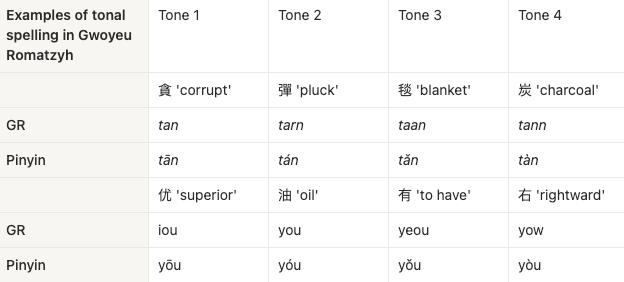
One “official-ish” direction was to create Romanization systems that could annotate pronunciation and support standardization. Gwoyeu Romatzyh (National language romanization, 国语罗马字), a system associated with leading linguists like Yuen Ren Chao (Zhao Yuanren), was officially adopted by the Nationalist government on September 26, 1928. The hope was pragmatic: a standardized national pronunciation plus a teachable phonetic system could accelerate literacy and modern education. Gwoyeu Romatzyh was the first official scheme to use tonal spelling for Mandarin, and it served as a prototype for Pinyin.
But there was also a more revolutionary current: not “letters alongside characters,” but letters instead of characters.
Latinxua Sin Wenz: The Boldest “Replace Characters” Project
The most explicit attempt at full replacement was Latinxua Sin Wenz (Latinized New Script, 拉丁化新文字). It began taking shape in the late 1920s among Chinese and Soviet scholars, with a stated goal of combating illiteracy by superseding characters.
To keep it usable for mass literacy campaigns, Sin Wenz made choices that look radical even today: most famously dropping tone marking for pragmatic reasons. Trials and promotion continued for years, including in Communist-controlled regions during wartime periods.
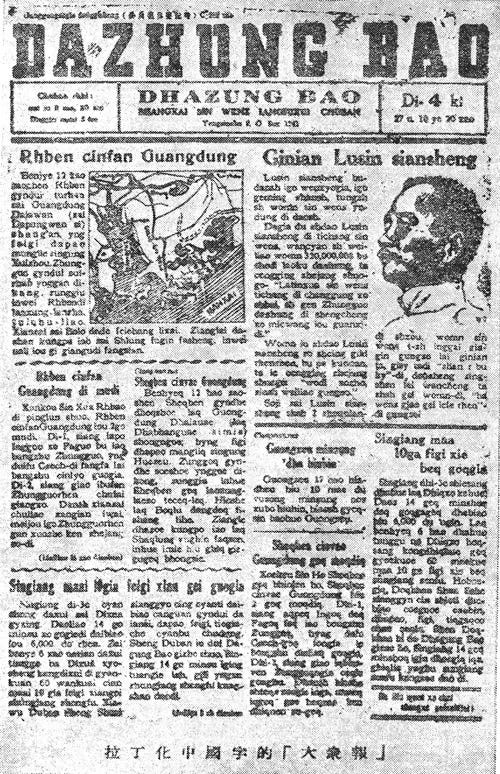
In other words: there really was a moment when “Chinese written in the Latin alphabet” wasn’t a tech feature. It was a political and educational proposal with institutional backing.
So why didn’t it stick?
The Counterattack: “Try Reading This in Letters”
Opponents of full romanization did not always argue in abstract terms. Sometimes they used a stunt.
One of the most famous is “Lion-Eating Poet in the Stone Den” (施氏食獅史, Shī shì shí shī shǐ,The Story of Mr. Shi Eating Lions), associated with linguist Yuen Ren Chao as a demonstration of how Mandarin can collapse into near-unreadable homophony when reduced to sound alone. The essay is written entirely with syllables pronounced “shi” in Mandarin (distinguished only by tones), and it becomes dramatically harder to interpret in romanization, especially if tone marking is weakened or absent.
石室詩士史氏,嗜豕,失仕,誓食十獅。獅似嗜虱。史氏設寺,恃師勢,使施氏拾獅屍,俟食時,始識世事。史使侍逝適市,視施氏。試釋是事。
Shíshì shī shì shǐ shì, shì shǐ, shī shì, shì shí shí shī. Shī sì shì shī. Shǐ shì shè sì, shì shī shì, shǐ shī shì shí shī shī, shì shí shí, shǐ shí shìshì. Shǐ shǐ shì shì shì shì, shì shī shì. Shì shì shì shì.
This translates to:
Living in a stone den is a poet-scholar named Shi, addicted to pork. Having lost his official post, he vowed to eat 10 lions. Lion seems to like lice.. Mr. Shi set up an office, and used his master’s influence to dispatch a messenger named Shi to fetch lion corpses, awaiting his time to eat. Only upon eating did he begin to understand the ways of the world. Mr. Shi sent his envoy to the market to observe another man named Shi. Try to explain this matter.
The deeper point wasn’t that Chinese cannot be written phonetically at all. It was that Mandarin has many homophones, and characters carry disambiguation in a way that pure phonetic spelling struggles to match, particularly for short, classical, or densely packed text.
That critique landed because it exploited a real structural tension. Chinese is linguistically diverse (many “dialects” are mutually unintelligible), yet the character system historically provided a shared written medium across speech varieties, while a single alphabet would tend to privilege one pronunciation standard.
So even reformers who liked letters faced a political question: Whose sounds become the nation’s spelling?
Characters, for all their complexity, have long functioned as a bridge across speech differences: readers in different regions can often understand the same written sentence while pronouncing it differently. A full alphabetic script, by contrast, hard-codes a pronunciation standard into the writing system itself. That’s manageable for a nation-state with a unified spoken standard. It’s politically and socially explosive in a place where linguistic diversity is enormous and historically entrenched.
So the “alphabet solution” ran into three pressures at once: Homophones and tone make phonetic ambiguity costly in many contexts. Classical and mixed registers don’t map cleanly to modern speech. Dialect diversity turns “one alphabet” into “one chosen pronunciation,” with real cultural stakes. By the mid-20th century, the center of gravity shifted from replacement to compromise.
The Compromise Begins: Simplify, Don’t Abolish
As alphabetization faced resistance, reform energy flowed into the other path: simplification.
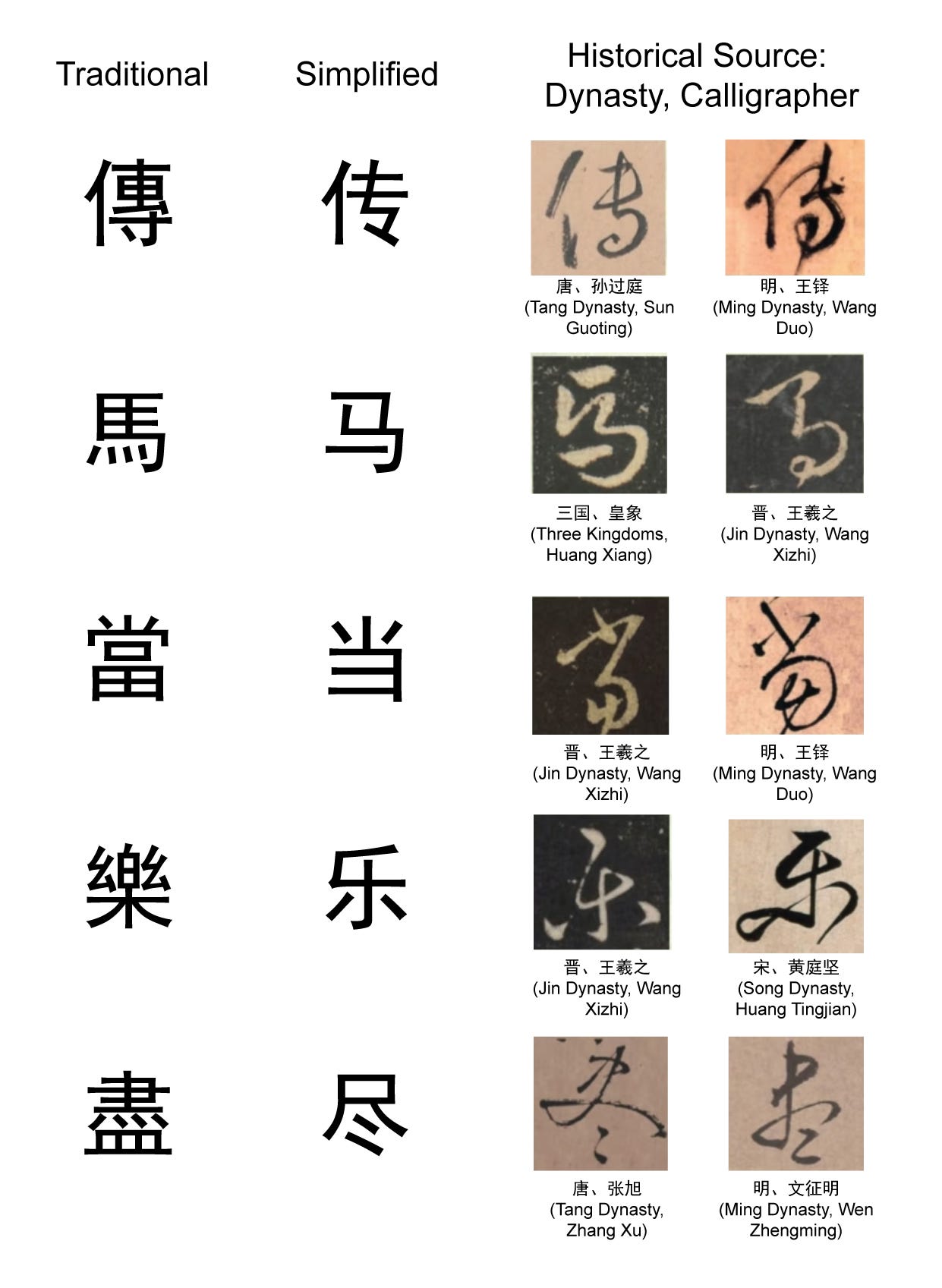
A crucial detail is that simplified characters were not invented from scratch by the People’s Republic in a single stroke. Many simplified forms draw on long-existing shorthand, cursive, and variant forms used in handwriting for centuries, people have always abbreviated strokes when speed mattered.
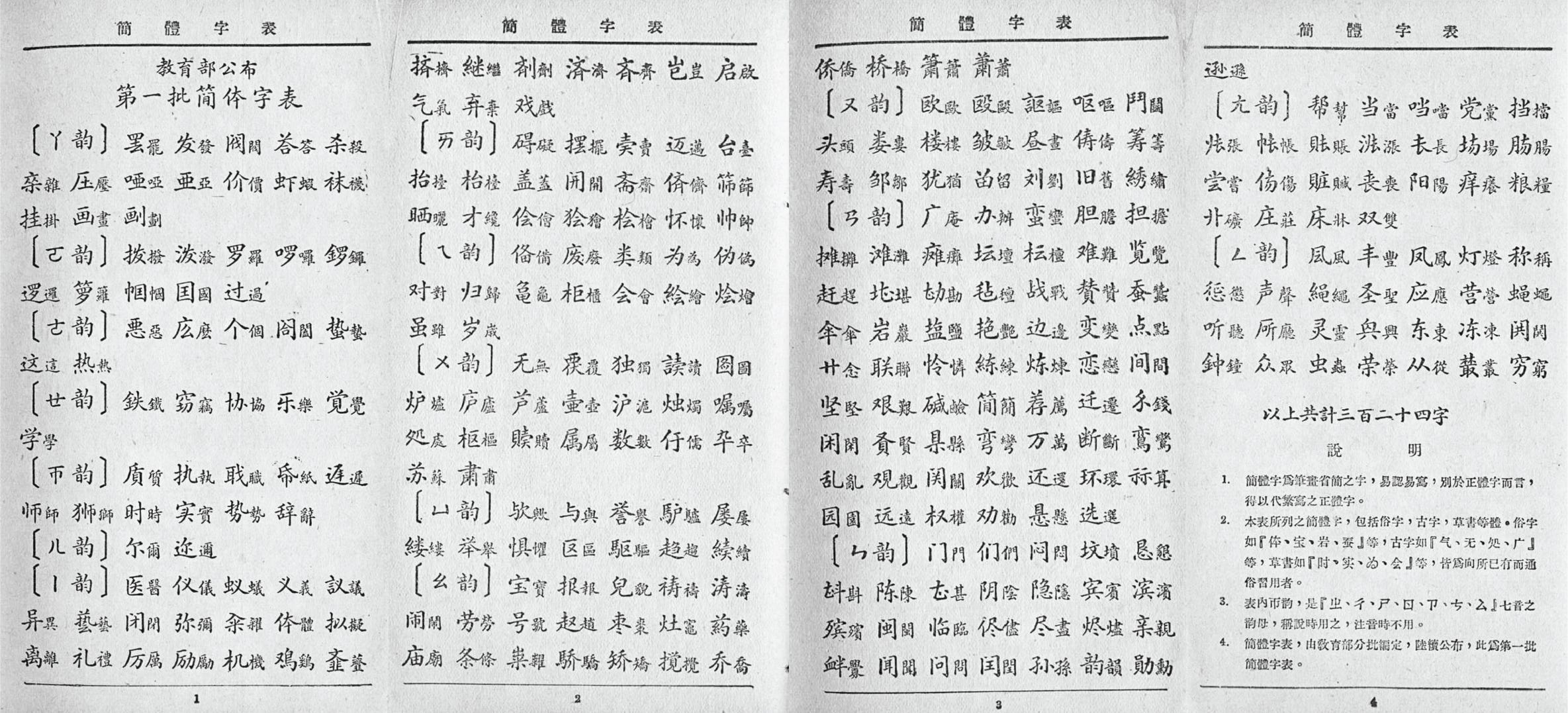
And simplification as policy began earlier than many assume. In 1935, the Republic of China’s Ministry of Education issued an official list of 324 simplified characters, but it was quickly rescinded in 1936 after political backlash. This brief episode matters because it shows that simplification was not inherently “Communist script”, it was already being tested under the Nationalist state, even if the attempt failed.
After 1949, the paths split. The PRC turned simplification into sustained national policy as part of broader literacy campaigns, standardizing simplified forms through multiple reform rounds. Taiwan, under the ROC, retained traditional characters as the official standard, partly for continuity, partly as cultural and political positioning in an era when scripts became identity markers.
This is why the script divide today feels bigger than typography. It is not only about stroke counts; it is also about historical memory and political boundary-making.
The Neighbors
Korea: An Alphabet Was Already Waiting
Korea had a native alphabet—Hangul—created in the fifteenth century, but for a long time it coexisted with Chinese characters (Hanja) in mixed writing. Over the twentieth century, South Korea steadily reduced Hanja’s role, moving toward Hangul-dominant literacy (with Hanja surviving in limited educational and disambiguation contexts).
In other words, Korea’s “replacement” didn’t require importing the Latin alphabet. It had an indigenous phonetic script with strong nationalist symbolism and educational advantages. Hangul offered the speed and accessibility reformers wanted—without needing to solve “which pronunciation wins” across a continent-sized linguistic landscape.
Vietnam: Latin Letters as State-Building Tool
Vietnam’s case is more direct: chữ Quốc ngữ, a Latin-based script, became compulsory under French colonial administration in 1910, helping displace both classical Chinese writing and the older vernacular character-based system (chữ Nôm).
This shift is sometimes celebrated purely as a literacy leap—and it did make basic decoding easier. But it also illustrates something else: alphabetization can be entangled with colonial administration, schooling systems, and state power. A script change is rarely just a pedagogical upgrade; it is also a reconfiguration of who controls education, publishing, and “proper” language.
Japan: A Third Option—Keep Kanji, Add Kana
Japan offers the most revealing “middle way,” because it resembles China in using Chinese characters (kanji) while also building a robust phonetic layer.
Instead of abandoning characters, Japan developed kana syllabaries: hiragana, associated with cursive forms, and katakana, derived from fragments of kanji. This created a hybrid system: kanji for many content words; kana for grammar, inflection, and native elements.
Japan also pursued script reform—but largely as restriction and simplification, not replacement. After World War II, the government introduced a daily-use kanji list (the tōyō kanji, 1,850 characters, in 1946) and later replaced it with the jōyō kanji list (1981). The modern jōyō list is presented as a guideline for general public writing, and its current standard set is 2,136 characters.
Japan’s choice highlights a practical constraint that Chinese reformers also faced: for languages with many homophones and heavy compounding, logographs can serve as semantic anchors, while a phonetic layer handles grammar and pronunciation. Japan built that phonetic layer inside the writing system; China largely built it beside the writing system (pinyin as education and input).
Chinese Did Become Alphabetic, Just Not Visibly
The deepest irony is that digital world quietly solved one of the character script’s biggest costs: production. For most of history, literacy in Chinese demanded that you learn to write thousands of forms by hand. In the digital era, you can be functionally literate while producing characters through phonetic input. That’s why modern Chinese feels like a layered system:
Alphabet at the interface (pinyin input; pronunciation teaching; indexing and search)
Characters on the surface (reading, publishing, cultural continuity, semantic clarity)
This layered model achieved what full Latinization promised, faster mass access, without paying the full price of replacement: choosing one spoken standard to rule them all, losing the character script’s semantic cues, and severing continuity with older written registers.
So the answer to “Why didn’t Chinese become an alphabet language?” is not because it couldn’t. It’s because Chinese found something more politically stable and practically scalable: a division of labor between letters and characters.
Letters became the invisible plumbing. Characters remained the public façade. And that hybrid turned out to be the reform that lasted.
If my insights brought you a fresh perspective, please consider supporting me by buying me a coffee. Your generosity fuels my writing.
‘China Primer’ Series
How China's Past Haunts Its Political Present

In 2012, when China’s sweeping anti-corruption campaign began, many observers interpreted it as a way to consolidate power and weaken rivals. That interpretation captured an important part of the story. Yet the campaign also struck a familiar chord for many within China: throughout history, rulers who failed to check corruption saw their dynasties decay…
Traditional Chinese Art is a Modern Invention

Walk into any museum wing labeled “Chinese Art” and you meet a tidy universe: bronzes, ceramics, scroll paintings, calligraphy, ink landscapes, maybe a room for Buddhist sculpture, perhaps a “contemporary” gallery at the end. Common as it is, that Chinese art gallery feels timeless. It isn’t. The very idea that these practices belong to one thing called “art”, a bounded field with schools, genres, museums, departments, and degrees, is a modern construction that arrived in China in the late nineteenth and early twentieth centuries. China has an immense, sophisticated
Did China Ever Have Philosophy

When Chinese intellectuals at the turn of the twentieth century began rebuilding their nation’s cultural identity, they faced a perplexing question: did China ever have philosophy?
Some languages in the region developed their own indigenous writing systems, but even these were alphabetical or syllable based, and so were fully tied to the phonetics of those languages. The point of the article we’re commenting on here, however, is that Chinese *characters* per se were never fully “phonetic”, hence the impossibility of fully replacing them with an alphabetical/phonetic system. The “shi shi” story is a hilariously extreme example.
I loved your book on the topic. I remember how my Chinese friends struggled on their laptops but cheered the advent of smartphones.