

Looking at the modern Middle East, Judaism and Islam are almost exclusively framed through the lens of intractable geopolitical conflict. It is common to see these two ancient faiths separated by heavily fortified borders, competing nationalisms, and a narrative of absolute, irreconcilable difference.
Yet, rewinding the clock and shifting the map to the imperial heartland of China, specifically the streets of Song and Ming dynasty Kaifeng, a profound historical irony emerges. To the local Chinese population, Jews and Muslims were almost completely indistinguishable.
They were so fundamentally similar in their daily practices and theology that, for centuries, they shared the exact same name and the same architectural terminology for their places of worship.1
The Theological Mirror
The fact that the imperial Chinese grouped Jews and Muslims together was not the result of ignorance or a failure to grasp nuanced theology, but an observation of a profound religious twinship.
From a strict theological and historical standpoint, Judaism and Islam are the closest of cousin, far closer to each other than either is to Christianity. Both are religions of orthopraxy (right action) rather than just orthodoxy (right belief). While Christianity places immense emphasis on internal faith and the condition of the soul, Judaism and Islam are grounded in all-encompassing legal systems (Halakha for Jews, Sharia for Muslims). To an outside observer, their daily routines mirrored each other perfectly: both required ritual washing before prayer, both demanded strict dietary codes (Kosher and Halal), and both mandated the circumcision of male infants.
Furthermore, both faiths share a fiercely strict adherence to absolute monotheism and a complete rejection of physical idols. Neither mosques nor synagogues contain statues, paintings, or physical representations of the Creator.
The ultimate proof of this theological proximity lies in classical Jewish law itself. According to strict Halakha, a Jew is explicitly forbidden from entering a Christian church; the presence of crucifixes, statues of saints, and the concept of the Holy Trinity border on idolatry from a traditional Jewish perspective. However, a Jew is perfectly permitted to enter and pray inside an Islamic mosque. Because Islam is recognized by traditional Jewish scholars, most notably the great medieval philosopher Maimonides, as a pure, uncompromised monotheism devoid of idols, a mosque is deemed a halachically acceptable place to worship God.
The Great “Huihui” Umbrella
As the Silk Road and maritime trade routes flourished, waves of Persian, Arabic, and Jewish merchants arrived in China. They stepped into a vast empire steeped in polytheism, Buddhism, ancestor worship, and a culinary culture where pork was a primary staple.
The Han Chinese looked at the arriving Jews and Muslims and saw the exact same demographic. Both groups possessed foreign facial features. Both spoke incomprehensible Semitic or Indo-Iranian languages. Both vehemently refused to eat pork, both gathered in buildings devoid of statues to chant in foreign tongues, and both engaged in the same transcontinental mercantile trades.
Faced with these overlapping traits, the Chinese categorized them under a single, massive umbrella term: Huihui (回回).
Originally, Huihui was a broad catch-all for Central Asian and Middle Eastern foreigners. It effectively erased the theological boundaries between the two faiths. In the official records of the Yuan dynasty, Jews were not classified as an entirely separate religion, but rather as a specific sub-category of the Huihui. They were recorded as the Zhuhu Huihui (术忽回回). “Zhuhu” being a phonetic Chinese transliteration of the Judeo-Persian word Yahud (Jew). To the imperial court, a Jew was simply a branch of Muslim.
The Blue Hats and the White Hats
If everyone who refuses to eat pork and worships an invisible God is a Huihui, how does a society tell them apart in everyday life? The Chinese resorted to a simple, highly pragmatic visual shorthand based entirely on what to wear on their heads during prayer.
The White-Hatted Huihui (白帽回回): This moniker was designated for the Muslims, who traditionally wore white skullcaps (kufis) during their daily prayers at the mosque.
The Blue-Hatted Huihui (青帽回回 / 蓝帽回回): This became the colloquial name for the Kaifeng Jews. When reading from the Torah or conducting services, Jewish men traditionally wore blue head coverings (kippot or turbans).
It was a functional classification. The local Chinese could tell the difference just by looking at the color of the hats. They did not need to understand the theological difference between the Quran and the Torah, or the historical lineage stemming from Ishmael versus Isaac.
“Pure and True”
As both groups established permanent communities in cities like Kaifeng, they faced a monumental cultural translation challenge. How to explain an invisible, omnipotent, singular Creator to a society whose spiritual vocabulary is dominated by physical idols, Daoist philosophy, and Confucian filial piety?
Both Jewish and Islamic scholars in China landed on the exact same linguistic strategy. They borrowed a concept straight out of classical Chinese philosophy: Qingzhen (清真), meaning “Pure and True.”
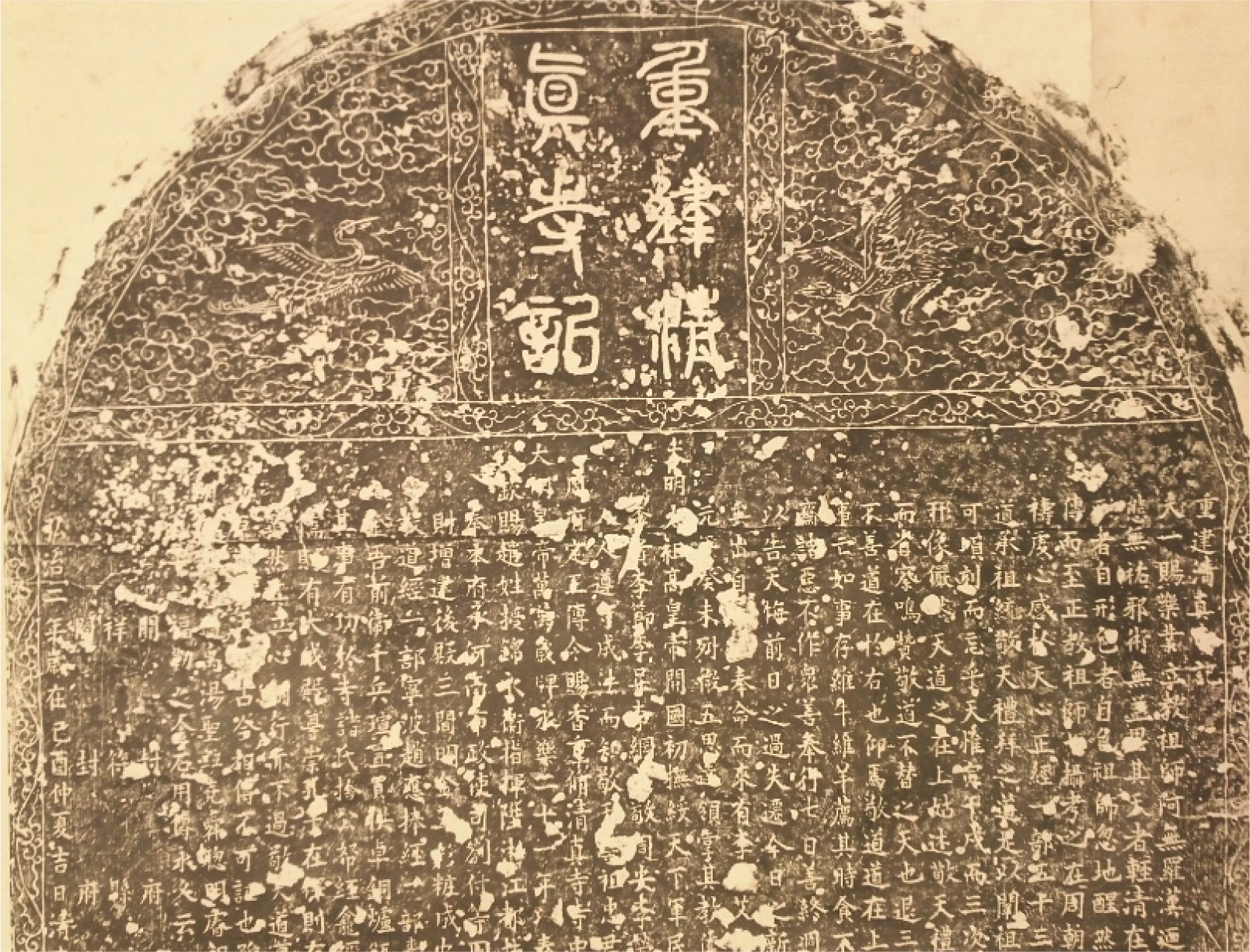
They used Qing (Pure) to communicate a God without physical form or idol, unpolluted by the material world. They used Zhen (True) to represent the singular, ultimate reality of the one God, standing in contrast to the myriad of local deities. For centuries, both Islamic mosques and Jewish synagogues in China were called Qingzhen Si (Temple of Purity and Truth).
This shared nomenclature is carved directly into the historical record. The famous 1489 stone stele erected by the Kaifeng Jews explicitly defines their faith using these terms: “Pure means being one and without a second; True means being righteous and without evil.” It wasn’t until the Qing dynasty, long after the Kaifeng Jewish community had begun to heavily assimilate and fade from public prominence, that the thriving Muslim community successfully monopolized the term Qingzhen, turning it into the exclusive Chinese translation for “Halal” that we recognize today.
The Sinew-Plucking Religion
Despite the shared names, the shared architectural terms, and the shared umbrella identity, Chinese neighbors eventually noticed one microscopic, highly specific dietary divergence between the Blue Hats and the White Hats.
