

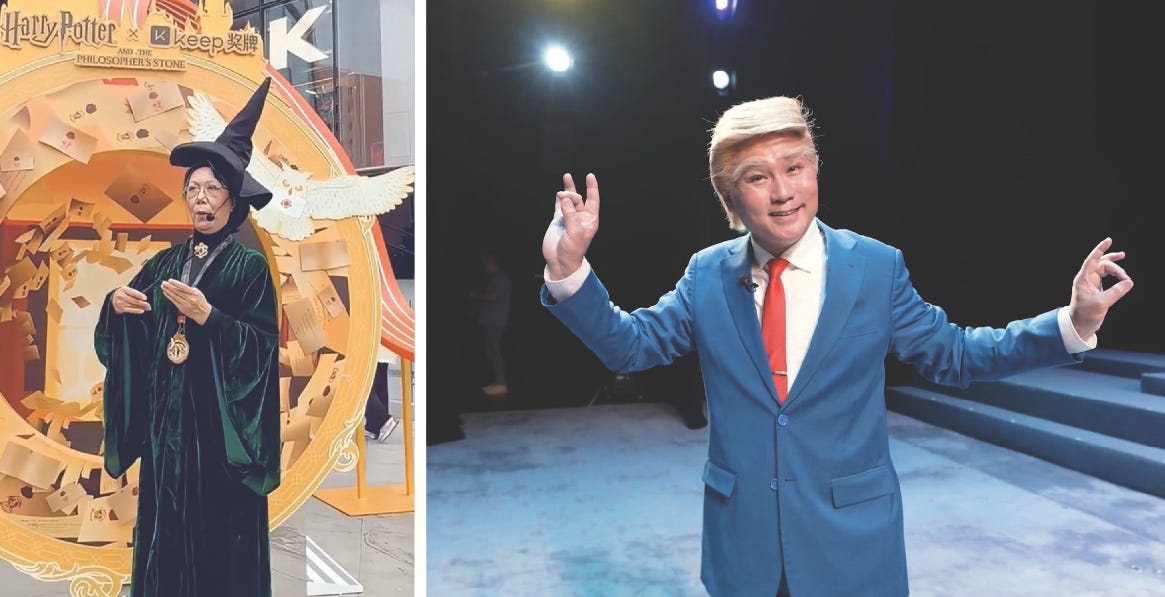
A curious scene unfolded recently in Beijing’s trendiest shopping district: a Peking Opera pop-up show re-enacting Harry Potter. Clad in flowing robes, a performer cosplaying Professor Snape bellowed incantations in Mandarin, accompanied by Jinghu fiddles (京胡) and gongs. Bemused shoppers at Sanlitun watched as the wizarding world collided with Chinese opera. Meanwhile in Hong Kong, a full-length Cantonese opera “Trump on Show” has been playing to packed theaters. This absurdist “Cantonese Opera Trump” features a performer in a golden wig singing in falsetto, reliving Donald Trump’s imagined misadventures – from a foiled assassination attempt on the campaign trail to a fantastical search for his long-lost Chinese twin. Bizarre as they sound, these East-meets-West mashups highlight a renewed creative energy around Chinese traditional theater, or Xiqu (戏曲), even as the art form grapples with modern relevance.
An Art Enjoyed from Emperor to Commoner
Chinese opera has always been more than highbrow entertainment. For over a millennium, it was arguably China’s most popular form of performance, enjoyed by emperors and commoners alike. Legend dates the first imperial troupe to the Tang Dynasty (8th century) “Pear Garden” (梨园, Li Yuan) under Emperor Xuanzong, and even today opera performers proudly call themselves “Disciples of the Pear Garden.” Unlike Western opera – born in royal courts and salons – Chinese opera evolved in bustling marketplaces, temple fairs, and village squares. By the Qing dynasty (1644-1911), hundreds of regional opera genres flourished across the country, from the clanging battle arias of northern Qinqiang (秦腔, originating in Shaanxi province, characterized by its powerful, high-pitched, and often metallic singing style, and is considered a precursor to many other Chinese opera traditions) to the love duets of eastern Yue opera (越剧, Yue Ju, originating in Zhejiang and flourishing in Shanghai, is a lyrical and graceful Chinese opera form renowned for its soft, melodic singing, elegant costumes, romantic themes, and predominantly female performers). Indeed, China today still boasts some 300-odd distinct opera forms (down from over 400 a few decades ago), each with its own dialect, musical style and repertory, yet all part of a shared tradition.

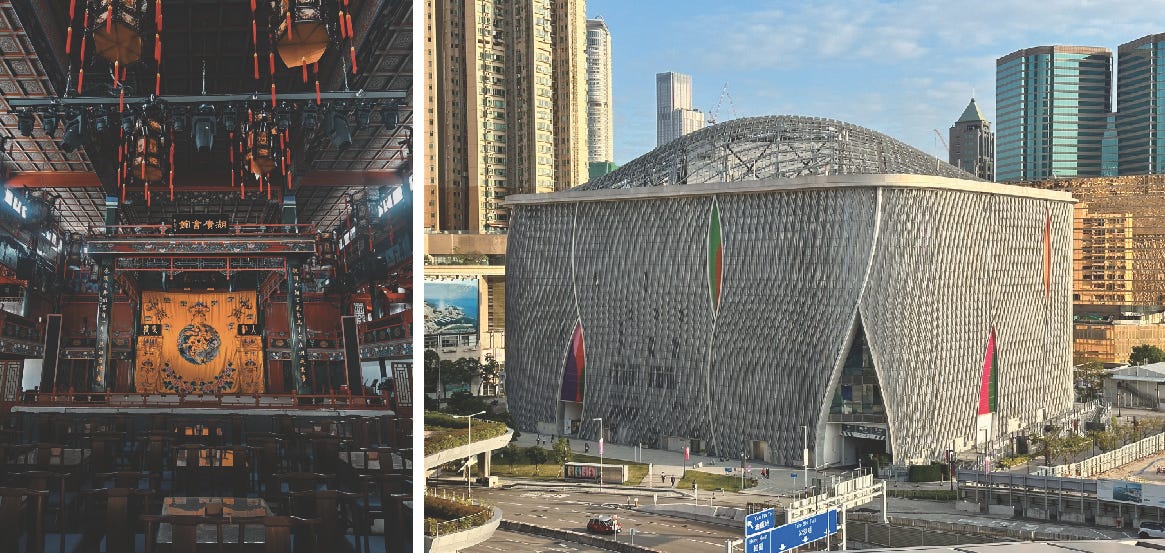
This very diversity has prompted China to reassert opera’s unique identity on the global stage. In Hong Kong’s West Kowloon cultural district stands the new Xiqu Centre – notably using the pinyin xiqu (戏曲, traditional opera) instead of the word “opera.” The choice was deliberate. Hong Kong authorities consulted experts who argued that “xiqu represents a unique Chinese performing art form which should be differentiated from Western opera or theater,” given its distinct techniques of singing, recitation, acting and acrobatics1. In other words, Chinese opera is not simply an Eastern variant of opera – it is its own genre, a rich blend of music, dance, drama and martial arts developed over centuries. The Xiqu Centre’s very name asserts this cultural independence, even if some locals found the unfamiliar romanization puzzling at first.
From the Emperor’s Favor to “National Essence”
Of all China’s opera forms, the Peking Opera (京剧, Jingju) is the most renowned. Ironically, this classic Chinese opera was born from a fusion of regional styles and even courtly fashion. In 1790, to celebrate Emperor Qianlong’s 80th birthday, four great troupes from Anhui province – known as the “Four Anhui Hui Troupes” – were invited to Beijing. Their earthy Hui opera (characterized by the erhuang (二黄) melody) quickly captivated the capital. They absorbed tunes and techniques from other operas – blending Kunqu (昆曲, a traditional opera known for its elegant melodies, poetic lyrics, and refined performance style) opera’s elegant melodies, Qinqiang’s robust rhythms, and local Beijing dialect jokes – to gradually form a new style. This hybrid theater, patronized by the Manchu aristocracy, came to be called Jingju or Peking Opera. By the mid-19th century it dominated Beijing’s stages, thanks in part to imperial favor: the Empress Cixi (the de facto ruler of China from 1861 until her death in 1908 during the late Qing Dynasty, known for her powerful influence and controversial reign) was an avid fan who even performed opera herself in the palace.

In the early 20th century, as the Qing Empire gave way to a modern nation-state, Peking Opera was elevated as a symbol of national culture. Chinese intellectuals and opera artists began referring to it as “Guocui” (国粹)– the national essence. The term, borrowed from Japanese, reflected rising cultural nationalism: if Westerners had their grand operas, China’s most refined indigenous art would be its answer. By the 1910s, Peking Opera was hailed as the national opera (国剧) of China. This status was not without controversy. Detractors noted that Peking Opera had narrow roots – originally a Beijing pastime for Manchu nobles and trendy urbanites – hardly representative of all Chinese folk culture. The writer Lu Xun (鲁讯), for one, scathingly dismissed Peking Opera and expressed his loathing for it as a remnant of a decaying feudal culture2. Nonetheless, the Guocui label stuck in the public imagination, marking Peking Opera as a treasured repository of Chinese tradition.
The very first Chinese film ever made was a Peking Opera recording. In 1905, the filmmaker Ren Qingtai (任庆泰) teamed up with opera star Tan Xinpei (谭鑫培) to shoot scenes from Dingjun Mountain (定军山), a classic Peking Opera battle tale. The short silent movie – essentially a filmed opera excerpt – premiered in Beijing in late 1905, heralding the birth of Chinese cinema. That China chose an opera performance (rather than, say, news or drama) for its inaugural film underlines how central opera was to entertainment at the time. Indeed, opera stars were among the first Chinese celebrities. The venerable Tan Xinpei’s face was known to audiences nationwide, and subsequent performers like Mei Lanfang (梅兰芳) would achieve even greater fame, both at home and abroad.
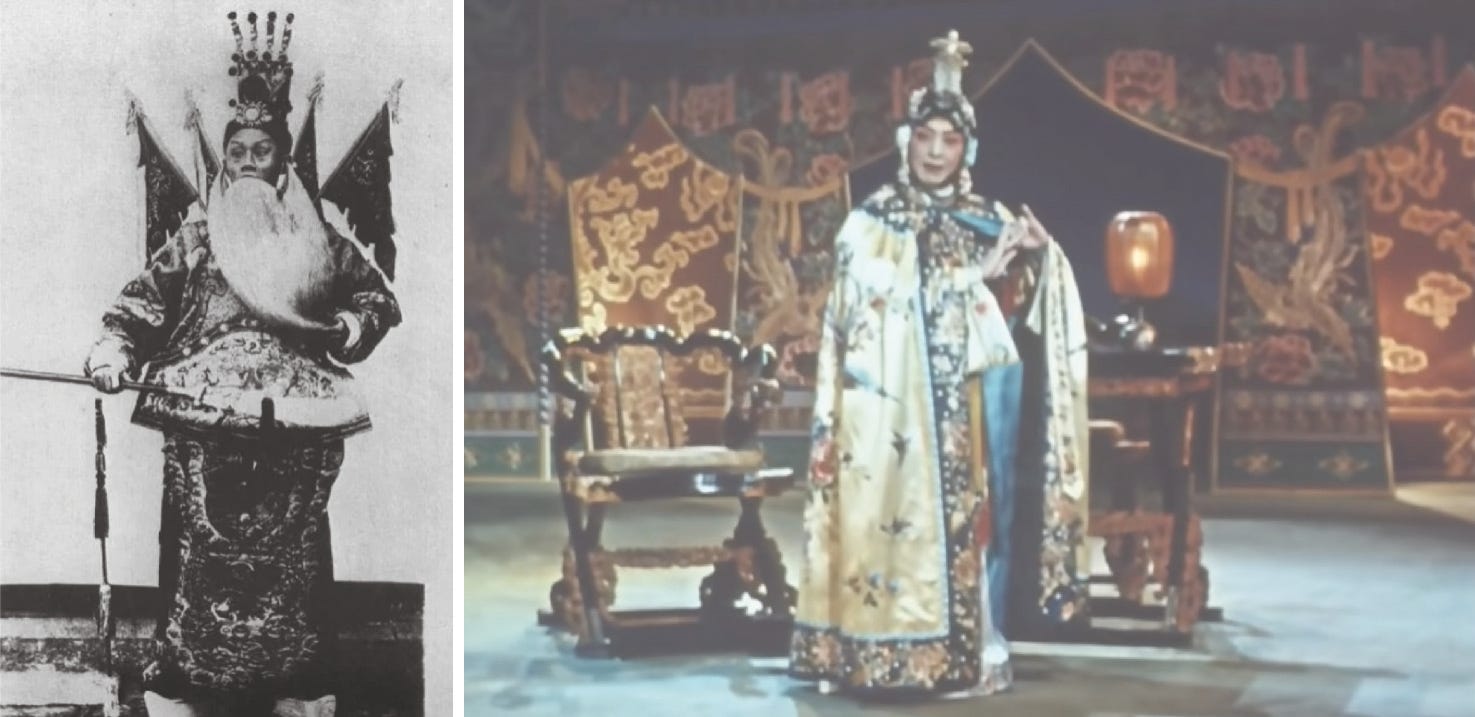
By the 1930s, Mei Lanfang had become Peking Opera’s global ambassador. He first toured Japan in 1919, then stunned Broadway and Hollywood during an American tour in 1930, and later visited the Soviet Union in 1935. Western audiences, unaccustomed to men singing falsetto as glamorous heroines (Mei’s specialty), were nevertheless mesmerized by the stylized beauty of his art. Mei’s tours earned “universal praise and admiration” and put Peking Opera on the world map. They also carried ideological weight back home. Within China’s cultural circles, a fierce debate raged over traditional opera’s value in a modern society – some reformers branded it a backwards “dregs of the old society,” while others defended it as a living art that could modernize without losing its soul3. Mei Lanfang firmly believed in the latter. He updated costumes, refined choreography, and presented Peking Opera as a modern, sophisticated theater to foreigners. His triumphs abroad were seen as vindication that Chinese opera could indeed stand tall as a national art, not a shameful relic. As one historian noted, Mei’s international tours became “the catalyst and crowning glory of the modernization of the genre,” helping secure Peking Opera’s stature as China’s national opera.

That stature in popular culture endured. Decades later, one of the most lauded Chinese films of the 20th century took Peking Opera as its subject and metaphor. Chen Kaige (陈凯歌)’s 1993 epic Farewell My Concubine (霸王别姬) – named after a famous Peking Opera – centers on two opera actors’ tragic lives and the upheavals of China’s modern history. The film not only won the top prize at the Cannes Film Festival (the first Chinese-language film to do so) but is considered one of the greatest Chinese films of all time. Through its melodrama and lush opera sequences, global audiences were introduced to the spellbinding aesthetics of Peking Opera. By the end of the 20th century, the image of the Peking Opera diva in dazzling costume and makeup had become a potent emblem of Chinese culture – recognizable worldwide from Mao suit posters to Hollywood films.
A Shared Cultural Memory
Part of Chinese opera’s enduring influence comes from its stories. Across China’s many opera genres, the repertoire has long drawn on the same treasury of tales – historical romances, moral parables, ghost stories, and heroic legends known to virtually every Chinese. While the performance styles differ by region (one opera might be sung in a Beijing dialect with piercing fiddles, another in Cantonese with mellow gongs), the plotlines are often familiar across locales. It is common that a village audience in Sichuan watching their local opera would recognize a story that urban Beijingers had enjoyed in Peking Opera, or that had been told for centuries in Kunqu verses.
For example, the tragic saga Injustice to Dou E (窦娥冤) – in which a wrongfully executed young woman’s ghost cries out for cosmic justice – dates back to a 13th-century Yuan Dynasty drama. That heart-rending tale has been adapted into countless forms: Kunqu opera, Yu opera, Cantonese opera, and Beijing opera all have their versions. In Peking Opera the piece is known as Snow in June (六月雪). Another omnipresent character is Judge Bao (包公), the incorruptible black-faced magistrate from Song Dynasty lore. There exists an entire cycle of “Bao Gong” operas in various regional styles, so much so that Chinese speak of “watching a Bao Gong play” as shorthand for any dramatized courtroom justice story. In these plays – whether performed in the shrill cadences of Henan’s Yu opera (豫剧) or the soft Suzhou dialect of Kunqu – Judge Bao might punish evil-doers on Earth by day and even descend to the underworld at night to judge hell’s denizens. Likewise, The Peony Pavilion (牡丹亭) – a romantic ghost-love story written in 1598 – was originally a Kunqu opera but became so beloved that its scenes are now performed in everything from Yue opera to Peking Opera, and known to most Chinese schoolchildren. Romance of the Three Kingdoms, Journey to the West, The White Snake…the list of shared stories is long.

Through centuries of these operatic retellings, certain narratives and characters became a collective cultural memory for the Chinese people. Before mass literacy, it was often through traveling opera troupes that villagers learned history and ethics – the exploits of ancient heroes, the loyalty of virtuous maidens, the karma rewards and retributions that underpin folk values. Traditional opera long served as both entertainment and a vital source of spiritual sustenance, instilling a common set of cultural references and moral lessons across a vast, diverse population. The legend of Dou E’s wrongful death teaching the wages of corruption, or Judge Bao’s stern face symbolizing justice-for-all, left an enduring imprint on the Chinese imagination. In short, Chinese opera helped knit together a sense of social cohesion and a Chinese worldview, much as Grimm’s fairy tales or the Bible did in the West – only it was done with painted faces, gongs and falsetto arias on an outdoor stage.
At the Village’s Heart – Opera as Social Glue
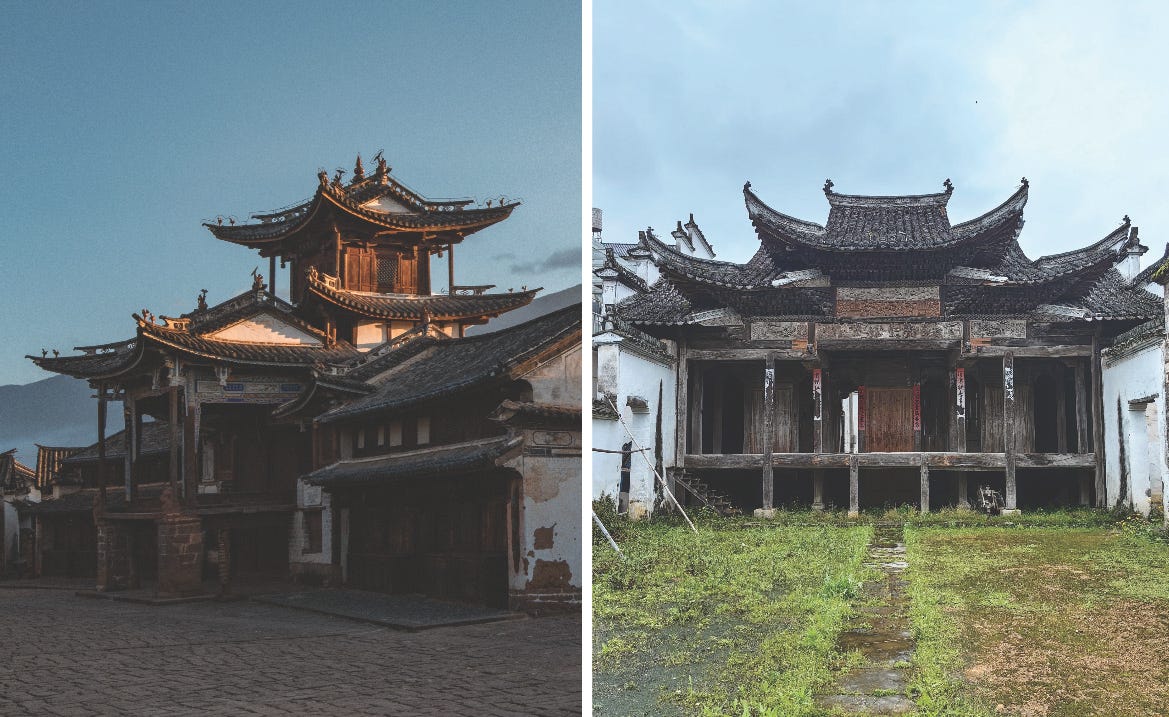
In traditional China, opera was not confined to capital stages or imperial theaters; it permeated everyday life, especially in the countryside. If a European town’s focal point was its church, a Chinese rural community’s pride was often its opera stage. Many villages had a permanent stage adjacent to the temple or market square, and local opera troupes would perform during festivals, temple fairs, weddings and funerals, drawing everyone from nearby villages. By the late 19th and early 20th century, virtually every county had its own opera companies and theaters. Opera was the mass entertainment of the era – the movies and television of its time.
Republican-era reformers, recognizing opera’s broad appeal, sought to harness it for education and nation-building. Progressive intellectuals experimented with writing new operas on patriotic or social themes, hoping to “save the nation” through drama. In the 1910s and 1920s, Chinese stages saw historical rescue operas about modern subjects – one early Beijing Opera in 1919 depicted the failed 1900 Boxer Rebellion, while another in Shanghai dramatized anti-opium campaigns. Revolutionary operettas, new spoken drama (话剧), and Western-style plays also emerged, but they often lacked the grassroots reach of traditional opera. So some thinkers instead tried to reform traditional Xiqu itself: introducing modern props, current events and even female actors (who had been banned in imperial times) to make opera a vehicle for enlightenment. The results were mixed – some purists balked, while audiences still craved classic tales – but the impulse spoke to opera’s importance as a popular forum.
Throughout the Republican period (1912–1949), rural opera troupes continued to thrive on their age-old circuit. Everywhere from Guangdong to Gansu, itinerant performers pitched stages in open-air fairgrounds or temple courtyards, performing multiple shows a day as crowds sat on benches from morning till night. A 70-year-old villager from Shaanxi might recall how as a child he learned stories of the Yang family generals or Princess Chang’e flying to the moon by watching Qinqiang opera under the stars, surrounded by neighbors. These opera events were communal celebrations – equal parts entertainment, social gathering, and ritual observance (often sponsored to honor local deities or clan ancestors). In northwestern China’s plateau, one veteran Qinqiang troupe manager reminisced that in the late 1970s his troupe of 50 actors would tour the countryside, “sometimes performing up to three shows a day to rapt audiences who sat on stools from dawn to dusk”4. In those days, he says, “opera was the most widespread form of entertainment – everyone could hum a little bit from famous works.” The melodies of those operas, carried on the wind from village to village, were truly the soundtrack of rural life.

Not only entertainment, opera was also seen as a means of moral instruction (in line with Confucian tradition). Official notices in the 1930s urged troupes to stage “healthy” plays extolling virtue and patriotism, rather than only ghost romances or frivolous comedies. This echoes the way Medieval European church plays taught Bible stories – Chinese opera, through vivid costumes and dramatic action, imparted cultural values to an illiterate populace. The opera stage was effectively the people’s theater and classroom. Given this central role, it is little wonder that after 1949 the new Communist regime viewed opera as a crucial tool for propaganda and public education – and moved swiftly to bring it under state control.
Revolutionaries and Modern “Model Operas”
When the People’s Republic was founded in 1949, the Communist Party initially embraced traditional opera as a means to reach the masses. Opera’s grassroots popularity made it an ideal vehicle for propaganda, especially in the vast countryside. The Party commissioned new operas based on revolutionary history, adapted for different regions and dialects so they could play everywhere. The same stirring tale might appear as a Peking Opera in Beijing, a Yue opera in Shanghai, and a Shaanxi Qinqiang in Xi’an – allowing a single message to resonate nationally through local art forms. For instance, “Taking Tiger Mountain by Strategy (智取威虎山)”, a thriller about communist guerrillas outwitting bandits, became one of the era’s most famous operas. Originally created as a Peking Opera in the 1950s, Tiger Mountain was later performed in other opera traditions and even made into a feature film. Similar cross-genre adaptations occurred with pieces like The Red Lantern (红灯记) and Sha Jia Bang (沙家浜), embedding socialist ideology into the familiar framework of opera.
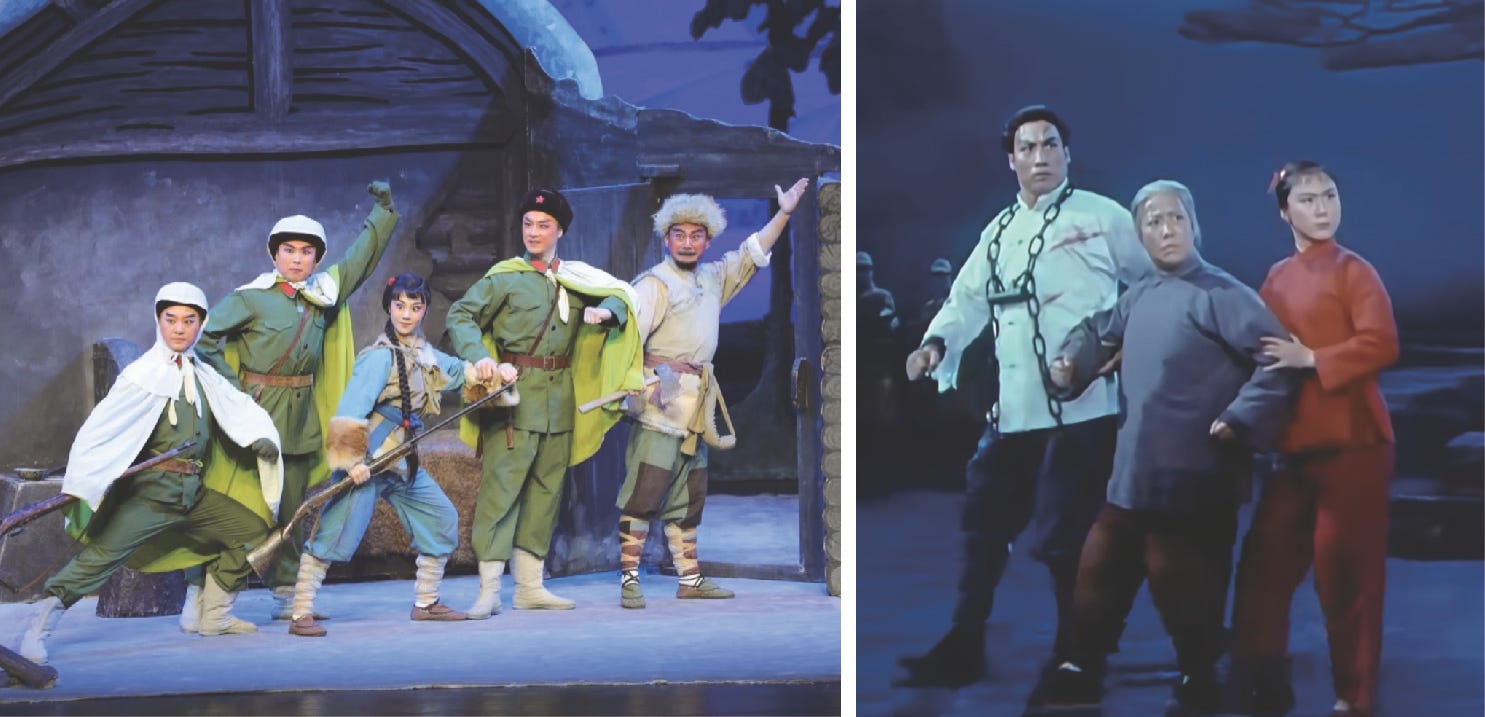
Yet the Party also sought to purge elements of traditional opera it deemed feudal or inappropriate. Storylines involving ghosts, spirits, or romance were frowned upon as “superstitious” or decadent. After 1949, many classical operas were edited to excise their supernatural parts or to give them more politically correct endings. Operas about magistrates or emperors were rewritten to emphasize anti-imperial themes; comic operas with bawdy innuendo were toned down. This campaign culminated during the Cultural Revolution (1966–1976) when Jiang Qing (Madame Mao) imposed a draconian new repertoire of “eight model operas” on the nation. All other operas were banned as “old culture.” The only shows allowed on stage were revolutionary spectacles with proletarian heroes – essentially propaganda musicals set to operatic music. Traditional costumes, stories and characters disappeared. For a decade, Chinese opera became almost unrecognizable to its former fans – a tool of politics rather than amusement. By 1976, opera troupes had been disbanded or forced to conform; Chinese opera as a folk art nearly went extinct.
Paradoxically, these model operas were hugely popular in their time – largely because they were the only entertainment permitted. Works like The Red Lantern and Sha Jia Bang were seen by hundreds of millions, giving them a permanent place in collective memory. Older generations in China still recall stirring model-opera tunes by heart. But the model opera era also did lasting damage: it severed the continuity of traditional repertoire and alienated many ordinary people who simply wanted operatic escapism, not lectures. Turning opera into overt propaganda stripped away its pure entertainment value, and when the novelty wore off, audiences – especially younger urban ones – drifted away.
After the Cultural Revolution, classical operas were gradually revived in the late 1970s. The government rehabilitated famous performers and allowed regional troupes to perform old favorites again. In many places, the opera stage sprang back to life as a living link to pre-revolution culture. However, the world had moved on during those lost years. By the 1980s, television and films had penetrated even remote villages, offering new storytelling media that didn’t require sitting outdoors for hours or understanding archaic Chinese. The impact on opera’s popularity was devastating. What the smartphone is doing now to television, is the same as what television did to opera.
Opera today is perceived as old-fashioned by many youth, a niche pursuit requiring effort to appreciate. Unlike English-speaking countries, where Shakespeare might still be taught in school, Chinese schools have not traditionally incorporated opera education – leading to what one scholar calls a severe “cultural alienation” among the young.
Aging performers retire without successors; stages fall silent. The Chinese government has responded by designating many operas as Intangible Cultural Heritage and pouring money into training programs, festivals, and even introducing opera into some school curricula. In 2015, the State Council issued policies to support traditional opera troupes, and by 2021 Beijing was doubling down on intangible heritage protections. Notably, Peking Opera enjoys pride of place, officially affirmed as “China’s national opera” that must be preserved. But hundreds of lesser-known local operas get far less support and still struggle to find audiences or recruits. A stark statistic illustrates the challenge: over 60 opera genres have effectively vanished since the 1980s despite protective efforts.
New Wine in Old Bottles: The Future of Xiqu
This brings us back to the quirky phenomena at the start of our story: Harry Potter in Peking Opera garb, and Trump in Cantonese opera makeup. These viral hits hint at one possible future – injecting fresh, contemporary content into traditional opera formats to win back public interest, especially among the young. The past few years have seen a flurry of such experiments, often starting online. In 2014, a video clip of a Peking Opera skit called “Three Trials of Galileo” exploded on Chinese social media, delighting netizens with its incongruous premise: the 17th-century astronomer Galileo dragged before a Chinese imperial court (in full operatic style) for judgment. Its tongue-in-cheek humor and “magical” mixing of East and West made it a cult favorite. Since then, creative hobbyists and some professional actors have produced opera-themed parodies of Hollywood blockbusters – Pirates of the Caribbean reimagined as a Peking Opera, The Lord of the Rings with Chinese lyrics, and so on。
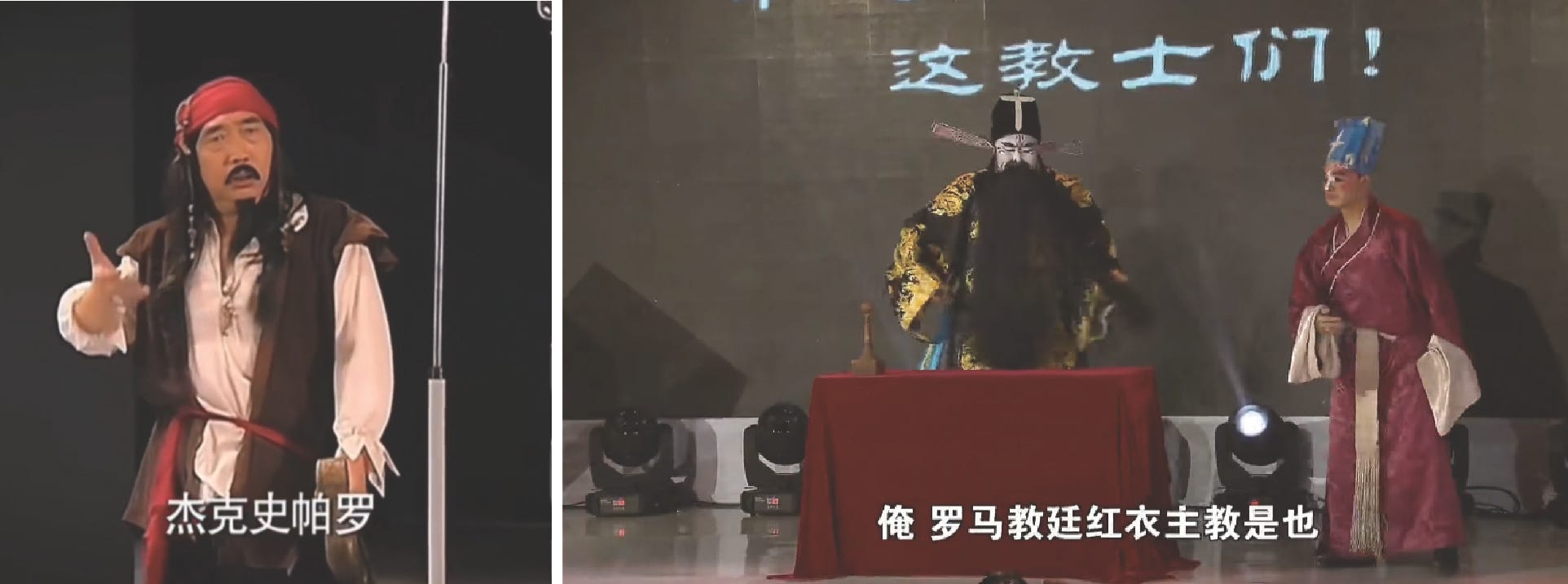
The pop-up show in Beijing’s Sanlitun – essentially bringing one of those mashups into real-life performance – garnered thousands of likes and comments when videos hit the internet. Unlike previous mashups, the Sanlitun stunt was part of a licensed Harry Potter merchandise event, indicating that even big brands see value in linking with traditional opera for a dash of Chinese cultural flair. Such pop culture crossovers are making opera “cool” again – or at least meme-worthy.
But perhaps the boldest attempt to revitalize opera through contemporary storytelling is Hong Kong’s hit “Trump” Cantonese opera. Premiering in 2019, Trump on Show has since been staged three times to sold-out audiences, drawing an unusually young crowd for Cantonese opera. The production is the brainchild of Hong Kong playwright and feng shui master Lee Kui Ming, who envisioned an “absurd comedy” mixing current American politics with Chinese opera tropes. The result is a nearly four-hour epic that opens with President Richard Nixon’s 1972 visit to Mao Zedong and then spirals into fantasy: Donald Trump discovers he has a twin brother in rural China, leading him on a time-traveling adventure that includes encounters with Mao, Kim Jong-un, and other figures. In one scene, Trump (played by veteran baritone Lung Koon-tin) survives an assassination attempt and sings in high-pitched Cantonese, “This is a bullet! It wants to send me to my grave.” – a direct quote of Trump’s operatic lament at a campaign rally shooting. The sight of an orange-haired “King of America” singing Chinese arias is as surreal as it is entertaining. Audiences have flocked to it, many out of curiosity, and left thoroughly amused. “This show is great fun because it blends time-travel, China and America – totally unrelated elements – all together,” one young theatergoer enthused.

Beyond the laughs, Cantonese Opera Trump carries a subtext of cultural confidence. Lee Kui Ming has hinted that poking fun at a Western leader through the medium of Chinese opera “actually puts the focus back on China”. In other words, by appropriating global political figures into a local opera tradition, the production makes a statement that Cantonese opera can tackle anything – even the wild absurdities of 21st-century geopolitics. Hong Kong’s freer creative environment undoubtedly enabled such satire; it’s hard to imagine a similar opera in mainland China. The success of Trump on Show has given Cantonese opera a burst of media attention, with international news agencies from AP to AFP covering it as a human-interest story. Lee is even musing about touring the show to the United States – performing it in front of Donald Trump himself one day, he dreams.
On the mainland, no full-length original opera production has yet achieved the same “viral” pop culture status. Most innovations have been in bite-sized doses. There have been attempts at serious new operas on contemporary themes, but garnered only modest notice. In truth, large state-funded opera companies often prefer to stick to safe classics or patriotic warhorses – the audience for niche new operas is too small, and commercial risk too high. Thus, much of the true innovation is happening at the margins, driven by passionate amateurs, independent troupes, or crossover artists.
Yet alongside these experiments, there is also a quieter revival of older, almost-forgotten traditions, aided by heritage programs. In Henan, the “Danampo Project” (大南坡计划) helped restore a once-dissolved rural troupe of Huaibang Ju (怀梆剧, a traditional folk theater originating from Henan province, known for its vigorous singing, rustic charm, and distinctive use of bangzi (wooden clappers) for rhythmic accompaniment), rehiring elderly performers and bringing them back on stage, not as museum pieces but as living artists. In Shaanxi, the raw, percussive folk style known as Huayin Laoqiang (华阴老腔, a vibrant and ancient Chinese folk musical tradition from Shaanxi province, characterized by its raw, powerful vocals and energetic percussion, often performed with simple instruments like benches and wooden clappers) — long dismissed as peasant art — has been recognized and revitalized, even featured in national galas. These cases show that state or local heritage initiatives, when done with sensitivity, can reconnect opera to its grassroots origins. They demonstrate that revival need not mean embalming; instead, it can reinsert opera into the rhythms of community life, while giving artists dignity and audiences authentic connection.
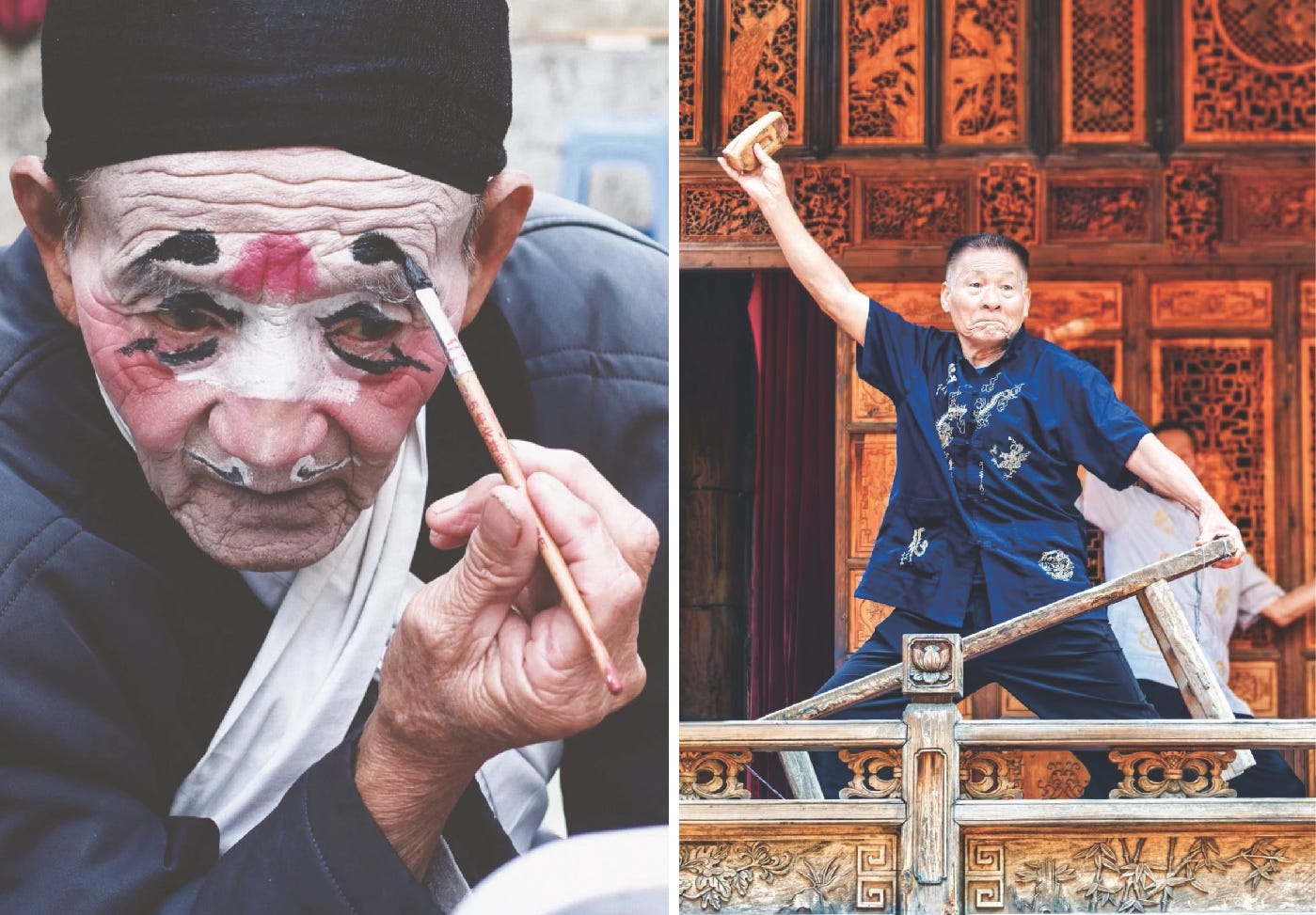
Opera thrived in its golden days because it was relevant and beloved, not because it was labeled a “heritage” to protect. An art form lives or dies by its connection to people’s lives. In the fast-paced, urbanized lifestyle of modern China, can traditional opera find that connection anew? The answer may lie in balancing reverence for tradition with bold innovation. The sight of Hogwarts professors singing Peking Opera in a mall or a Trump caricature in Cantonese costume may seem gimmicky—but they have sparked conversations, laughter, and crucially, attention from those who might otherwise have ignored xiqu. From there, curiosity can grow. A college student amused by a Harry Potter clip might next click on a video of Mei Lanfang’s Farewell My Concubine—and discover that this centuries-old art form still speaks, in its own stylized voice, to timeless human emotions.
In a way, Chinese opera is coming full circle: once more being performed in marketplaces (or shopping malls) and adapting folk stories of the day (whether a local village scandal or a global political satire) just as it did in imperial times. The forms and faces are old, but the content can be new. The small rural troupe singing for peasants and the flashy metropolitan troupe doing a pop-culture mashup share the same goal – to win the audience’s hearts here and now.
After two centuries of highs and lows, from imperial patronage to near oblivion, Chinese opera remains a resilient symbol of cultural identity. Its survival will depend not on freezing it under a glass case, but on letting it breathe and even play. In the end, xiqu might just cast a spell of its own kind of magic – one that doesn’t need a wizard’s wand to enchant new generations. The curtain has not fallen yet; the next act of this grand old art form is only beginning.
If my insights brought you a fresh perspective, please consider supporting me by buying me a coffee. Your generosity fuels my writing.
Additional Readings/Narratives in Art and Cultural History


https://www.info.gov.hk/gia/general/201905/29/P2019052900354p.htm
《论“旧形式的采用”》 ("On the Adoption of Old Forms"), Lu Xun discusses the conservatism of traditional arts. Additionally, he disdains certain aspects of Peking Opera is echoed in other writings, such as 《社戏》 ("Village Opera")
https://events.umich.edu/event/32789
https://www.theworldofchinese.com/2021/10/the-uncertain-future-of-grassroots-chinese-opera/
Absolutely delightful. Thank you!