

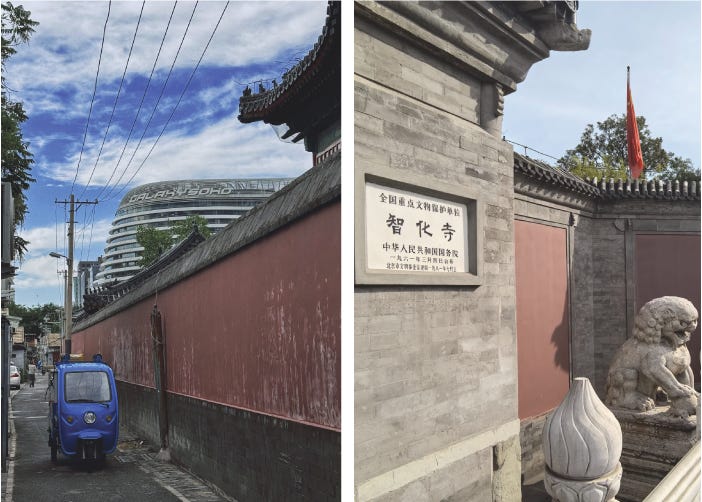
Next to the flowing curves of Zaha Hadid’s Galaxy Soho—a futuristic swirl of glass and steel—lies one of Beijing’s oldest hutong districts. Here, among narrow alleys and weathered brick walls, you can glimpse a scene where past and future coexist. Step through a modest gate, and the noise of the city gives way to the hollow strike of a wooden fish drum, the faint scent of incense, and the dim glow of Ming-dynasty timber beams. This is Zhihua Temple (智化寺), a sanctuary that has preserved not only architecture but also sound itself for nearly six centuries.

At first glance, the temple does not impress in the way of China’s better-known monuments. Its courtyards are small, its halls modest compared to the grandeur of the Forbidden City just a short walk away. Yet Zhihua Temple (智化寺) holds something far rarer: a living musical tradition dating back to the Ming dynasty, one of the oldest continuous forms of Buddhist ritual music in the world. The sound of its haunting flutes and deep, resonant chants may be as close as one can get to hearing the voices of imperial Beijing. Within these timber halls, generations of monks and musicians have performed the same repertoire—solemn pieces that once blended courtly refinement with religious devotion. Over centuries, this “Zhihua Temple music” (智化寺京音乐) was passed from master to disciple in an unbroken oral chain, surviving invasions, political upheavals, and even the near-erasure of Buddhist practice in the twentieth century. Today it is recognized as a national intangible cultural heritage of China, and visitors who attend a performance describe the experience as otherworldly: low, droning horns undercut by sharp percussion, melodies rising like smoke into the rafters.
The temple was founded in 1444 by Wang Zhen, a powerful eunuch who served under the Ming emperor Zhengtong. Wang, like many court officials of his time, sought spiritual merit through lavish patronage of Buddhist institutions. Zhihua Temple was his private project, built in the style of the imperial court and adorned with exquisitely carved beams and painted ceilings. Its main hall, Zhihua Hall, is a masterpiece of Ming wooden architecture with a double-eaved roof and interlocking brackets.
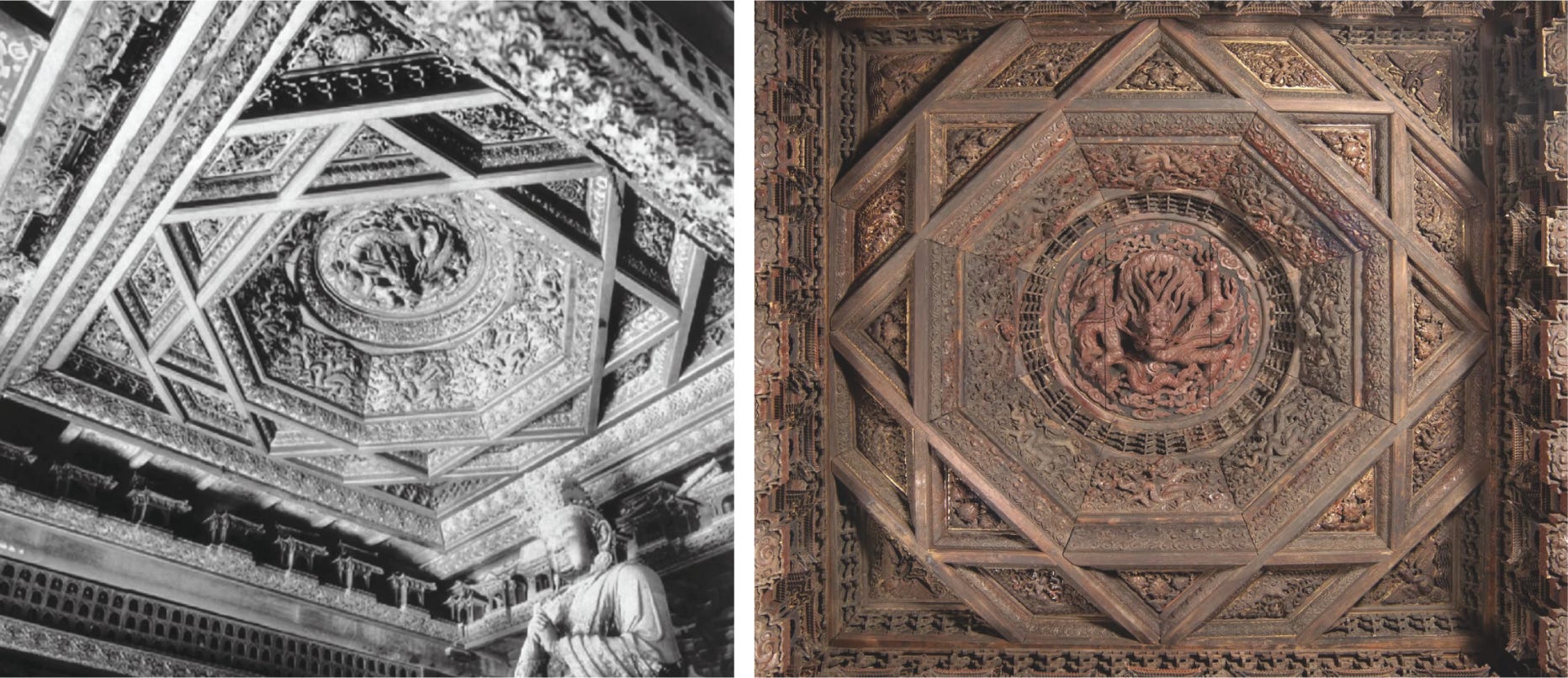
The temple’s most painful losses came in the Republican era. In the late 1920s and early 1930s, short of funds and mired in disrepair, Zhihua Temple dismantled two of its magnificent caisson ceilings (藻井). One was purchased on behalf of the Philadelphia Museum of Art by Horace Jayne; the other, first sold locally to coffin-makers, was later acquired by the young curator Laurence Sickman for the Nelson-Atkins Museum of Art in Kansas City. Today those glittering Ming-dynasty coffers—carved cypress, flecked with gold leaf, dragons coiling toward a painted heaven—hang in American galleries, eloquent artifacts of a precarious moment when Beijing’s sacred interiors were traded piece by piece to survive.
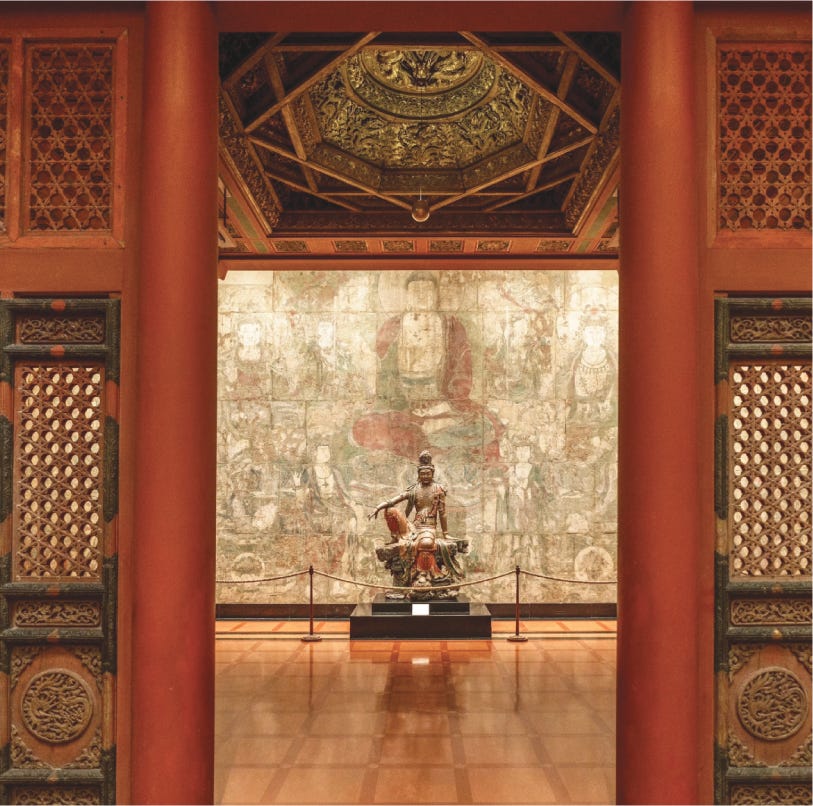
The Chinese Temple Room is comprised of three interior components: The first of these is a huge mural nearly 15 metres in length, The Assembly of Tejaprabha Buddha, originally painted for a Yuan dynasty (1272–1368) building in the complex of Guangsheng Temple, Hongdong, Shanxi province. The second component is a splendid ceiling that includes a coffered vault and ceiling panels formerly installed in the upper floor of the Hall of Tathagata in the complex of the Zhihua Temple, built in 1444 of the Ming dynasty (1368–1644) in Beijing. The third component is a set of twelve latticed door panels from an unidentified temple built in the Qing dynasty (1644–1911). These door panels screen off the room from the larger Chinese art gallery in front of it.
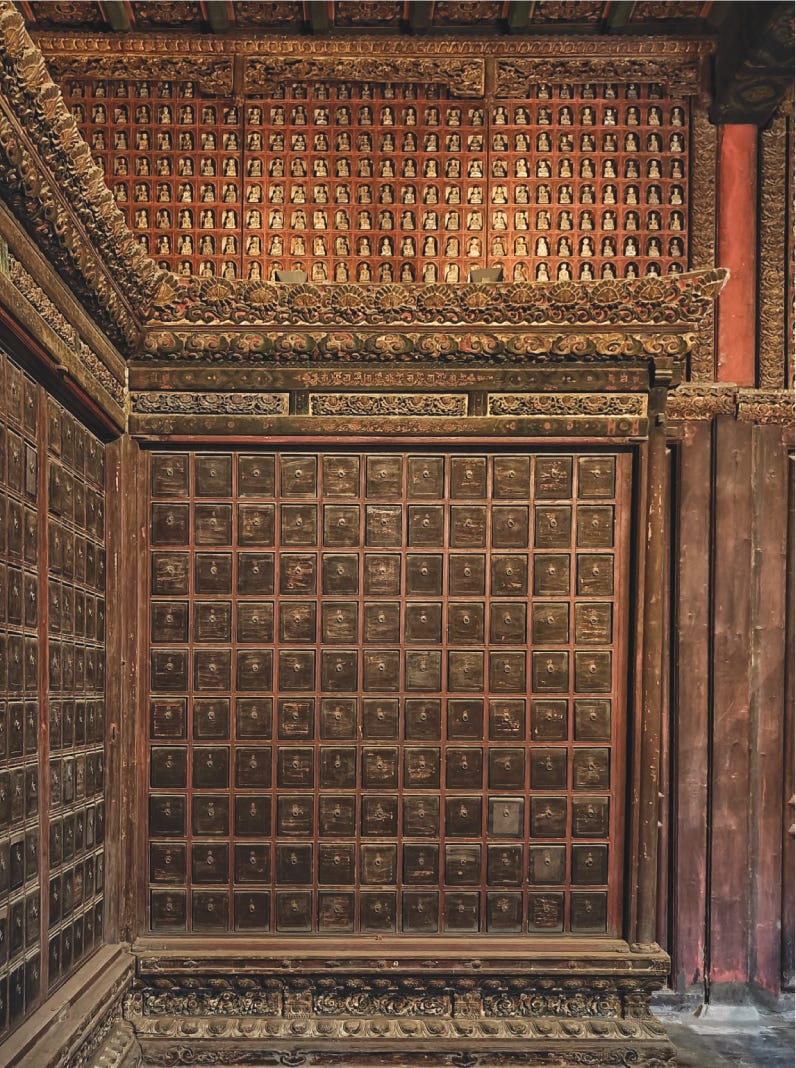
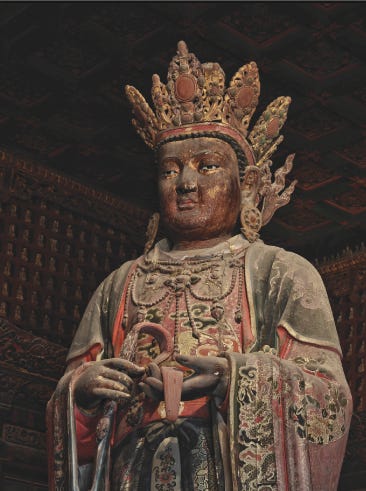
Today, Zhihua Temple stands quietly amid the old hutong lanes, its brick walls and timber eaves weathered by six centuries of wind. Inside, the halls remain dim and intimate. The bronze Buddha statues, their faces softened by incense smoke, sit beneath surviving painted ceilings that shimmer faintly with red, blue, and gold. Along one wall, the Thousand-Buddha niche (千佛龛) glows with rows of miniature figures—each one a gesture of devotion carved by hands long gone. These details, more than grand architecture, reveal what endurance really looks like: faith and artistry persisting in small, deliberate acts. In the stillness of the temple, surrounded by the city’s glass towers, the viewer senses how history here has not vanished, only quieted.


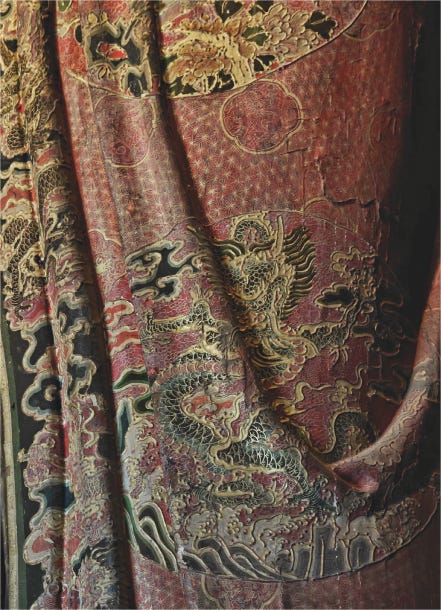

The music is very similar to Daoist ritual music. Love the photos, esp the first one.
Thank you for this thoughtful essay. I first visited Zhihua in 1985, just as it opened to the public after many years of desolation. The details you provide of the fate of the two 藻井ceilings are fascinating — and heart-rending. Geremie