

Aesthetics is translated as meixue (美学) in modern Chinese. Yet neither the word nor the concept existed in classical Chinese. It was first introduced in the early twentieth century, borrowed from Japanese kanji translations of German philosophy. Wang Guowei (王国维), who studied in Tokyo and is one of my favourite guoxue dashi (国学大师, masters of Chinese classical learning), introduced the word and the concept and applied them to the study of Chinese culture and tradition. Since then, mei 美 has become a transcendent concept standing above all other Chinese concepts. People study A History of Chinese Aesthetics before touching any specific Chinese art.
The Shuowen Jiezi (说文解字), compiled around 100 CE, defines mei as sweet:
美,甘也。
Mei means sweet.
Mei was something on the tongue, not something beautiful or aesthetic. Read the graph of 美: it is composed of 羊 (sheep) over 大 (big), a fat sheep, good to eat. Beauty begins as a flavour.
So my question is: before aesthetics was introduced, how did the Chinese appreciate the world they lived in and experienced? What concepts and methods did they use to describe that experience?
A Word Rooted in German Philosophy
Aesthetics is not an old tradition in the West. From the Greek aisthēsis, sensation was first introduced by the German philosopher Alexander Baumgarten around the 1740s. He used it to describe the science of sensory knowledge, as a “lower” counterpart to logic. Beauty became its main object because beauty was perfect sensory knowledge.
There has been debate over whether the translation meixue was first created by the Chinese or the Japanese. What is clear is that in the 1870s, Meiji translators in Japan invented kanji compounds for an entire Western curriculum. Among them, aesthetics was translated as bigaku (美学), along with 哲学 (philosophy) and 宗教 (religion).
Japan became one of the main destinations for Chinese students studying abroad, especially after its victory in the Sino-Japanese War of 1894–95. Since the two languages shared a writing system (Kanji/Hanzi), Chinese students absorbed much of Western thought through already mature Japanese translations. Wang Guowei picked up aesthetics through Japanese editions of Kant and Schopenhauer in the early 1900s.
Cai Yuanpei (蔡元培), who studied in Leipzig from 1907 to 1911, gave aesthetics an institutional mission. In a 1917 speech he proposed replacing religion with aesthetic education(以美育代宗教). His vision helped build a curriculum around the concept of aesthetics, and its influence on Chinese education continues today. De zhi ti mei lao (德智体美劳), moral, intellectual, physical, aesthetic and labour education, remains the official formula of the Chinese school system.
The Despised Aesthetic Subject
Aesthetics is not as ancient as philosophy, because the makers of objects did not hold a respected social status. Rome was built by slaves and freedmen. Only after the Renaissance raised the social status of craftsmen, especially painters and sculptors, did the works they produced become worth discussing. Aesthetics was the theory of a newly elevated class of makers, addressed to a new public of salons, museums and buyers.
In China, the makers had long stood at the bottom of society. In the seventh century, Emperor Taizong summoned Yan Liben (阎立本), already a court official, to paint a strange bird. Attendants called out for “the painter Yan Liben,” and he went home and told his son never to learn this “lesser skill” (末技). Hereditary musicians (乐户) and actors were registered as jianmin (贱民), debased people, and their sons were barred from the civil examinations (keju, 科举). The Lei family (样式雷) designed imperial palaces and tombs for some two centuries, until the early twentieth century, but barely appears in the official record. The carvers of the Yungang and Longmen grottoes are almost all nameless. Peking Opera performers are still sometimes called xizi (戏子), a contemptuous name for their profession.
Professional painters, musicians, architects, sculptors and actors were rarely recognised by society as authors.
At the top stood the four accomplishments of the literati, qin qi shu hua (琴棋书画): the guqin (Chinese zither), the board game weiqi (Go), calligraphy and painting. Their prestige depended on being unpaid. At the end of the Ming, Dong Qichang’s (董其昌) theory of the Southern and Northern Schools sorted painters into a superior lineage of scholar-amateurs and an inferior one of professionals, a social ranking dressed as a history of style.
When aesthetics arrived in the early twentieth century, the map flipped. Its categories (painting, sculpture, architecture, music, theatre) matched the products of the people Chinese society had ranked lowest. Chinese intellectuals were alarmed to find that what the West regarded as advanced was embedded in work they had despised for thousands of years. In 1917 Kang Youwei (康有为) lamented the decline of Chinese painting and praised the realism of the Song court painters over literati brushwork. In 1919 Chen Duxiu (陈独秀) called in New Youth (新青年) for a “revolution in art” (美术革命) that would begin by overthrowing the Four Wangs, the canon of Qing literati painting. Elites educated in the West began to adopt these methods and apply them back to Chinese culture.
Lu Xun (鲁迅) collected rubbings of Han stone reliefs. Mei Lanfang (梅兰芳), born into a family of actors, became the face of Chinese art abroad. Liang Sicheng (梁思成) travelled across China to survey its ancient architecture, and in 1937 he and Lin Huiyin (林徽因) identified the Tang-dynasty Foguang Temple (佛光寺). The work of nameless carpenters became national heritage. The People’s Republic later created the title “master of arts and crafts” (工艺美术大师) for craftsmen of exceptional skill.
The Literati Arts, Professionalised
The makers rose. The literati’s arts and tastes, instead, were taken apart. The guqin became one “national instrument” among many. Weiqi (Go) left art altogether and became a sport. Calligraphy (书法, shufa) lost its prominent place as a reflection of a gentleman’s character and became a pastime or a school subject. Painting became part of the Chinese fine arts, and the ideal of the inspired amateur became entirely professional academies, led by figures such as Xu Beihong (徐悲鸿), trained in Paris in academic realism. Rocks, tea and incense were filed under lifestyle. The role these arts had played in self-cultivation lost its original form.
The literati’s ideal was the pursuit of yi (逸), untrammelled freedom from the market and from rules. It sounds very like Kant’s disinterested pleasure, so aesthetic theory fitted the literati well. Aesthetic taxonomy, however, fitted the artisans better. Categorising literati art as “Chinese aesthetics” stripped away the context that supported its form, and the rituals and habits built around these practices faded with it. The ways and vocabulary Chinese intellectuals had used to appreciate the world moved from daily life into books and libraries.
Verbs of Appreciation
Aesthetic pleasure is believed to be disinterested and addressed to the distant senses of sight and hearing. A museum treats the work of art as finished. Chinese appreciation, however, was more interactive, and it was about bonds and relationships.
Pin (品): to rank and to taste. In 220 CE the Wei state ranked candidates for office into nine grades (九品中正制), and critics soon ranked poets and painters the same way. Zhong Rong’s (钟嵘) Shipin (诗品, c. 513) sorted 122 poets into three classes; Xie He’s (谢赫) Guhua Pinlu (古画品录) sorted 27 painters into six. Later, pin also came to mean to taste and to distinguish.
In the Tang dynasty, the official Li Jiqing (李季卿) met Lu Yu (陆羽), author of The Classic of Tea (茶经), and sent a soldier to fetch water from Nanling, a spot in the middle of the Yangzi said to give the finest water for tea. Lu Yu tasted it and said it was river water from near the bank. The soldier insisted it was not. Lu Yu poured the water out slowly, stopped halfway, and said the rest was Nanling water. The soldier confessed: half the jar had spilled on the way, and he had topped it up at the shore. The story is probably embellished, but it shows what pin meant: a palate so trained that tasting became telling apart. In The Classic of Tea, Lu Yu turned the same skill into a scale: mountain springs first, river water second, well water last (山水上,江水中,井水下).
Wan (玩): to handle. The Chinese words for collectibles, guwan (古玩, antique playthings) and wenwan (文玩, scholar’s playthings), name objects by what the hand does with them. Turning a pair of walnuts in the palm until they acquire baojiang (包浆), a patina of skin oil and time, is called pan (盘). The object is changed by being appreciated.
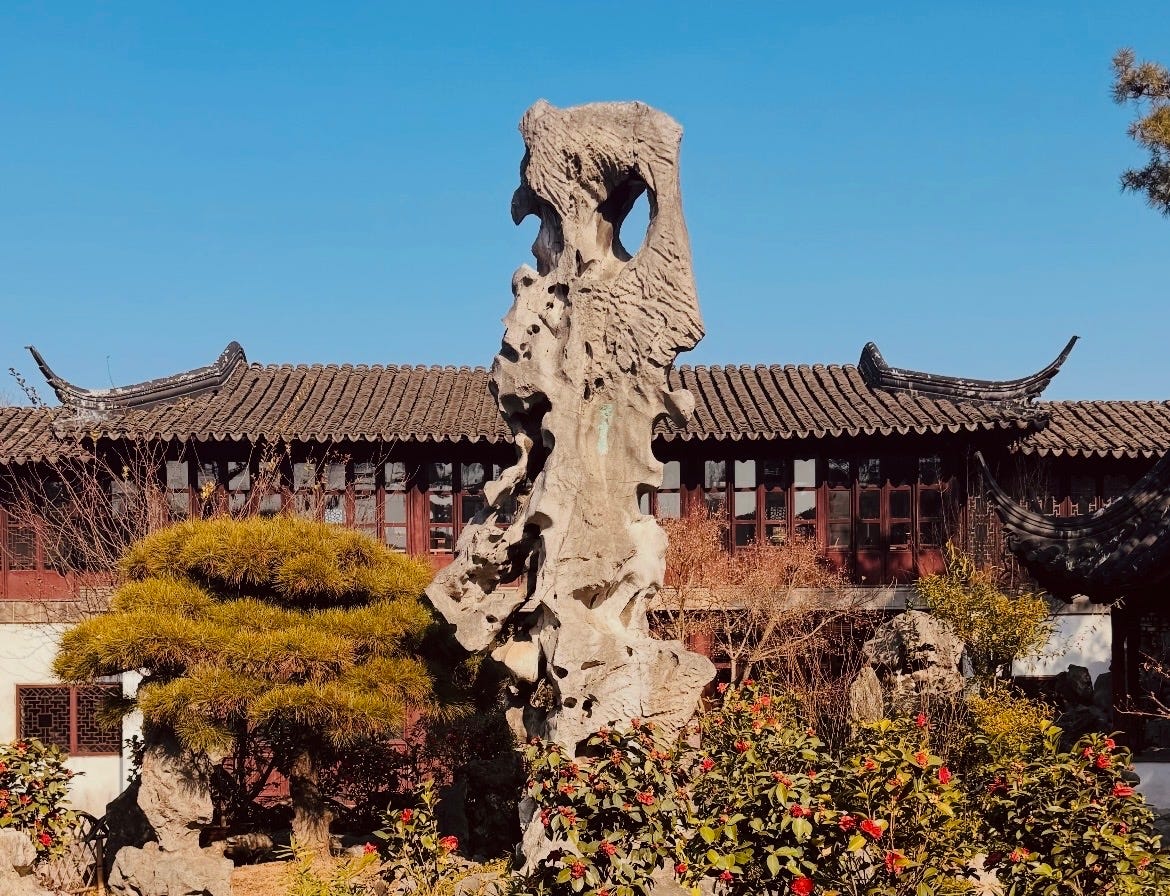
Bai (拜): to bow. The Song painter Mi Fu (米芾) saw a strange rock, put on formal robes, bowed to it and called it “elder brother” (具衣冠拜之,呼之为兄). Scholars’ rocks came to be judged by four qualities usually attributed to him, shou lou tou zhou (瘦漏透皱): thin, perforated, open, wrinkled. A natural stone sits near the centre of elite taste.
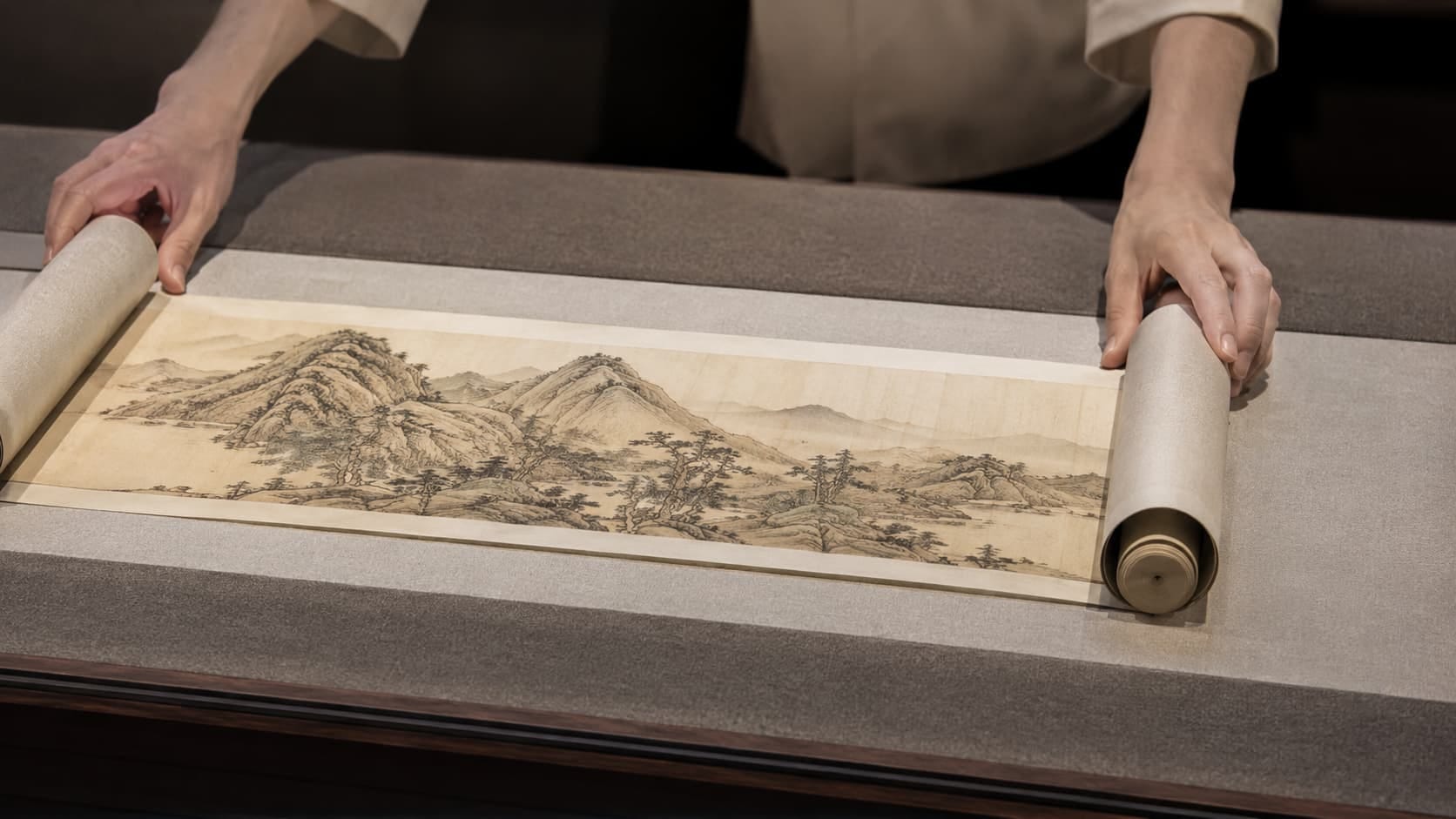
You (游): to roam. Zong Bing (宗炳, 375–443), too old and ill to travel, painted the mountains he had climbed on the walls of his room. He resolved to “clear his heart, contemplate the Way, and roam them lying down” (澄怀观道,卧以游之). Woyou (卧游), roaming while lying down, became a standard name for looking at landscape. The traditional Chinese handscroll was built for it. It is unrolled an arm’s length at a time, right to left, so the viewer travels through the picture rather than standing before it.
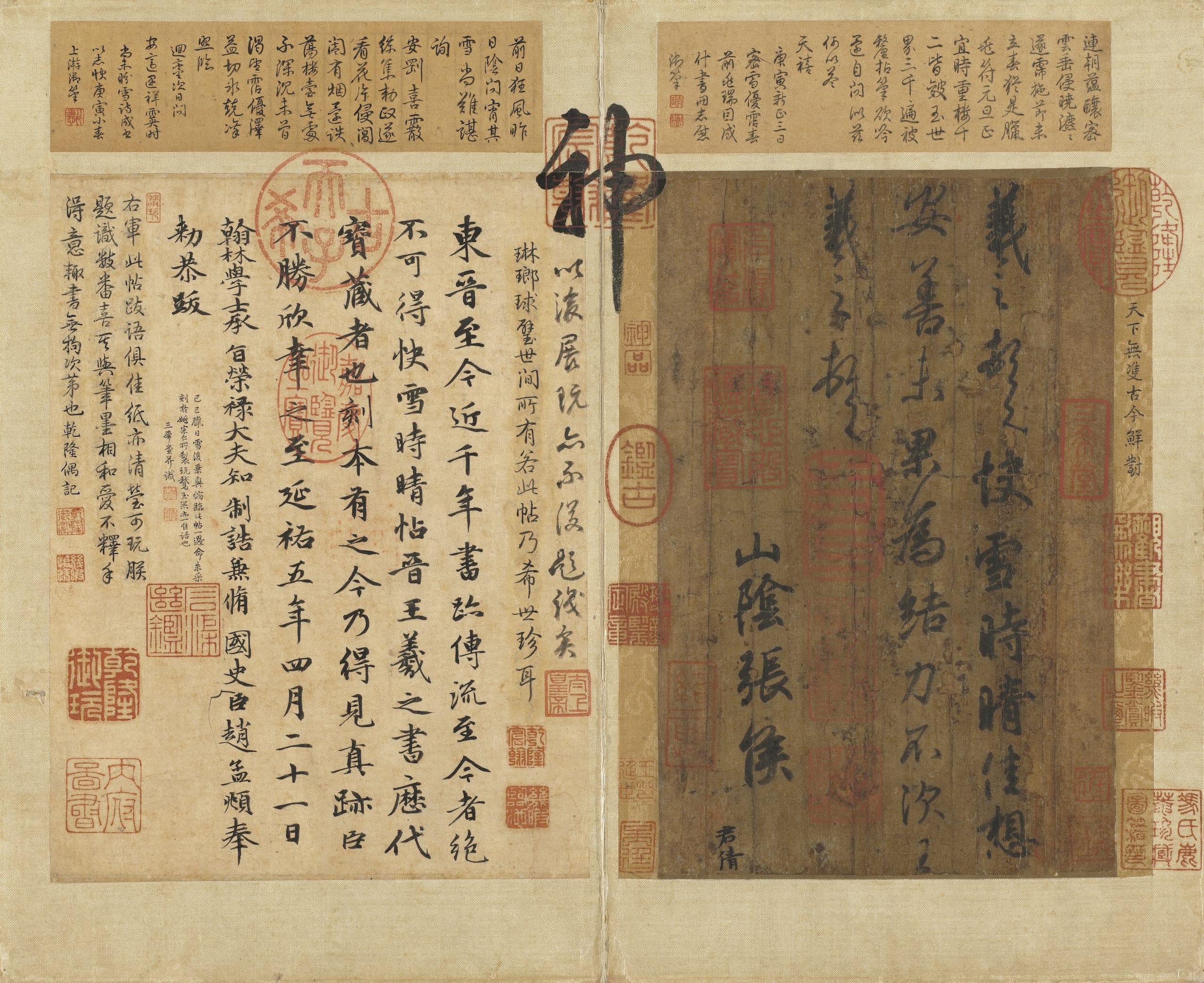
Ti (题): to inscribe. Owners wrote on the works they loved. Wang Xizhi’s (王羲之) Kuaixue Shiqing Tie (快雪时晴帖) is a note of 28 characters. The Qianlong emperor surrounded it with dozens of his own inscriptions and seals. When a scroll is passed down long enough, the inscriptions of its successive owners may run far longer than the original piece. They are the record of appreciation, and later viewers appreciate the inscriptions as well. The work is never finished.
Lin (临): to copy. A calligrapher learns a model by copying it stroke by stroke, linmo (临摹). Appreciation is re-performance. When the living hand retraces the motion of a hand dead for centuries, it experiences the feeling and circumstances of that moment. Calligraphy is judged by its strokes and movement, not its shapes.
Zhiyin (知音): to recognise. When the woodcutter Zhong Ziqi died, the guqin master Bo Ya broke his strings and never played again, because no one left could hear what he meant. Zhiyin, “one who knows the sound,” still means a true friend. Tao Yuanming (陶渊明) is said to have kept a guqin with no strings and stroked it when he had drunk enough: “I know the joy within the zither; why trouble the sound on its strings?” (但识琴中趣,何劳弦上声). What is appreciated here is a person or a state of mind, not just sound.
Appreciation happens in the body, over time and between people. The process changes both the thing and the one appreciating it.
The Missing Vocabulary
Modern intuition places beauty (mei, 美) and the sublime at the core of art. Much of the Chinese tradition, however, prized a different quality: dan (淡), blandness. The Daodejing says that the Dao, once spoken, is “bland, without flavour” (道之出口,淡乎其无味). Su Shi (苏轼) praised the poetry of Tao Yuanming for being “dry outside and rich within, seemingly bland but truly beautiful” (外枯而中膏,似淡而实美).
In 1907 Wang Guowei tried to add guya (古雅), antique elegance, as a third category beside the beautiful and the sublime. Ye Lang (叶朗), in An Outline History of Chinese Aesthetics (中国美学史大纲, 1985), argued that mei was not the central category of Chinese aesthetics at all, and proposed yixiang (意象, image-idea) in its place. Western aesthetics has no box for these Chinese vocabulary.
Yet the habit of analysing Chinese culture and art through the concept of aesthetics has proved remarkably enduring. The self-criticism that the Chinese lack aesthetic sense has been discussed from the early twentieth century to the present day. The word now lives mostly as shenmei (审美), “examining beauty.” The painter Wu Guanzhong (吴冠中) famously remarked, “Today few people are illiterate, but many are beauty-blind” (今天文盲不多了,美盲却很多).
Mei is so simple and easy to understand that it seems to overwrite the rich experiences people have in their daily lives. Meixue, as a translation, may have strayed from the word’s original meaning: sensation.
If my insights brought you a fresh perspective, please consider supporting me by buying me a coffee. Your generosity fuels my writing.
Thank you for this delightful essay — many “old friends” here. You might also enjoy the following:
https://chinaheritage.net/journal/inspiration-taste-considering-on-the-spur-of-the-moment/
Interesting to see how much culture changed with wester imports, thanks