

Contemporary wellness culture prescribes a singular cure for modern anxiety: “clear the mind.”
For the hyper-active modern intellect, this is often a trap. The brain, trained by years of dopamine loops to seek, define, and categorize, does not resemble a clear sky. When the modern mind attempts to “do nothing,” the neural circuitry rebels and screams for input.
This essay proposes a different approach. The goal should not be to empty the mind, but to occupy it. Occupy it with a system so dense, so multidimensional, and so deliberately ambiguous that the linear, anxious ego is forced to shut down to process it.
Try Classical Chinese (文言文, Wenyanwen). Just as a difficult asana forces muscles to align, the grammatical “superposition” of Classical Chinese forces neural pathways to align. It is a technology of the soul that works not by detaching from the world, but by engaging with it more deeply.

The Prison of Specificity
Modern language is a language of precision. It is governed by a structure of “Subject-Verb-Object.”
This structure mirrors the modern ego, linear, causal, and obsessed with the self. The precision of the modern language is to exist in a state of constant, low-grade hyper-vigilance, where every action must be assigned an actor and a timeline.
Meditation attempts to counter this by removing language entirely. Classical Chinese offers a “Third Way.” It does not remove language; it changes the physics of it.
Language as “Superposition”
In a Classical text, the grammar is fluid. The part of speech is volatile, a noun can function as a verb, or an adjective as a noun, depending on the “energy” of the sentence. Most importantly, the text often lacks the rigid boundaries of subject and tense.
Consider the famous line from the poet Tao Yuanming 陶渊明 (365–427 AD):
采菊东篱下,悠然见南山
Pluck chrysanthemum east fence under, leisurely see South Mountain
Notice what is missing. There is no “I.” There is no tense.
Who is plucking the chrysanthemum? Is it Tao Yuanming? Is it the reader? Is it the universe acting through a human form? By dropping the subject, the language dissolves the barrier between the observer and the observed. The reader cannot simply watch the action; they must become the instantiation of the action.
Furthermore, without a tense marker, the action is not “happening” (now) or “happened” (then). It exists in a state of timelessness. It is an eternal recurrence.
For the ancients, this ambiguity was not a flaw of primitive expression; it was a deliberate architectural feature. They understood that the moment you define something precisely, you kill its spirit. To name the Way is to lose the eternal Way. Classical Chinese constructs a sanctuary where the mind can rest in uncertainty, free from the ‘tyranny of logic’.
Until the practitioner engages with the text, the meaning is a cloud of probabilities. Once asking: “Who is seeing the mountain?” But the text refuses to answer. To understand it, the practitioner must suspend linear logic and activate a holistic intuition.
The Code of Breath
The modern reader often forgets that reading was originally a somatic (bodily) act. To the modern mind, reading is a silent, visual download. But the ancient character for “read” (读, dú) contains the radical for “speech” (言), and the Shuowen Jiezi 说文解字 defines it explicitly as “chanting” (诵, sòng).
To merely scan a text with the eyes was categorized differently, as kàn (看, watching) or yuè (阅, inspecting). True “reading” was an acoustic process necessitated by the physics of the text itself: ancient scrolls lacked punctuation. The reader’s primary task was jù dòu (句读), literally “sentence stopping”, using the breath to punctuate the stream of characters. Thus, comprehension was not a silent cognitive process, but a physical act of rhythmic segmentation.
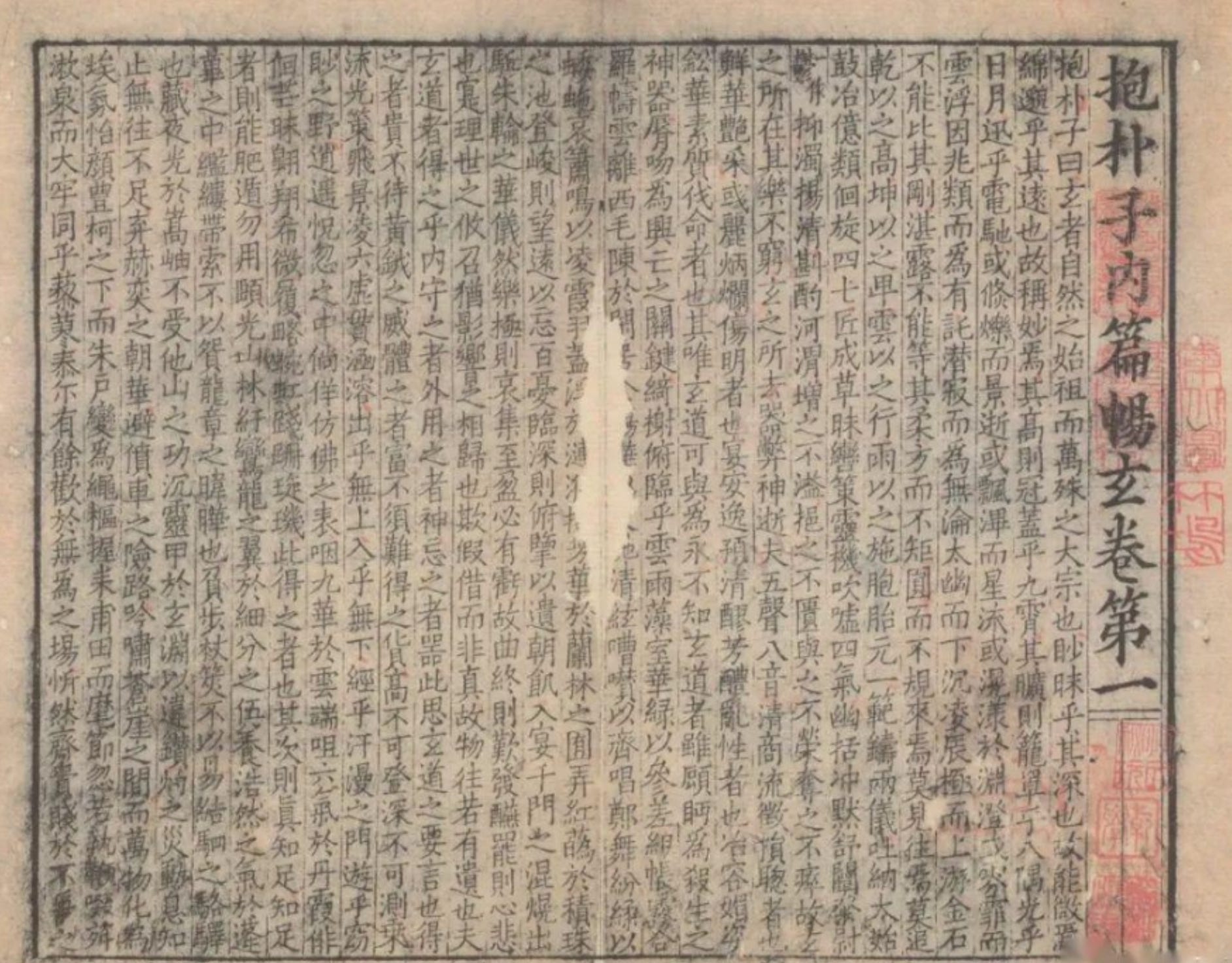
The Qing Dynasty’s “Tongcheng School” (桐城派) further developed this into developed the theory of “Seeking Qi through Sound” (因声求气, Yin Sheng Qiu Qi). They posited that the rhythm of a text was a direct map of the author’s vital energy (Qi).
Consider the physiological impact of the four-character structure, which dominates texts from the Thousand Character Classic 千字文:
天地玄黄 (Tiān Dì Xuán Huáng)
宇宙洪荒 (Yǔ Zhòu Hóng Huāng)
(Heaven and Earth are dark and yellow; The Universe is vast and wild.)
Try reciting this. The rhythm is stable, square, and grounded. To chant it properly, you cannot use the shallow, rapid breathing of conversational speech. You are forced to engage the diaphragm, slowing your respiration to a steady, deep cadence.
This is, in essence, Pranayama (breath control) guided by syntax.
Annotation as Meditation
If recitation is the cultivation of the breath, Annotation (Zhu 注) is the cultivation of the mind.
In the Western tradition, a footnote usually serves to clarify a fact or provide a reference. In the Chinese tradition, annotation is a spiritual merging, a cognitive entanglement between the reader and the source.
Because the Classical text is a “superposition” of meanings, it requires an observer to complete it. The text is porous; it is full of ‘holes’. The practice of annotation is the act of pouring one’s own life force and wisdom into the emptiness.
This is why the great commentaries, like Wang Bi’s 王弼 notes on the Laozi or Zhu Xi’s 朱熹 notes on the Confucian Analects, are revered as much as the original texts. These scholars did not just “explain” the text; they collapsed the superposition using their own wisdom.
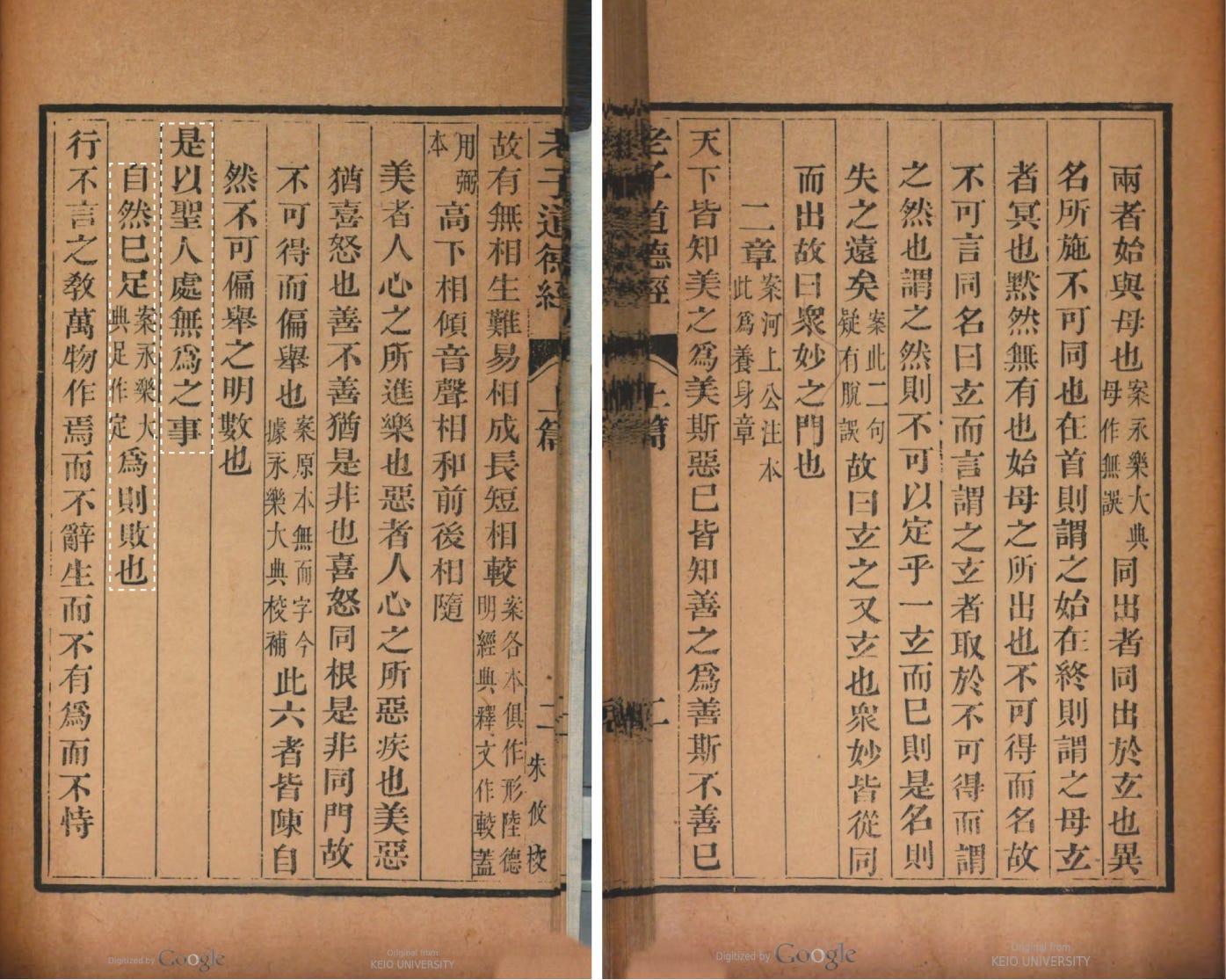
When Wang Bi (226–249 AD) annotated the Tao Te Ching at the age of twenty, he did not merely explain what Laozi meant. He used Laozi’s text as a lattice to climb toward the absolute. He engaged in a dialectic with the void.
Where Laozi wrote:
“Therefore the sage dwells in affairs of non-action” (是以圣人处无为之事)
The text is open. Is it passivity? Is it laziness?
Wang Bi collapses the superposition with a sharp axiom:
“Nature is already sufficient; to act is to ruin it” (自然已足,为则败也).
He does not merely define the word “non-action”; he diagnoses the human condition. He posits that the universe (Ziran) is complete in itself, and that human intervention is a corruption of that perfection. He is not reading the text; he is completing it.
This transforms reading from Consumption into Co-creation.
In modern reading, we are consumers of information. We scroll, we scan, we extract the “takeaway.” The modern text is a product. In ancient reading, the text is a mirror. The ambiguity of the Classical line forces the reader to stop and project their internal state onto the page. If you are anxious, the text reads anxious. If you are at peace, the text yields peace.
Ultimate Training: Calligraphy as Energy Manifestation
The final stage of this cultivation technology is the transition from the void to the material: Calligraphy (Shu 书).
If reading is the intake of energy, calligraphy is the output. It is the moment the superposition creates a reality.
In the philosophy of Chinese calligraphy, the most critical moment is not the stroke itself, but the split second before the brush touches the paper. The brush hangs suspended in the air. This is the state of Potential Energy (Shi 势). In that suspension, the character exists in all its possible forms. It is perfect, infinite, and unmanifested.
The moment the brush hits the paper, the wave function collapses.
The ink is the trace of that collapse. It records the exact energy of the writer in that millisecond. There is no delete key. There is no “undo.” Unlike typing, where letters are standardized digital commodities, a calligraphic stroke is a biological signature. It captures the speed of the breath, the steadiness of the wrist, and the clarity of the intent.
Look at the Manuscript for Mourning My Nephew (祭侄文稿) by Yan Zhenqing (709–785 AD). It is messy. There are crossed-out characters, ink blots, and strokes that tremble with rage and grief. It is considered one of the greatest works of art not because it is “pretty”, but because it is a high-fidelity of a soul in agony.
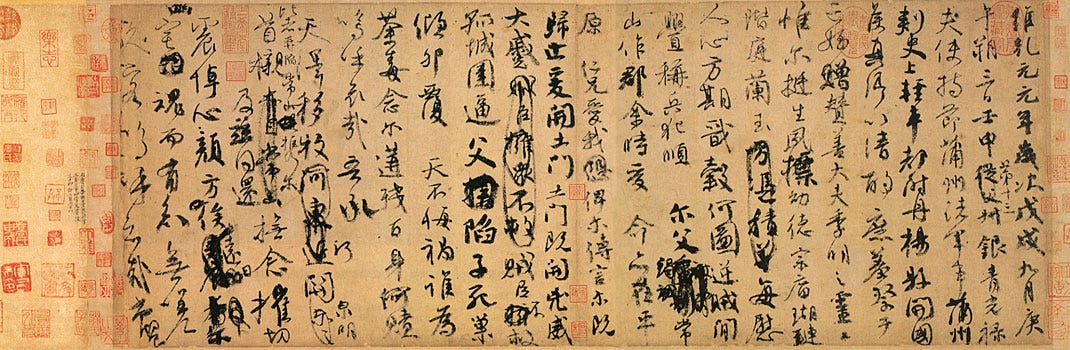
Writing Classical Chinese is the practice of Decisive Collapse. To meditate on the potential (the suspended brush), and then to act with total commitment (the stroke). It trains the mind to move from the infinite possibilities to the concrete reality, and to do so with grace and power.
Reclaiming the Void
In an era of data overload and spiritual starvation, language has become a utility—precise, efficient, and utterly disenchanted. People are losing the ability to tolerate ambiguity, to sit in silence, to breathe in rhythm with the cosmos.
Classical Chinese offers a way back. It is not merely a subject to be studied; it is a Technology of the Self.
To Read (Recite) is to tune the biological instrument, using ancient rhythms to regulate modern breath.
To Annotate is to train the mind to tolerate the “superposition” of truth, resisting the urge to simplify the complex.
To Write is to practice the art of bringing intention into reality without hesitation.
One does not need to become a monk to practice this. The approach to the text simply needs to be different. Instead of asking “What does this mean in English?”, one can ask “How does this breath feel?” Instead of demanding a definition, one can inhabit the sanctuary of the undefined.
If my insights brought you a fresh perspective, please consider supporting me by buying me a coffee. Your generosity fuels my writing.
Translation of the Manuscript for Mourning My Nephew (祭侄文稿)
維乾元元年歲次戊戌九月庚午朔三日壬申,
〈從父〉第十三叔、銀青光祿〈脫「大」字〉夫、使持節蒲州諸軍事、蒲州刺史、上輕車都尉、丹陽縣開國侯真卿,以清酌庶羞,祭于亡姪贈贊善大夫季明之靈曰:
In the first year of the Qianyuan era, the year of Wuxu, on the third day (Rinshen) of the ninth lunar month (which began on the day of Gengwu), I, your〈paternal uncle〉thirteenth uncle, Silver-Blue-Green Grand Official of Imperial Light 〈missing the character “Grand”〉, Commissioner with a Tally for the Military Affairs of Puzhou, Prefect of Puzhou, Superior Commandant of Light Chariots, and Founding Marquis of Danyang County, Zhenqing, with pure wine and various offerings, sacrifice to the soul of my late nephew, the posthumously titled Palace Censor Jiming, saying:惟尔挺生,夙標幼德,宗廟瑚璉,階庭蘭玉。
You were born with exceptional talent and displayed youthful virtue early on; you were a precious vessel for the ancestral temple, a fragrant orchid and fine jade in the family courtyard.
〈方憑積善〉。每慰人心,方期戩穀。〈Just as we relied on accumulated goodness〉. You were always a comfort to our hearts, and we expected you to receive great blessings and longevity.何圖逆賊閒釁,稱兵犯順。
Who could have foreseen the treacherous rebels seizing an opportunity to cause strife, taking up arms and revolting against the rightful order?尔父
〈□制,改被脅又改〉竭誠,常山作郡。
Your father〈[illegible], changed to “coerced”, then changed again〉devoted his full sincerity to serving as the Prefect of Changshan.余時受命,亦在平原。
At that time, I received the imperial command and was also stationed in Pingyuan.仁兄愛我,
〈恐〉俾尔傳言。
My benevolent elder brother, out of love for me,〈feared/concerned〉sent you to deliver messages.尔既歸止,爰開土門。
Once you had returned, you then opened the Tumen Pass.土門既開,凶威大蹙。
With the Tumen Pass opened, the rebels’ ferocious momentum was greatly suppressed.
〈賊臣擁眾不救〉賊臣〈擁〉不救,孤城圍逼。
〈The treacherous official held his troops and did not come to the rescue〉The treacherous official〈held back〉and did not rescue you, leaving the solitary city besieged and pressured.父
〈擒〉陷子死,巢傾卵覆。
The father was〈captured〉trapped and the son died; the nest was overturned and the eggs were broken.天不悔禍,誰為荼毒。
Heaven did not relent in its calamity, who brought about such bitter suffering?念尔遘殘,百身何贖?嗚呼哀哉!
Thinking of you meeting such a cruel end, how could a hundred lives ever redeem yours? Alas, how grievous!吾承天澤,移牧
〈河東近〉河關。
I have received the Emperor’s grace and have been moved to govern〈Hedong, near〉the river passes.
〈尔之〉泉明比者,再陷常山。〈Your brother〉Quanming recently went back into the fallen Changshan.
〈提〉攜尔首櫬,〈亦自常山〉及茲同還。〈Carrying〉Bringing back the casket containing your head,〈also from Changshan〉returning here together.撫念摧切,震悼心顏。
As I cherish your memory, my heart is torn with grief; the shock and mourning mark my soul and countenance.方俟〈□□〉遠日,〈□〉卜尔幽宅。
I am now waiting for 〈[illegible]〉 a distant day, 〈[illegible]〉 to divine a place for your eternal home.
〈撫〉魂而有知,無嗟久客。〈Comforting〉Should your soul have awareness, do not lament being a long-time traveler in the afterlife.嗚呼哀哉!尚饗!
Alas, how grievous! May you enjoy this offering!
This piece is interesting because it points to something modern people keep missing: meditation is not the only way to loosen the grip of the self. Sometimes language itself can do that. Not language as information transfer, not language as utility, but language as a field that resists immediate capture.
That is where Classical Chinese becomes interesting. Not because it is exotic, mystical, or somehow purer, but because it seems to leave more unsaid without collapsing into emptiness. Modern Western language often moves too fast to fix subject, action, time, and meaning. It wants clarity before contact. It wants control before relation. It wants the world already interpreted before it has even been met.
And that is the deeper sickness.
We have become so conditioned to think that understanding means pinning something down that we no longer see how much violence there is in that reflex. We don’t enter reality. We seize it. We label it, stabilize it, categorize it, and then mistake that reduction for truth. So when a language appears that does not force everything into explicit subject-object grammar, many modern readers experience that as vagueness or deficiency. But maybe what they are really encountering is a form of intelligence that does not begin with domination.
That is why I think your point lands. Classical Chinese is not just a different linguistic system. It can function as a different posture of mind. It frustrates the modern ego because the ego wants to arrive too early. It wants ownership of the sentence. It wants to know who is acting, what is being acted on, when it happened, and what the final meaning is. Immediately. But not all reality presents itself that way. And not all wisdom survives that kind of grammatical conquest.
So yes, perhaps for many people meditation is needed because they are trapped in the compulsive machinery of modern cognition. But perhaps certain languages already carried another possibility within them. Not escape from thought, but a different relation to thought. Not silence against language, but language that has not yet been flattened into administrative clarity and nervous self-assertion.
That, to me, is the real point here.
Not that Classical Chinese is some magical cure. It is not. Any tradition can become empty ritual. Any practice can become performance. But some forms really do train perception differently. Some forms leave room for emergence instead of premature closure. Some forms do not force the world to appear only through the narrow grammar of control.
And that may be what modern people have lost most deeply: not peace, but the capacity to let reality arrive before they translate it into themselves.
I’ve just started to learn some basic mandarin so I can have simple interactions with my teachers. This looks so cool! What comes to minds is how we view chord symbols in Jazz. Looking forward to your webinar on Sunday! ❤️☯️🙏🏼