

Chinese history holds two opposing views on Qin Shi Huang (秦始皇), the first emperor of China. He was the man who unified the country in 221 BCE, standardizing currency, axle widths, and, above all, the written script: 书同文 (shū tóng wén). The standardization of written characters held the civilization together for thousands of years to come. He was also known as the tyrant who “burned the books and buried the scholars”—焚书坑儒 (fén shū kēng rú)—in an attempt to erase the history and classics of the states he conquered. Unification and destruction: this duality runs through the entire story that follows.
A person from Canton and a person from Fujian could both understand the Analects (论语), but neither would understand a word the other read out loud. The same text possesses different sounds in different regions, sometimes just across the river.
The unit of Chinese language was the written system 文 (wén), not the spoken one 语 (yǔ). For most of Chinese history, there was no such thing as “the way Chinese is supposed to sound.”
“Mandarin” Derives from Malay
Before “Mandarin,” a series of names were created for China and its language. Seres, the Greco-Roman name for the silk. Cīna, from Sanskrit, the root word of “China” itself, probably from the name of the Qin or Jin dynasty. Cathay, widely used in Russian sphere, from the name of the Khitan people of the northern China.
Then came the Portuguese in the early 1500s. Back then, Malay was the lingua franca for trade across the Indian Ocean. The Malay word menteri (originally from the Sanskrit mantrin, meaning counselor) was used for high government officials—and by extension, the speech of local Chinese officials. Portuguese sailors picked up menteri and tweaked it into mandarim.
Portuguese already had the verb mandar (”to command”). So to a 16th-century sailor, mandarim sounded almost like a native word meaning “someone who gives orders.” It just fit and the label stuck.
Once the Portuguese pushed further into mainland China, they encountered a wild mosaic of mutually unintelligible dialects. But there was a workaround: imperial magistrates from different regions used a shared spoken language to run the country. The locals called this guānhuà (官话)—literally, “official speech.”
When Jesuit missionaries like Matteo Ricci showed up decades later, mandarim had already been Portuguese slang for half a century. Rather than invent a translation for guānhuà, they just stuck with what they knew: língua mandarina (”the speech of the mandarins”). English eventually inherited the term.

Guanhua Was Not One Standard
Guānhuà, however, is a group of dialects—a whole family of regional speech varieties spread across the north and southwest of China, whose branches are related but still sound different from one another. A national linguistic fieldwork in 1987 divided Guanhua into eight distinct sub-families. While the modern Mandarin is derived from Northern Guanhua anchored in Beijing. But what Mandarin did Jesuit and Portugese merchant hear in the Ming dynasty?
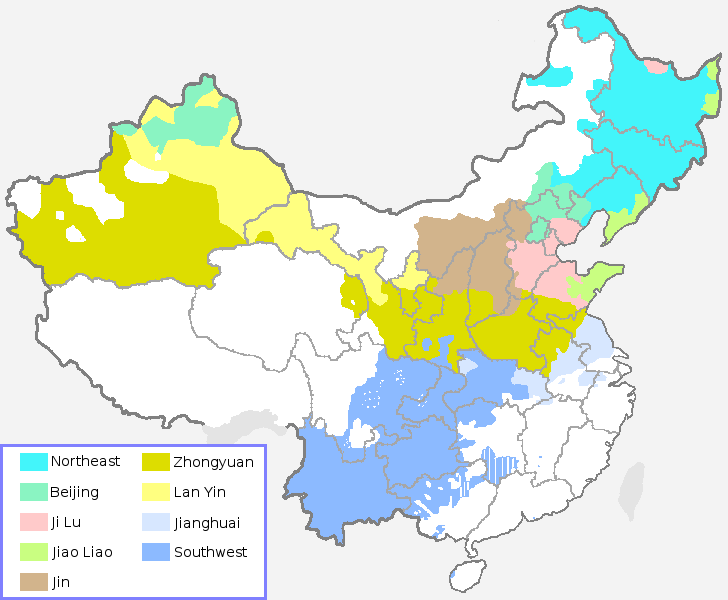
We don't actually know what the Ming officials of the 14th–17th centuries sounded like; there are no recordings, and the reconstruction is contested. But the best evidence suggests the mainstream guānhuà during the Ming was anchored on Nanjing (which was the original capital of the Ming), a southern dialect. Even Beijing was the capital, the Guanhua was still dominated by the Nanjing version.
Ruled by northern ethnic groups for centuries, vernuclar languages in the north, especially around Beijing, already drifted away from the southern standard. So when restored northern region from Mongol, the Ming resurrected the southern standard but rarely influenced the local dialect.
Manchu rule after 1644 disrupted the prestige of Southern Guānhuà. As Beijing settled into its role as capital, official speech merged local northern dialects with Manchu linguistic traits to form Beijing Guānhuà (北京官话). Late 19th-century dialect mapping recognized just two main divisions: Northern Guānhuà in Beijing and Southern Guānhuà in Nanjing.
The Standard for Rhyme
Until early 20th century, speaking and writing were two different systems. People wrote in Wenyan, highly stylized, concise, non-spoken classic Chinese. It was hard to understand through speech. While Guanhua and dialects are spoke vernacular. So, even there has been no clear speaking standard, there has been a reading standard for the written characters.
The foundation was the book 切韻 (Qièyùn), compiled in 601. It was time of the Sui dynasty that had just reunified China after nearly four hundreds years of division and civil war. The compilers set themselves a clear goal, which was to resolve “spatial divergences and correctness between the North and South, solve the continuity, and barriers between ancient and modern times.” 南北是非、古今通塞.
For a long time, scholars believed that the Qieyun was compiled based on the speech of Luoyang and Xi’an, but recent research shows that it was a synthetic system. Out of deliberate compromise, it was designed to mix both northern and southern reading habits. Thus, it was neither the speech of any specific region nor anyone’s mother tongue.
The spelling method in Qieyun called 反切 (fǎnqiè). Fanqie defines a character’s pronunciation using two other simpler characters. The first character supplies the initial consonant, the second supplies the rhyme and tone. To take the principle in English: you could specify the sound of “bat” by writing “b(ird) + (c)at”, take the front of one, the back of the other, and collide them. 反切 did exactly this, character by character, across the entire language.
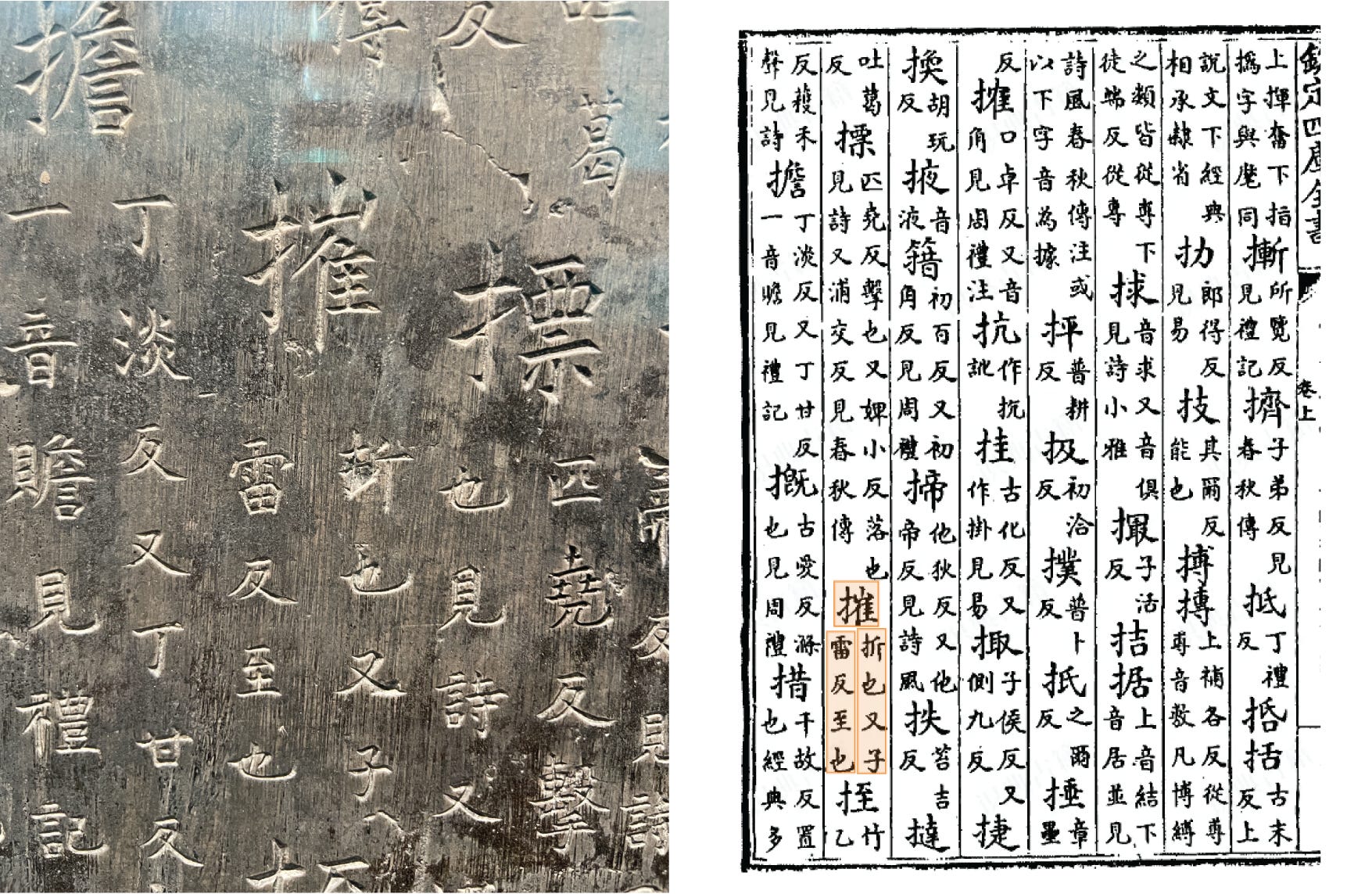
Here is how a character “摧” gets annotated:
摧【折也。又子雷反,至也】
「折也」 “to break.”
No pronunciation (fanqie) given, because this is the everyday reading that no one would get wrong.
The actual fanqie, as 《唐韻》 records it, is 昨回切. Worked out in modern Mandarin, 昨 zuó + 回 huí → z- + -uí = zuí, which lands close to today’s cuī.
昨 was 從母, a Middle Chinese voiced obstruent; Middle Chinese voiced obstruents in 平聲 regularly become aspirated in Mandarin (濁音清化). Hence c- rather than z-.
「又子雷反,至也」
A different sound, and with it a different meaning: 「至也」 “to arrive, to reach.”
「又」 “also, alternatively” — it introduces a second reading, not an addition.
The fanqie 「子雷反」. Worked out in modern Mandarin, 子 zǐ + 雷 léi → z- + -éi = zéi, which is wrong. Taken as Middle Chinese (精母 + 灰韻平聲) it gives zuī. (In practice most readers today still just say cuī for this sense.)
雷 is léi today, having lost the -u- medial after l-, whereas 回 huí kept it. Both are 灰韻 in Middle Chinese — same rhyme, two different modern outcomes. This is exactly why the shortcut is a convenience, not a method.
The system fixes the relationships between sounds without fixing the sounds themselves. So a reader in Canton and a reader in Luoyang could both “obey” the Qieyun while pronouncing every syllable in their own local reading. The compromise lived at the level of contrasts, not phonetics. That’s why Chinese poetry and verse could rhyme across different regions, since there was a consistent rhyme system behind the pronunciation.
While the Qieyun defined Middle Chinese (中古漢語) pronunciation, the rhyme history of the northern dialects that evolved into modern Mandarin dates back to the Zhongyuan Yinyun (中原音韻) of 1324. It was a rhyme guide compiled for writers of Yuan-dynasty musical drama. By Yuan dynasty, northern China had been ruled by northern ethnic groups for centuries. Comparing to Middle Chinese, the pronunciation had been drifted and simplified. In this system, the entering tone (rùshēng 入聲) had vanished, the level tone (píng 平) had split into two, and what emerged was essentially the four-tone system a Mandarin speaker uses today.
Yet the story did not end with the vernacular shift of the Yuan. In 1375, the Ming dynasty published the Hongwu Zhengyun (洪武正韻) to restore classical southern orthodoxy. This official imperial dictionary pushed back against the colloquial northernisms of the Zhongyuan Yinyun. Instead, it attempted a conservative synthesis: re-establishing classical categories, including the vanished entering tone. Officially it claimed to follow 中原雅音, "the elegant sound of the Central Plains"—yet because most of its compilers were southerners, southern features leaked back in. The result was neither cleanly northern nor southern, and the Hongwu Zhengyun became the rigid standard for Ming imperial examinations, creating a long-standing tension between official court registers and evolving spoken dialects.
The Republic Standard
In 1913, after the fall of Qing, the new Republic convened the “Commission on the Unification of Pronunciation” 讀音統一會 (Dúyīn Tǒngyī Huì). Its job, again, was to create a shared standard that acceptable for both north and south. A vote had been conducted to choose the standard reading of thousands of individual characters.
A wide spread anecdote on Chinese internet claims that Cantonese once lost the vote to become the national language by a hair. It never happened. There was no such vote. The story probably belongs to a derivative of the same folklore as the American legend that German lost to English by one vote in Congress.
Again the result was a designed language that no one could speak natively. The standardization was later called “Old National Pronunciation” 老國音 (lǎo guóyīn). It took Beijing phonology as its base, then deliberately grafted southern features back on: it kept the entering tone (borrowing the Nanjing Guanhua, just like Hongwu Zhengyun). It also preserved the 尖團 (jiān-tuán) distinction that Beijing speech had merged, and restored three initials, 万 [v], 兀 [ŋ], 广 [ɲ] , that northern speech had lost.
The renowned scholar Zhao Yuanren (趙元任) created a gramophone records to demonstrate how Lao guoyin 老國音 was supposed to sound. And he joked about that he might be the only person on earth who could actually speak it. The system was unlearnable at scale. Schoolteachers across the country could not teach a set of sounds none of them natively made.
Facing the impossibility of implementation, in 1923, the commitee decided to abandon the compromise and revise the standard toward plain Beijing pronunciation. The revision was formalized over the following years and published as the Dictionary of National Pronunciation for Everyday Use 國音常用字彙 (Guóyīn Chángyòng Zìhuì) in 1932. Old version was quietly buried and replaced by the Beijing sound, the “New National Pronunciation” 新國音 (xīn guóyīn). This New National Pronunciation is the direct ancestor of the Mandarin today, for both Taiwan’s Guoyu 國語 and the mainland’s Putonghua 普通話. But the standard was far from the actual implementation.

Mandarin, Putonghua, and Pinyin
The People’s Republic inherited the problem and created new name. At a 1955 conference, the common language was designated to be called 普通话 (pǔtōnghuà). It inherited the Xin Guoyin (New National Pronunciation) and continued with “taking Beijing pronunciation as the standard sound.”
Beijing dialect nowadays often refers to the street speech of Hutong. However, the source of the “Beijing pronunciation” means the refined speech of Beijing, 北京雅音, It is the idealized, cleaned-up Beijing sound, explicitly not street speech with the actual swallowed, heavily 儿化 (érhuà, r-colored). The standard was an abstraction of Beijing, not Beijing itself.
Surprisingly, the most orthodoxy Beijing accent, is from a county called Luanping (滦平), north of Beijing beyond the Great Wall. Recent decades, it has been marketed as the place where the standard sound of Putonghua was collected.
Luanping’s dialect belongs to the Beijing Mandarin subgroup, yet it lacks the features that make actual Beijing street speech hard to standardize. Its articulation comes out clear and evenly separated.
The reason is another demographic accident. Luanping, outside the Great Wall was deliberately emptied under the Ming as a military buffer. It then repopulated in a under the Qing, largely by bannermen and Beijing-area migrants moving up the corridor toward the Qing imperial resort at Chengde. The area was transplanted with Beijing phonology, with no pre-existing dialect to compete with. Most of the land was set aside as private estates for Manchu elites, meaning no outsiders could enter or settle there. It became a linguistically frozen region, isolated from the colloquial drift that reshaped speech inside the capital. The result is a dialect that sounds more like the Putonghua ideal than Beijing does.
Then came the tool that made the standard teachable, 汉语拼音 (Hànyǔ Pīnyīn), Pinyin was a phonetic notation to write the standard sound in Latin letters. It first rolled out in the 1950s. As the first lesson in Chinese language class in primary school, pinyin let a student look at a character and know how it was supposed to be pronounced.
From the 1960s, standard Mandarin entered the mandatory school curriculum nationwide (minority regions excepted, a story for the next article).
However, across the country, “Mandarin class” did not mean speaking Mandarin. It was only a part of Chinese language class. It actually meant a Pinyin-and-reading class, which taught how to mark the correct Pinyin above a character by standard. In the daily life of the classroom, teacher and students kept talking to each other in the local dialect. Most local teachers had themselves never received any formal training in speaking standard Putonghua. They knew how to annotate it from the standard textbook. But most of them could not pronounce it. For a generation, Mandarin remained exactly what it had been at the start, a manufactured second language, learned on the page, rarely spoken in the room.
On national level however, all broadcast media, film, television, and national radio were progressively restricted to Mandarin as the only permitted standard. Only local level broadcaster could continue running in dialect.
It was not until 1994 that China introduced the Putonghua Proficiency Test (PSC, 普通话水平测试) and made it a requirement for broadcasters and schoolteachers. Only then did standard spoken Mandarin begin to penetrate the everyday speech of ordinary people.
The Fading Dialects
Standardization and uniformity always come at the cost of diversity. This persistent duality reemerges once again. Alongside with mandatory PSC test for the teachers, a “Mandarin-only in schools” policy was also implemented in the mid-1990s.
Wu Chinese (吴语) the language of Shanghai, Zhejiang, and southern Jiangsu, spoken across the wealthiest and most developed region in the country. It has fallen the fastest and the furthest. When the “Mandarin-only in schools” policy was enforced, children began speaking Mandarin to each other, in school and after school. At the same time, Shanghai and Hangzhou became national economic magnets, attracting millions of migrants from everywhere. Mandarin became the natural default of the public space, the workplace, the shop, the subway.
Within two generations, the gap is visible in almost every original Shanghai family. Teenagers who can understand Wu when their grandparents speak it but cannot fluently speak it back. It’s a textbook scenario of passive bilingualism, a language going quiet inside the households that still technically hold it.
Cantonese (粤语) held out far longer, since it had a media empire behind it. From the 1970s through the 2000s, the explosion of Hong Kong popular culture gave Cantonese something no other Chinese regional language possessed. Guangdong was uniquely permitted to run major television and news channels in Cantonese, partly to compete with the Hong Kong.
At the school level, a similar Mandarin policy was also enforced. Speaking Cantonese on school grounds was discouraged or penalized, and children developed the habit of using Mandarin with their classmates. As a result, even native Cantonese children now default to Mandarin among peers. Other regional dialects experienced a very similar fate.
For a long time, the diversity of dialects was seen as an obstacle. However, in 2015, a national-level initiative—the Chinese Language Resources Protection Project—was launched to digitally archive the country’s vanishing dialects. Due to the project, kindergartens and public transit systems in Shanghai and Guangzhou have reintroduced dialect nursery rhymes and bilingual announcements. Instead of erasing dialects entirely from the public sphere, a small, curated dose of the local tongue has been restored to keep regional languages from disappearing completely.
Toward a Common Language
Putonghua has transitioned from a regional Han lingua franca into a mandatory state standard. Across Xinjiang, Tibet, Inner Mongolia, and Hong Kong, local school systems have increasingly integrated Mandarin as the primary medium of instruction.
Interestingly, when Mandarin was designated as Putonghua in the 1950s, its intention was not bound to be standard 汉语 Hànyǔ (the language of the ethnic Han). And this introduces the next stage of Mandarin’s story: how Putonghua became the lingua franca of the whole country, and how almost everyone in China came to speak it.
If my insights brought you a fresh perspective, please consider supporting me by buying me a coffee. Your generosity fuels my writing.
References & Further Reading
W. South Coblin, “A Brief History of Mandarin,” Journal of the American Oriental Society 120.4 (2000): 537–552. — The Nanjing-anchored standard and its later shift to Beijing; backbone of “Guanhua Was Not One Standard.”
Richard VanNess Simmons, “Whence Came Mandarin?” Journal of the American Oriental Society 137.1 (2017): 63–88. — How the Beijing standard actually won out; companion to “The Republic Standard.”
Gina Anne Tam, Dialect and Nationalism in China, 1860–1960 (Cambridge UP, 2020). — Fangyan reframed as “variants” of a national language; the history beneath “The Fading Dialects.”
Jing Tsu, Kingdom of Characters (Riverhead, 2022). — The reformers behind the 1913 Commission and 老國音, told as narrative; for “The Republic Standard.”
Excellent article, Jingyu. Not the least for the mandarin picture and the knowledge that the western name for the language came before the fruit. Alway wondered.
Regarding regional dialects, (or languages, depending on your pov) I have a couple of anecdotes about dialect resistence. In the late 1990s, I was working in a regional city in Guangdong. Although the school obviously was supposed to teach in Mandarin, some of the classes (many of the classes) were taught in Cantonese. Local Guangdong teachers teaching local kids. However for families that had moved their from other places in China, this was difficult, and, they considered, against the national standard. So they complained at a parent-teacher evening, only to be told by the principal, this is Guangdong. We speak in Guangdong hua. Topic over.
Fast forward a couple of decades and I was living in Suzhou, based in Suzhou but travelling for work. People regularly spoke the Suzhou version of Wu. One of the places I went to was Changshu, about an hours drive from the SIP and technically within the Suzhou city jurisdiction. There the locals spoke their own version of Wu, Changshu dialect. Even Suzhou dialect speakers could not understand the Changshu dialect.
A really interesting thing happened once. While much of the dialogue between parents and teachers occurred in Changshu-ese, one afternoon a grandparent came, who was from a smaller village outside of Changshu. Her dialect and Changshu dialect were mutually unintelligible. Staff had to find a teacher who spoke a similar dialect from a village near the small village, with enough similarities to be understood. Then that teacher translated from the village dialect to Changshu dialect, which was then translated to Suzhou dialect for other teachers, and finally into Mandarin for those who didn't speak Suzhou-ese.
I wondered about the dialects and asked people. They were adamant that their children were going to grow up speaking Changshu dialect, Suzhou dialect, and standard mandarin.
That was probably about a decade ago. I wonder how it's going now. Suzhou has also had an influx of people from other places, and old locals commiserate about how their Suzhou culture is dying.
Other than auditory clarity and convenience, were there any other reasons why the specific Luanping pronunciation was adopted?