

If you’ve lived in China for any length of time, you’ve probably seen scenes that feel religious. Students burn incense at a Confucius temple before an exam. Families perform ancestor rites with a seriousness. A business opening might include offerings and bows. There is ritual. There is reverence. There is a sense that some order sits above everyday life.

And yet open the Analects 论语, and run into a different Confucius. He is not selling salvation. He does not build a church. He rarely indulges metaphysical speculation. Much of what he offers looks like training: how to become a person, how to behave in public, how to make society governable without turning it into a cage.
So the question returns: Is Confucianism a religion?
The honest answer is: it depends on what is “religion.” And the deeper answer is: the question itself is historically loaded. Because “religion” is a measuring stick made in one intellectual workshop and applied to material built in another.
The word “religion”
“Religion” often arrives as a bundle: belief, doctrine, clergy, church, sacred texts, a god (or gods), and some narrative of salvation or ultimate meaning. That package was shaped by European history, then exported globally as a universal category.
Confucian traditions, by contrast, have long described themselves in other terms: dao (道, a way), jiao (教, teaching), xue (学, learning), and above all li (礼, ritual propriety, institutions, and the visible architecture of order).
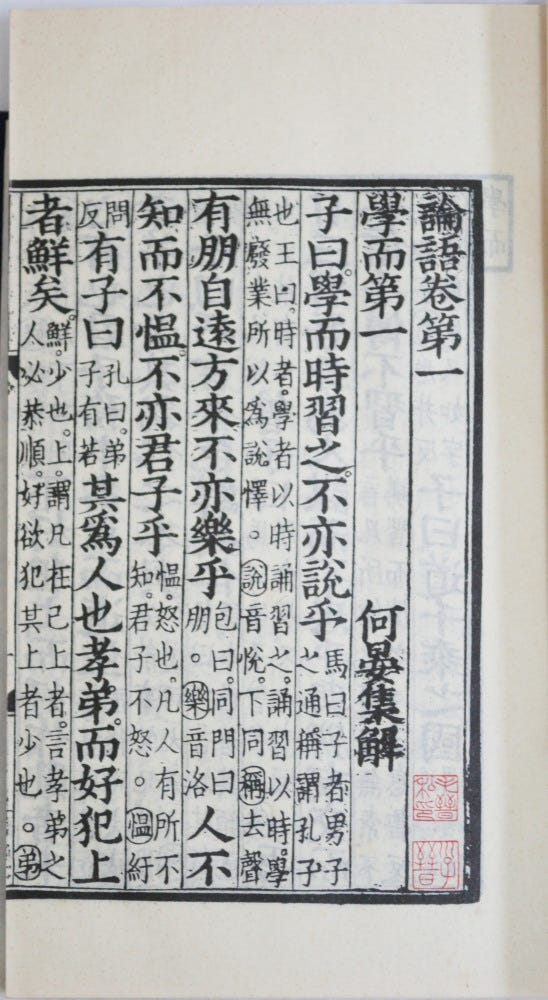
Confucianism does not always center on “what I believe.” It centers on what I do, what I become, and how relationships hold. That difference matters. Because when people ask whether Confucianism is a religion, they are often asking whether a tradition organized around ritual and ethical formation can fit into a category organized around faith and worship.
Confucianism started as expertise in li 礼
Early “Confucians” (around 500 BCE) were not necessarily a sect in the way we imagine religious communities today. They resembled a professional class: people trained in rites, ceremonies, and the protocols that made public life legible: sacrifices, funerals, court audiences, hierarchical obligations, and social forms that prevented a world of kinship and power from dissolving into chaos.
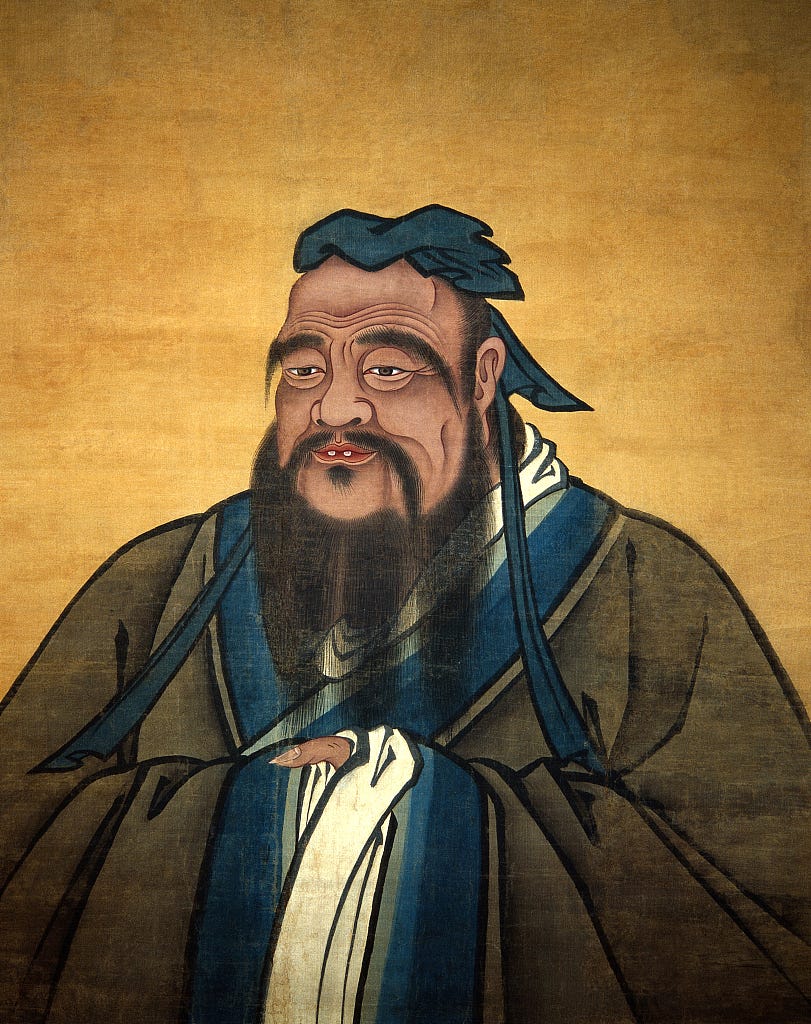
In that sense, the early Confucian project was closer to civilizational maintenance than spiritual promise.
Confucius’s own posture fits this. He is less an “enlightened founder” than an editor and trainer. He was someone trying to recover a shattered moral-political grammar. The core vocabulary is practical and interpersonal:
Ren (仁, humaneness): how personhood becomes real in relations
Li (礼, ritual): how that humaneness takes public form
Junzi (君子, the exemplary person): a reproducible model of character
This can later be sacralized. But at the starting line, Confucianism reads like a system for making humans governable without making them less human.
Ethics plugged into heaven
Confucianism begins to look more “religious” when it becomes entangled with a larger cosmological circuit, especially in the Western Han (202 BCE – 9 CE) and beyond, where heaven (天, tian), moral order, and political legitimacy were increasingly wired together.
In the idiom associated with Dong Zhongshu 董仲舒 and Han-era statecraft (think of it as a climate, not a single author), the logic runs like this: Heaven and humanity correspond; the cosmos is morally structured. Political disorder is not merely administrative failure, it is a breach of cosmic order. Heaven communicates warnings through anomalies: disasters, eclipses, strange omens. The ruler is not just a manager but a hinge between the human realm and the cosmic realm.
This is an enormous upgrade in moral stakes. It turns ethical cultivation into an interface with the universe. It doesn’t need a personal god for the system to become “sacred.” It only needs the conviction that order is not invented, but mandated, and that violating it invites cosmic consequences.
That’s one reason later generations speak of “Confucian teaching” (儒教, rujiao) with a seriousness that feels religious: it is not merely advice about virtue; it is a theory of legitimacy.
“Banning the Hundred Schools”
Han ideological consolidation is oftern summerized with the line “ban the hundred schools, honor Confucianism alone.” (罢黜百家,独尊儒术) But as a historical description, it’s too clean.
What really happens looks more like selective absorption. The empire needs a stable, examinable language of governance. Confucian classics provide a bureaucratically elegant grammar: It can naturalize authority as moral duty. It connects personal cultivation, family order, and statecraft into one chain. It can be standardized into texts, commentaries, curricula, and institutions.
Meanwhile, legal techniques, cosmology, local cults, and practical governance never disappear. They are often incorporated under the surface. The famous phrase “Confucian on the outside, Legalist on the inside” (外儒内法) is less a quip than an operating principle.
So “exclusive Confucianism” was often an exclusivity of official narrative, not a monopoly of lived practice.
Confucian “religiousness” often lives in its ritual infrastructure
If defining religion by ritual systems: sacred calendars, ceremonies, rites of passage, Confucianism looks very close. Over time it built a layered ritual ecology:
State rites: sacrifices to Heaven, Earth, ancestors of dynasties, altars of soil and grain
Local rites: schools, community rituals, temple ceremonies, the institutional life of moral instruction
Family rites: ancestor worship, funerary rites, clan genealogies, household hierarchies
And here is the twist: in many religions, rituals serve a deity; in Confucianism, rituals often serve relationships: between ruler and ruled, parent and child, the living and the dead, humans and Heaven.
This is why some scholars and observers have described Confucianism as a kind of civil religion: it sacralizes the moral bonds that make a society coherent. The sacred is not primarily located in a supernatural being, but in the order that binds.
Why Western observers keep asking the question
A lot of the debate is not about Confucianism “as it is,” but about the categories used to recognize it.
Two historical frictions matter:
First: translation and naming.
“Confucianism” itself is a Western-style label: an “-ism” attached to a founder’s name. But the Chinese tradition of ru 儒 is not simply “the cult of Confucius.” It includes texts, education systems, rituals, political philosophy, moral psychology, and institutional governance.
Second: the default template of religion.
In Christian-inflected frameworks, religion often implies clear doctrine, church structures, and a salvation narrative. Confucianism appears incomplete by those criteria, too ethical, too civic, too embedded in state institutions. That mismatch produced competing narratives:
One tradition (notably some early Jesuit strategies) portrayed Confucianism as “high moral philosophy,” compatible with Christianity.
Another emphasized rites, ancestor worship, temples, and sacrifice, pushing it toward the category of “religion” (or, in polemical terms, “idolatry”).
The argument, in other words, is often a fight over whether a European concept can explain a tradition whose center of gravity is ritual order and ethical formation, not faith confession.
Modern China asked the same question: because modernity forces everything to declare its category
For most of imperial history, Confucianism didn’t need to declare what it “was.” It was woven into the state (rituals, schools, examinations), into local governance (temples, community instruction), and into the family (ancestor rites, funerals, clan rules). There wasn’t a neat boundary between ethical teaching, state ritual, and sacred practice—they were part of one operating system.
That changes in the late nineteenth and early twentieth centuries, when a modern state framewor, like Western-derived vocabulary of “religion,” “education,” and “politics”, enters China as a set of administrative categories. Once these boxes exist, Confucianism is forced into a new kind of question:
Is it education (a curriculum and moral training)?
Is it politics (a state ideology)?
Is it religion (a faith-like institution with rites and public worship)?
Or is it “just” philosophy?
So is Confucianism a religion? Depending on the lens
If religion means faith in a deity and a salvation story, Confucianism usually isn’t.
If religion means a sacred ritual system that binds a community, Confucianism often is, especially in its imperial form, where rites, schools, and moral instruction were inseparable from governance.
If religion means a way a civilization trains people, organizes reverence, and manages the moral weight of life and death, then Confucianism is something like China’s long-running civil theology. It is ****a system that makes ethics feel not optional, but cosmic.
Maybe the most accurate line is this: Confucianism is not a church. It is a foundation.
People don’t always see it. But they can feel it in how public life is staged, how family obligations are narrated, and how authority is moralized. And that’s exactly why the question: is it a religion? keeps coming back. It’s a question about whether “religion” is a universal category or a culturally specific lens that sometimes distorts what it tries to clarify.
If my insights brought you a fresh perspective, please consider supporting me by buying me a coffee. Your generosity fuels my writing.


I’ve appreciated several of your recent articles. I grew up within the context of “Western Christianity,” which, breaking from the roots of the original Church in the East, developed into Roman Catholicism and Protestantism. (The Nestorians broke with the original Church just about 200 years before reaching China.) After receiving a degree in secular Western religious studies and a masters from a Protestant seminary, I found the Eastern Orthodox Church. I’m now a priest in the ancient church of Antioch of Syria, describes in the New Testament. Ancient Christianity in the East is quite different than its later Western development. Theology for us is not religious philosophy. (This confusion came with the rise of scholasticism in the West.) We have a strong sense of li as a virtue. It is relational with regard to one other and the heavenly reality within a life uniting heaven and earth. The “Tradition” is an unchanging way passed down generation to generation as a lifestyle, not merely as a book of Scripture or lists of religious ideas. The Faith for us is experiential, not academic. Indeed, doctrine are signs marking a path, but knowing where signs are isn’t the same as walking the path. From an Orthodox perspective, the Chinese classics make more sense to me with regard to practical living - not just in the world of ideas - than would have probably been true if I had encountered them earlier.
Confucian principles are, as you say, a foundation. In my opinion.
One aspect that you don't cover, but which is an extension of ritual, is the embodiment aspect where the body itself is anchored in the principles of Chi and energy flow, Tai Chi, Chinese medicine and acupuncture. These embodiment practices form a physiological kinetic articulated logic and ground the intellectual framework in a way that surpasses anything from the western traditions, as far as I am aware. While the heavenly mandate does eventually arrive, as you outlined, it is adjacent to both the cultural understanding of Chi as a cosmic force of order and justice, as well as the ultimate authorisation of the emperor's position.
Religions tend to work from above towards the bottom/ foundation, except perhaps for Hinduism which is so diverse and almost overpopulated with Gods and deities, but where the vibe on the streets are rather chaotic.
Chinese culture seems extremely well anchored, no matter what anyone wants to categorise it as.