

Every high school student in China has seen the checkbox. Buried in the gaokao (高考, China’s national college entrance exam, a single test that determines the trajectory of nearly every eighteen-year-old in the country) registration form, nestled among fields for name, school, and ethnicity, there is a small box labeled huaqiao zinü (华侨子女, children of overseas Chinese). Check it, and you get bonus points, five, ten, sometimes more, depending on the province. In the northern provinces, far from the old emigrant coasts of Fujian and Guangdong, almost nobody checks it. And almost nobody can tell what a huaqiao actually is.
The standard assumption is simple enough: a Chinese person living abroad. But this definition has been written, erased, and rewritten at least five times in the past 150 years, and each rewrite left a few million people on the wrong side of the line. Today, Chinese law maintains a precise three-way taxonomy: huaqiao (华侨, Chinese citizens residing overseas), huaren (华人, foreign nationals of Chinese descent), and huayi (华裔, descendants of huaren). These look like neutral administrative categories. Each one is the scar tissue of a political crisis. The bonus points on the gaokao form are not a reward. They are reparations for an injury inflicted by the very act of classification.
The Deserters
Before the word huaqiao existed, China had a different name for people who left: qimin (弃民), the forsaken. Those who crossed the sea had, in the eyes of the court, forsaken the civilizing influence of the empire, zi qi wanghua (自弃王化, forsake the civilizing influence of the imperial order), and whatever happened to them afterward was their own affair.
The Ming dynasty made this doctrine law. The haijin (海禁, sea ban) of 1371 prohibited private maritime trade. Coastal populations were forcibly relocated inland. To sail beyond the horizon was not emigration but treason.
During the Zheng He voyages (1405–1433), the Yongle Emperor established the Jiugang Xuanweisi (旧港宣慰司, the Pacification Commissioner’s Office in Palembang), on the island of Sumatra in present-day Indonesia. It was headed by Shi Jinqing (施进卿), a Guangdong-born Chinese who had risen to lead the local Chinese community. For a brief window, the Ming state had a formal administrative outpost in Southeast Asia, staffed by overseas Chinese, sitting astride the maritime silk road. The arrangement revealed the empire’s instincts: no troops were dispatched, no tax officials posted, no administrators sent. The court gave Shi a title and a gold seal, treated Palembang as a tributary vassal. When the Zheng He voyages ended and the court turned inward, the office withered.
Yet the Ming was not a monolith: in 1567, the Longqing Emperor partially lifted the ban, opening a single port in Fujian to private trade. For the last seventy-seven years of the dynasty, silver poured in from the South Seas and the Americas, and merchants from Fujian and Guangdong fanned out across Southeast Asia. The state allowed their goods to move. It never stopped regarding their departure as a defection.
The Qing escalated the ban to a level the Ming never approached. In 1661, to cut supply lines to the Ming loyalist Zheng Chenggong (郑成功, Koxinga) in Taiwan, the court issued the Qianjie Ling (迁界令, the Coastal Evacuation Order): the entire population of the southeastern seaboard was forced to relocate thirty to fifty miles inland. Houses were burned, fields destroyed, boats smashed. After Taiwan fell in 1683, the Kangxi Emperor reopened the coast and established four maritime customs houses. But in 1717, he reversed course again with the Nanyang Haijin (南洋海禁, the South Seas Trade Ban), prohibiting Chinese ships from sailing to Southeast Asia. The stated reason was revealing: too many people were going and not coming back. Each year, over a thousand ships set out; barely half the men aboard returned. The state’s anxiety was never really about trade. It was about people who left the empire’s reach and might never return to serve it. Goods could cross the sea. Loyalty could not.
In 1740, this logic was tested in the most brutal way possible. Dutch colonial authorities in Batavia (now Jakarta) massacred an estimated 10,000 ethnic Chinese residents in what became known as the Hongxi Canan (红溪惨案, the Batavia Massacre). The Dutch, fearing Qing retaliation, sent envoys to explain themselves. Provincial officials, including the Viceroy of Liangguang 两广总督, ts῾ereng 策楞, reported the incident to Beijing and commented:
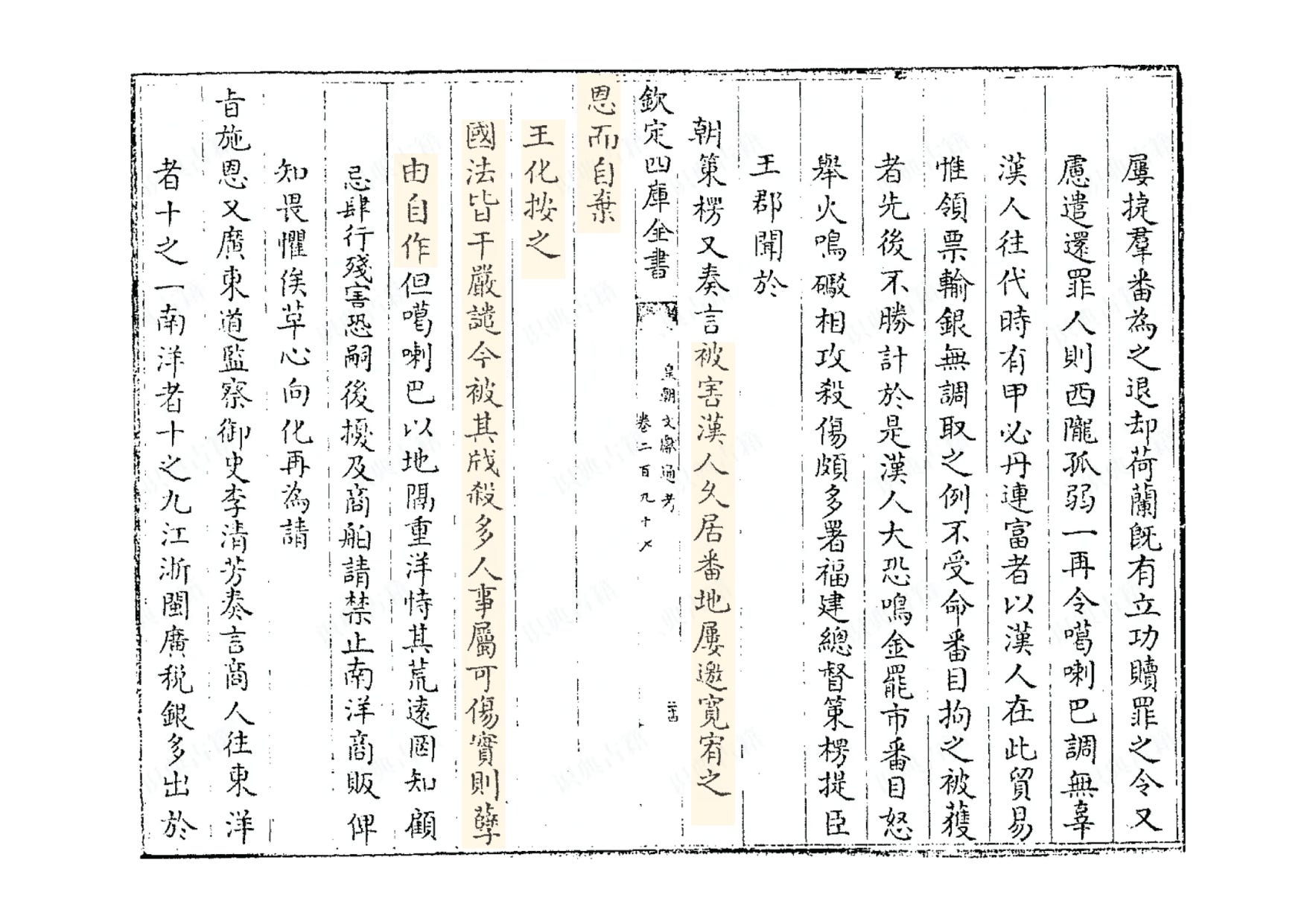
The Han Chinese who were killed had lived abroad for many years. Despite repeated acts of clemency and invitations to return, they chose to forsake the civilizing influence of the imperial order. According to the laws of the Qing Empire, they were all subject to serious punishment. Although the loss of so many lives is regrettable, their fate was ultimately the consequence of their own actions.
被害汉人久居番地,屡邀宽宥之恩,而自弃王化,按之国法,皆干严谴。今被其戕杀多人,事属可伤,实则孽由自作。
For most of Chinese imperial history, the state’s relationship to its diaspora was not protection but disavowal. The people who would later be called huaqiao, cherished overseas compatriots, mothers of revolution, sons of the Yellow Emperor, were simply people who no longer counted.
The Invention
The turning point came not from compassion but from accounting.
By the late nineteenth century, the overseas Chinese communities of Southeast Asia, concentrated in the Malay Peninsula, the Dutch East Indies, Siam, the Philippines, and French Indochina, had accumulated substantial wealth. Tin mines in Malaya, sugar plantations in Java, rice mills in Bangkok, shipping networks across the South China Sea: an entire commercial infrastructure built by Hokkien, Teochew, Cantonese, and Hakka migrants over generations. The reformer Liang Qichao (梁启超) and the revolutionary Sun Yat-sen (孙中山) both grasped the same fact at the same time: this money could fund the transformation of China, if the people who had it could be persuaded they were still Chinese.
In 1909, the Qing court issued the Guoji Tiaoli (《国籍条例》, Nationality Law), adopting the principle of jus sanguinis, nationality by blood. Article 1 was unambiguous: any person whose father was Chinese, regardless of birthplace, was a Chinese subject. Overnight, millions of Southeast Asian residents who had never set foot in China, who spoke Malay or Dutch or Thai in their daily lives, became subjects of the Qing empire on paper.
The Qing court and the revolutionary movement were competing for the same resource. Sun Yat-sen made his pitch explicit: huaqiao wei geming zhi mu (华侨为革命之母, “the overseas Chinese are the mother of revolution”). Between 1894 and 1911, Sun made at least seven fundraising tours through Southeast Asia. The Tongmenghui’s (同盟会) Singapore branch alone funneled enormous sums back to China. The word huaqiao was Sun’s instrument of recruitment. And the character qiao (侨) was doing critical ideological work: it means “to sojourn,” to reside temporarily away from home. The word encodes an obligation: you are away, but you belong here.
The 1909 law created a collision that would take half a century to detonate. Southeast Asian colonial governments operated on the opposite principle, jus soli, nationality by birthplace. A Chinese-descended person born in the Dutch East Indies was, by Dutch colonial law, a Dutch colonial subject. By Qing law, the same person was Chinese. The result: millions of people with two nationalities, two claims on their allegiance.
The Bandung Partition
After 1949, the collision doubled. Two Chinese governments, the People’s Republic in Beijing and the Republic of China in Taipei, simultaneously claimed every overseas Chinese person as a citizen, citing the same jus sanguinis inheritance from the 1909 law. For the newly independent nations of Southeast Asia, it was alarming: Indonesia alone had over two million ethnic Chinese residents who might owe allegiance to one of two hostile foreign powers.
The reckoning came in April 1955, at the Asian-African Conference in Bandung, Indonesia. Zhou Enlai (周恩来) arrived with a diplomatic offering: China would sign a treaty with Indonesia on the dual nationality problem. The core concession was Beijing would no longer automatically claim overseas Chinese as its nationals. Ethnic Chinese in Indonesia would choose: Chinese citizenship or Indonesian citizenship. No more double-counting.
This was pragmatic diplomacy. Southeast Asian leaders feared a “fifth column” of Beijing-loyal Chinese embedded in their economies. Zhou’s gesture was designed to defuse that fear. But at the level of identity, it was a severing. The state that had spent fifty years telling overseas Chinese “you are ours” was now saying “you may choose not to be.”
The old blanket term huaqiao fractured into a legal taxonomy that persists to this day. Huaqiao (华侨): Chinese citizens who reside abroad, still “ours,” still sojourners, still expected to return. Huaren (华人): people of Chinese descent who hold foreign citizenship, no longer “ours” in law, but still connected by blood. Huayi (华裔): the children and grandchildren of huaren: a further dilution, a fading signal.
On paper, the lines were clean. In practice, they solved nothing. Millions of ethnic Chinese in Southeast Asia never actively “chose” a nationality. The choice was made for them by bureaucratic inertia. Many who chose Indonesian or Vietnamese citizenship did so under pressure, without fully understanding the implications. And the governments they chose to belong to often did not care what box they had checked. When the violence came, it came for anyone who looked Chinese.
Your Face is Your Dossier
Indonesia, 1959. President Sukarno issued Presidential Regulation No. 10, banning foreign nationals from retail trade in rural areas. The regulation targeted all foreigners in theory; in practice, it targeted the Chinese, who dominated small-scale commerce. An estimated 500,000 ethnic Chinese lost their livelihoods overnight. China dispatched ships and evacuated over 60,000 people between 1960 and 1962. The question at stake was still legible within the Bandung framework: which passport do you hold? Those with Chinese citizenship had a government that would, however reluctantly, take them in. Those who had chosen Indonesian citizenship were on their own.
Indonesia, 1965. After the September 30th Movement and Suharto’s seizure of power, the logic changed entirely. The anti-communist purge that followed killed hundreds of thousands, and ethnic Chinese, regardless of citizenship, regardless of political affiliation, were swept into the violence. Chinese-language schools were shuttered. Chinese-language newspapers were banned. Chinese names were forcibly replaced with Indonesian ones. It no longer mattered what nationality you had chosen at Bandung. Your face was your dossier. The distinction between huaqiao and huaren, between Chinese citizen and Indonesian citizen of Chinese descent, offered no protection whatsoever. China and Indonesia severed diplomatic relations in 1967. They would not restore them for twenty-three years.
Vietnam, 1978. As Sino-Vietnamese relations collapsed in the prelude to the 1979 border war, Hanoi turned on its ethnic Chinese population. Households were subjected to forced nationality registration. Chinese-language schools were closed. Businesses were confiscated under the banner of “socialist transformation.” In the north, ethnic Chinese were expelled overland through the border crossings at Hekou and Dongxing; in the south, many were pushed out to sea on boats. Between April 1978 and early 1980, over 260,000 refugees crossed into China. The overwhelming majority, over 220,000, were ethnically Chinese but legally Vietnamese. They had chosen Vietnam. Vietnam unchose them.
The Bandung taxonomy works in peacetime and collapses in crisis. When a state decides to expel or exterminate its Chinese minority, it does not consult the nationality registry.
The Red Brick Houses
Every wave of Anti-Chinese movement created a cluster of low-rise red brick buildings on the outskirts of a southern Chinese town. They surrounded by rubber trees or sugarcane fields, with a canteen that serves dishes no one in the neighboring village recognizes.
These are the huaqiao nongchang (华侨农场, overseas Chinese farms), eighty-four of them, scattered across Guangdong, Guangxi, Fujian, Yunnan, Hainan, and Jiangxi. Forty-one were established in the 1950s and 1960s to absorb returnees from Indonesia, Malaysia, Burma, and India, over 80,000 people. The welcome did not last. During the Cultural Revolution, the returnees’ overseas connections made them automatic suspects. The state that had called them home now classified them alongside landlords and counter-revolutionaries. Forty-three more were built in the late 1970s for the Vietnamese wave after the Cultural Revolution, 160,000 people settled on the farms, another 70,000 placed in state forestry and agricultural units, the rest dispersed into towns.1
The word gui (归) in guiqiao (归侨, returned overseas Chinese) deserves the same scrutiny as qiao. Gui means “to return” — it presupposes a place one originally belonged. But for most of these people, no such place existed. The Vietnamese refugees of 1978 were second- and third-generation descendants of Hokkien and Cantonese migrants. They were born in Haiphong or Saigon, spoke Vietnamese at school, ate phở for breakfast. Their “China” was a grandparent’s accent and a shrine to Mazu in the living room. When they crossed the border at Dongxing, they were not returning. They were arriving, arrived in a country that called them its own but could not recognize them.
The farms operated as self-contained state-owned enterprises. Returnees received worker status, monthly wages, subsidized housing, free medical care, and guaranteed job placement for their children. It was a package that, in the planned economy of the 1970s, was more than many rural Chinese citizens received. But the settlement was also a quarantine. The returnees lived apart. They spoke Teochew or Cantonese or Vietnamese among themselves. They cooked with fish sauce imported from their former countries. They celebrated holidays their neighbors had never heard of. To the surrounding communities, they were not quite Chinese. To themselves, they were no longer Vietnamese or Indonesian either.
In 1985, the state declared the farms would transition to market-based enterprises. The safety net that had made resettlement tolerable was withdrawn. Without state support, they deteriorated. Today, many have been absorbed into expanding cities or reclassified as suburban districts. The residents remain, aging, their children scattered into the broader economy, their specific history dissolving into the general noise of Chinese urbanization.
The Checkbox
Return now to the gaokao form. That checkbox has been there, in one form or another, since the very first national university entrance exams. In 1950, the regulations already stipulated that overseas Chinese students with slightly lower scores could be admitted leniently. By 1956, huaqiao students were formalized as one of six preferential categories, alongside workers, peasants, soldiers, ethnic minorities, and martyrs’ children. In 1990, the Law on the Protection of the Rights and Interests of Returned Overseas Chinese and Their Relatives(《归侨侨眷权益保护法》 ) codified the policy into statute. Its constitutional foundation is Article 50 of the PRC Constitution: “The People’s Republic of China protects the legitimate rights and interests of overseas Chinese.” Today, the policy grants up to twenty bonus points to san qiaosheng (三侨生), three categories: returned overseas Chinese themselves, their children, and the domestic children of overseas Chinese. The checkbox on the gaokao form is the visible tip of this legal edifice.
This article has focused on Southeast Asia, where the collisions between identity classification and physical violence were most extreme. But the checkbox does not say “Southeast Asian Chinese.” It says huaqiao, and the policy applies to the entire global diaspora: the Cantonese communities of San Francisco and Vancouver, the Wenzhounese networks of Paris and Milan, the Fujianese in New York, the new waves of students and professionals in Tokyo, Sydney, London, Nairobi. The Southeast Asian chapter is one segment, the bloodiest and most politically consequential. It’s of a much larger story that this series will only partially tell.
And then, in the spring of 2026, something unexpected happened. A small Teochew-dialect film called Gei Ama de Qingshu (《给阿嬷的情书》, Dear You), made with no star actors and no major studio backing, opened in Guangdong cinemas with a 1.6% first-day screening share. Within weeks it had crossed 1.5 billion yuan in box office, ranked second for the year, and sent over forty million people into theaters. The film tells the story of a grandson who travels to Thailand to find his long-lost grandfather, only to discover that the man who had been writing love letters and sending money to his grandmother for decades was not his grandfather at all, but a stranger repaying a debt of kindness. Ninety percent of the film’s details are drawn from real overseas Chinese stories.
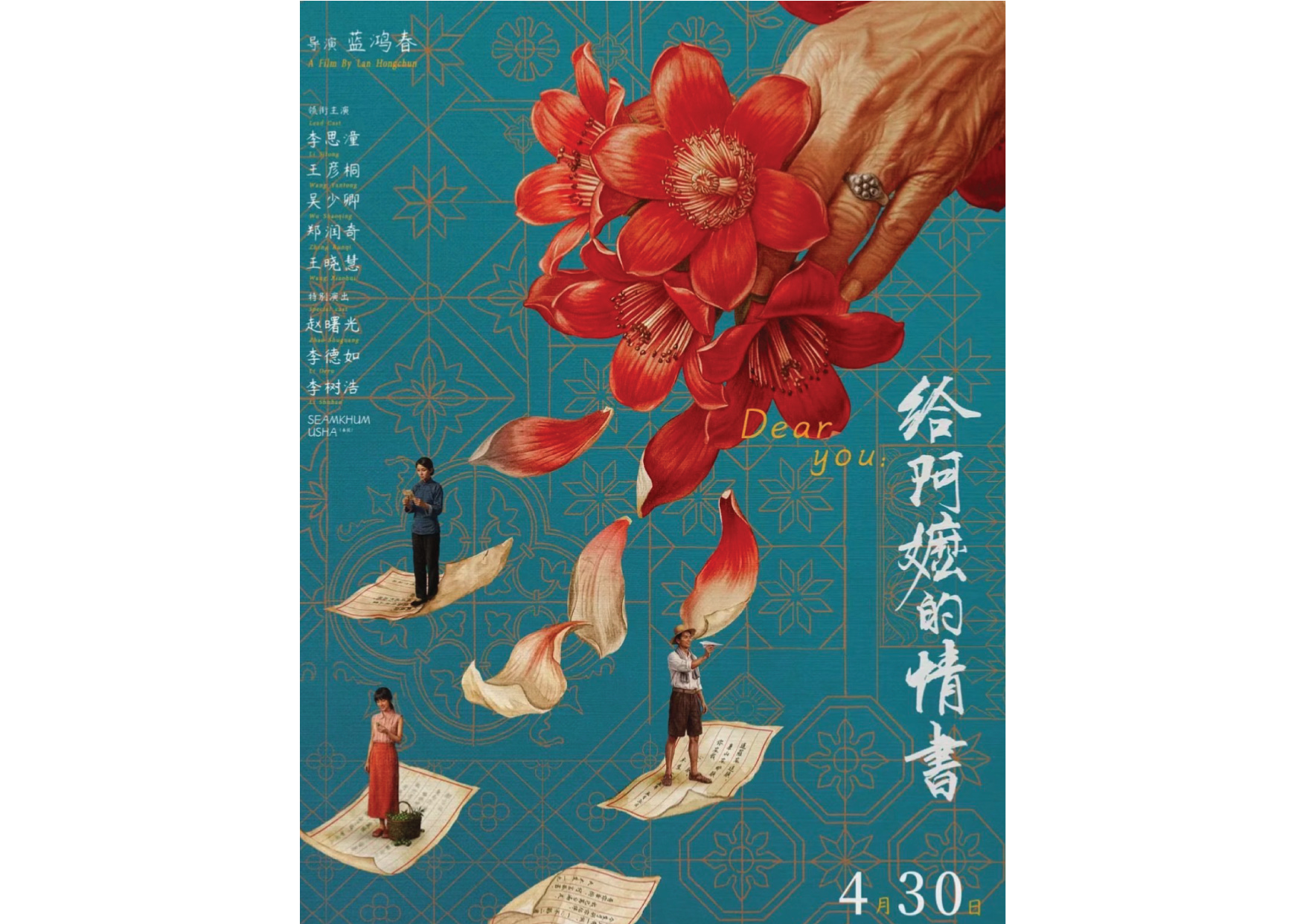
Dear You is, by any measure, the first time the huaqiao story has entered mainstream Chinese popular culture at this scale. For decades, these narratives belonged to the emigrant coasts, Chaoshan, southern Fujian, Hainan, and were told in dialects most Chinese cannot understand. It is a signal that the story of invention, abandonment, violence, and reclassification is finally being heard.
If my insights brought you a fresh perspective, please consider supporting me by buying me a coffee. Your generosity fuels my writing.
Thanks for a fascinating tale. Migration can be a wrench. Must be terrible to be caught in the middle with no place that you can really call home. But there have always been intrepid and resourceful types willing to give it a go.
Wow! Fascinating story, thanks much. I'm going to find 给阿嬷的情书...