

Living in an era of mass immigration, public debate often collapses into two opposing instincts. One frames population movement as a threat; the other treats it as a moral good in itself. Both approaches miss a more consequential question. Immigration is not a verdict on a society’s values. It is a stress test of its institutions.
The Western Jin dynasty (265–316) offers a sobering historical case. Its collapse was not caused by immigration alone, nor by “foreign invasion” in any simple sense. Population movement became destructive only after the state lost the administrative capacity and political authority needed to govern a diverse society. What failed was not coexistence, but statecraft.
In July 311, this failure reached its breaking point. Luoyang, the Jin capital, was sacked by the Han-Zhao regime, a state led by elites descended from resettled Xiongnu groups. Tens of thousands were killed, and Emperor Huai was captured in what later historians called the Disaster of Yongjia (永嘉之乱). Though often remembered as a sudden catastrophe, the sack of Luoyang was the culmination of pressures that had been accumulating for decades.
Immigration as Statecraft
In the late Han and early Jin periods, population movement was not viewed as a symptom of disorder. It was a governing technique. Through a policy known as “internal resettlement” (内徙), the state relocated frontier communities into the empire’s interior to repopulate devastated regions, secure borders, and stabilize food production.
The resettlement of the Southern Xiongnu (南匈奴) illustrates this logic. According to the Book of the Later Han (Hou Hanshu), imperial authorities deliberately placed Xiongnu groups in commanderies such as Yunzhong, Wuyuan, Shuofang, and Beidi, where they were expected to cultivate land and serve as a defensive buffer against rival nomadic powers. Similar policies applied to Di (氐) and Qiang (羌) communities in the Guanzhong region, who lived alongside Han settlers, paid tribute, and supplied military labor.
At its best, this system reflected confidence in administrative reach. The state assumed it could register households, allocate land, adjudicate disputes, and extract taxes across ethnic and cultural lines. immigration was treated as a logistical challenge, not a moral one.
Over time, however, this confidence proved fragile. As central authority weakened in the late third century, the institutions responsible for integrating resettled populations began to decay. Immigration did not destabilize the empire on its own; it exposed the limits of a state that could no longer guarantee protection, predictability, or equal treatment.
The Breakdown of State Capacity
The decisive rupture came from within the ruling elite. Between 291 and 306, the War of the Eight Princes (八王之乱) consumed the Jin court in a cycle of coups, purges, and counter-purges. To outmaneuver rivals, imperial princes increasingly relied on non-Han frontier commanders and tribal cavalry as mercenary forces.
This strategy had lasting consequences. It dissolved the state’s monopoly on organized violence and transferred military experience, weapons, and legitimacy to actors beyond effective central control. At the same time, the prolonged civil war devastated the fiscal and bureaucratic foundations of the empire. Census registration collapsed, tax revenues dwindled, and the professional army disintegrated.
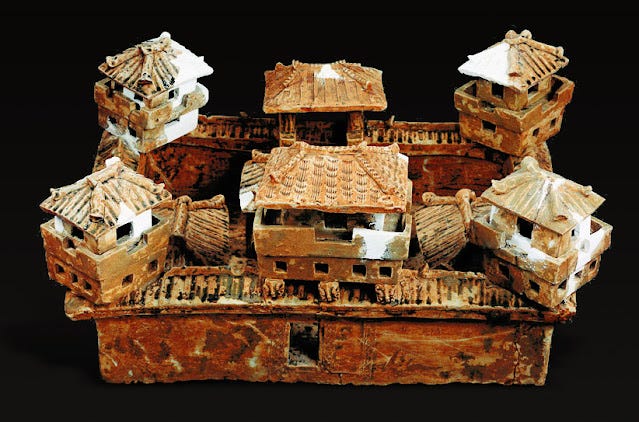
As imperial protection receded, local elites filled the vacuum. Across the countryside, fortified private estates known as wubao (坞堡) emerged as centers of security and governance. These enclaves offered shelter during famine and war, but they also marked the privatization of order itself. Law enforcement, taxation, and military defense increasingly answered to local magnates rather than the court.
For resettled populations, this shift was especially destabilizing. Without a functioning central authority to mediate disputes or enforce protections, they became vulnerable to exploitation by both local gentry and provincial officials. Migration had placed diverse communities within the empire; state collapse determined how they would be treated.
The Architecture of Exclusion
The Jin state never fully incorporated resettled groups as equal participants in the imperial order. Communities such as the Southern Xiongnu in Bingzhou (modern Shanxi) were allowed to retain their own chieftains and internal customs, while simultaneously remaining subject to Jin officials like the “Protector of the Xiongnu” (使匈奴中郎将). This dual-authority arrangement kept these groups inside the empire, but outside its civic core.
In practice, this produced administrative segregation rather than autonomy. Resettled populations were registered, taxed, and conscripted, yet excluded from meaningful political representation or legal parity. They functioned as a permanent labor and military reserve, mobilized in moments of crisis but denied long-term security.
As conditions deteriorated, this system hardened into exploitation. By the early fourth century, many resettled communities faced what amounted to double extraction: obligations to tribal leaders alongside heavy labor and military demands from Jin authorities. During famines and civil wars, local officials frequently treated these populations as disposable assets rather than subjects entitled to relief.
One notorious example involved the Jin governor Sima Teng (司马腾), who, instead of organizing famine aid, reportedly seized Jie and Xiongnu families, chained them together, and sold them into slavery in eastern provinces to finance his troops. Whether exaggerated or not, such accounts reflect how far provincial governance had drifted from imperial responsibility.
Elite discourse mirrored this exclusion. Scholars like Jiang Tong (江统, famously for Xi Rong Lun 徙戎论 , Treatise on the Resettlement of the Tribes) warned that proximity between Han and non-Han populations carried inherent risks, articulating anxieties that framed difference as a permanent political problem rather than a challenge to be managed. These views did not cause collapse, but they provided ideological cover for policies that denied integration even as the state depended on migrant labor and soldiers.
Immigration as a Catalyst
The Disaster of Yongjia was not the triumph of chaos, but of an alternative state-building project. When Liu Yuan (刘渊) founded the Han-Zhao regime, he did so not merely as a tribal leader but as a political strategist fluent in Chinese administrative traditions. Having spent years in Luoyang as a hostage-prince, he understood both the symbolic language of imperial legitimacy and the depth of Jin’s institutional decay.
By naming his regime “Han 汉,” Liu Yuan positioned himself as a restorer of order rather than an outsider. His appeal extended beyond resettled Xiongnu communities to Han peasants, displaced refugees (liumin, 流民), and former Jin soldiers abandoned by the collapsing state. These groups did not rally simply because of shared ethnicity, but because Han-Zhao offered predictable command, material provision, and a credible alternative to warlord rule.
By the time Han-Zhao forces reached Luoyang, the capital was already isolated. Its defenses relied heavily on troops drawn from the same marginalized populations the Jin state had exploited. The surrounding countryside, filled with refugees and resentful resettled groups, supplied intelligence, labor, and logistical support to the advancing armies. The city did not fall to a foreign tide; it collapsed when its neglected periphery withdrew allegiance from a state that no longer governed.
From Disaster to Division
The sack of Luoyang marked the end of the Western Jin and the beginning of prolonged fragmentation. Northern China fractured into competing regimes, while waves of refugees fled south, where the Eastern Jin established a new court. This demographic shift reshaped China’s political and cultural geography for centuries, laying the foundations of the Northern and Southern Dynasties period.
Immigration, once again, was not the root cause. It was the mechanism through which state failure propagated across regions, transforming a dynastic collapse into a structural division.
Insights for Today
The Western Jin’s fall offers lessons that extend beyond its historical setting.
Immigration reflects institutional health. Large-scale population movement rarely destroys a functioning state. When institutions are capable, immigration becomes a source of labor, innovation, and renewal. When they are hollowed out, immigration exposes fractures that already exist.
Parallel systems undermine integration. The Jin state relied on resettled populations while denying them equal legal and civic status. This produced communities that were physically present but politically excluded. Durable integration depends less on cultural assimilation than on uniform access to law, protection, and predictable governance.
State capacity precedes social cohesion. Integration is not a passive process. It requires a state able to register households, collect taxes fairly, enforce contracts, and maintain a monopoly on violence. When these foundations erode, diversity becomes harder to manage—not because of who arrives, but because the state can no longer govern effectively.
The Western Jin did not collapse because it welcomed migrants. It collapsed because it dismantled its own institutions and betrayed the people living within them. Immigration became the fuse only after the house itself was already structurally unsound.
If my insights brought you a fresh perspective, please consider supporting me by buying me a coffee. Your generosity fuels my writing.
Wonderfully eye-opening and educational as always. 🙏🏻 I can't help thinking, how predictable we are, and how little we learn.
“internal resettlement” (内徙) - oh god, what could go wrong?! 😂