

Recently I heard a claim that surprised me: Xinjiang once ran one of the best bilingual education systems in the world. Most people are aware of the controversial policies of recent years promoting Mandarin as the common language in ethnic minority regions. I then decided to find out what actually happened.
I traced the claim to a study on Yi-language (彝族, another major minority in southwest China) bilingual education. In this 2019 Springer monograph on minority schooling, Lubei Zhang and Linda Tsung wrote that China “should be regarded as a world leader” in developing bilingual education for minorities, naming the Uyghurs and Kazakhs of Xinjiang, the Mongols, the Tibetans, and the Koreans of Yanbian as groups that built mother-tongue school and examination systems.
As to the authors, Zhang is at Southwest Jiaotong University, Chengdu; Tsung is at the University of Sydney. Tsung’s PhD, “Minorities in China: Language policy and education,” dates to 1999 at Sydney. She is a three-decade specialist in exactly this field. Most bilingual education studies focus on North America and Western Europe; from the late 1990s, however, scholars started turning to the vast minority regions of China. And these studies delineate the outline of a system that most Han Chinese never encountered or even heard of in their lives.
However, in the same monograph, the authors also quote that the government's language policy had led to "perhaps the greatest language shift and loss" in the world. So this article is about how both verdicts can describe the same system.
Parallel, All the Way Up
Linguists sort bilingual schooling into two broad models. A maintenance model teaches in the mother tongue and adds the second language as a subject. A transitional model uses the mother tongue as a ramp, then hands instruction over to the second language.
For most of the People’s Republic’s history, for those groups that already had writing systems, the system was maintenance, and it was parallel at two levels. At the level of the school types, two tracks ran side by side, Chinese-medium schools, and minority-language schools. A minority family could choose either.
Inside a minority-language school, the parallel ran on the curriculum: mathematics, physics, and history were taught in Mongolian, Uyghur, Kazakh, Korean, or Tibetan, from textbooks translated from the Chinese editions, by teachers trained in those languages, while Mandarin entered as an independent course around grade two or three. It’s like the way English entered as the second language in Mandarin-speaking schools. By the end of 2016, more than 12,000 primary and secondary schools taught bilingually, using 29 scripts of 21 ethnic groups, with about eight million pupils enrolled.
The full maintenance system ran for the language with prior writing system. In Yang’s (2005) classification these are the Type 1 minorities — Koreans, Kazakhs, Mongols, Tibetans, and Uyghurs, whose writing systems were in broad use before 1949. They are about 24 million of China’s 106 million minority citizens. Many other scripts were invented or reorganized after 1949, including Yi 彝 and Zhuang 壮. Those groups got occasional bilingual education, with Mandarin as the main teaching language and the mother tongue as a scheduled course. The 42 groups without functional writing systems were schooled in Chinese from the start.
In the maintenance model, students learned in their native language all the way up to college and PhD. Yanbian University, a Korean-medium institution in Jilin, enrolled its first students in March 1949. Xinjiang University taught in Uyghur until 2002. The Gaokao, national college entrance exam, could also be completed in a minority language. The category is called min kao min (民考民, “minority examined in minority language”). Tests were translated: mathematics and the science or humanities composites were printed in Mongolian, Uyghur, Kazakh, or Tibetan, answered in the same script.
A Mongol science (理科) candidate took five papers: mathematics, sciences, a foreign language (mostly English), Chinese, and Mongolian. The Chinese and Mongolian scores were averaged into a single “language” grade, so the total came to the same 750 points as the Han track. From the those who took “minority examined in minority language” Gaokao, they went on to attend university programs taught in that same minority language. Or they could also choose Chinese-medium universities, with an extra preparatory year.
Four Versions of Parallel
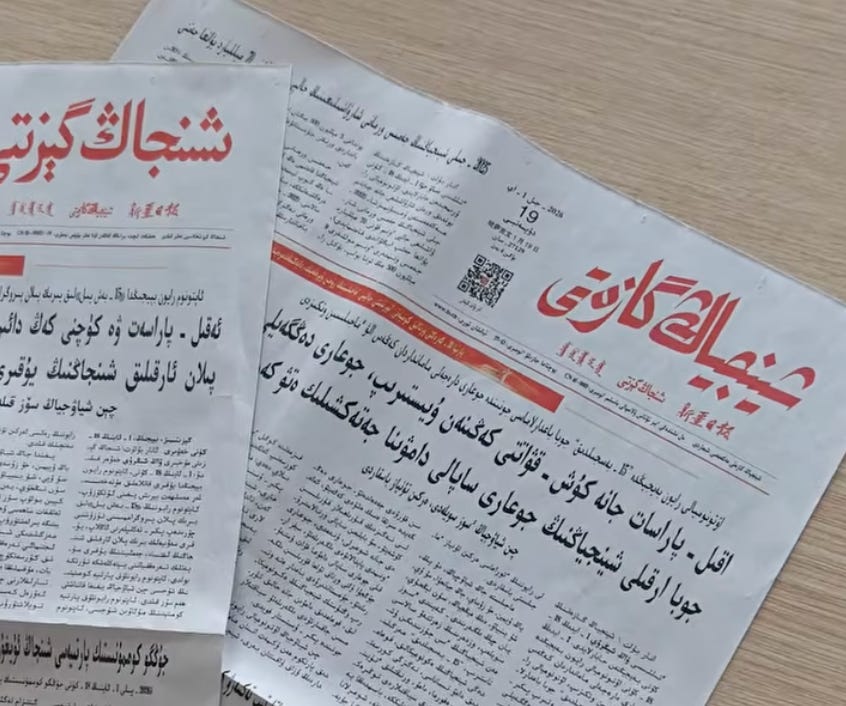
Xinjiang ran it at the widest linguistic scale. The region’s minority track was never only Uyghur: Kazakh, Kyrgyz, Mongol, and Xibe (close to Manchu) schools operated in their own languages. The Xinjiang Daily still prints in four scripts — Chinese, Uyghur, Kazakh, and Mongolian. In Qapqal 察布查尔 county, the Xibe have published a newspaper in their own script since 1946.
Inner Mongolia ran the textbook version of maintenance: every subject in Mongolian, a Chinese course from grade two, English from grade three, and classrooms stocked with two parallel sets of textbooks: one Mongolian, one Chinese. They were kept side by side for cross-reference.
Tibet ran it partially. Primary schools taught largely in Tibetan, but most middle and high schools in the Tibet taught in Chinese from shortly after 1959. The parallel track, in other words, reached different heights in different regions: full pipeline in Yanbian and Inner Mongolia, university-capped in Xinjiang, primary-level in most of Tibet.
Yanbian ran it deepest, and earliest. Koreans in the northeast built their own school network before the Chinese state did. Migrating from the Korean Peninsula from the late 19th century, Koreans inherited the tradition of Korean-language education. A teachers’ college for Korean schools opened in 1913. In 1951, the new government recognized minority languages as media of instruction. With premium resource and support in education, a universal secondary education arrived in Yanbian by 1958, long before the nine-year compulsory education into law enacted in 1986. The system eventually produced an export: from the early 1990s after China and South Korea normalized diplomatic ties in 1992, the “Korean Wind” carried hundreds of thousands of Korean Chinese to work in South Korea, where the bilingualism their schools had built converted directly into wages, and Yanbian’s economy reorganized around the remittances.
The Transitional Model
Travellers now complain about the English level of Chinese people when travelling in China. But most Chinese have actually learned English as a second language since primary school. So most younger Chinese should have been fluent in English. But the exam-oriented teaching method produces exam takers rather than language users.
With this, you could imagine how Mandarin marginalized as the second language in minority regions. For several decades, partly due to the lack of funding and resources, partly due to the maintenance model, many people in minority regions were still unable to speak or use Mandarin. In the national language survey of 2000, only about 53 percent of China’s population could communicate in Mandarin (普通话, Putonghua). By 2020 the figure had reached 81 percent, with minority regions below the national line. Mandarin was to them what English is to most Chinese people.
Catalonia keeps probably the most complete maintenance-style language education in Europe: schools teach in Catalan, with Spanish as a subject. And in the Basque Country, Basque-medium schooling has become the majority choice. Catalonia independence vote in 2017 was suppressed by the Spanish central government, yet the schools stayed Catalan. The economy was one reason behind the vote, but language could also create a severance tendency. To a central state, a separate school language can read as infrastructure for a separate nation. Spain chose to intervene at the ballot box, while China, which holds national unification as its mission, targeted at the classroom. The parallel system then started fading out.
In September 2017, Xinjiang began shifting elementary and junior high instruction to Mandarin. In 2019, Mandarin became the official medium of instruction in primary schools of the Tibet Autonomous Region. From September 2020, Inner Mongolia moved three subjects — language and literature, morality and law, and history — into Mandarin with the national textbooks, phased in through 2022. From August 2021, Korean schools in Yanbian switched their medium of instruction to Putonghua, with Korean continuing as a separate course.
The exam followed the classroom. Since 2021, Xinjiang’s minority-track candidates have taken the exam in Mandarin, with Uyghur, Kazakh, Kyrgyz, or Mongolian remaining as one subject among the papers. Inner Mongolia, by contrast, was still printing translated mathematics and composite papers in 2024, and only from 2025 stopped translating the Chinese portions of the foreign-language paper.
The Manchu
From 1644, the Manchu ruled China for nearly three centuries. Yet instead of becoming the major language, Manchu is now one of the languages closest to extinction.
The Qing court ran an empire on four-script paperwork, edicts, examinations, and archives kept in Manchu, Chinese, Mongolian, and Tibetan side by side. Yet by the mid-Qing, the Manchu bannermen living in the city had largely shifted to northern Chinese in daily life, with Manchu language required only for specific official occasions. The emperors noticed the decline of the language. Qianlong-era edicts pressed bannermen to keep up the “national speech and mounted archery” (国语骑射, guoyu qishe), which were the two marks of Manchu identity. Puyi, the last emperor, could barely speak any Manchu at all.
By 2011, linguists counted three fluent Manchu speakers in Sanjiazi, a village in Heilongjiang founded in 1689. They were all past eighty. The village elementary school has offered Manchu classes since 2017: taught as a language course in the curriculum. The most durable custodians turned out to be the Xibe, a banner people Qianlong transferred to the Ili 伊犁 valley in 1764 to garrison the frontier. Their descendants in Qapqal county still read and publish a script nearly identical to Manchu. The closest living relative of the Qing court language survives inside Xinjiang.
The Manchu did not simply disappear, it partly merged into modern Mandarin. The Chinese spoken by Manchus, concentrated in Beijing’s banner inner city, fed into the formation of the Beijing speech that later became the national standard (the story told from the previous piece on Mandarin). Manchu words still reside in the language: every Beijing bakery sells sachima (萨其马), a pastry whose name was Manchu.

The Mandarin Dominance
Language diversity is declining in China with the promotion of Mandarin. It affects not only the languages other than Chinese, but also the dialects within Chinese itself. Mandarin indeed levels the differences in speech across regions.
Decades ago, most job descriptions in China explicitly required candidates to speak Mandarin. This created a significant barrier, and at times discrimination, against those who could not speak the language, with ethnic minority groups being the most affected. However, with the widespread promotion of Mandarin, fluency is no longer listed as an explicit qualification. It has become such a default expectation that few people today realize it was once a hurdle to overcome.
Another effect of the policy: wherever you travel around China, you can now always expect young children to be able to communicate in fluent Mandarin. It was just unimaginable a few decades ago.
If my insights brought you a fresh perspective, please consider supporting me by buying me a coffee. Your generosity fuels my writing.
Key References
Zhang, Lubei & Linda Tsung, Bilingual Education and Minority Language Maintenance in China: The Role of Schools in Saving the Yi Language. Springer, Multilingual Education vol. 31, 2019. DOI: 10.1007/978-3-030-03454-2.
Dai, Qingxia & Cheng Yanyan, in Anwei Feng (ed.), Bilingual Education in China: Practices, Policies and Concepts. Multilingual Matters, 2007.
An unbiased description of the situation. You can read the process as progress or loss, but unless the facts are acknowledged, discussion will descend into accusations of bias in one direction or another. (Which I have seen aplenty in other posts on Substack, including one objectionable poster who accused me of serving up lies from the mainstream media.) Thank you, North Whale.
Thanks for a really nice article.
I observed a boarding school for (mainly) Tibetans in rural Yunnan 20 years ago, lots of challenges. Of course there was a "learn Mandarin" aspect, but in fact students from different isolated mountain valleys couldn't understand each other or understand Tibetan as spoken in Lhasa, so using their "home" language was really not an option. Chinese became their lingua franca. Such groups are probably a fraction of a fraction of a percent of the populations you discuss. In addition, as infrastructure has been built out, the number of villages that are a 2-day walk to the nearest road must by now be vanishingly small.
I saw that as well in the mountains of the Philippines last year, an isolated community (Occidental Mindoro) where almost no one was familiar with Tagalog or English, and most couldn't communicate with the "same" ethnic group on the other side of the mountain, 8 separate "dialects". Our hosts, who had been working with the group for a decade-plus, thought that they were at the extreme end of isolation among all the minorities in the Philippines. The people I've met in the north of Luzon may have kept their ethnic identity, but were often trilingual with some education and an ability to interact with government offices/workers. And wanting their kids to have more education.