

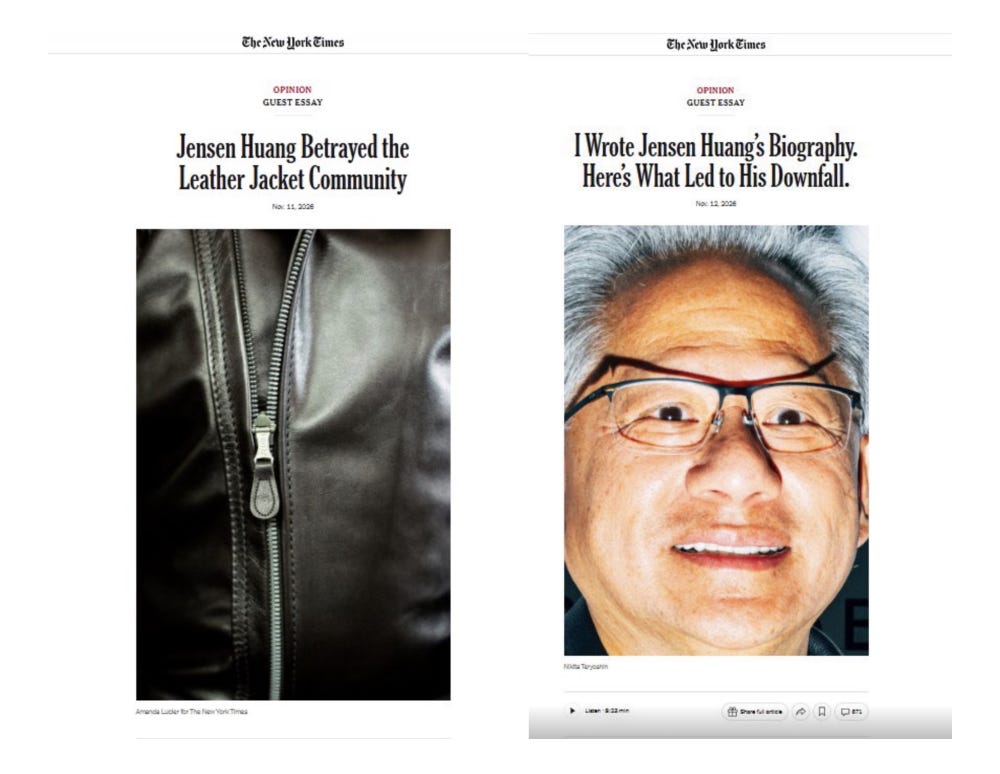
A week before Jensen Huang resigned from Nvidia on Nov. 12th, American media staged what looked like a Cultural Revolution dazibao (大字报), a public big-character poster campaign. In a dazibao, you paste accusations onto the wall, stir up ideological panic, smear with curses, and reinterpret everything the target has ever done or said as proof of a “two-faced double-dealer” (两面派). The New York Times acrimoniously accused Jensen of “betraying the leather jacket community.”
It reminds me of the story of Qian Xuesen, who co-founded the Jet Propulsion Laboratory at Caltech, was forcibly driven out of the US in the ‘50s, and became “China’s Father of Missiles.”
People have talked about whether Jensen’s resignation was because of national security reasons to completely cut the supply of GPUs to Chinese companies, Democrats’ revenge on Big Tech for supporting Republicans after winning the midterms, or Anthropic and OpenAI working behind the scenes to suppress Jensen and his advocacy of open-source models.
All of them might be the reason behind the massive and abrupt campaign toward Jensen. But what I find pertains more to the deeper root is: When a scientist or entrepreneur with Chinese ties becomes essential to American technological power, does that success protect him from political suspicion—or make him more vulnerable to it?
The Chain of Events
Half year ago in May 2026, Culper Research published a report accusing Nvidia of a “China problem.” It first brought Singapore-based cloud firm Megaspeed to the public. Owned by Chinese businesswoman Alice Huang, Megaspeed assets had surged nearly 90-fold to $3 billion within recent years. U.S. intelligence had already briefed Trump in October 2025 and again in May 2026 alleging Alice Huang was a Chinese intelligence operative targeting Jensen. Yet Trump took no action, even allowing Jensen to board Air Force One with him for a trip to Beijing that same month.
It escalated from October 30, 2026, when The Wall Street Journal published an article claiming Singaporean officials had investigated Alice Huang’s close ties to Jensen and her links to Beijing. However, the next day, Singapore’s Ministry of Home Affairs published its raw email exchange with the Journal, stating: “Neither the Singapore Government nor its officials said this. And there were no such investigations conducted in respect of Alice Huang.”
The media bombardment followed. Between November 7 and November 11, The New York Times and The Economist ran consecutive stories framing Alice Huang as a spy who influences GPU export to Chinese companies. On November 8, Jensen sent an internal memo admitting to an extramarital affair, triggering Nvidia’s board to open an investigation with outside counsel. The Economist demanded that he resign or be fired, declaring that his past lobbying against chip export controls “will now arouse suspicion.”
What actually forced Jensen to resign on November 12 was the internal governance violation. On the evening of November 11, The New York Times reported that Jensen had also carried on an extramarital relationship with Kimberly Powell, Nvidia’s vice president of healthcare. Hours later, the Journal reported that Nvidia’s board was preparing to remove him over the two affairs, since a relationship with a direct subordinate violated the company’s code of conduct. Following an emergency board meeting, Jensen resigned the next morning.
Ever since, it feels like a coordinated movement putting pressure from every angle, extramarital affairs, national security, espionage, internal corporate governance, all just to force Jensen out of Nvidia. And since Jensen resigned, Treasury Secretary Scott Bessent has pushed for an outside CEO to lead Nvidia, which is basically removing Jensen’s influence from Nvidia altogether.
Why China’s Missile Father Left America
A rather similar loyalty purge happened seventy-five years ago on Qian Xuesen 钱学森, the man later canonized as China’s “Father of Missiles.”
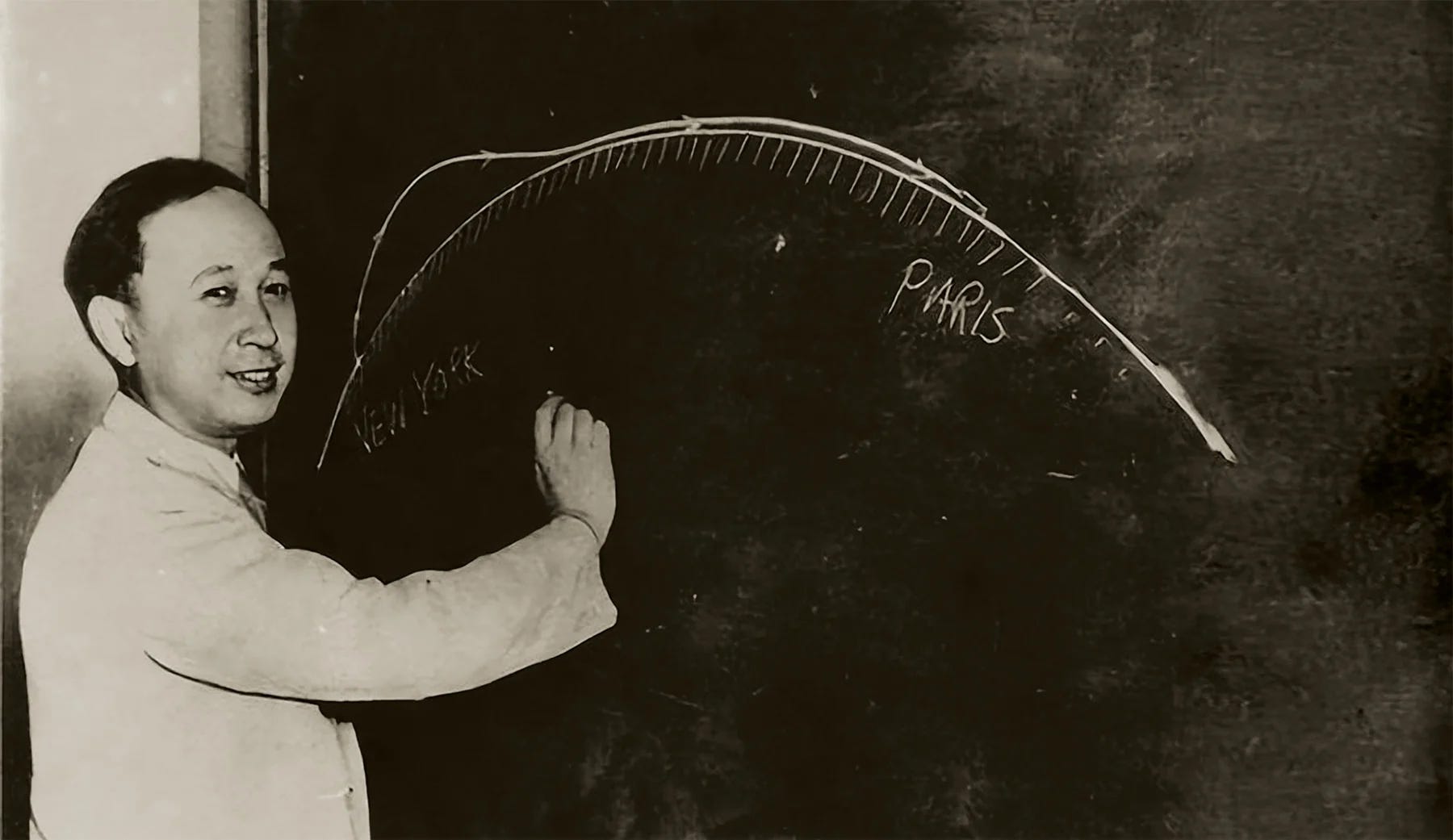
Qian arrived at the US in 1935, during the Republic era. He enrolled at MIT on a Boxer Indemnity scholarship. He later co-founded Jet Propulsion Laboratory at Caltech. As US and China were alliance during the period, at the end of World War II, he held top-secret U.S. military clearances, and traveled to Germany with the rank of a U.S. colonel to interrogate Nazi rocket chief Wernher von Braun. He was never an ideological sleeper agent waiting to defect to the communist side. By the founding of People’s Republic on October 1949, Qian held a prestigious chair at Caltech and ignored every appeal from Beijing to return. Further, he even formally applied for U.S. citizenship. He intended to stay.
Then the Korean War in the early '50s flipped everything, as Communist China finally became an opponent of the West. Under McCarthyism, JPL’s new leadership began suspecting Chinese scientists of espionage. Because Qian had attended 1938 social gatherings hosted by a Caltech chemist later accused of Communist sympathies, the FBI revoked his security clearance in the summer of 1950. It wiped out almost all of his research overnight.
The initial several years of the People’s Republic displayed a promising future in China; even though the Communist Party took the lead, those outside the party still had various freedoms of speech and movement. Compared to the KMT regime, which had just lost the civil war and retreated to Taiwan, mainland China was a promising land and really attracted overseas Chinese to go back and contribute. So when the FBI revoked Qian’s clearance during the 1950s, Qian intended to go back to China. On the contrary, even by the time he still held the passport of Republic of China, as many other overseas Chinese, he chose to go back to the mainland instead of Taiwan.
Upon his return in August, U.S. customs seized his shipping crates at the Port of Los Angeles, claiming that his academic notebooks were classified military intelligence. Even after confirming the documents contained no real secrets, federal authorities arrested Qian and locked him in a detention cell on Terminal Island. There, guards flashed lights into his cell every 15 minutes until he lost nearly 30 pounds from sleep deprivation in 15 days. He was released only after Caltech colleagues raised $15,000 in bail. He later got a contradictory deportation order that actually barred him from leaving the country. He was then kept under government surveillance. Over the next four years, he kept appealing his deportation order in court, just to clear his name and remain in America.
According to his cousin, Nobel laureate Roger Tsien, Qian did not return to China out of Communist fervor. Rather, as Tsien put it, the U.S. government simply "pissed him off," driving him out in a deeply insulting manner. Confined to Los Angeles County under 24-hour surveillance for five years, Qian was finally traded away by the Eisenhower administration in August 1955 as a diplomatic exchange of American prisoners held in China. Former Navy Secretary Dan Kimball later called Qian’s expulsion "the stupidest thing this country ever did."
American Dreamer and the Identity Dilemma
Qian was more like a shidafu (scholar-official) raised in traditional Chinese culture. When America expelled him, returning to China to build the country fit a Confucian template of state service.
Jensen Huang is different altogether. Born in Taiwan in the era of the Chinese Cultural Renaissance, he was sent to a Kentucky boarding school at age nine, and educated at Oregon State and Stanford after washing dishes at a Portland Denny’s. Jensen is an idol of the typical American Dream. His native language, his business instincts, and his social contract are thoroughly American.
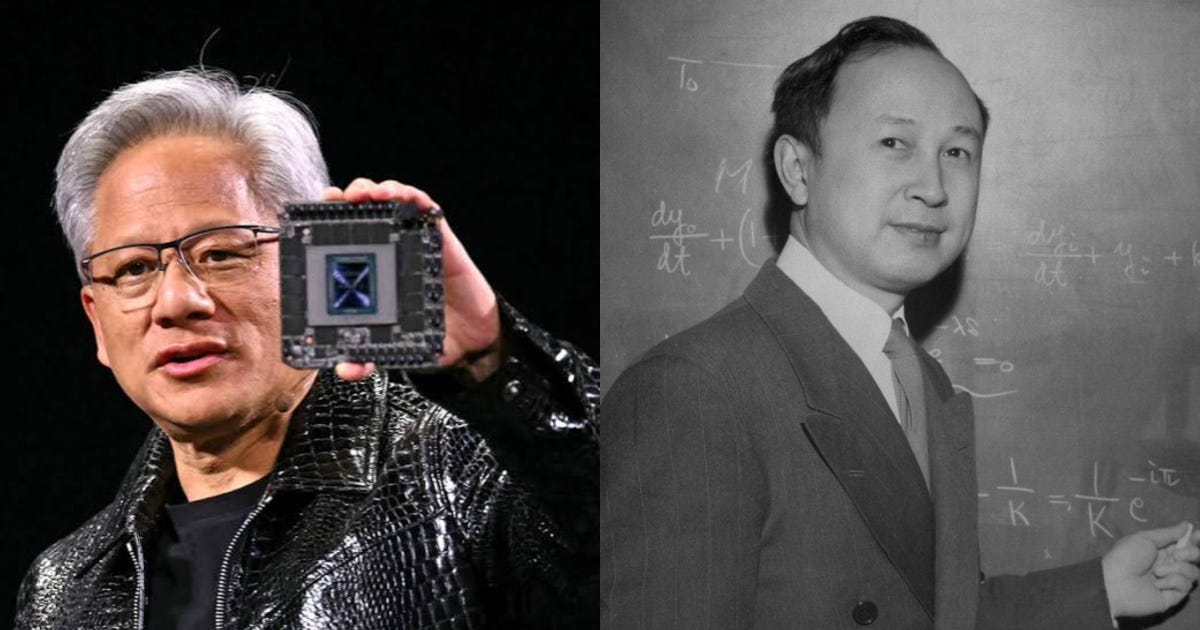
The difference is structural. Qian carried aerodynamics in his head, allowing him to rebuild from scratch anywhere. Jensen’s genius is the creation of the ecosystem. By orchestrating the entire supply chain, upstream and downstream, he keeps all parties spinning around a single gravity and making a profit. Upstream of Nvidia GPUs, he binds together American chip-design software, Dutch ASML lithography, Taiwanese TSMC manufacturing, and Chinese suppliers across raw materials, components, and hardware integration. He turns rival geographies and specialized vendors into co-dependent stakeholders. Downstream in the GPU ecosystem, his focus on helping people play better games created a massive consumer base that anchored Nvidia’s architecture long before AI. During the AI era, he has supplied not only closed-source AI titans, but also supported the open-source AI world, in which Chinese open-source models hold a great share. By funding the software stacks and developer tools, he ties the entire open-source model ecosystem to Nvidia hardware.
What glued this vast system together was Jensen himself, his East Asian background, his cultural fluency, and his deep connections to Taiwan and China. Keeping Chinese AI labs inside Nvidia’s CUDA system was the exact pragmatic commercial decision that kept America’s chip monopoly dominant instead of forcing China to pour boundless resources into domestic replacements and create a parallel open-source system.
In a rational market, the cultural fluency would have been Jensen’s shield. Yet, viewed through the lens of racialized capitalism, Jensen’s situation could be interpreted as another example of the “model Asian” curse. Asians are celebrated as long as they stay grateful, keep their heads down, and prove their usefulness to the system. The moment an Asian founder becomes powerful enough to do business his way and maintain connections that Washington wants severed, the situation flips into suspicion. Asians have to constantly argue for their existence and acknowledgment only when they can contribute.
As mainland China turned into the opponent to the West since 1949, parts of the diaspora tried to draw their own protective lines, creating a long-standing dilemma within the ethnic Chinese community itself. Further, since the 1970s, when the Republic of China left the United Nations, overseas people from Taiwan understandably began using “Taiwanese” as a safer, more self-coherent identity to distinguish themselves from the mainland. Yet in practice, sharpening that boundary is often flattened by outsiders into a simplistic moral binary, casting “Taiwanese” as positive and “Chinese” as suspect, which ultimately reinforces the broader suspicion hanging over all ethnic Chinese in America, regardless of origin.
Immigrants from Taiwan simply arrived in the United States earlier than those from the mainland. Both waves pursued the same dream through education and hard work. Even as a real idol of the American dream, being born in Taiwan, raised in America, and hailed as the pride of Taiwan did not shield Jensen for a single second. The identity boundary vanishes the moment real power is at stake.
Why China Has No Room for a “Jensen Huang”
Even if Jensen wanted to restart in China, the Chinese system is neither culturally nor structurally prepared to welcome him.
In 1955, Qian Xuesen returned to a virgin land. China had zero missile infrastructure, so he was handed the highest command of the nation’s aerospace program. In 2026, China’s semiconductor and AI sector is a hyper-saturated turf war locked in ferocious involution. State-backed champions like Huawei and dozens of subsidized domestic chip startups fight for funding, energy quotas, and domestic capacity. An outsider has to first break through networks and boundaries that have already been monopolized.
More fundamentally, from the Thousand Talents Plan 千人计划, unfolded during the 2010s, the Chinese government wants controllable engineers and scientists who solve supply-chain bottlenecks and problems, not autonomous founders whose personal charisma and capital might threaten the interests of existing players.
Also, of the more than 1,500 Western-trained scholars who returned to China in the early 1950s, a vast majority were later persecuted during the Anti-Rightist Campaign and the Cultural Revolution, when dazibao posters across Beijing’s residential compounds for scientists declared: “Those who return from abroad are spies” (海外归来是特务). Even Qian Xuesen, uniquely shielded on Zhou Enlai’s personal protection list, only survived by authoring six pseudo-scientific essays during the Great Leap Forward to validate the catastrophic grain-yield fantasies and later championing state-backed qigong mysticism.
Then the question is: where will the asylum be for this diaspora—the ethnic Chinese, Taiwanese, and Hongkongers? It might not be about finding the next safe hub, but fighting for where they stand. Yet so far, almost no one from his ecosystem on the East Asian side has spoken up firmly for Jensen.
If my insights brought you a fresh perspective, please consider supporting me by buying me a coffee. Your generosity fuels my writing.
The NYT snarked wittily -or it attempted to do so-by referring to Huand’s sartotial fetish of a leather jacket. Since the days of Steve Jobs and his boring black turtlenecks would-be fashionistas posture themselves over a foxed wardrobe as if to signify their relentless obsession on mighty goals. What’s next, underpants gnomes?
I agree with the prejudice assumption, it is real. But isn’t there another factor. China supplies Russia and Iran with components that are used in military endeavors that are in opposition to US interests. I am a pacifist and environmentalist and want an end to wasteful wars and the destruction of our ecosystem via petroleum. But realistically isn’t there some fear behind the transfer of the means of warfare right now that exists for China, in addition to prejudice?