

China’s 龙(龍) and the West’s dragon are not the same creature. They were pressed into a single word by an act of Bible translation.
Robert Morrison, the first Protestant missionary to China, spent years on a complete Chinese Bible, finished in 1823. When he reached the Book of Revelation, he faced a small choice with a long shadow. Revelation 12:9 describes a great red dragon thrown down from heaven, “that ancient serpent, called the Devil and Satan.” In the literary Chinese that would carry the scriptures across the next century, the verse reads: 巨龍與其使者、皆逐於地、昔有蛇、亦稱魔鬼撒但、素惑天下億兆、即此龍也. Morrison needed a Chinese word for that beast, and he chose 龙(龍): the emperor’s emblem, the bringer of rain, the creature coiled on the imperial throne and stitched into the robes of the Son of Heaven.
He knew what the word carried. Two centuries earlier the Jesuit Matteo Ricci had faced the same problem and deliberately picked a different character: 蛟, a kind of water-serpent, precisely to keep China’s auspicious beast away from the biblical monster. Morrison went the other way, using 龙(龍) in thirty-three verses. The literary Bibles that followed kept his choice, and so did the 1919 Union Version (和合本), the most widely read of all. And so, for generations of Chinese Christians, the animal their civilization called ancestor became the animal scripture called Satan. Converts were told to throw out dragon-patterned porcelain. Some who carried 龙 in their names were advised to change them.
Two centuries later, a campaign would set out to take the word back.
Loong comes back
As far back as 2006, a Chinese scholar named Huang Ji 黄佶 set up a website: loong.cn. He argues that “dragon” libels 龙 and should be retired for the transliteration loong; the same proposal has resurfaced in op-eds nearly every Year of the Dragon since. The argument barely changes from round to round: dragon names a fire-breathing, gold-hoarding monster, while 龙 in China means blessing, nobility and rain, so the two should not share a word.
What changed in early 2024 was that officialdom joined in. Ahead of the Year of the Dragon, Xinhua, CGTN and China Daily quietly stopped saying “dragon” and began calling it the Year of the Loong; Hong Kong’s chief executive wished the city a happy “Year of the Loong.” A campaign had become something like policy and backed the official call for “cultural confidence,” alongside the parallel move to render Tibet as “Xizang.”
There is a small irony in the spelling. The campaigners reached past the pinyin, long, already taken in English, where it is merely the adjective. The spelling Loong was itself first coined by another English missionary, Joshua Marshman, two centuries earlier.
It is easy to read this as nationalist fuss over nothing, and plenty of people did. In Hong Kong especially, “loong” happens to sound like the Cantonese word for burnt (𤓓). But the equation was not harmless. Tying 龙 to the Western dragon lent it, in foreign eyes, a monstrous shadow.
How the dragon was made
The mistranslation is older than Bible translation. When European travellers first met the beast of the Chinese court in the thirteenth century, they had to call it something. Marco Polo was among them, and they reached for the nearest word they owned: dragon. It was a rough fit, a traveller’s shorthand. But a shared name is not yet a shared nature.
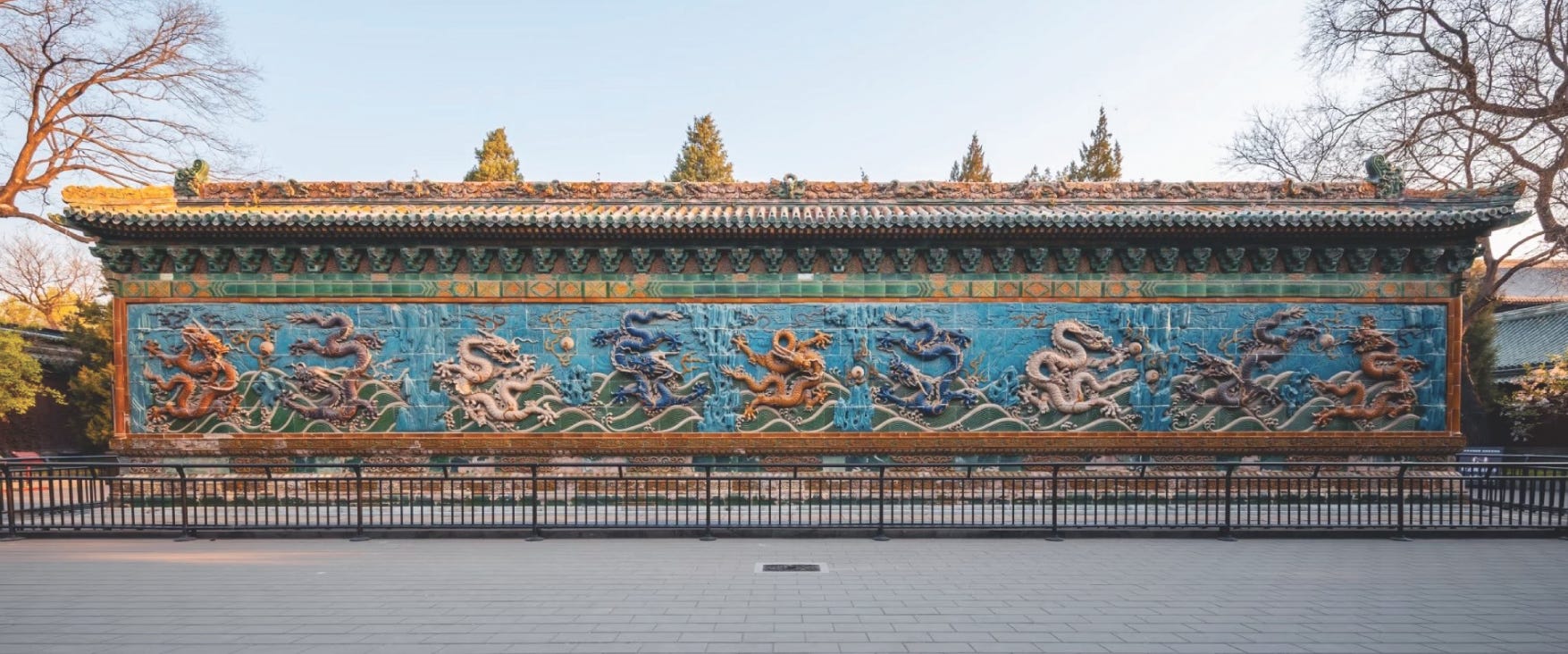
The first missionaries kept the two apart on purpose. Matteo Ricci and the Jesuits who followed him made a discipline of respecting Chinese culture, and they extended that care to its dragon. So when the Bible’s own monster needed a Chinese name, the Catholic tradition looked past 龙 for something fittingly sinister: 蛟, a kind of water-serpent.
The Protestants who arrived a decade later broke that caution. Joshua Marshman, compiling a Chinese grammar in 1814, took the harmless road: he spelled 龙 by its sound, loong, a foreign word kept foreign. Robert Morrison, finishing his Bible in 1823, took the other. He reached for the grandest, most familiar ‘serpent’ the language had, and folded the emperor’s emblem into the biblical monster. The split between the two churches could be read as a split of intent: where the Jesuits saw no need to separate Christianity from Chinese culture, the Protestants used 龙 precisely to brand that culture the “old self” a convert must leave behind.
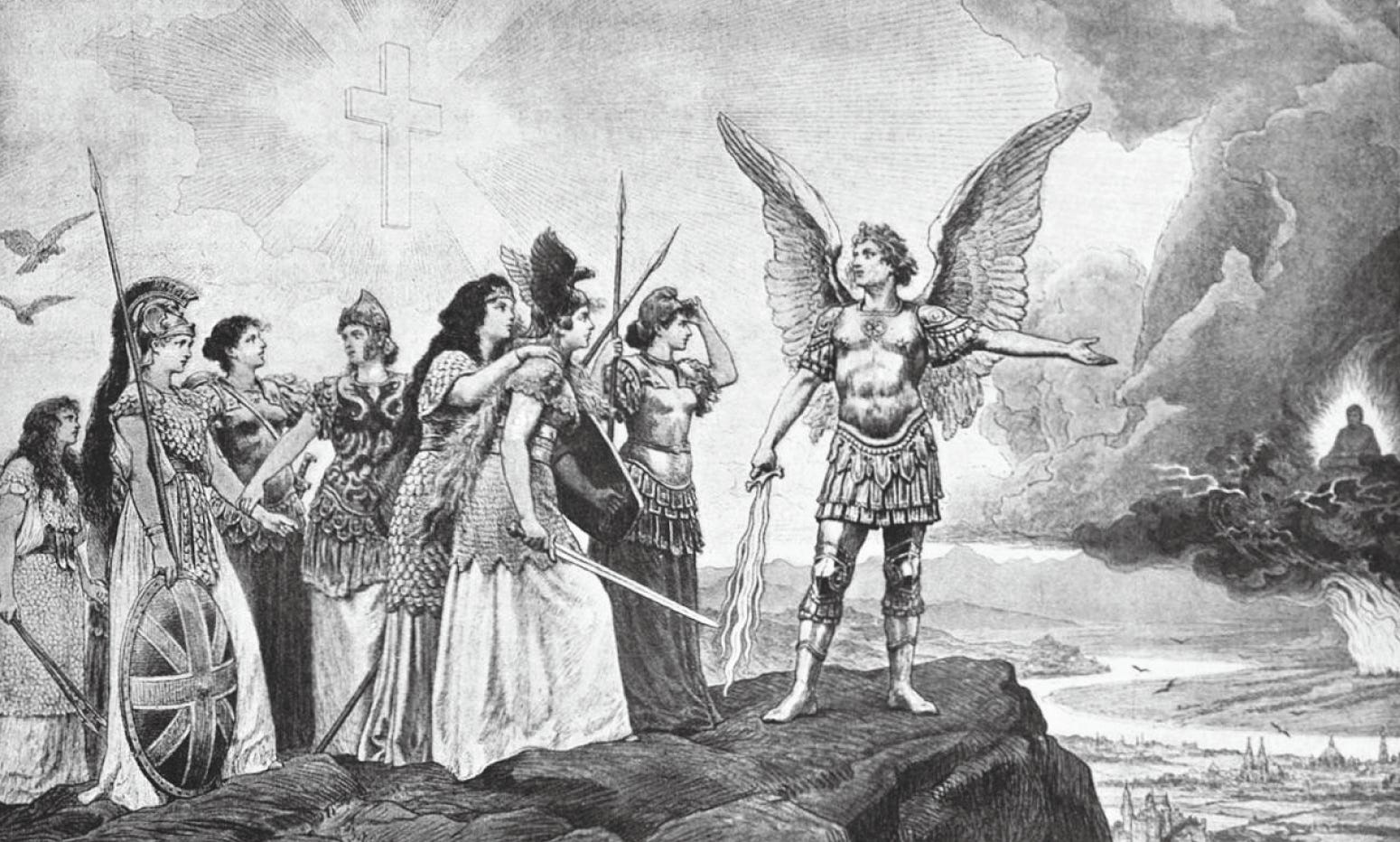
Even then, the fusion was only ink. What made it dangerous was politics. In 1895, after Japan’s defeat of the Qing, Kaiser Wilhelm II commissioned an allegory, Hermann Knackfuss’s Peoples of Europe, Guard Your Most Sacred Possessions. In the picture, the Christian nations of Europe, led by the archangel Michael, brace against a menace on the horizon: a Buddha borne out of a firestorm on the back of a dragon. It became a founding image of the Yellow Peril, the racial dread of Asia as an existential threat to the West, and the dragon was its face. Two decades on, the novelist Sax Rohmer sold his arch-villain Fu Manchu as “the Yellow Peril incarnate.”
The persisting image
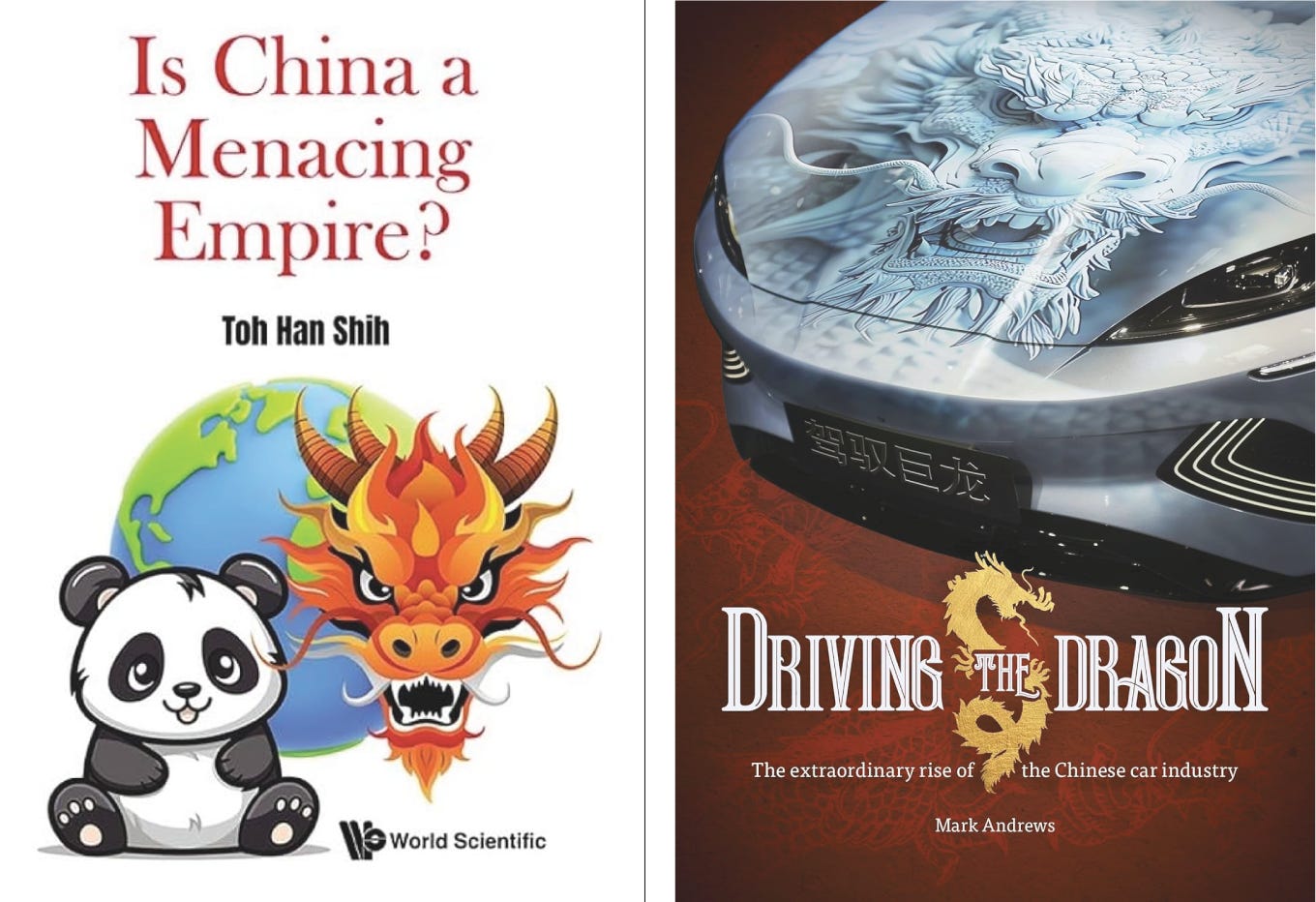
Walk past a bookshop’s China shelf today and the beast is still there. One recent title, Is China a Menacing Empire?, puts the whole ambivalence on a single cover: a cuddly cartoon panda on one side, and on the other a snarling, orange, fire-maned dragon drawn in the full Western idiom, the very monster the book’s question mark pretends to hold open. Another, Driving the Dragon, uses the beast as shorthand for China’s industrial rise, something powerful to be harnessed. The dragon has become the reflex image for China-as-force, toggled against the panda whenever the mood turns friendly.
Here the gap between the two Chinas reaches its sharpest point. The Chinese call themselves 龙的传人 “descendants of the dragon” and mean something proud: heirs to a sacred, sovereign lineage. Run those same four words through a Western ear trained on Revelation and on Wilhelm, though, and they can sound like a confession: a people announcing that they are the offspring of the monster. The same phrase, opposite meanings.
Still, it would be too easy to stop there. The folklorist Shi Aidong, who wrote an entire book on the invention of the Chinese dragon, The Making of the Chinese Dragon《中国龙的发明》. He offers the necessary correction: the word was never the cause. The fear came first, geopolitical, racial, and the dragon was simply the readymade face it reached for. Seen as an enemy, he observes, you will be drawn as a monster no matter how lovely your name; seen as a friend, even a mouse turns endearing, as Mickey did. Translation did not invent the Yellow Peril. It handed the Yellow Peril a monster that was already on the shelf.
There was never one dragon
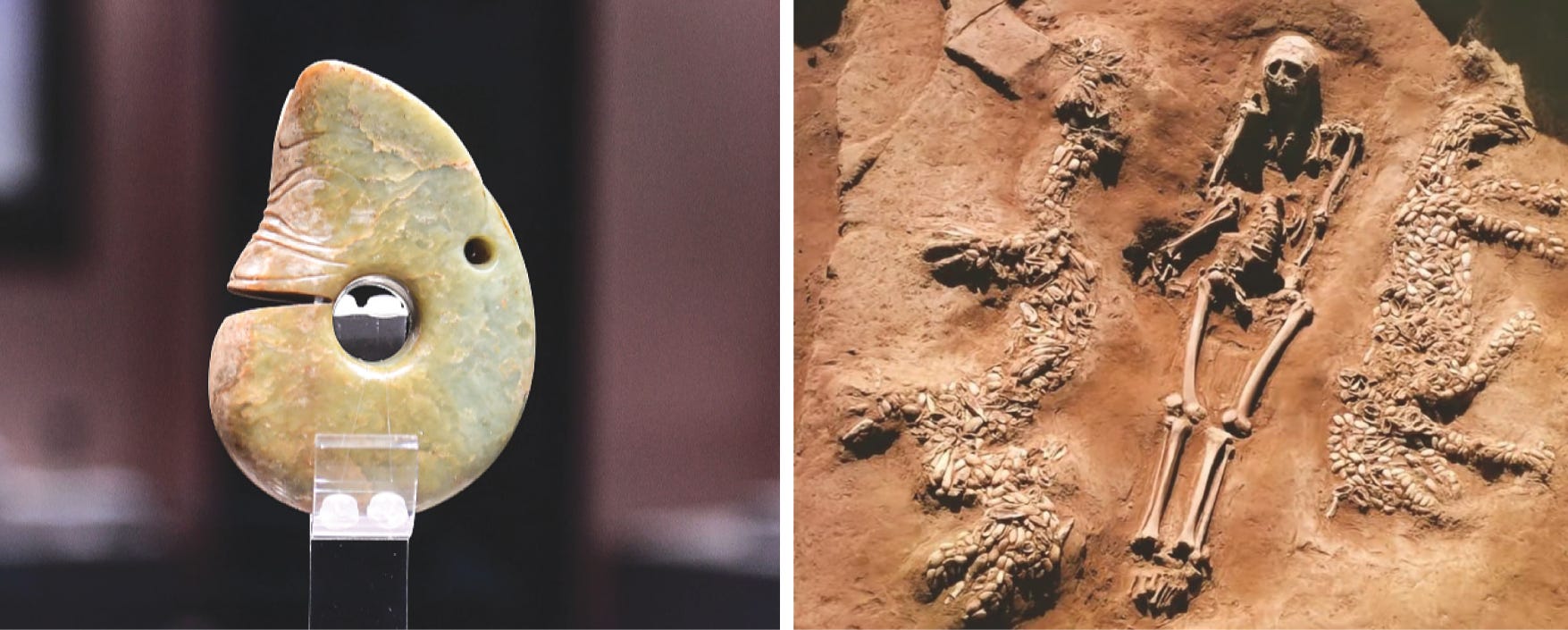
Coiled Loong shapes appear at Chinese sites up to eight thousand years ago. Jade “pig-dragons” (玉猪龙) and Loong figures laid out in clamshell mosaics existed long before any emperor used the creature as a symbol. It was also a composite. The Han scholar Wang Fu (王符) listed the Loong’s “nine resemblances” (龙有九似): a camel’s head, a deer’s antlers, a rabbit’s eyes, an ox’s ears, a snake’s neck, a clam’s belly, a carp’s scales, an eagle’s claws, and a tiger’s pads (头似驼、角似鹿、眼似兔、耳似牛、项似蛇、腹似蜃、鳞似鲤、爪似鹰、掌似虎). The folklorist Wen Yiduo (闻一多) suggested the mixed body recorded a political fact: separate clans, each with its own animal totem, merging into one people.
Those resemblances later hardened into the emblem of a single ruler and a single realm. By the Han dynasty the Loong belonged to the emperor. He was the 真龙天子, the “true loong, son of heaven,” seated on the loong throne and robed in the loong, and the five-clawed Loong was his alone to wear. The composite that had once marked many clans joining into one people now marked many lands held under one crown.
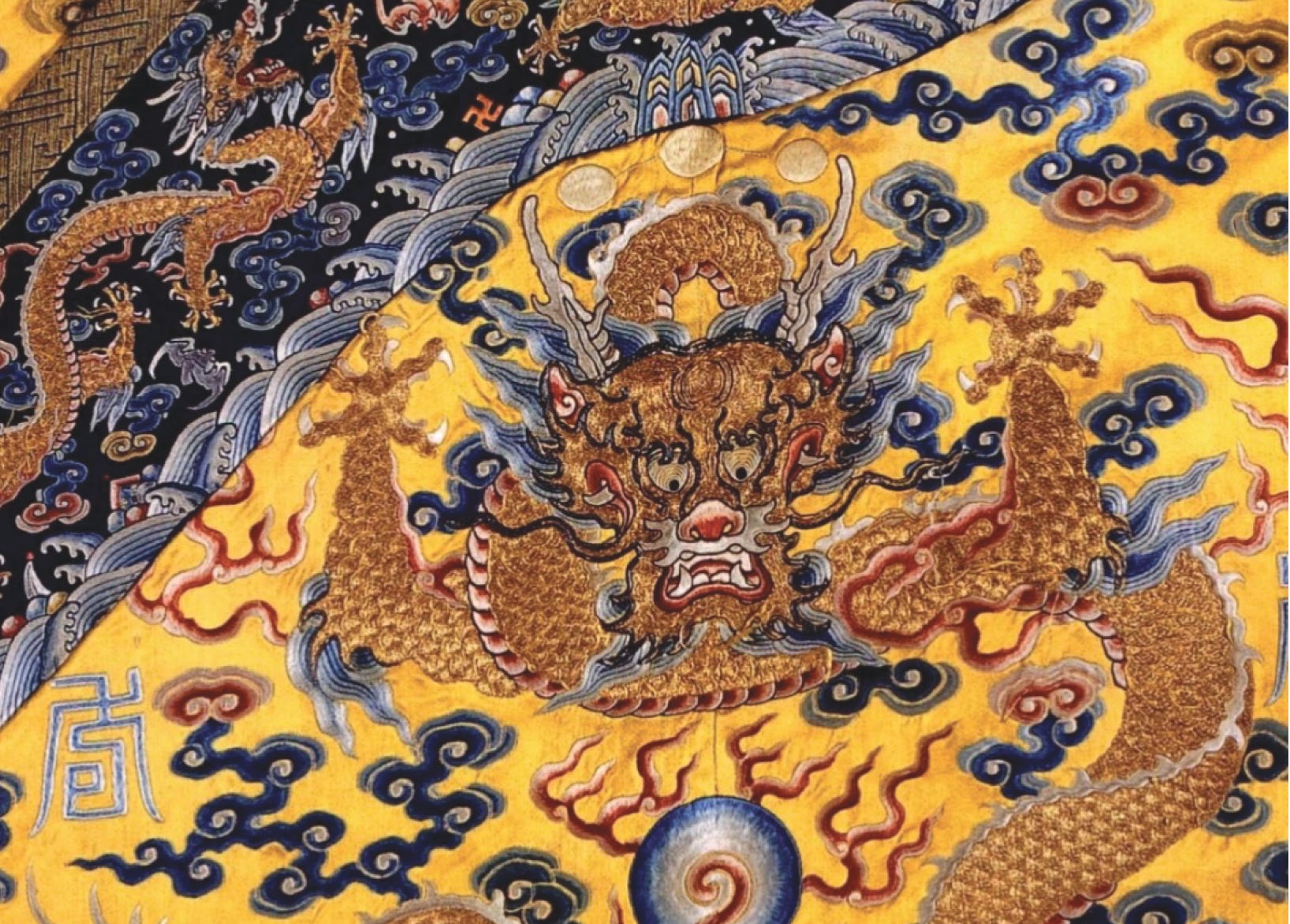
The Loong was not only the symbol of emperor and nation. In folk culture it was also deeply tied to Daoism, and its main role there was water: it controlled rain, rivers and floods, and emperors prayed to it during droughts. But the best-known water-loongs, the Dragon Kings (龙王, Longwang) who rule the four seas from underwater palaces, are not fully Chinese in origin. Before Buddhism reached China there were loongs but no dragon kings. It is said that the sea-ruling kings came with the Indian nāga, the serpent water-gods of Buddhist scripture; Chinese translators rendered them as 龙王 rather than transliterating. So the most familiar “Chinese” loong is itself a mixture of cultures.
The Loongs were also not always good. A Dragon King could hold back the rain and cause famine, or send too much and cause floods. Folktales tell of loongs beaten to death by villagers. In Journey to the West, the Dragon King of the Jing River fakes the rainfall to win a bet, breaks the Jade Emperor’s order, and is beheaded in a dream.
The Loong had always been the emperor’s symbol, never the common people’s. Only with the forming of the modern Chinese nation-state did the Loong, the culture’s highest symbol, begin to stand for the whole country. The Qing dynasty’s national flag was the Yellow Dragon Flag (黄龙旗). But the idea of the Chinese as 龙的传人, “descendants of the dragon,” came even later: barely older than the 1978 pop song named after it, which carried the phrase into popular culture. And the long-standing equation between loong and dragon has, in effect, absorbed the Western dragon (西方龙) into the image of the loong as well.
By sound or by sense
The dragon is not alone. The same thing happens to any Chinese term carried across by sense instead of by sound: the translator reaches for a western word that seems to fit, and the fit quietly reshapes the thing.
妖 (yao) became “demon” or “monster” in English, but a 妖 is not a devil. It is a morally ambiguous being, an animal or object that has cultivated supernatural power, capable of mischief or menace yet belonging to no cosmic war between good and evil. 仙 (xian) became “immortal,” or worse, “fairy.” But a 仙 is not merely a being that never dies, and certainly not a winged sprite. It is a transcendent, someone who has built their way toward the heavens through cultivation, where power is earned from the inside rather than bestowed from without.
Japanese terms usually crossed into English by sound. The very characters that give China a “demon” 妖怪 give Japan yōkai, kept whole in English like samurai and sushi, a word the reader must simply learn. 禅 reached the West not as the Chinese Chan but as the Japanese Zen; the rest of the spirits arrived as kami, oni, tengu, kappa, wearing their own names. Kept as sound, a term carries its strangeness with it and makes the reader come to it. Turned into an English equivalent, it arrives already dressed in a meaning it never had at home.
Line them up and the pattern surfaces. Dragon, demon, immortal, fairy. Each English word ‘smuggles’ in a Greek and Christian universe of fixed moral kinds: God against Satan, good against evil, mortal against immortal. Chinese supernatural creatures never lived in that universe. They shifted and cultivated, ascended and degraded, along a graded scale. Translation did not just swap the words; it quietly laid one cosmology over another. It is the same imposition this channel has traced in the West’s long struggle to render 道, and in its argument over whether Confucianism counts as a “religion” at all.
None of this is inevitable. When a concept truly has no equivalent, English can adopt the word instead of replacing it. Karma entered the language that way, not because a translator found a match, but because speakers eventually agreed there was none, and kept the Sanskrit until it grew familiar. Qi, xian, yao could travel the same road. Writing in Jade Moon Magazine, a translator who refuses to call a 仙 a fairy or a 魔 a demon argues exactly this: the remedy is not a better glossary but keeping the word, building its meaning across many encounters, and trusting the reader to meet it halfway.
A word kept in its own sound can mean nothing to a reader who has no thread to it. Loong, yao and xian ask for patience before they give anything back. A word swapped for a familiar equivalent is easy to take in, the cost is an inevitable drift in meaning and context. This is not a mistake anyone made. It is the ordinary price of carrying meaning between cultures, and it happens every time one tries to reach another.
If my insights brought you a fresh perspective, please consider supporting me by buying me a coffee. Your generosity fuels my writing.
Further reading
Emily Dunn, “The Big Red Dragon and Indigenizations of Christianity in China,” East Asian History 36 (2008): 73–85. The scholarly account of how 龙 became the Devil: Jesuit tolerance versus Protestant rejection, Morrison’s choice, and the Taiping afterlife of the “dragon-as-Satan.”
施爱东《中国龙的发明:16—20世纪的龙政治与中国形象》(生活·读书·新知三联书店, 2014; rev. ed.《近现代中国形象的域外变迁》, 2024). How the modern dragon’s image was politically manufactured, abroad and at home.
黄佶《译龙风云——文化负载词的翻译:争议及研究》 (Huang Ji, Loong vs. Dragon: Culture-Loaded Words, Controversy and Research). The loong campaign’s own comprehensive case, tracing Marshman’s 1814 “loong,” Morrison’s dictionary, and two centuries of the debate. See also his site, loong.cn.
M. W. de Visser, The Dragon in China and Japan (Amsterdam, 1913). The classic survey of the East Asian dragon: rain-god, the Dragon Kings, the Buddhist nāga behind them, and the folklore.
闻一多《伏羲考》(收入《神话与诗》). The classic essay behind the “nine resemblances”: the composite dragon read as the totem of many clans fused into one people.
Ironic that Chinese authorities should start demanding we switch out "dragon" for "loong" in the 21st century, well after we westerners had grown comfortable with the concept of dragons being good.
I guess not all of Western culture has a negative view of the dragon. There is a very famous children’s book in Germany called „Jim Button and Luke the Engine Driver“. In this story the two heroes travel to a sinister place, the „Dragon City“, where the daughter of the Chinese Emperor is held captive by an evil dragon, Mrs. Grindtooth. The two heroes eventually overwhelm the dragon, free the princess and deliver both of them to the Emperor. It turns out that the sinister dragons were under an evil spell all along. Having been defeated gives them the chance to undergo a miraculous transformation. So eventually, Mrs. Grindtooth turns into the Golden Dragon of Wisdom and a protector of China. Every German child knows this story and I believe they, like myself, have a fairly positive notion of dragons.