

There is a fatal irony in cultural exchange: the more you adapt a message for a foreign audience, the more you risk losing the very thing that made it worth sharing.
In the year 647, an Indian king sent word to the Tang court that he wanted a copy of the Tao Te Ching in Sanskrit.
Every standard story of Chinese Buddhism runs the other way. Sutras flow east. Pilgrims travel west. India is the source; China is the receiver; the great drama is Xuanzang 玄奘 walking seventeen years to bring back a great number of Buddhist texts. Almost nobody knows that the same Xuanzang, three years after his return, was assigned by Emperor Taizong to lead a translation team running in the opposite direction: to render Laozi into Sanskrit for an Indian king who had heard rumors of a Chinese sage and wanted the book.
The translation was completed. It was sealed, handed to the envoys, and sent west. Then it vanished. No copy survives in India, Nepal, Tibet, or Dunhuang. In 1912, the first modern scholar to look for it, Paul Pelliot concluded that it had either failed to circulate or been lost almost immediately.1
But before it disappeared, something extraordinary happened in the translation room. Xuanzang and a team of thirty Daoist priests fought for weeks over a single character: 道. The Daoists wanted to translate it the way it had been translated for six centuries, as bodhi (菩提), the Buddhist word for awakening. Xuanzang refused. He insisted on a different Sanskrit word entirely: mārga (末伽), meaning road, path, way.
The Request from Kāmarūpa
The diplomatic occasion is documented in three independent sources. Vice-envoy Li Yibiao (李义表) returned from a mission to India and reported that Kumāra Bhāskaravarman, king of Kāmarūpa, a powerful state in what is now Assam, had asked for the Tao Te Ching in Sanskrit. Kumāra appears by name in Xuanzang’s own Records of the Western Regions (大唐西域记) as a king who had personally hosted the Chinese monk during his Indian travels. He had heard, presumably from Xuanzang himself, that China possessed a sage older than the Buddha whose teachings the Chinese revered above all others.
Emperor Taizong agreed. Xuanzang was named chief translator. A team of around thirty Daoist priests was assembled to advise on the source text. Two of them are named in the record: Cai Huang (蔡晃), and Cheng Xuanying (成玄英), the latter the founder of Chongxuan (重玄, “Twofold Mystery”) Daoism, the most philosophically sophisticated Daoist movement of the early Tang, and a scholar influenced by Buddhist dialectical method.
Almost everything we know about what happened in that room comes from a single text: Ji Gujin Fodao Lunheng (集古今佛道论衡, Collected Debates on Buddhism and Daoism, Ancient and Modern), a chronicle of Buddhist-Daoist disputations compiled in 661 by the monk Daoxuan. Daoxuan was a near-contemporary, well-connected to the Tang religious establishment, and the foremost Buddhist historian of his generation. This is a Buddhist source written within an active Buddhist-Daoist rivalry, and its rhetorical posture favors Xuanzang. The details are vivid, the quoted exchanges have the texture of recorded speech, and most modern scholars accept the broad outline.
What the source describes is not just a translation seminar. It is three high-stakes hierarchies, imperial, Buddhist, Daoist, sharing one room, with the empire’s most senior monk arguing the empire’s most senior Daoists out of their own concepts.
Whose Concepts Are These?
The Daoists opened by glossing the Laozi using Madhyamaka 中觀 categories, concepts from the Zhonglun (中论) and Bailun (百论), the Indian Mahāyāna texts of Nāgārjuna’s school. Chongxuan Daoism had spent decades adapting Buddhist double-negation logic into its own metaphysics. To Cai Huang and Cheng Xuanying, Buddhism and Daoism shared a working vocabulary; the Laozi could be naturally explained through Madhyamaka because Madhyamaka had become part of how educated Daoists already thought.
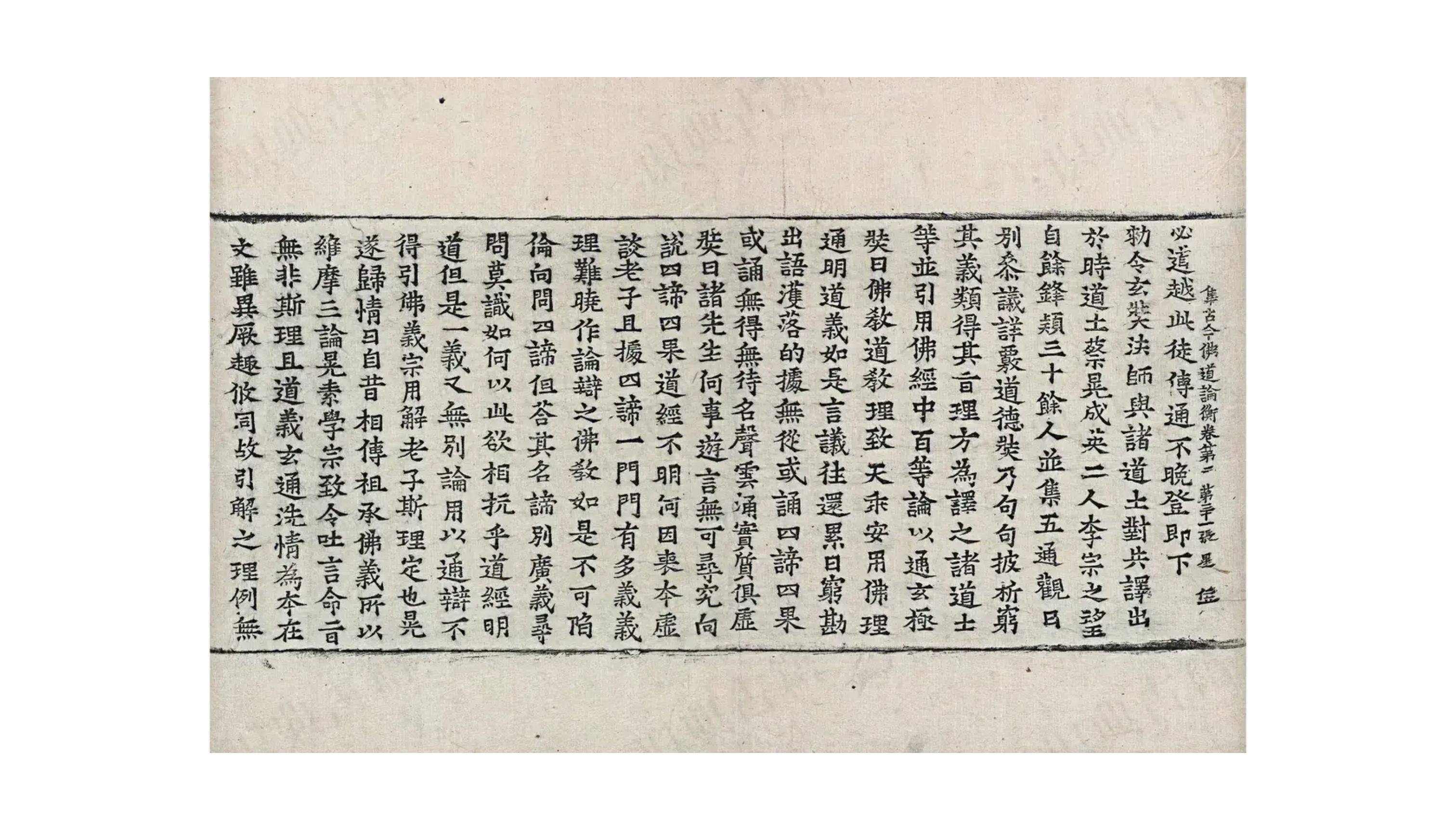
Xuanzang stopped them. The recorded exchange is sharp:
佛教、道教理致天乖,安用佛理,通明道义? The Buddhist and Daoist teachings differ at the root. Why use Buddhist terms to expound Daoist meanings?
Cai Huang protested. In the early centuries of Chinese Buddhism, monks like Sengzhao (僧肇, 384–414) quoted Laozi and Zhuangzi constantly. The traditions had always spoken to each other. The shared idiom was not a recent invention.
Xuanzang’s reply was the central methodological move of the entire encounter. The earlier borrowing, he said, happened because Buddhism had not yet developed a proper Chinese vocabulary (“佛教初开,深经尚拥,老谈玄理,微附虚怀。尽照落筌滞而未解。故肇论序致联类喻之。非谓比拟便同涯极。”). Translators in the third and fourth centuries reached for Daoist words because they had nothing else. The borrowing was provisional scaffolding, useful in its day, but the scaffolding was meant to come down. By the seventh century, after six hundred years of translation work, Chinese Buddhism had a precise technical lexicon of its own. The cross-borrowing should now end. Translation should be exact.
Then he turned the argument back on the Daoists. Why, he asked, among the dozens of available Laozi commentaries, He Yan 何晏, Wang Bi 王弼, Yan Zun 严遵, Gu Huan 顾欢, were they reaching for Buddhist texts to explain their own classic?
What “Tao” Actually Means
Xuanzang began the translation. For the character 道 he wrote the Sanskrit mārga (末伽) — meaning road, path, way.
The Daoists objected immediately. The standard equivalent, since the earliest Han renderings, had been bodhi (菩提). When the first Buddhist missionaries arrived in China, buddha had been translated as 道人 (”man of the Way”) and bodhi as 道. The equivalence was six centuries old.
Xuanzang’s opening reply:
菩提言觉,末伽言道,唐梵音义,确尔难乖。 Bodhi means “awakening.” Mārga means “path.” The Chinese and Sanskrit on both sides are precise. They cannot be conflated.
Cheng Xuanying pushed back with a structured rebuttal. Buddha, transliterated as fotuo (佛陀), has always been rendered into Chinese as jue (觉, “the awakened one”), an equivalence Xuanzang himself accepted. By the same authority of long usage, bodhi has always been rendered as 道:
佛陀言觉,菩提言道,由来盛谈,道俗同委。今翻末伽,何得非妄? Buddha is rendered as “the awakened one”; bodhi is rendered as “Tao.” This has been common usage for centuries, accepted by clergy and laity alike. To translate it now as mārga, how is that not arbitrary?
The argument was an appeal to precedent. If buddha = 觉 was a settled pairing, then bodhi = 道 deserved the same standing, six centuries of consistent usage. To break one half of the parallel without breaking the other was, in Cheng Xuanying’s eyes, philologically incoherent.
Xuanzang’s reply dismantled the parallel:
佛陀天音,唐言觉者;菩提天语,人言为觉。此则人法两异,声采全乖。 Buddha in Sanskrit means “the awakened one” in Chinese; bodhi in Sanskrit means “awakening.” One names a person; one names a teaching. They are categorically distinct, and the old translation conflated them.
Both Sanskrit words share the root budh-, “to awaken.” But buddha is an agent, the person who has awakened. Bodhi is the abstract state of awakening itself. To collapse both into 道 was to flatten an entire conceptual architecture into a single Chinese character.
He accepted that buddha corresponded to jue, “the awakened one.” What he denied was that this concession licensed the second pairing. Buddha and bodhi were two distinct Sanskrit words, agent and action, person and teaching, and the old Chinese rendering had erased the distinction by translating both as 道. The “settled equivalence” Cheng Xuanying defended was not a tradition of accuracy. It was a tradition of conflation.
And once that confusion was removed, what 道 actually meant came into view. It was not awakening at all. Its primary semantic field was path, the road one travels, the route of cultivation, the way things proceed. The Sanskrit equivalent for path was mārga. Xuanzang offered an empirical test: ask any Sanskrit-speaker, point at the road under your feet, ask what it is called. The answer is mārga.
For six hundred years, Buddhist translation in China had quietly absorbed Daoist vocabulary in order to gain a foothold, and over those same centuries, Daoists had grown comfortable with a Buddhist idiom that flattered their own concepts, that made 道 sound like the Buddhist absolute. Xuanzang was reversing the process. He was telling the Daoists that the word at the center of their own tradition did not mean what centuries of borrowed Buddhist vocabulary had let it sound like. Tao was not bodhi. It was mārga.
The Translation Argument That Wasn’t a Religious War
At this point, it is tempted to file the episode into a familiar category. Buddhist-Daoist conflict. The Tang court repeatedly issued edicts ranking Daoist priests above Buddhist monks (the imperial family claimed descent from Laozi); the Huichang persecution of 845 nearly destroyed institutional Buddhism; the Huahu Jing (《化胡经》) controversy had been running for centuries on the Daoist claim that Laozi had gone west and become the Buddha. The whole thing can look like a slow-burn Chinese version of the Catholic-Protestant struggle.
But there had never been a war. The translation argument took place inside an imperially convened translation bureau. Both sides were paid by the same emperor. Neither tradition had its own territory, its own army, or its own independent law. The conditions that produced crusades, inquisitions, and wars of religion in medieval Europe were structural facts of political autonomy that no Chinese religion ever possessed. The contested object was not doctrine but vocabulary: which Sanskrit word should render which Chinese character. And Cheng Xuanying, the most senior Daoist in the room, had built his entire philosophical system by borrowing Buddhist dialectical logic. The two sides were not isolated enemies; they were intimate co-developers who disagreed on the terms of a partnership they had been quietly conducting for centuries.
The Preface That Was Refused
After the main text was translated, Cheng Xuanying made one more request. Include the Heshang Gong (河上公) preface, the famous Han-era commentary that frames the Laozi as a manual of Daoist self-cultivation, with instructions for tooth-clicking (叩齿), saliva-swallowing (咽液), and breath retention. Without the preface, he argued, foreign readers would miss the practical dimension of the text.
Xuanzang refused. His stated reason is revealing:
观其治身治国之文,文词具矣。叩齿咽液之序,其言鄙陋。将恐西闻异国,有愧乡邦。 The sections on self-cultivation and statecraft are sufficient. The tooth-clicking and saliva-swallowing preface is crude. If it reached foreign ears, it would bring shame on our country.
The Daoists appealed to Chancellor Ma Zhou 马周. When Ma Zhou asked Xuanzang whether India had anything comparable to Laozi and Zhuangzi, Xuanzang answered carefully: yes, India had its own philosophical schools, the Sāṃkhya system’s twenty-five principles, the materialism of the Cārvākas, the dialectics of the ninety-six non-Buddhist schools. But they were different in kind, and Indian philosophical readers would judge by different standards. Then he rendered his verdict:
若翻《老》序,则恐彼以为笑林。 If we translate the Laozi preface, the Indians will treat it as a joke book.
The preface was cut. Xuanzang was not deciding what was true. He was deciding what was exportable. What could survive translation without disgracing its source. The Daoist preface failed his test, and he stripped it from the version that traveled west.
The Translation That Never Arrived
The Sanskrit Tao Te Ching was completed, sealed, and handed to the Indian envoys. And then, it vanished.
No Sanskrit Tao Te Ching survives anywhere. Not in Indian manuscript collections, not in the Tibetan canon, not in Dunhuang, not in Nepal. Paul Pelliot, devoted eighty pages of T’oung Pao in 1912 to reconstructing the event and searching for traces. He found none. After 1912, no further evidence has emerged. The translation Xuanzang fought so hard to get right reached its destination and disappeared without leaving so much as a citation in any surviving Indian source.
The Daoists wanted bodhi; Xuanzang gave them mārga, and won. The Daoists wanted the preface translated; Xuanzang refused, and won. Then the entire translation evaporated. None of those careful distinctions ever had an Indian reader.
Xuanzang’s translation theory may have been correct, but the cost of correctness was a text that nobody in India found worth keeping. A Daoist priest who had packaged the Tao in familiar Buddhist clothing, who had let bodhi and Tao remain identical, who had translated the longevity preface, who had made the Laozi sound like a Mahāyāna sutra, might have produced a text that survived. Xuanzang produced one that was philosophically honest and historically silent.
Twelve hundred years later, D. T. Suzuki would do precisely what Xuanzang had refused to do: package Chan Buddhism in the vocabulary of William James and the rhetoric of mystical experience, betray every distinction that Xuanzang had defended, and reach millions of Western readers in the process. (See more: How Chan Became Zen) The pattern is the same, only the direction is reversed. Suzuki sold awakening to America by letting bodhi sound like Tao. Xuanzang refused to sell Tao to India by letting it sound like bodhi. One translation traveled. One translation was right.
The question that hangs over both: is a translation that travels but distorts, or a translation that is faithful and forgotten, the deeper betrayal of the text?
If my insights brought you a fresh perspective, please consider supporting me by buying me a coffee. Your generosity fuels my writing.
Autour d'une traduction sanscrite du Tao tö king, https://www.jstor.org/stable/4526292
I admire the depth and breadth you take to your writings!
Incredible story, really exposed me to something new and presented so well. 🙏🏻🙏🏻
What a shame that this translation was lost - on all sides.