

I’m always fond of exploring places where time got encapsulated, where you wander into a rural village nobody recommends and find a preserved temple hall standing quietly behind a primary school.
Traditional Chinese architecture has held me since childhood. Living in a city dominated by Soviet-style architecture and unregulated brick-and-cement housing, the surviving architecture from the previous generation holds some magical tension against the monochrome city fabric. There were stories behind the preservation of that building, the regret of how some got demolished without a trace, the narrative sealed inside the physical site that can only be told through the remaining steles.
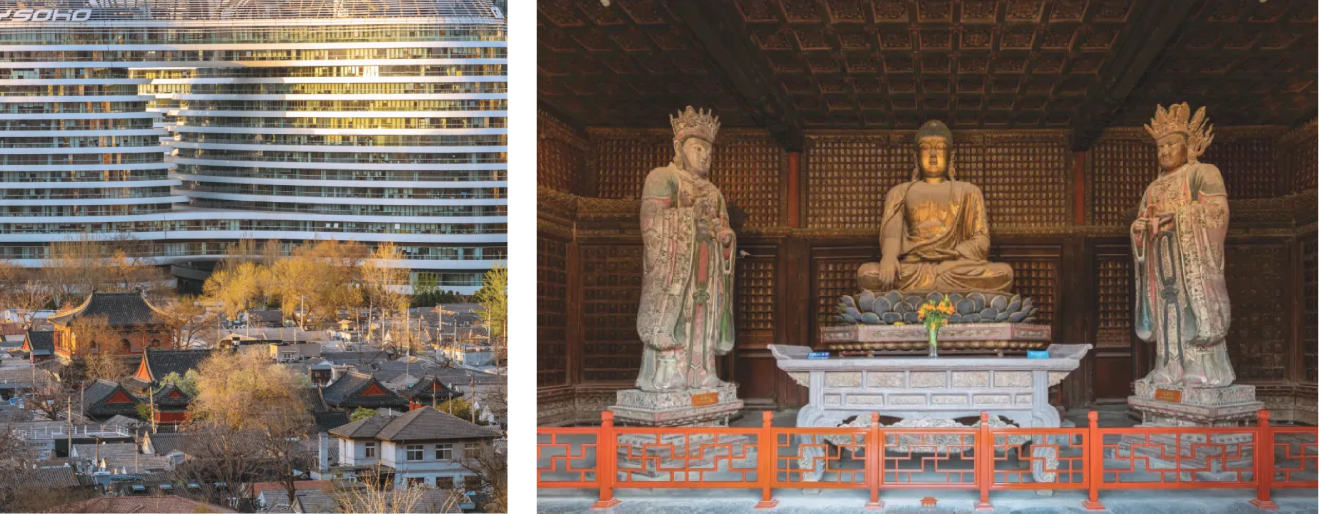
When China named its first batch of national key cultural heritage sites in 1961, preservation was the least priority for the whole society. Heritage carried no merit but carried sin. An old temple was superstition. An old mansion was a landlord’s crime. The safest thing an old building could do was make itself useful, become a granary, a school, a warehouse, a factory. Even the Forbidden City was once proposed to be demolished leaving only the main hall. Only lately has that turned around. Decades of heritage/relics surveys rediscover the sites and start preserving them from the fate of eventual decay. But the process is rather slow and sometimes controversial.
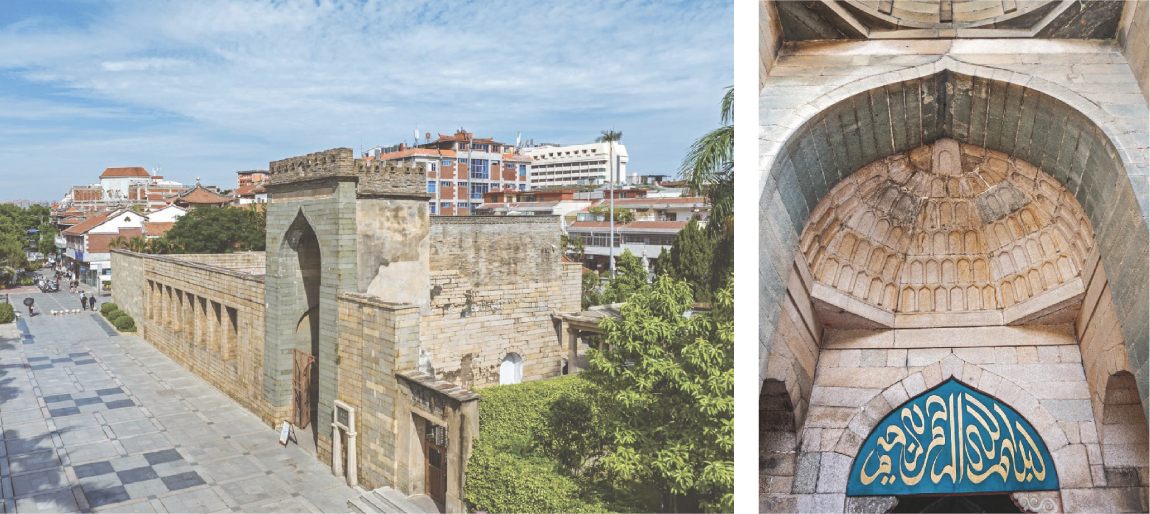
When I first wrote about Chinese cultural heritage last September, I found a wide gap between what I regularly visit and what people coming to China usually see. There’s a major barrier due to language and a lack of information. The most famous sites are not only the classical ones, but also the most calibrated, like theme parks with similar stories and anecdotes told thousands of times.

A trip of heritage visit, for me, is a process of healing, an antidote that restores depth to life. And each time I travel, it’s not only the sites I visits, but the people who are living around, make me see the possibilities of life.
The problem I kept running into
There is no single place that I can get all the infomation I want. To plan a trip I had to stitch things together by hand, a heritage list in one tab, a map in another, Wikis, and dozens of social media pages. The information existed, but scattered, and always in the wrong shape. It’s never formatted in the way a curious traveler actually thinks.
Worse yet, sometimes, I don’t know exactly where I wanna go. It usually start with just an idea or a feeling that haunting in my mind. The unknown places are always the ones worth visiting. But standard search engines and mainstream AI tools are not built for this. They only give you generic answers or mainstream recommendations, filtering out the very obscurity and nuance you are looking for.
Flow AI, built from real sites
What if there were an AI that actually understood culture and heritage, built specifically to help me plan and explore?
The trouble has always been the data. Generic models give generic answers. Ask for a route and I get the same heavily touristed spots everyone already knows. They can’t offer the kind of granular, historically accurate recommendation I expect: Where is the most magnificent surviving Song-dynasty temple? Which cluster of heritage tells the story of early Buddhist transmission? Or where can I trace the development of Daosim?

It’s common to presume that there should be an official website documenting everything cleanly, but the reality is that there isn’t. What I started with was just a scanned PDF listing several thousand sites, with only their names and provinces.
That is why I built Flow Heritage and Flow AI.
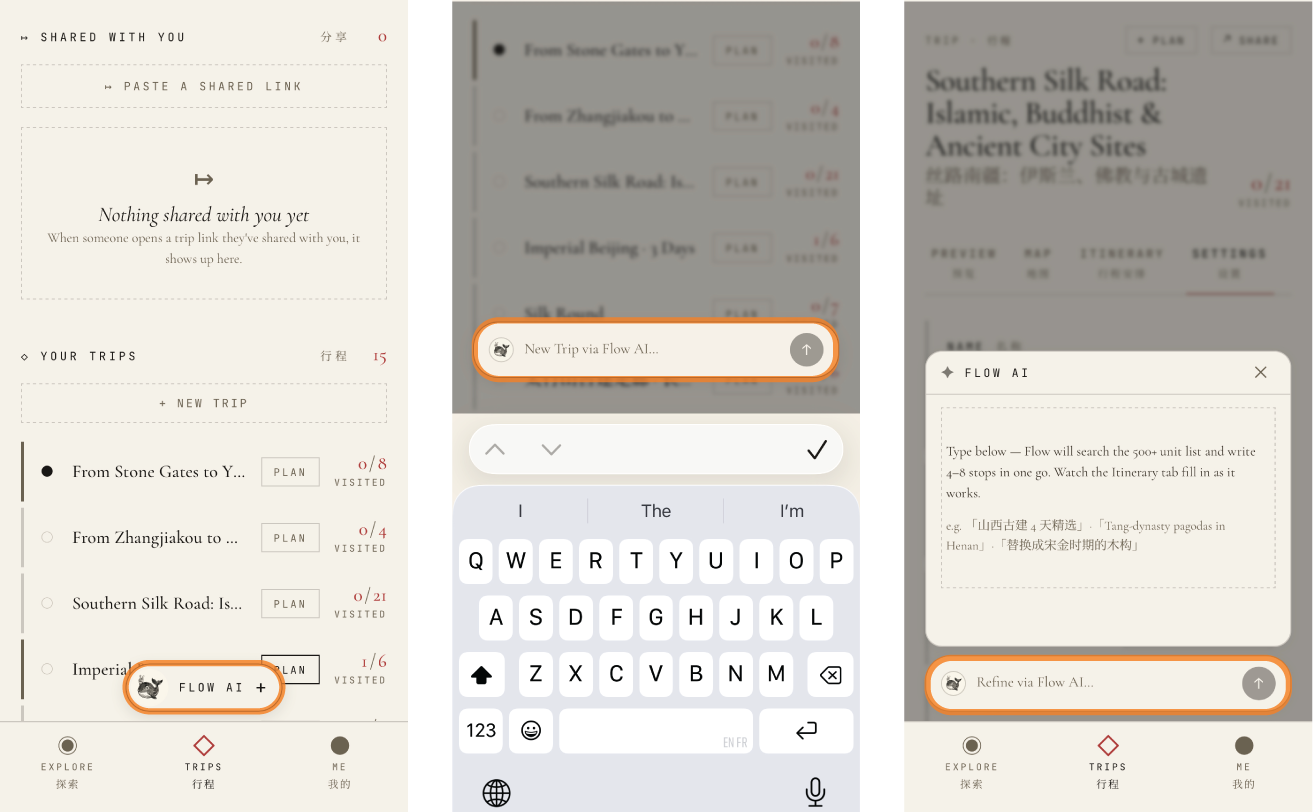
Flow AI curates trips and stories with structured heritage data, mapping sites, dynasties, coordinates, typologies, and nuanced asethetic tags. Instead of relying on the generic training memory and general search engine, it queries the dataset to extract precise historical sites, building them into an itinerary that matches the intellectual curiosity I wanna follow.
The itinerary below is what I built with Flow AI, a 5-day journey through Gongyi and Kaifeng during Duanwu Festival, including obscure tombs, grottos, and rarely brick pagodas that I rarely encounter on social media feed.
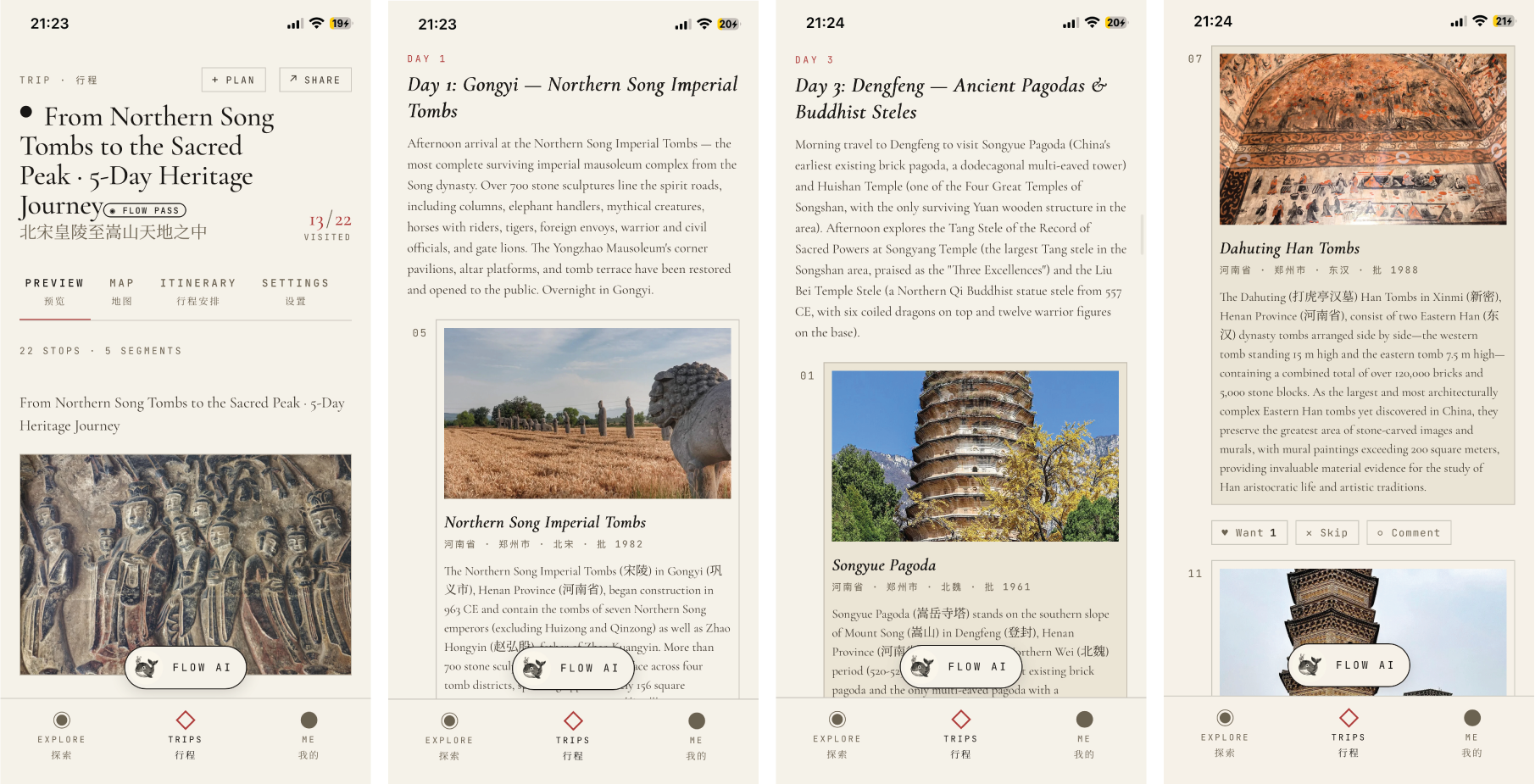
Flow also tells the story
I believe an AI product should not keep people indoors, staring at a screen, but should encourage them to get out into the real world. The best possible outcome after a conversation with Flow is gaining the enthusiasm to explore the next place.
Even when you have no specific place in mind, but just questions and curiosity, Flow can help. Whether it’s about how Confucianism, Buddhism, and Daoism coexist in China, what the worldview of Chinese people is, or even the mainstream narrative of modern China, Flow can trace that thread and weave real sites directly into the narrative. Curiosity turns into a destination to visit.
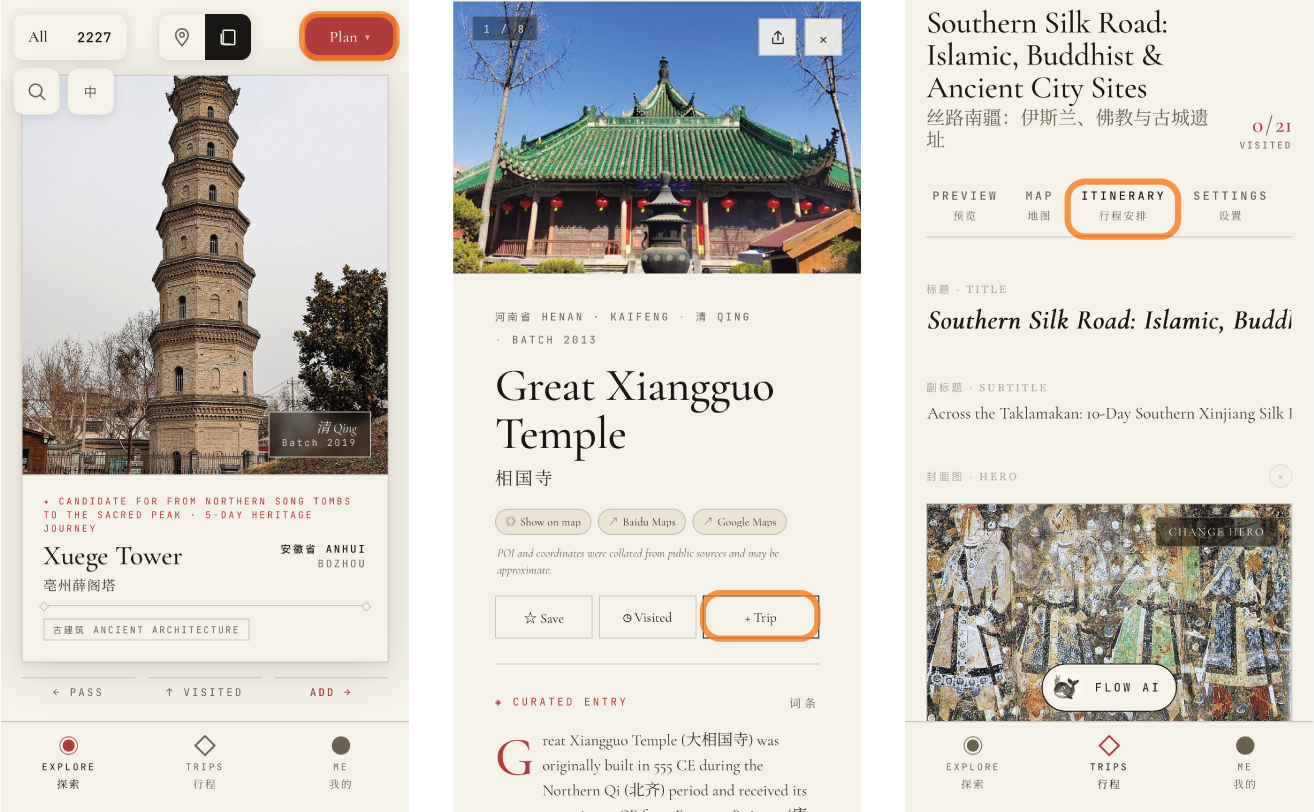
And of course, Flow AI doesn’t dominate. When Plan Mode is on, you can start adding sites to the trip by swiping right. You can also always add specific sites through the details page. Finally, in the Itinerary tab of the trip, you can edit and curate your trip manually.
Bring your friends
A trip is never a solo endeavor. For every trip, you can share with your friends and pull them in. They can work on the same itinerary with you, propose places, suggest stops, and vote on where actually go.
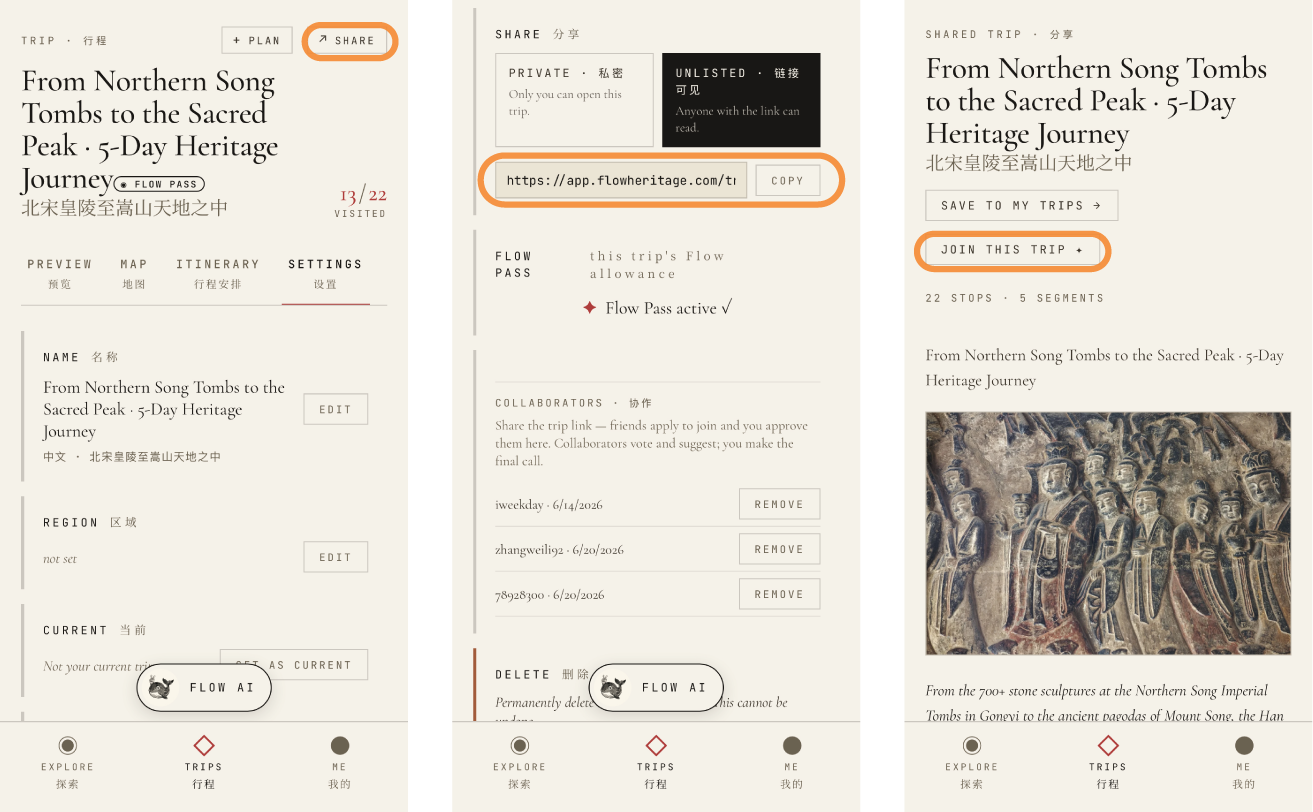
So, share it with your friends.
You are invited:
From Northern Song Tombs to the Sacred Peak · 5-Day Heritage Journey
From Stone Gates to Yuan Timber: A Two-Day Immersive Journey Through Shanghai
The old-school ways
Not everything needs to pass through an AI.
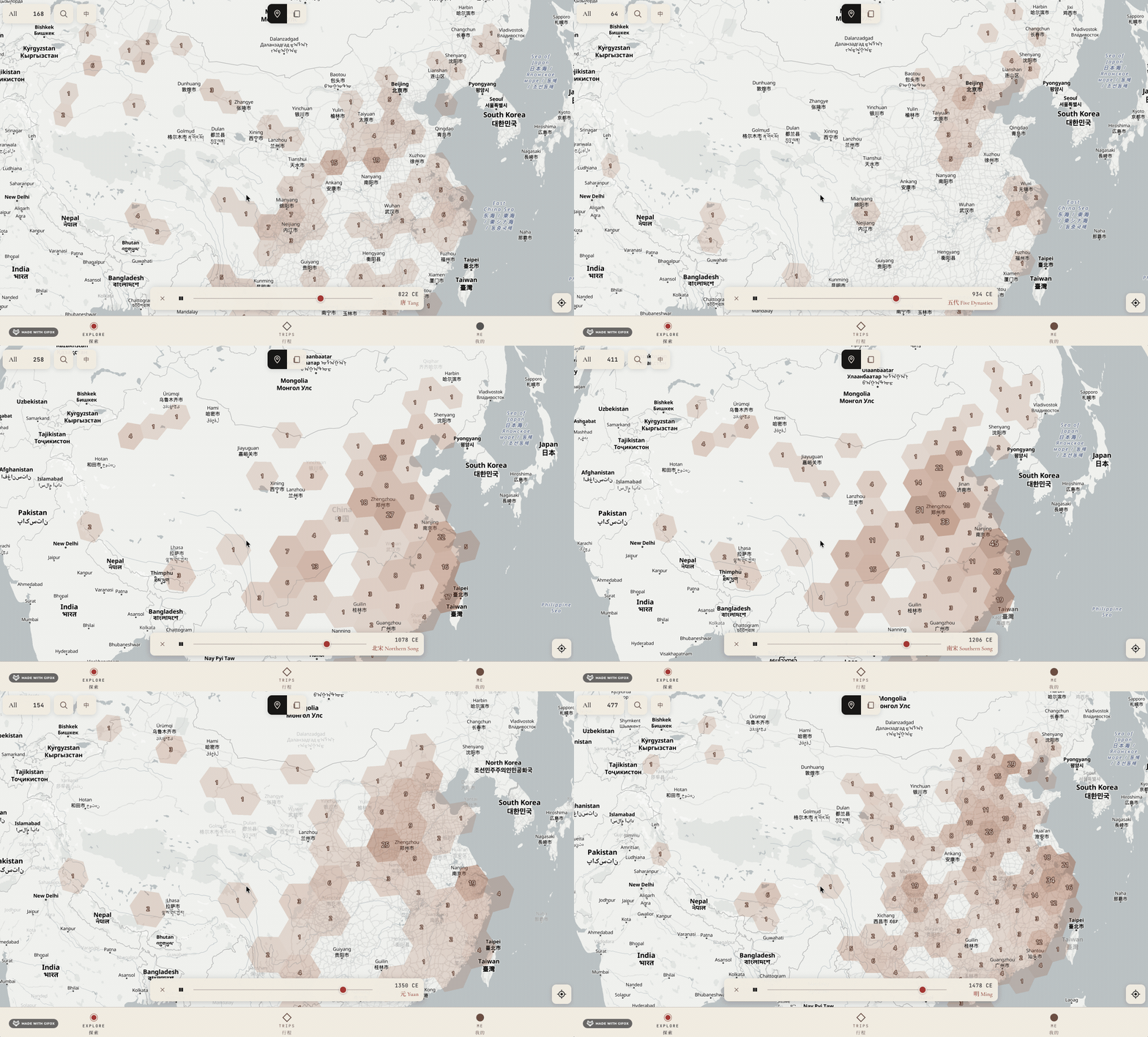
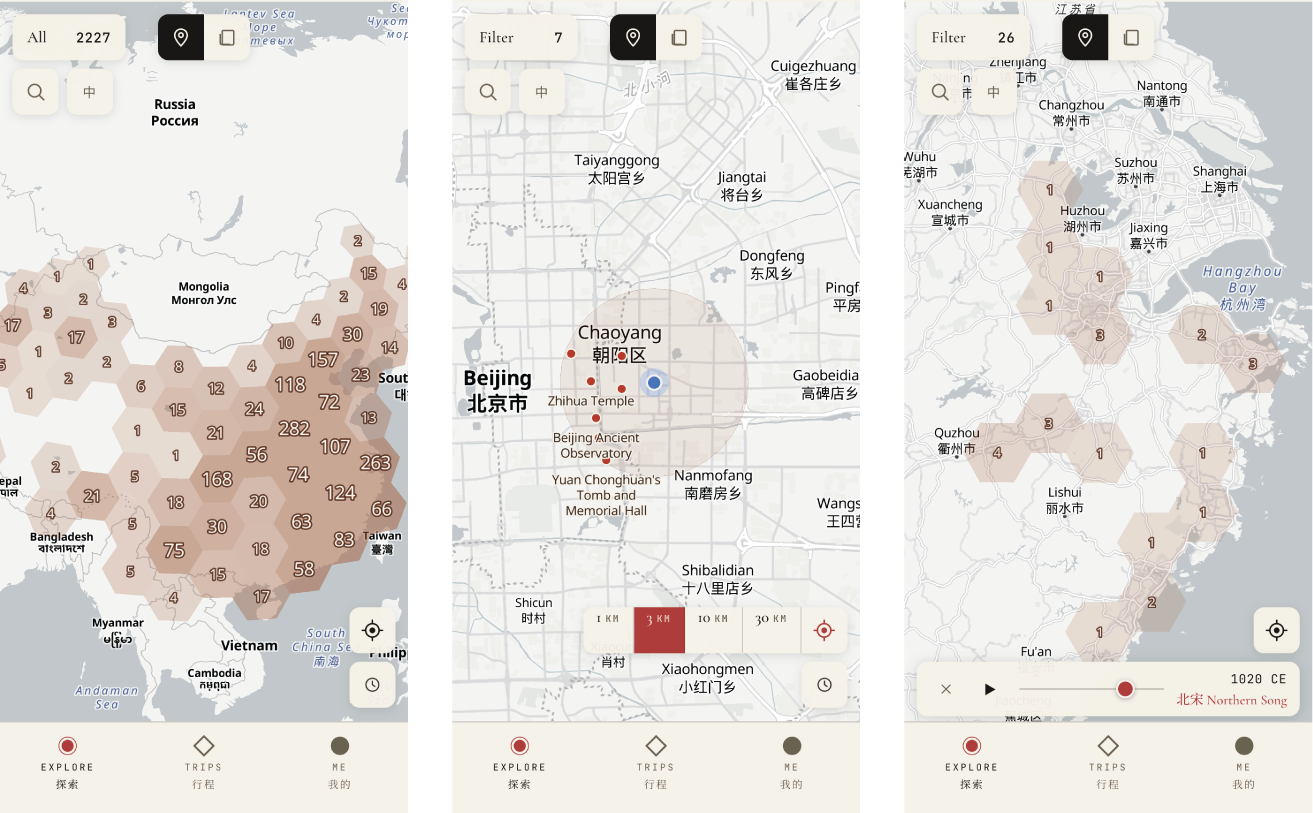
In the Explore tab, there is a Map Mode. You can see the whole country as a field of density. Filter it down by dynasty, by region, by type, until thousands of sites narrow to the few you actually care about. And if you happen to be physically in China, turn on your location and simply look at what is standing around you right now.
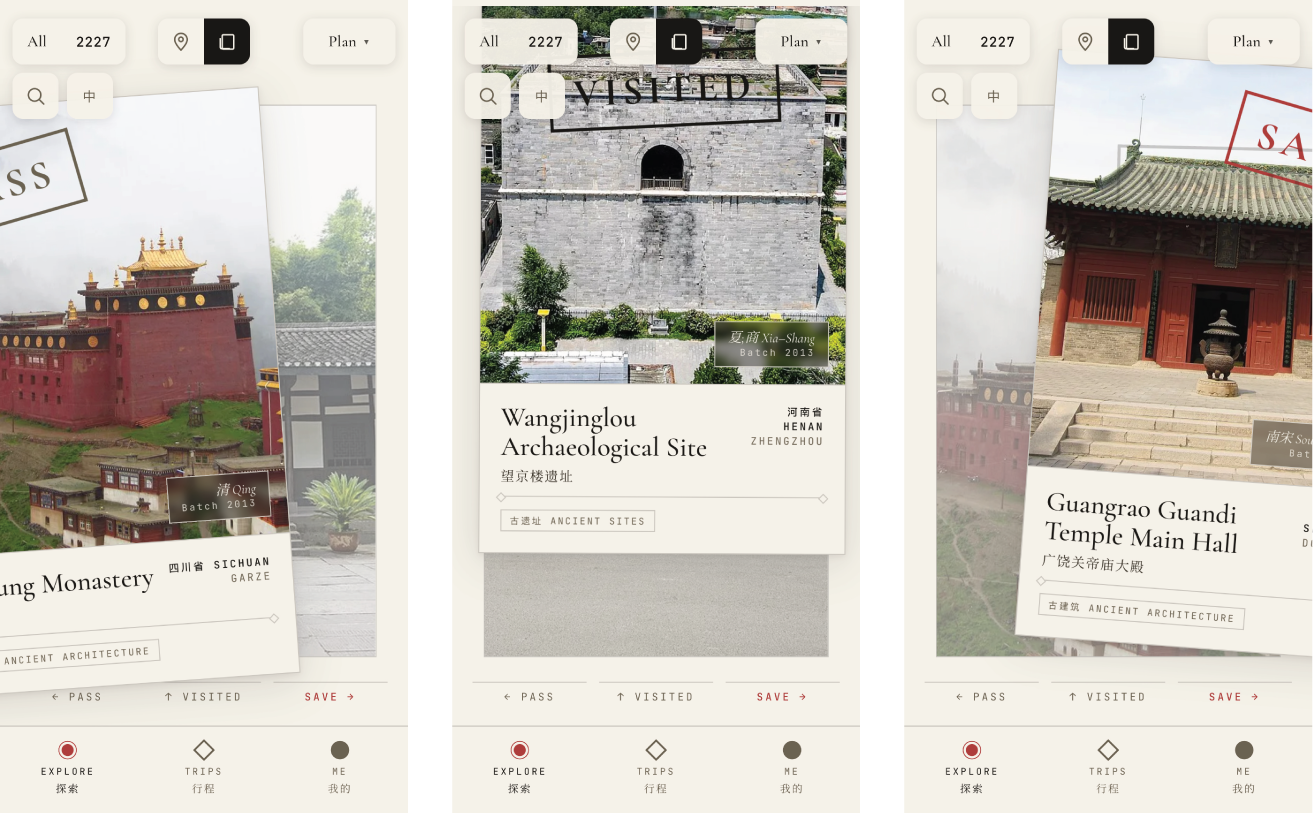
There is also a Swipe Mode, for when you have no plan at all. Swipe through sites card at a time and keep the ones that ‘match’ with you.
Look ahead
The database is not complete yet. There are more than 5000 sites across the country. I’m still deep in the work of curating the data, cleaning, translating, adding photographs.
This is a beginning. Over time I want to fold in more kinds of data, like urban renewal projects, experience points, things that are not strictly “heritage” but belong to the same habit of looking closely at a place.
And I want to reach beyond China, integrating heritage data across East Asia. I feel that once seeing the region on one map, together, we can find more links, connections, and cultural interchange that tightly knit the region, bringing both the shared roots and the honest differences into view.
Come along
Join the Discord for updates and whatever is newest with Flow Heritage.
Please leave a comment: for your next trip to China, what would you like to see?
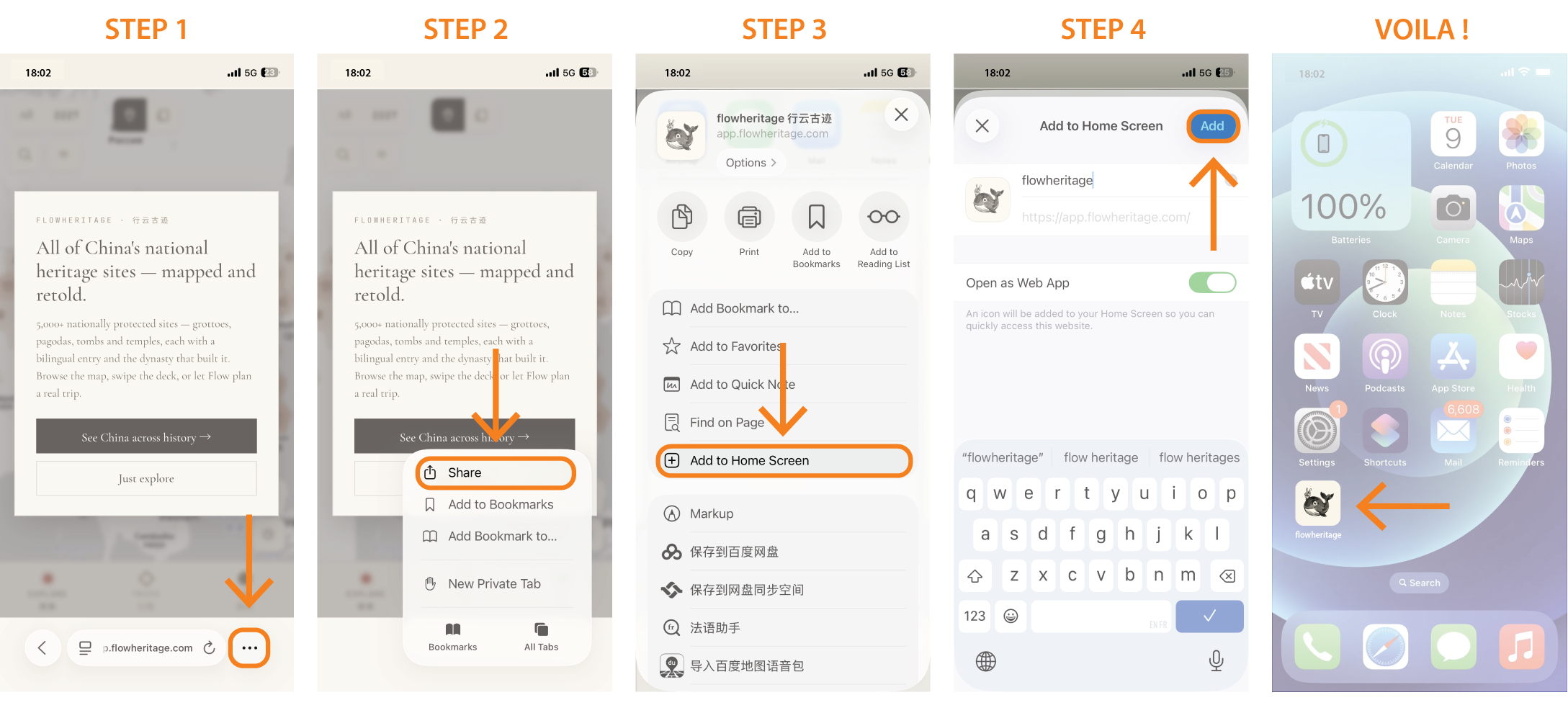
And one small, practical thing: this is not only a website. On your iPhone you can add it to your home screen, and it behaves like a real app, which is exactly how I use it every day.
Please consider supporting me by buying me a coffee. Your support fuels this project and keeps it going.
I never cease to be amazed at how industrious you are! How do find time to eat and sleep?
Sounds really great! Should be done for other places with a rich past. I am thinking of Italy where I spend part of the year.