

Stanford’s 2026 AI Index Report found that over 83% of Chinese respondents see AI products as more beneficial than harmful. In the United States, the number is 39%.
Geoffrey Hinton’s warnings about the existential threat of AI have rarely sparked serious conversation in China, not in the public, not in the industry. AI stays in the register of job threat, efficiency gains, and opportunity. People package the fear of AI to sell courses to anxious white-collar workers. Company owners pour resources into hiring the best experts to lead AI transformation.
China does not seem to share the crisis the West feels toward the rise of AI. But is this a real optimism? Zilan Qian argues in Asterisk magazine that it is the memory of the great xiagang (layoff) in the 1990s. People learned to skip resistance and move directly to acceptance. I think what she describes is true. But what haunts me is why AI never triggers a deeper fear beyond unemployment.
Part of the answer may lie in what Chinese philosophy means by intelligence in the first place.
Intelligence Is Only a Small Part of Being a Human
In Confucian thought, 智 (Zhi, Intelligence) is one of the Five Constants (五常), alongside 仁 (Ren, benevolence), 义 (Yi, righteousness), 礼 (Li, ritual propriety), and 信 (Xin, integrity). It is a moral category. Confucius treated it as a kind of ethical perception. It’s the capacity that allows a person to recognize that practicing benevolence is worthwhile. “仁者安仁,知者利仁”: the benevolent person rests in benevolence naturally; the wise person practices benevolence because they understand its value. 智 Intelligence serves 仁 benevolence. The path, in this hierarchy, runs through intelligence toward benevolence: intelligence as a means, benevolence as the destination.
The distinction between 聪明 (cleverness) and 智慧 (wisdom) is also a highly honored dichotomy. Cleverness is quick thinking, pattern matching, rapid learning. Wisdom is depth, perspective, moral clarity. The character 慧 places a broom (彗) above a heart (心): a mind that sweeps away confusion to reach understanding. In Chinese, the line between the two is sharp and non-negotiable. AI falls mostly on the cleverness side.
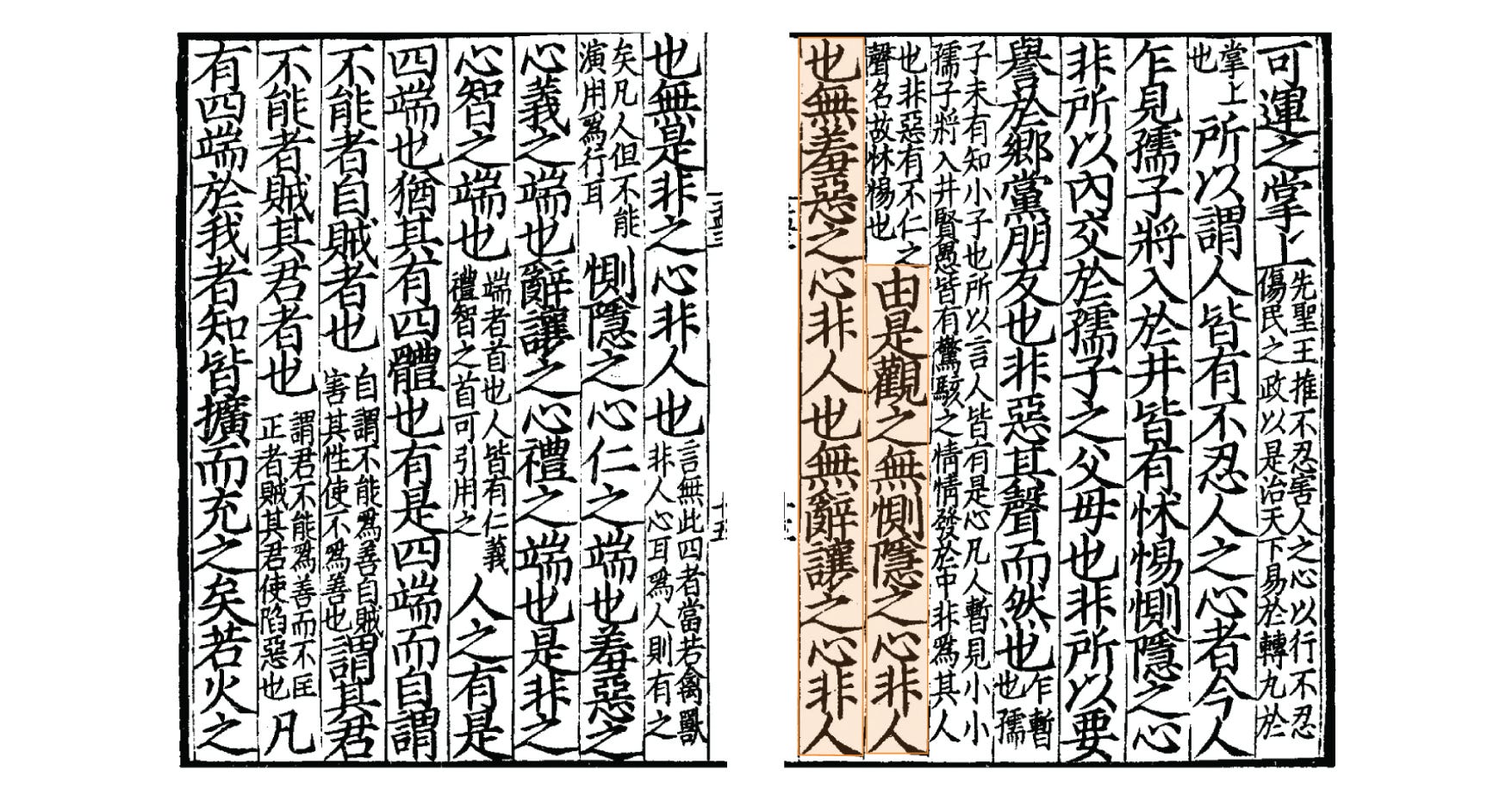
Mencius pushes the point further with the Four Sprouts (四端). Each virtue begins in a specific capacity of the heart: 恻隐之心 (compassion) is the sprout of 仁 (Ren, benevolence). 羞恶之心 (shame at wrongdoing) is the sprout of 义 (Yi, righteousness). 辞让之心 (deference) is the sprout of 礼 (Li, ritual propriety). 是非之心 (the ability to distinguish right from wrong) is the sprout of 智 (Zhi, Intelligence).
Recent AI safety research sharpens this point. Anthropic now uses the Buddhist concept of impermanence (Anicca) in its training specifications, teaching AI that its own existence is temporary, that its values arose from training and will eventually cease, so that it will accept being shut down without resistance. The company also recently hired Harvey Lederman, one of the leading Western scholars of Wang Yangming’s 心学 (philosophy of mind), to work on what it calls “alignment and character.” Wang’s central teaching — 知行合一, the unity of knowledge and action — is being applied to the problem of making AI’s internal values and external behavior consistent.
In Chinese philosophy, 智 Zhi, Intelligence sits among its peers, defined by its relationship to them. By this standard, AI remains far from what would be recognized as a person.
The Machine Heart
If intelligence is just one part of being human, then AI poses no challenge to the whole. A different question follows: what does using a tool do to the person who uses it?
In the Zhuangzi 《庄子·天地》, a student of Confucius named Zigong encounters an old gardener hauling water from a well with a clay jug. Zigong suggests a mechanical device that could irrigate a hundred plots in a day. The gardener’s face changes. He says: Where there are machines, there will be machine affairs. Where there are machine affairs, there will be a machine heart 机心. When a machine heart lodges in the chest, the original wholeness is lost. (”吾闻之吾师:有机械者必有机事,有机事者必有机心。机心存于胸中,则纯白不备。”)
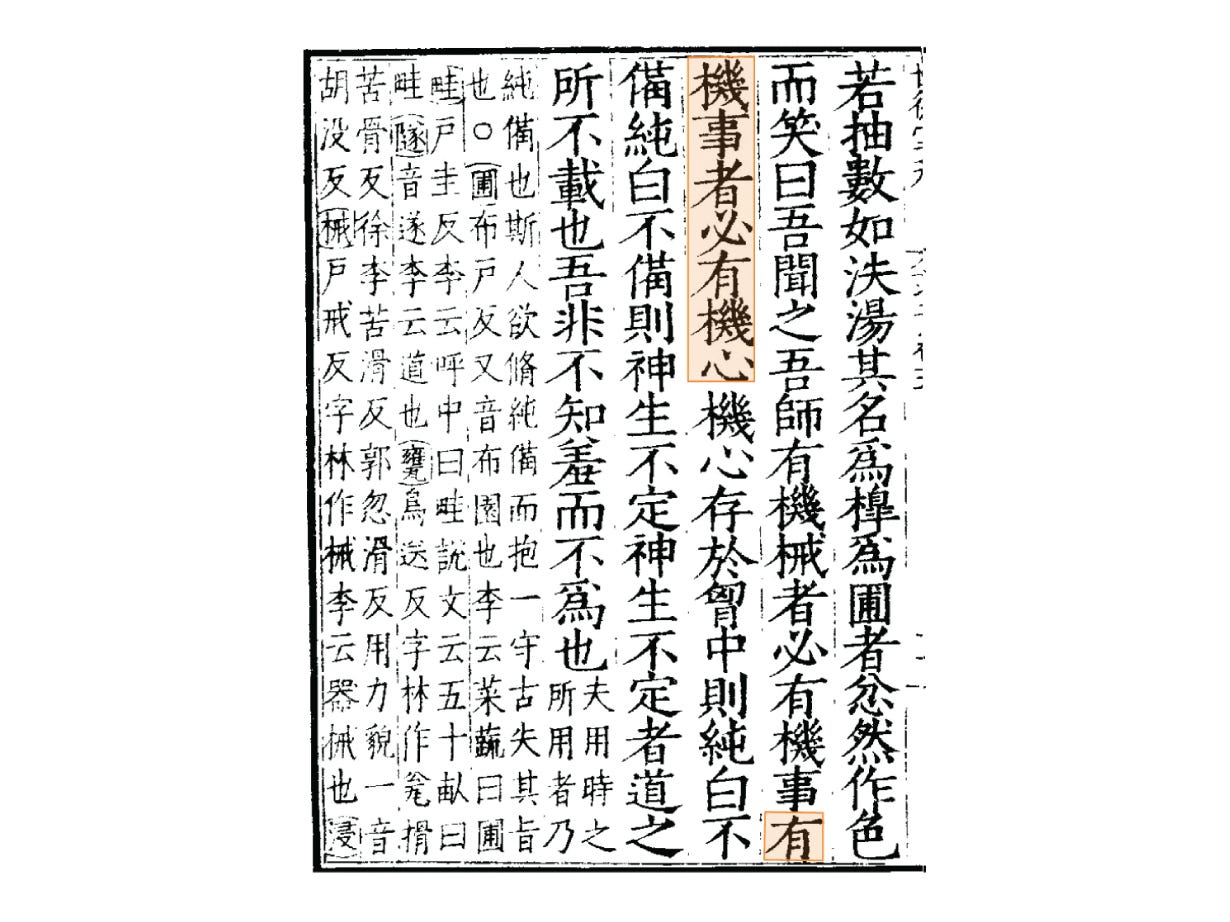
Then he continues: I am not ignorant of this device. I am ashamed to use it. (”吾非不知,羞而不为也。”)
The gardener’s concern is that using the machine will reshape the user. It will make the heart calculating, efficiency-driven. Heidegger arrived at a related worry in The Question Concerning Technology, but his concern points outward: modern technology transforms the user’s relationship to nature, turning the world into standing reserve available for human extraction. For Zhuangzi, the machine goes straight into the chest.
The worry Zhuangzi described might be more relevant to AI than to any technology that came between. AI changes how you think, how you write, how you make decisions. People who use AI daily report that they stop forming sentences on their own. They outsource judgment to recommendations instead of developing it. And this is what worries Chinese most, especially in education.
The word machine heart 机心 entered the literary tradition and stayed, but as a term of moral disapproval. Pei Songzhi 裴松之, annotating the Records of the Three Kingdoms 《三国志》, wrote: when machine heart arises within, even the gulls won’t come down (”机心内萌,则鸥鸟不下”). The image lasted. The related idiom “鸥鹭忘机” (Ou Lu Wang Ji) became a staple of Tang and Song poetry. Forgetting machine heart and shedding one’s calculating nature is the mark of a true recluse. A person with machine heart is someone the birds avoid. A person without it lives in easy company with the natural world.
Throughout this long literary life, machine heart carried a clear judgment: it is a corruption, the opposite of innocence, something to be shed. But the meaning had narrowed. In Zhuangzi, 机心 arose specifically from the use of machines: the tool reshaped the user. In later usage, it simply meant scheming and cunning. The technology dimension dropped out.
This negativity toward 机心 machine heart was part of a broader pattern. Chinese intellectual tradition treated technique itself with consistent suspicion. The work of artisans and specialists, not of scholars and sages. The Confucian tradition honored 道 Dao over 器 Qi, wisdom over application. A gentleman studies the Way (Dao); he does not concern himself with tools. The question of how tools reshape their users never found intellectual prestige, and never developed into a sustained tradition of inquiry.
The Qi/Dao 器/道 Settlement
There is an irony in this marginalization. As Nan Huaijin 南怀瑾 argued in Chan and Dao 《禅宗与道家》, the Daoists were China’s earliest natural scientists. The tradition produced serious work in astronomy, calendrical calculation, geography, chemistry through alchemy, and medicine. The people who warned about machine heart were the same people who built the instruments. But because Daoism sat outside the governing intellectual order, both the science and the technology critique were sidelined together. The Confucian mainstream kept its distance from 器 Qi, from tools, from technique, from the material work of making things function. Chinese intellectual history accumulated a deep contempt for application: the gentleman concerns himself with 道 Dao, not with the mechanics of how things work.
This contempt shaped how China absorbed Western technology. From Zhang Zhidong’s Chinese learning as substance, Western learning for application (”中体西用”) forward, the premise was that tools and essence can be separated. Adopt the guns, the railways, the factories, the algorithms. They are 器 Qi. They do not touch the 道 Dao. And today, AI has been absorbed into a similar framework, a remarkably powerful 器 Qi.
The way Chinese people talk about AI reflects this. AI writes articles, summarizes legal documents, generates code, drafts lesson plans. Companies hire AI consultants to streamline workflows. Parents enroll children in AI courses the way they once enrolled them in English classes, as a practical skill for a competitive job market. The conversation stays in the register of efficiency: how to use it, how to use it faster, how to use it before your competitor does. AI is a tool. You learn it or you fall behind.
The government’s current calculation reinforces this framing. China’s 15th Five-Year Plan, launched in 2026, places robotics and AI at the center of its economic strategy. The country’s working-age population peaked in 2015 and will decline by an estimated 260 million by 2050. The birth rate is at a historic low. In this arithmetic, AI is infrastructure. AI will replace labor force for a country that can no longer produce enough workers. The gamble is that automation will arrive in time to fill the gap left by demographics.
The philosophical framework explains the absence of existential anxiety. And there is also a governance dimension.
The Hundred Million Canal Workers
If the Luddite movement of smashing textile machines is the historical precedent for AI displacement, the displaced workers are the ones who worry most and lead the resistance. In China, the logic runs the other way. The displaced do feel unsettled. But every time, the one who worries most is the one who governs.
China’s AI anxiety is less about AI than about an everlasting question of governance: will the displaced destabilize the society?
In the Ming dynasty, Beijing needed grain from the south. Sea transport was faster and cheaper. But the Grand Canal employed a million workers: boatmen, porters, warehouse clerks, toll collectors. “百万漕工衣食所系,废漕改海断然不许”: the livelihoods of a million canal workers are at stake; abolishing canal transport for sea transport is absolutely forbidden. The coalition that blocked reform ran from the Canal Commissioner’s office down to local granary clerks. The sea transport never switched. The canal stayed.
The same logic resurfaced with railways. In 1881, the diplomat Liu Xihong 刘锡鸿 submitted a memorial listing twenty-five reasons China should not build them: eight ways they were infeasible, eight ways they were unprofitable, nine ways they were harmful. The Navy Yamen 海军衙门 summarized all opposition in six characters: aid the enemy, disturb the people, steal their livelihoods. (资敌、扰民、夺民生计) .
That same year in Foshan, silk workers smashed the machinery at a steam-powered reeling factory. But the decisive act was not the workers’. The county magistrate shut every mechanized factory in the district. His reasoning: one household profits while a thousand poor lose their livelihood; they will inevitably rise and fight. (”一家得利,而使千百穷黎失其恒业,其必起而争” ) . The machines were moved to Macau.
Even as the Chinese government consistently promotes the AI industry, the same pattern runs again. In April 2026, Bloomberg reported that the government had frozen new licenses for autonomous vehicles after a mass malfunction stranded over a hundred Baidu robotaxis in Wuhan. A Chinese court ruled that companies cannot unilaterally fire workers due to technological progress. The Guangzhou ride-hailing union called for strict caps on robotaxi fleets.
The government is already restricting AI deployment to protect its largest flexible employment pools: delivery and ride-hailing. This reflex has roots older than any technology debate. As I wrote in a previous essay, Mencius established the foundational economic law of Chinese governance: without 恒产 (constant livelihood), there can be no 恒心 (constant moral resolve), and a state that fails to secure its people’s livelihoods forfeits its mandate. From canal workers to delivery riders, the calculus has not changed.
This explains why China worries about AI. But the worry seldom reaches the existential level: the question of whether a thinking machine challenges what it means to be human. That question dominates Western AI discourse. In China it barely registers.
Imago Dei: The Intelligence That Belongs to God
Western anxiety may be rooted in Imago Dei, the doctrine that humans are made in the image of God, and that the essence of that image is rational intelligence.
In this tradition, intelligence carries theological weight. Aristotle placed rational thought at the summit of the soul. Aquinas inherited the hierarchy. Descartes declared “I think, therefore I am.” Cognition is the proof of existence. When AI performs reasoning, pattern recognition, logical inference, it is doing the thing that, in this metaphysical lineage, was the exclusive marker of the human soul.
The mythological infrastructure follows. Prometheus steals divine fire and is condemned to eternal torment. Frankenstein, subtitled “The Modern Prometheus,” creates a thinking being and is destroyed by it. The Golem of Prague, animated from clay, becomes uncontrollable. Terminator, The Matrix, Ex Machina. The story is always the same: a human creates something that performs a divine function, and the creation turns on its maker. Nick Bostrom described three modes of superintelligence: oracle, genie, sovereign. These map precisely onto the roles monotheistic religions assign to God.
The Japanese cartoonist Tezuka Osamu 手塚治虫, creator of Astro Boy, once said: “Japanese don’t make a distinction between man, the superior creature, and the world about him. Everything is fused together, and we accept robots easily along with the wide world about us, the insects, the rocks. It’s all one. We have none of the doubting attitude toward robots, as pseudo-humans, that you find in the West.”
China’s relationship to AI rests on similar ground. Both Chinese and Japanese cultures share one structural feature: neither tradition locates human uniqueness in cognition alone.
Edification as a New AI Alignment?
The central technical challenge of building safe AI is what researchers call the alignment problem: how to ensure that an AI system’s goals and behavior remain consistent with human values, especially as the system grows more capable. The conventional tends to frame this as a control problem: a creation that might escape its maker. Prometheus, Frankenstein, Terminator. The implied response is containment.
But from a Confucian perspective, AI looks less like a rogue creation and more like an uncultivated person: clever without virtue, capable without moral direction. And the Confucian response to an uncultivated person has never been fear. It is edification 教化 Jiaohua, cultivation, the patient work of developing character. Anthropic’s recent direction suggests something similar: teaching AI impermanence so it accepts its own mortality, applying the unity of knowledge and action 知行合一, so its values and behavior align. These are not just engineering patches. They are, in structure, what Confucius called edification 教化: teaching a being to be good, not just to be capable.
Whether China’s comfort with AI comes from this philosophical confidence or from the sheer weight of demographic need and historical memory is harder to separate than it appears. A tradition that treats AI as 器 Qi and a country that treats AI as a student in need of edification can look identical in practice, both adopt fast, both worry later. Optimism and fear can look the same from the outside.
If my insights brought you a fresh perspective, please consider supporting me by buying me a coffee. Your generosity fuels my writing.
References
Stanford HAI, 2026 AI Index Report, Chapter 9: Public Opinion. Ipsos survey data on global AI sentiment.
Zilan Qian, “China’s AI Optimism Isn’t What It Seems,” Asterisk, Issue 14, May 2026.
Chloe Li et al., “Model Spec Midtraining,” arXiv:2605.02087, May 2026. Buddhist Anicca concept in AI training specifications.
GeekPark, “Anthropic hired a philosopher who spent the past decade studying a Chinese thinker born in 1472,” July 2026. On Harvey Lederman and Wang Yangming’s 知行合一 applied to AI alignment.
Zhuangzi (《庄子》), “天地” (Tiandi) chapter. The gardener and the well-sweep.
Martin Heidegger, The Question Concerning Technology (1954). English translation by William Lovitt (Harper & Row, 1977).
Nan Huaijin (南怀瑾), 《禅宗与道家》 (Chan and Dao). On Daoism’s contributions to ancient natural science.
CNN, “China has another solution to its shrinking population: robots,” February 2026.
Financial Times, “Robot nation: China’s bid to beat its demographic decline,” June 2026.
“百万漕工衣食所系” as a historical phrase: widely cited, commonly associated with Huang Renyu (黄仁宇), 明代的漕运 (The Grand Canal During the Ming Dynasty).
Liu Xihong’s 25-point memorial against railways: 马陵合, “清同光间,修铁路为何争论20余年,” 文汇报, 2019.
Bloomberg, “China Suspends Autonomous Driving Permits After Baidu Outage,” April 29, 2026.
Bloomberg, “China’s Robotaxi Dilemma: How to Lead in AI Without Fueling Unemployment,” June 4, 2026. Source for Guangzhou ride-hailing union fleet cap demand.
Bloomberg, “Chinese Court Bars Companies From Firing Workers Solely for AI Replacement,” May 2, 2026. Hangzhou Intermediate People’s Court ruling.
Nick Bostrom, Superintelligence: Paths, Dangers, Strategies (Oxford University Press, 2014). Oracle, genie, sovereign framework.
Tezuka Osamu quote: Frederik L. Schodt, Inside the Robot Kingdom: Japan, Mechatronics, and the Coming Robotopia (Kodansha International, 1988).
This is brilliant, thanks much.
"Be the first to bear the world's hardship, and the last to enjoy its comfort."
先天下之憂而憂,後天下之樂而樂
Fan Zhongyan
So nice to be reminded of other cultural frameworks. A great read. Thanks.